Ask any pharmacist for an “eye pressure” supplement and you will usually get one of two answers: it lowers intraocular pressure, or it protects the optic nerve. Neither is a settled claim. What the published research actually measured, in which populations, and where the evidence stops is a more useful place to start — and for a category this heavily marketed, the honest answer is surprisingly narrow.
Four ingredients keep appearing in eye-pressure research: lutein, zeaxanthin, bilberry extract and French maritime pine bark extract. This guide reports what each trial measured, who it measured it in, how large the effect was, and — just as importantly — what each trial did not measure. Nothing here promises a pressure reduction, and no supplement replaces prescribed eye drops.

What “eye pressure support” actually means
Intraocular pressure (IOP) is the pressure of the fluid inside the eye. It matters because elevated IOP is the one risk factor for glaucoma that a person can act on, which is why lowering IOP is the target of every proven glaucoma treatment, from prostaglandin analogues to laser and surgery. Diagnosis and management of glaucoma are handled against clinical guidelines such as the NICE glaucoma recommendations, where the mainstay of care is pressure-lowering medication plus monitoring.1
Two things follow from that, and both matter for reading the research below. First, “eye pressure support” is an ambiguous phrase: it can mean a supplement that lowers IOP, or one that supports the tissue — the macula, the retina, the optic nerve — that IOP damage affects. Trials frequently measure the second while marketing implies the first. Second, and more bluntly: no supplement has yet been shown in a controlled trial to alter the course of glaucoma or to reduce the risk of losing vision to it.2 That is the boundary the evidence sits at.
So the useful question is not “does this lower pressure” but “what was actually measured”. Here is what each ingredient’s trials measured, ordered by how directly they touched IOP.
| Ingredient | What the trial measured | Who was studied | What it does not show |
|---|---|---|---|
| Lutein + zeaxanthin | Macular pigment optical density (MPOD) — the density of the yellow pigment layer at the centre of the retina | Adults with open-angle glaucoma (62 participants) and adults with glaucoma (88 participants) | That IOP was lowered. MPOD was the endpoint; pressure was not |
| Bilberry anthocyanins | Retinal and optic-nerve-head blood flow, and visual field progression over 24 months | Adults with normal-tension glaucoma (30 patients) and 38 open-angle glaucoma patients on eye drops | That IOP fell. In these trials it essentially did not |
| French maritime pine bark + bilberry | IOP itself, by Goldmann applanation tonometry | 18 Japanese POAG patients on medication; 38 European adults with ocular hypertension | That glaucoma progression or vision loss was reduced. Neither trial measured either |

Lutein and zeaxanthin: the trials measured pigment, not pressure
This is the most common point of confusion in eye supplement marketing, because the carotenoid evidence in glaucoma is real and is routinely described as if it were pressure evidence. It is not.
The strongest data comes from two randomised controlled trials in people with glaucoma. In the first — the European Nutrition in Glaucoma Management study — 62 adults with open-angle glaucoma were enrolled and randomised to a carotenoid supplement of 10 mg lutein, 2 mg zeaxanthin and 10 mg meso-zeaxanthin, or to placebo, for 18 months. Macular pigment optical density volume increased significantly in the treatment group at every study visit (6, 12 and 18 months) while the placebo group showed no change, and mesopic contrast sensitivity under glare improved at 18 months in the treatment group but not in the placebo arm. No other structural or functional change was observed.3 In the second, the Macular Pigment and Glaucoma trial, 88 glaucoma patients were randomised to placebo or to 10 mg lutein, 2 mg zeaxanthin and 10 mg meso-zeaxanthin daily for six months; central pigment density rose significantly in the treatment arm at 0.25 and 0.50 degrees of eccentricity and not in the placebo arm, though the increase was small next to that reported in people without glaucoma.4
Read carefully, neither trial reported that pressure fell. The endpoint was pigment density — a measure of how much blue light the macula filters, which is a different biological question. The carotenoid dose with the strongest clinical track record overall is the AREDS2 formulation of 10 mg lutein with 2 mg zeaxanthin daily, tested for age-related macular degeneration and covered in the Cochrane review of antioxidant supplements for that condition.5 That is a real, well-characterised dose — and it is worth saying plainly that AREDS2 was a macular degeneration trial, not a pressure trial.

Bilberry: the trials measured blood flow and visual field, and left IOP alone
Bilberry (Vaccinium myrtillus) anthocyanins are frequently described as supporting “eye pressure”. The controlled data points in a different direction. In a clinical study of 30 patients with normal-tension glaucoma who took 50 mg of a bilberry anthocyanin complex daily for six months, blood flow at the optic nerve head and peripapillary retina improved, while IOP for every patient remained essentially stable across the test period.6 A separate 24-month randomised, placebo-controlled, double-masked trial in 38 open-angle glaucoma patients already on eye drops found that 50 mg/day of bilberry anthocyanins slowed visual field degradation relative to placebo — a genuine functional outcome — while other systemic and ocular measures did not change.6
A review of herbal medicines in glaucoma reaches the same conclusion about the wider category. Across controlled trials of ginkgo and bilberry, visual field indices improved in some studies and ocular blood flow increased in others, while IOP showed no significant change; in the retrospective study of bilberry and ginkgo supplementation over 6 to 59 months, visual acuity improved in the supplemented group with no effect on IOP found for bilberry. The review’s conclusion is the one that matters here: ginkgo and bilberry may slow retinal ganglion cell death, but there is not yet evidence that they alter the course of glaucoma.2
The other well-known bilberry claim, night vision, is weaker still. A systematic review of placebo-controlled trials found little evidence to support it, and a 2022 review of the clinical literature describes the night-vision indication as resting on a largely unsubstantiated origin, noting contradictory results across trials and a general lack of large double-blinded controlled research.7 That is a statement about the state of the evidence, not a rule — it means the night-vision evidence base is thin, and that a label relying on it is borrowing credibility it has not earned.
French pine bark and bilberry together: the two trials that measured pressure
Only two studies in this area put IOP itself in front of a tonometer, and both used a combination of French maritime pine bark extract with bilberry rather than a single ingredient. They are worth reading in full precisely because they are small and unusually designed.
The first, published in 2008, enrolled 38 adults with ocular hypertension and no signs of glaucoma. Twenty received a twice-daily supplement of 40 mg French maritime pine bark extract with 80 mg standardised bilberry extract per tablet — 80 mg and 160 mg respectively per day — and 18 were followed untreated. Mean IOP fell from 25.2 mmHg to 22.2 mmHg after two months and to 22.0 mmHg after three months, a significant difference against the untreated controls, with no further improvement after six months; 19 of the 20 treated patients had a decreased IOP at three months, while the control group showed only marginal effects.8
The second, published in 2021, enrolled 18 Japanese patients with primary open-angle glaucoma (29 eyes) who were already using one to three bottles of glaucoma medication, with IOP of 15 mmHg or above. After a two-week observation period, each took one tablet a day containing 40 mg French maritime pine bark extract and 90 mg bilberry fruit extract for four weeks. Mean IOP fell from 17.2 to 15.7 mmHg, an 8.7% reduction, and self-measured morning pressures fell from 14.1 to 13.3 mmHg. The authors reported that nine of the 18 participants responded, six were unchanged and three were actually higher, and concluded that further study is required to confirm the effect and its mechanism.9
Now the part most marketing copy leaves out. Both studies were small. The 2008 study had no placebo and no randomisation — the control group simply received nothing. The 2021 study was a single-arm, pre-post design with no placebo either. Neither measured glaucoma progression, visual field loss, or whether anyone kept their sight. A 2022 review of the bilberry literature notes that the same pine-bark-and-bilberry combination was once described as lowering pressure almost as effectively as latanoprost but taking far longer to do so, while flagging that study’s own lack of a placebo group, blinding and randomisation.7
So what does the pine bark and bilberry evidence actually support? A short-term reduction in measured pressure in two small studies that used a combination product and could not rule out placebo effects, timing effects or regression to the mean. That is a signal worth further study. It is not a demonstration that a supplement treats glaucoma, and it is not a basis for telling anyone to stop a prescription.
How to weigh a trial that measured pressure
When you read a supplement study that reports an IOP number, four questions separate a useful result from a marketing number.
- Was pressure the primary endpoint, or a secondary one that happened to move? The carotenoid glaucoma trials were designed around macular pigment. A pressure reading in such a study is a side observation, not a finding.
- Was there a placebo group? Neither of the two studies above used one. Without placebo, part of any improvement is what people in any study tend to report and measure at follow-up.
- Was it randomised and blinded? The 2021 Japanese study was neither. It was a single-arm pre-post comparison, which cannot separate the supplement from time, season, adherence and regression to the mean.
- Was the outcome that matters to patients measured? Nobody’s eyesight improves because a number on a chart fell by 1.5 mmHg. Visual field progression, optic nerve structure and the need for less medication are the outcomes that matter, and none of these trials measured them.
What OptiVue provides, and what it does not claim to do
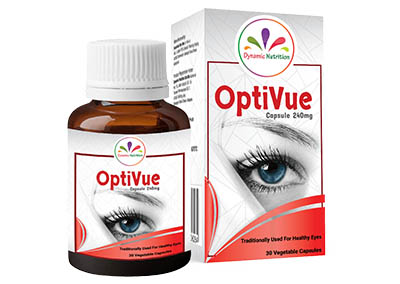
OptiVue is a combination of three standardised extracts: 60 mg of Lutemax 2020 marigold extract (standardised to a minimum of 20% lutein and 4% zeaxanthin, providing 12 mg lutein and 2.4 mg zeaxanthin per capsule), 120 mg of European bilberry extract standardised to a minimum of 25% anthocyanins, and 60 mg of French pine bark extract standardised to a minimum of 95% proanthocyanidins. Each bottle holds 30 capsules, with one capsule daily after a meal. The product is registered with Malaysia’s National Pharmaceutical Regulatory Agency as MAL19126070TC.
Set those numbers against the studies above and the comparison is informative. The 60 mg of French pine bark extract is above the 40 mg used in each of the two IOP studies, and the 120 mg of bilberry extract sits between the 90 mg used in the 2021 Japanese study and the 160 mg daily dose in the 2008 study. The carotenoid content — 12 mg lutein and 2.4 mg zeaxanthin per capsule — is in the same range as the 10 mg plus 2 mg formulation used in the AREDS2 and glaucoma pigment trials.
What must be said just as plainly: a formula that resembles the tested combination does not inherit the tested result. No trial has tested OptiVue itself against placebo, no trial has measured glaucoma progression on it, and this article is not making a claim that it lowers intraocular pressure. Anyone with glaucoma, ocular hypertension or a raised-pressure reading should treat any supplement as an addition to their care and should raise it with their ophthalmologist — not as a replacement for drops or for monitoring.
Safety, interactions and who should check first
The doses used in these trials are generally well tolerated, and the main reported side effects are mild digestive discomfort. A handful of practical points are worth carrying into a pharmacy conversation.
- Blood pressure and anticoagulants. French maritime pine bark extract affects nitric oxide signalling and platelet function in laboratory studies, and anthocyanins have been flagged for a possible additive effect with warfarin, aspirin or clopidogrel. Mention any of these to your prescriber before starting a combined formula.
- Blood sugar. Bilberry has case reports of affecting glucose control. If you take diabetes medication, monitor and mention it.
- Surgery. Standard practice with products that may affect clotting is to stop roughly two weeks before a planned operation.
- Pregnancy and breastfeeding. There is no established dose in either group, so treat it as a question for a clinician rather than a default.
- Existing glaucoma or eye medication. This is the group where the interaction question is most real, because these are the exact populations in the trials above, and where the stakes of changing a prescription are highest.
The short answer
The research on lutein, zeaxanthin, bilberry and French pine bark for eye pressure is real but narrower than the marketing. Lutein and zeaxanthin trials in glaucoma measured macular pigment density, which rose reliably — not pressure. Bilberry anthocyanin trials measured optic nerve blood flow and visual field stability, with no meaningful IOP change. The two studies that actually measured IOP used French pine bark plus bilberry together, in 18 and 38 participants, without placebo or randomisation, and reported short-term pressure reductions of roughly 8.7% and 13% that have not been confirmed in a larger blinded trial or linked to any preservation of sight.
That is the honest evidence boundary. None of these ingredients is an established glaucoma treatment, and no supplement has been shown to prevent glaucoma or to reduce the need for prescribed eye drops. What the research does support is that a standardised combination at studied doses is a reasonable nutritional addition for people who want to support the macula, the retinal microcirculation and the optic nerve — with the pressure claim left where the evidence leaves it.
References
- NICE. Glaucoma: diagnosis and management. NICE guideline NG81. 2022. https://www.nice.org.uk/guidance/ng81
- Ige M, Liu J. Herbal medicines in glaucoma treatment. The Yale Journal of Biology and Medicine. 2020;93(2):347-353. https://www.ncbi.nlm.nih.gov/pmc/articles/PMC7309662/
- Loughman J, Loskutova E, Butler JS, Siah WF, O’Brien C. Macular pigment response to lutein, zeaxanthin, and meso-zeaxanthin supplementation in open-angle glaucoma: a randomized controlled trial. Ophthalmology Science. 2021;1(3):100039. https://www.ncbi.nlm.nih.gov/pmc/articles/PMC9562333/
- Siah WF, Loughman J, O’Brien C. Macular pigment optical density response following oral dietary macular pigment supplementation in glaucoma. Investigative Ophthalmology & Visual Science. 2015;56(7):1980 (ARVO Annual Meeting Abstract). https://iovs.arvojournals.org/article.aspx?articleid=2331728
- Evans JR, Lawrenson JG. Antioxidant vitamin and mineral supplements for slowing the progression of age-related macular degeneration. Cochrane Database of Systematic Reviews. 2023;9:CD000254. https://www.ncbi.nlm.nih.gov/pmc/articles/PMC10498493/
- Nomi Y, Iwasaki-Kurashige K, Matsumoto H. Therapeutic effects of anthocyanins for vision and eye health. Molecules. 2019;24(18):3311. https://www.ncbi.nlm.nih.gov/pmc/articles/PMC6767261/
- Vanekova Z, Rollinger JM. Bilberries: curative and miraculous — a review on bioactive constituents and clinical research. Frontiers in Pharmacology. 2022;13:909914. https://www.frontiersin.org/journals/pharmacology/articles/10.3389/fphar.2022.909914/full
- Steigerwalt RD, Gianni B, Morazzoni P, Bombardelli E, Burki C, Schonlau F. Effects of Mirtogenol on ocular blood flow and intraocular hypertension in asymptomatic subjects. Molecular Vision. 2008;14:1288-1292. https://www.ncbi.nlm.nih.gov/pmc/articles/PMC2447819/
- Manabe K, Kaidzu S, Tsutsui A, Mochiji M, Matsuoka Y, Takagi Y. Effects of French maritime pine bark/bilberry fruit extracts on intraocular pressure for primary open-angle glaucoma. Journal of Clinical Biochemistry and Nutrition. 2021;68(1):67-72. https://www.ncbi.nlm.nih.gov/pmc/articles/PMC7844666/
Product you may be interested in