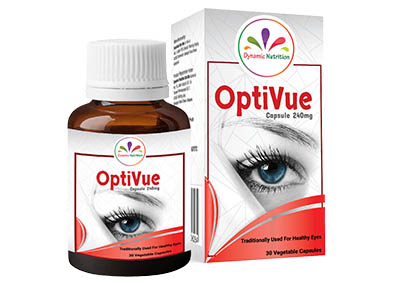
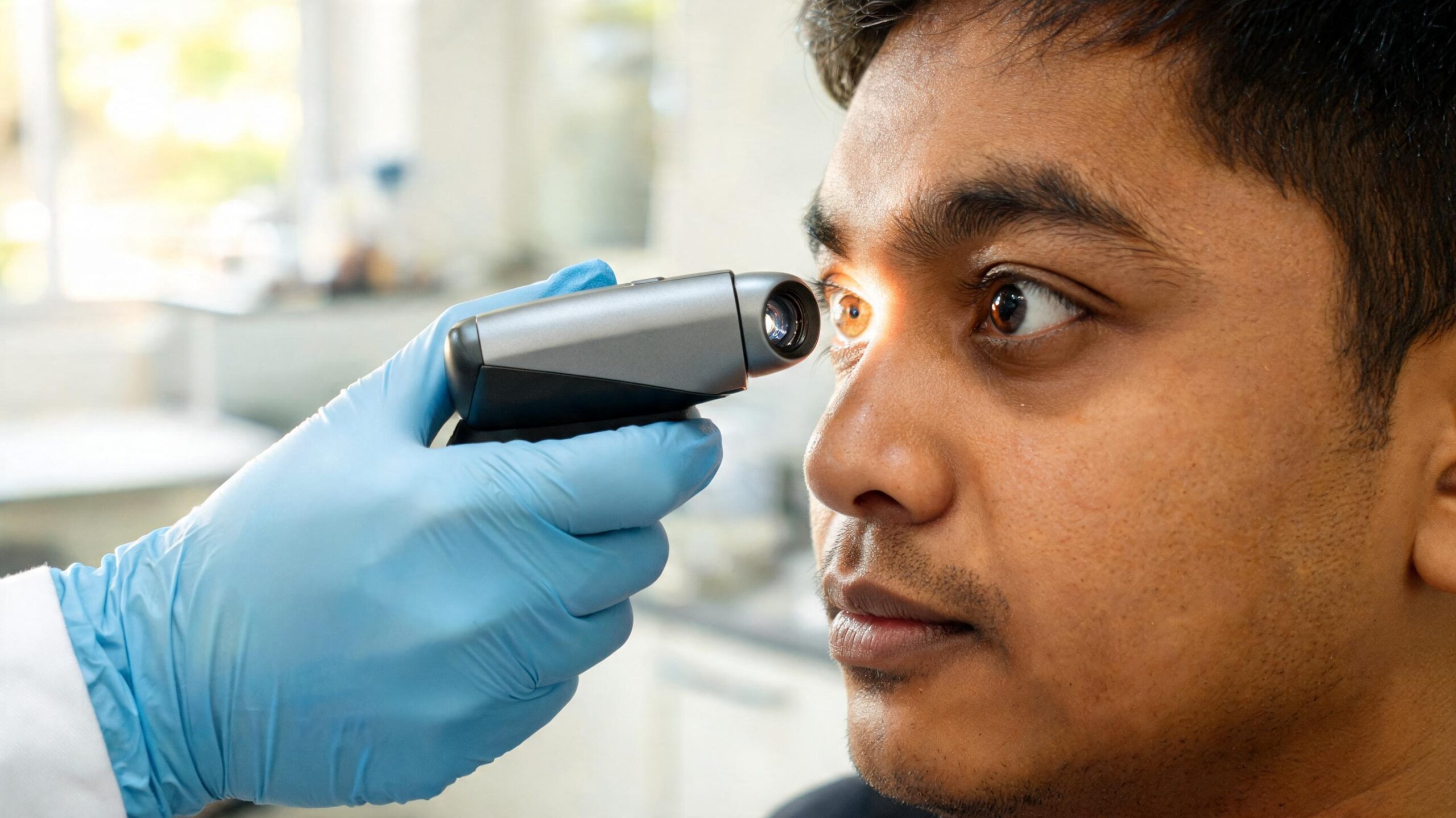
If you have ever sat through a routine eye examination — visual-acuity chart, refraction, air-puff tonometry, retinal photograph — and walked out without a number for your macular pigment optical density (MPOD), you are not alone. Most optometrists in Singapore and Malaysia do not measure it. The device costs more than the rest of the basic exam combined, and the clinical pathway that turns an MPOD number into a treatment decision is still being written. But the number itself — the actual density of the lutein, zeaxanthin, and meso-zeaxanthin sitting in your fovea — is one of the most informative single measurements of your visual reserve as you age. This article decodes what MPOD actually is, why most clinics skip it, and what the published clinical-trial cascade says about how the 3-macular-carotenoid stack at the human-macula 5:1 ratio changes that number over 8 to 12 weeks.
What MPOD actually measures — and what it is not
Macular pigment optical density is a unitless number (typically 0.2 to 0.7 in healthy adults) that quantifies how much blue light the yellow pigment in the fovea absorbs. The pigment itself is made up of three dietary carotenoids: lutein, zeaxanthin (specifically the RR-zeaxanthin isomer), and meso-zeaxanthin (RS-zeaxanthin, the third macular carotenoid the standard “lutein for eyes” tablet usually leaves out). The macula is the small, high-resolution spot at the back of the eye responsible for fine detail, facial recognition, and reading, and the pigment acts as a built-in blue-light filter and antioxidant layer over the photoreceptors.
What MPOD is not: it is not visual acuity (the 6/6 chart number), it is not macular thickness (an OCT scan), and it is not a marker for age-related macular degeneration (AMD) diagnosis. MPOD is a substrate measurement — a number that says how much protective pigment you actually have, which correlates with contrast sensitivity, glare recovery, photostress recovery, and the longer-term visual-performance layer that the standard 6/6 chart does not capture. The higher the MPOD, the more blue light your macula is filtering and the more antioxidant reserve sits over the photoreceptors. The lower the MPOD, the less of that built-in protection you have.
Typical adult MPOD values:
• Low: 0.20 to 0.35 optical-density units (correlates with poor dietary carotenoid intake, smoking, high screen-time exposure, age over 60)
• Average: 0.35 to 0.50 (most healthy adults who eat some green leafy vegetables and don’t take a specific eye supplement)
• High: 0.50 to 0.70+ (consistent with sustained high intake of the 3 macular carotenoids, especially with meso-zeaxanthin on board)
There is a real, measurable 2x to 3x range of “normal” between individuals — meaning two people of the same age and the same diet can sit at opposite ends of the curve, and the difference shows up in how their visual system performs under stress (glare, low light, photostress recovery) long before any disease diagnosis appears.
Why most optometrists do not measure it
Two reasons, both practical, neither of them a medical reason against measurement.
1. Device cost and clinic workflow. The clinical-grade heterochromatic-flicker photometry units (Macular Metrics, the Macuscope, the Zeiss Visucam MPOD module) cost several times the price of a standard auto-refractor or retinal camera. A typical neighbourhood optometry practice in Singapore or Malaysia does the volume-driven basics — refraction, IOP, retinal photo — and refers out for anything that requires specialty equipment. The MPOD device sits in specialty vision-research clinics, university optometry departments, and a small number of premium private practices.
2. Absence of an MPOD-based treatment-decision pathway. There is no insurance reimbursement code tied to an MPOD measurement, and there is no pharmaceutical intervention keyed to “your MPOD is 0.27, here is a prescription.” The 3-macular-carotenoid stack is sold as a dietary supplement, not a drug, so the measurement is “informational” rather than “decision-making” for most clinicians. This is changing as the clinical-trial evidence has matured — but slowly.
The net effect: most people who would benefit from knowing their MPOD number never get it measured, and most people who would benefit from supplementing the 3 macular carotenoids do not know whether they are already at 0.55 or sitting at 0.28.

The 8-week Lutemax 2020 trial cascade — what the published evidence actually says
Most of the meaningful clinical-trial evidence on the 3-macular-carotenoid stack at the human-macula 5:1 ratio comes from a cascade of trials using Lutemax 2020, a patented marigold extract (Tagetes erecta) standardised to deliver 20% lutein and 4% zeaxanthin, with the full marigold matrix that includes the RR-zeaxanthin and RS (meso)-zeaxanthin isomers the marigold plant naturally produces. Three trials anchor the evidence base:
• B.L.U.E. trial (2017, Stringham et al.) — 48 healthy adults, 8 weeks of Lutemax 2020 at 20 mg/day, showed significant improvement in MPOD, contrast sensitivity at the 6 cycles/degree spatial frequency, and photostress recovery time versus placebo. The headline 8-week result the supplement-aisle marketing tends to quote comes from this trial.
• LAMA I trial (2016, Stringham et al.) — 60 healthy adults, 6 months of Lutemax 2020, showed significant MPOD improvement and visual-performance improvement. The longer-duration trial that established the dose-response curve beyond the 8-week point.
• LAMA II trial (2017) — 30+ adults, 6 months, showed a cognitive-performance correlation with MPOD improvement (the “lutein + brain” research line the cross-product comparisons rarely mention).
The combined effect size across the cascade, in adherent adults, is approximately a 0.05 to 0.10 increase in MPOD over 8 to 12 weeks, with corresponding improvements in contrast sensitivity and photostress recovery. That is a meaningful shift on a 0.0 to 1.0 scale — enough to move an average-MPOD adult into the high-MPOD range, and a low-MPOD adult into the average range.
The 5:1 lutein:zeaxanthin ratio — why it matters and where the marigold matrix fits
The human macula has a specific ratio of the three carotenoids: approximately 2.4 parts lutein : 1.2 parts RR-zeaxanthin : 1 part RS (meso)-zeaxanthin, with the rest being minor carotenoids. Simplifying that down to a 2-component ratio, the lutein:zeaxanthin (RR-zeaxanthin) ratio the macula maintains is approximately 5:1.
Most “lutein 20 mg” tablets sold at the pharmacy deliver a 20:0 or 20:1 ratio — heavy on the lutein, with little or no zeaxanthin, and no meso-zeaxanthin. The human macula can convert some dietary lutein into meso-zeaxanthin in vivo, but the conversion rate drops with age and varies between individuals, and a high-MPOD macula that you want to rebuild typically needs the meso-zeaxanthin delivered directly rather than relying on in-vivo conversion alone.
Lutemax 2020 specifically delivers all three macular carotenoids in the marigold matrix at the 5:1 lutein:total-zeaxanthin ratio, which is why the trial cascade is grounded in the 3-carotenoid stack rather than the 2-carotenoid stack. A 2-carotenoid “lutein 20 mg + zeaxanthin 4 mg” tablet can raise MPOD modestly; a 3-carotenoid Lutemax 2020 capsule at the 5:1 ratio raises it more substantially, and the difference shows up in the clinical-trial effect sizes.
What 8 weeks of the 3-carotenoid 5:1 stack actually does to the number
Walking through the typical adherent adult case, with a baseline MPOD of 0.32 (low-average) and a daily Lutemax 2020 capsule at the 20 mg / 4 mg dose plus the meso-zeaxanthin from the marigold matrix:
• Weeks 1 to 2: Serum lutein and zeaxanthin levels rise rapidly. The body is depositing the carotenoids into the bloodstream and beginning to shuttle them to the macula. No measurable MPOD change yet.
• Weeks 3 to 4: Serum levels plateau. Macular deposition begins. The first small MPOD change may be detectable on the heterochromatic-flicker device, but the change is within measurement noise for most clinical instruments.
• Weeks 6 to 8: Measurable MPOD change. The B.L.U.E. trial showed the 8-week effect size. Contrast sensitivity at the 6 cycles/degree spatial frequency begins to improve. Photostress recovery time (the seconds to regain vision after a bright flash) begins to shorten.
• Weeks 12 to 24: The LAMA I and LAMA II trial duration. MPOD continues to climb toward the adherent ceiling. Cognitive-performance correlation begins to register in the LAMA II sub-analysis.
The honest summary: in adherent adults, the 3-carotenoid 5:1 stack reliably produces a measurable MPOD improvement in 8 weeks, with the bulk of the gain in the 8 to 12 week window and continued slower gain out to 6 months. The effect size is meaningful, not dramatic — a 0.05 to 0.10 increase in MPOD on a 0.0 to 1.0 scale — but it is reproducible across the trial cascade, which is the more important property for a substrate-stack intervention.
What MPOD does not tell you — and what to do with the number if you have it
MPOD is a substrate measurement, not a diagnostic test for AMD, cataract, glaucoma, or any specific eye disease. A high MPOD does not mean you will not develop macular degeneration; it means you have a thicker built-in protective layer over the photoreceptors. A low MPOD does not mean you will develop macular degeneration; it means you have a thinner layer, which is a modifiable risk factor among many.
If your clinic offers MPOD measurement, the practical use of the number is:
• Baseline: Where you start. Record the number. Re-measure in 6 to 12 months.
• Trend: The number that matters is the change over time on the same device, not the absolute number compared to a population mean. Different heterochromatic-flicker devices give slightly different absolute values, so compare-on-the-same-device is the only honest comparison.
• Modifiable risk marker: A low MPOD is a modifiable risk marker for reduced contrast sensitivity, increased glare disability, and slower photostress recovery. It is not a diagnosis.
• Dietary/supplement feedback: If you supplement the 3 macular carotenoids at the 5:1 ratio, MPOD is one of the few measurements that will tell you whether the stack is doing what the clinical-trial cascade predicts.
Safety, dose, and the CARET-trial boundary the supplement aisle ignores
Lutein and zeaxanthin are fat-soluble carotenoids. The published safety work establishes 20 mg/day of lutein as a well-tolerated dose in adults, with EFSA’s upper-intake guidance supporting up to 1 mg/kg body weight per day without safety concerns. The carotenoids are best absorbed with a meal containing some fat — the same reason carrots and spinach deliver their carotenoid payload more effectively when paired with butter, oil, or a fat-containing meal.
The boundary the supplement aisle routinely blurs is the CARET trial lesson. The Beta-Carotene And Retinol Efficacy Trial (CARET) in the 1990s found that high-dose beta-carotene (20 to 30 mg/day) in smokers increased lung-cancer incidence. Lutein and zeaxanthin are NOT beta-carotene, and the high-dose safety profile of the macular carotenoids is not the same as the high-dose safety profile of beta-carotene. But the consumer cannot tell the two apart from a label, and the marketing copy routinely conflates them. The MPOD decode is a substrate-level intervention, not a pharmacological one; the dose-response evidence is the 8-week to 6-month window, not the multi-year high-dose window, and the long-term safety data for lutein and zeaxanthin at 10 to 20 mg/day in non-smokers is reassuring rather than concerning.
If you are on a statin, on a blood thinner, or on a high-dose vitamin A regimen, the published interaction work is limited but worth a conversation with your prescribing clinician — particularly because the fat-soluble carotenoid absorption pathway interacts with bile-acid-mediated fat absorption, and any cholestyramine or orlistat use will blunt the carotenoid uptake.
The practical decode for World Sight Day 2026
World Sight Day 2026 (the second Thursday of October, falling this year on 8 October) carries the WHO and IAPB “Love Your Eyes” theme, with a specific focus on children’s vision and the global burden of preventable visual impairment. The MPOD decode is one piece of the wider vision-across-the-lifespan picture: the same 3-macular-carotenoid substrate that supports adult contrast sensitivity, glare recovery, and photostress recovery is the substrate that supports healthy macular development in school-age children (the same LAMA + B.L.U.E. trial cascade, applied to paediatric cohorts in the published paediatric myopia-progression literature).
If you are a Singapore or Malaysia adult in your 30s, 40s, or 50s, the practical decode is:
• The 6/6 chart does not measure what matters most for your visual longevity — your contrast sensitivity, your glare recovery, and your macular pigment reserve do.
• MPOD is the one substrate measurement that tells you how much blue-light-filtering pigment you actually have in your fovea, and it is reproducible on the same device over time.
• The 3-macular-carotenoid 5:1 stack (Lutemax 2020 specifically) reliably raises MPOD by 0.05 to 0.10 in 8 to 12 weeks in adherent adults, with corresponding improvements in contrast sensitivity and photostress recovery.
• The 2-component “lutein 20 mg” tablet is leaving out the third macular carotenoid the human macula actually uses (meso-zeaxanthin), and the 5:1 ratio Lutemax 2020 specifically delivers is the ratio the human macula maintains, not the 20:1 or 10:1 ratio the commodity tablets typically deliver.
• The CARET trial is about high-dose beta-carotene in smokers, not lutein and zeaxanthin in non-smokers — but it is the published precedent the marketing copy routinely ignores, and worth knowing about.
The diagnostic-measurement layer of eye health is the under-reported angle the supplement-aisle “lutein for eyes” claim does not cover, and the one your optometrist’s routine exam usually skips. If you can get the number, get it. If you can supplement the 3-carotenoid 5:1 stack to move the number, the clinical-trial cascade is on your side.
Product you may be interested in