Your fasting blood glucose was 92 mg/dL. Your HbA1c came back at 5.6 percent — “normal range,” the lab slip says. Your doctor tells you to come back in a year.
One week later, you put on a continuous glucose monitor out of curiosity. Within three days you see your blood sugar spike to 174 mg/dL after a bowl of nasi lemak, hover near 160 for ninety minutes, then crash back to 72 two hours after lunch. You have those spikes four or five days a week.
None of it shows up on the test your insurance paid for.
That gap is exactly what this article is about.

The two tests most people get, and the third they rarely do
The standard yearly panel checks two numbers: fasting plasma glucose and HbA1c. Both are population averages, neither tells you what is happening in the three hours after a meal.
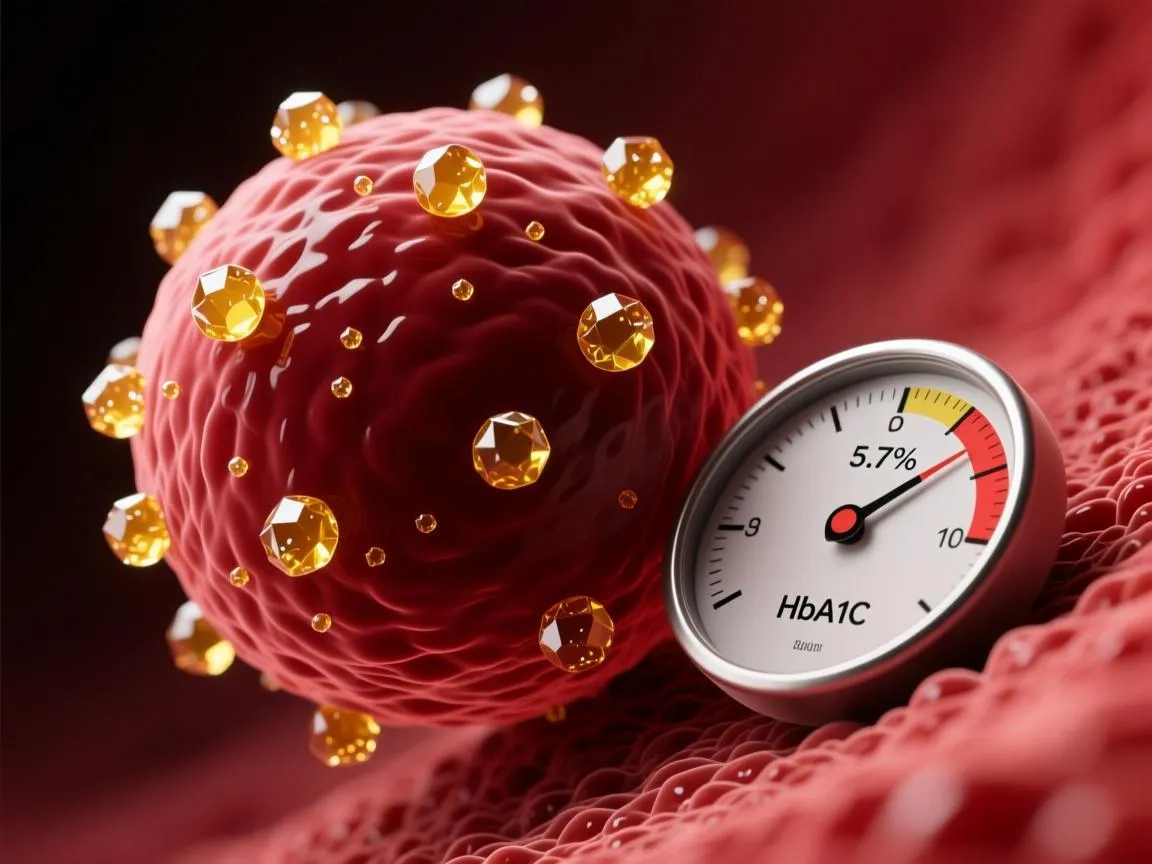
HbA1c is a weighted estimate of your average blood sugar over the prior two to three months, derived from the percentage of your haemoglobin that has glucose stuck to it. A 5.6 percent reading is technically “normal” — anything below 5.7 is, by the 2023 American Diabetes Association cut-off, not even pre-diabetes. But HbA1c is a rear-view mirror. It averages out the spikes.
Fasting glucose is a single snapshot, taken first thing in the morning before you eat. By definition it tells you nothing about how your body handles carbohydrates — exactly the question you actually care about if you eat rice three times a day, which is most of Malaysia and a lot of Singapore.
The third test — continuous glucose monitoring (CGM) — costs about a dollar a day, lasts two weeks, and shows every meal, every crash, every overnight dip. Few GPs order it for patients who look “fine” on the standard panel. Most patients only get access after the standard panel is already abnormal.
What HbA1c actually measures — and what it hides
HbA1c reflects the average glucose your red blood cells have been exposed to over their roughly 120-day lifespan. So a 5.6 percent reading is consistent with a person whose glucose really is flat at 95 mg/dL all day and with a person who spends half the day at 75 and the other half at 170 — the two scenarios produce the same HbA1c, very different biology.
The clinical literature on this goes back to the early 2000s, but the cleanest demonstration is the 2018 Hall and colleagues review in The Lancet Diabetes & Endocrinology, which showed that post-meal spikes — not the average — drive endothelial dysfunction, oxidative stress and the progression from pre-diabetes to type 2 diabetes. The “spike frequency × spike amplitude” matters; HbA1c misses both.
There is also a numerical quirk: HbA1c can under-read if you have anaemia, haemoglobin variants (common across South-East Asia — HbE and beta-thalassaemia trait are not rare here), or a recent blood loss. If your HbA1c and your fasting glucose disagree, one of them is wrong.
The 1-hour post-meal test nobody orders
The international consensus has shifted to a stronger signal: a 1-hour post-load glucose above 155 mg/dL during a 75-gram oral glucose tolerance test predicts type 2 diabetes progression better than the 2-hour value that almost every clinic still uses. The data come from the 2018 BMC Endocrine Disorders meta-analysis and the 2022 update from the Danish ADDITION-Denmark cohort.
But the 1-hour test is not in your standard panel. You almost certainly have not had it. And if you are reading this from a phone in Kuala Lumpur or Tampines, it is the single biggest negative predictor of “I had normal fasting glucose last year, why did I just get diagnosed today?”
Why your fasting glucose looks fine even when the rest of the day is not
Fasting glucose is measured after an 8-to-12-hour overnight fast. By morning, the morning-dawn cortisol spike has mostly cleared and your last meal was twelve hours ago. Your liver has been drip-feeding glucose from glycogen to keep your brain working — a process called hepatic glucose output. If your insulin sensitivity is good, your fasting glucose reads low.
But the moment you eat a plate of nasi goreng, your body faces a 60-gram carbohydrate load that lands in your bloodstream over twenty minutes. A healthy beta-cell response releases enough insulin to clear that load in 90-120 minutes. An early stage of insulin resistance means the same load takes three hours to clear and produces a temporary glucose excursion. Fasting glucose does not see this. HbA1c averages it into the background.
The famous “rice belly” pattern in this region — eating rice three times a day — is what produces exactly this profile. A 2019 Malaysian cohort study at the University of Malaya found that adults eating white rice at all three meals had 18 percent higher post-meal glucose AUC than adults who replaced one meal with a non-rice carbohydrate source, despite identical fasting glucose.
This is the version of the disease that does not show up on the standard blood test, and that a lot of doctors in this region still miss.
Fructosamine and glycation gap — the tests that catch what HbA1c hides
If you cannot get a CGM, two lower-cost blood tests catch what HbA1c misses:
Fructosamine measures glycated serum proteins rather than haemoglobin. It reflects the prior two to three weeks (not two to three months) and is not fooled by anaemia or haemoglobin variants. A fructosamine that is normal but an HbA1c that is borderline is the textbook signature of “HbA1c is under-reading because of my blood.” A fructosamine that is high but an HbA1c that is normal is the textbook signature of “I have been spiking hard for three weeks and the HbA1c is averaging it out.”
The glycation gap (HbA1c minus fructosamine-predicted HbA1c) quantifies that disagreement. A negative gap — measured HbA1c lower than the fructosamine prediction — is associated with lower red blood cell survival and a falsely reassuring HbA1c. A positive gap — measured HbA1c higher than the fructosamine prediction — flags higher individual-cell glycation and is associated with worse microvascular outcomes at every HbA1c level.
Neither of these tests is expensive or unusual. Most private labs in Malaysia and Singapore run both. Ask for them next time you see your doctor, especially if you are over 35, have a family history of diabetes, or eat rice at every meal.
The self-checklist you can run this week
You do not need a clinic visit to know whether you are in the gap. Five questions, all “yes-or-no”:
1. Do you feel sleepy 60-90 minutes after a meal, often enough that you notice it?
2. Do you get hungry again only two hours after finishing a “full” meal?
3. Do you eat white rice (or white bread, or noodles) at two or more meals a day?
4. Have you gained 3 kg or more around your waist over the last five years without changing what you eat?
5. Does your last HbA1c reading still sit in the “normal” range (under 5.7)?
Three or more yeses points strongly toward the profile this article is about. The HbA1c looks fine because the test was designed to look at the average. The underlying biology is spiking.
What actually moves the needle for the “normal A1c but spiking” pattern
Three mechanism-level interventions, in order of how directly they target the spike itself:
1. Slowing the carbohydrate surge at the meal. Alpha-glucosidase inhibitors (the acarbose class of prescription drugs, and the mulberry-leaf extract 1-deoxynojirimycin / DNJ, which works on the same enzyme at lower potency) delay the breakdown of complex carbohydrates into glucose in the small intestine. The 2014 Chinese clinical trial at Suzhou Municipal Hospital showed 750 mg of standardised mulberry-leaf extract reduced post-sucrose peak glucose from a baseline of 134 mg/dL to 96 mg/dL — a drop equivalent to converting a medium-glycemic food to a low-glycemic one.
2. Improving cellular uptake of the glucose that does arrive. AMPK activation (the mechanism behind metformin, the most-prescribed diabetes drug in the world, and behind bitter-melon extract at a fraction of the dose) improves how efficiently your muscle and liver cells clear glucose from the bloodstream. The Hong Kong Polytechnic 2014 RCT documented a 7 percent fasting glucose reduction and a 17 percent HbA1c reduction after twelve weeks of 4,000 mg/day bitter-melon extract, in a real prediabetic cohort.
3. Slowing intestinal carbohydrate absorption via prebiotic fibre. Inulin and chicory-root fibre feed gut bacteria that produce short-chain fatty acids, which in turn improve insulin signalling at the cell. A 2012 review in Diabetes/Metabolism Research and Reviews tallied fourteen human trials showing inulin supplementation reduces post-meal glucose excursion by 8-15 percent in prediabetic adults.
All three mechanisms address a different slice of the spike. Most over-the-counter products address only one. The ones that work ship all three at clinically meaningful doses, because the “normal HbA1c but spiking” pattern is not one problem — it is three problems at once.
You are not imagining it
If your fasting glucose has always read 90-something and your HbA1c has always read under 5.7 — and yet you feel a post-lunch crash every day, you crave carbs at 3 p.m., and your waistband has gotten tighter — you are not imagining it. You are seeing the part of the glucose curve the standard blood test is not designed to measure.
Order the fructosamine. Ask for a CGM. Push back on the “come back in a year.” The panel most of us get is built around the average. For the spike-driven biology many of us in this region actually have, the average is the wrong number to be looking at.
Related Topics
Prediabetes IS Reversible – Take Control with GlucoPal
What a Blood Sugar Spike Feels Like and Why It Matters
How Your Daily Choices Quietly Shape Your HbA1c
Mulberry Leaf: Nature’s Brilliant Brake on Blood Sugar Spikes
Nature’s Bitter Gift: Could Bitter Melon Help Steady Your Blood Sugar?
Inulin for Insulin Sensitivity: The Butyrate Layer
Mulberry Leaf Extract (DNJ): Clinical Evidence on Blood Sugar Spikes
Product you may be interested in