If your fasting glucose and HbA1c are creeping up despite the usual advice — eat less sugar, walk more, lose weight — and you are not sure what is actually moving the dial, the answer may be hiding in a part of digestion you rarely think about: the colon. Not the small intestine where carb absorption happens, but the colon, where a specific class of fibre is fermented by specific bacteria into a molecule that talks directly to the insulin system. That molecule is butyrate, and the fibre that feeds the bacteria that make it is inulin — a fructo-oligosaccharide (FOS) found in its highest concentration in chicory root.
The Under-Reported Half of Every Blood-Sugar Stack
Most “fibre is good for blood sugar” pieces stop at “fibre slows glucose absorption in the small intestine.” That is true, but it only tells half the story — the half that lives in the duodenum and jejunum. The other half lives 5 to 6 metres further down, in the colon, and it works through a completely different mechanism: not by slowing carb absorption, but by feeding the bacteria that make the short-chain fatty acids (SCFAs) your insulin-signalling system depends on.
The standard “high-fibre diet lowers HbA1c” finding is real, but it is the downstream effect of a more specific upstream mechanism: inulin-type fructans selectively promote Faecalibacterium prausnitzii and Bifidobacterium species in the colon, which in turn produce acetate, propionate, and — the key one — butyrate. Butyrate then does two things that directly affect insulin sensitivity: it acts on colonic L-cells to release GLP-1 and PYY (the incretin and satiety hormones that upregulate insulin secretion and slow gastric emptying), and it drives colonocyte energy supply plus a systemic anti-inflammatory effect via histone-deacetylase inhibition.
What the Published Evidence Actually Says
This is not speculation. The butyrate → GLP-1 → insulin-sensitivity chain is supported by multiple human and animal studies. Pedersen and colleagues, in a 2016 Nature Microbiology cohort of nearly 300 non-diabetic adults, showed that gut microbiome composition — specifically butyrate-producing bacteria — inversely correlated with insulin resistance independent of BMI. Zhao and colleagues, in a 2018 Science Translational Medicine human RCT, demonstrated that inulin-type fructan supplementation improved insulin sensitivity in obese adults over 6 weeks. And Canfora’s 2017 review in Best Practice & Research Clinical Endocrinology & Metabolism consolidated the SCFA-insulin-sensitivity pathway into a working framework that explains the dose-response seen in the epidemiological data.
What none of the consumer-facing “fibre for blood sugar” pieces tell you is the specificity: not all fibres feed the right bacteria. Inulin (FOS) is selectively fermented by the butyrate-producers; cellulose, the most common plant fibre, is poorly fermented and does not produce meaningful SCFA signalling. Psyllium, another common supplement fibre, is fermented but produces different SCFA ratios. If the goal is butyrate production specifically — and therefore the GLP-1 and insulin-sensitivity signal — inulin is the targeted substrate.
Dose, Duration, and the Practical Stack
The published evidence window for inulin-type fructan supplementation is 10 to 15 grams per day over 6 to 12 weeks. Below 5 grams per day, the SCFA signal is too low to drive a measurable insulin-sensitivity change. Above 20 grams per day, the GI side effects — bloating, flatulence, cramping — escalate fast in the first 1 to 2 weeks before the gut microbiome adapts.
The practical approach is dose escalation: start at 5 grams per day for the first week, increase to 10 grams per day in week 2, and reach 12 to 15 grams per day from week 3 onward. After 6 weeks at 10 to 15 grams, the butyrate-producing bacterial populations typically stabilise at the elevated level, and the GI side effects subside for most people.
Chicory Root Versus the Other Inulin Sources
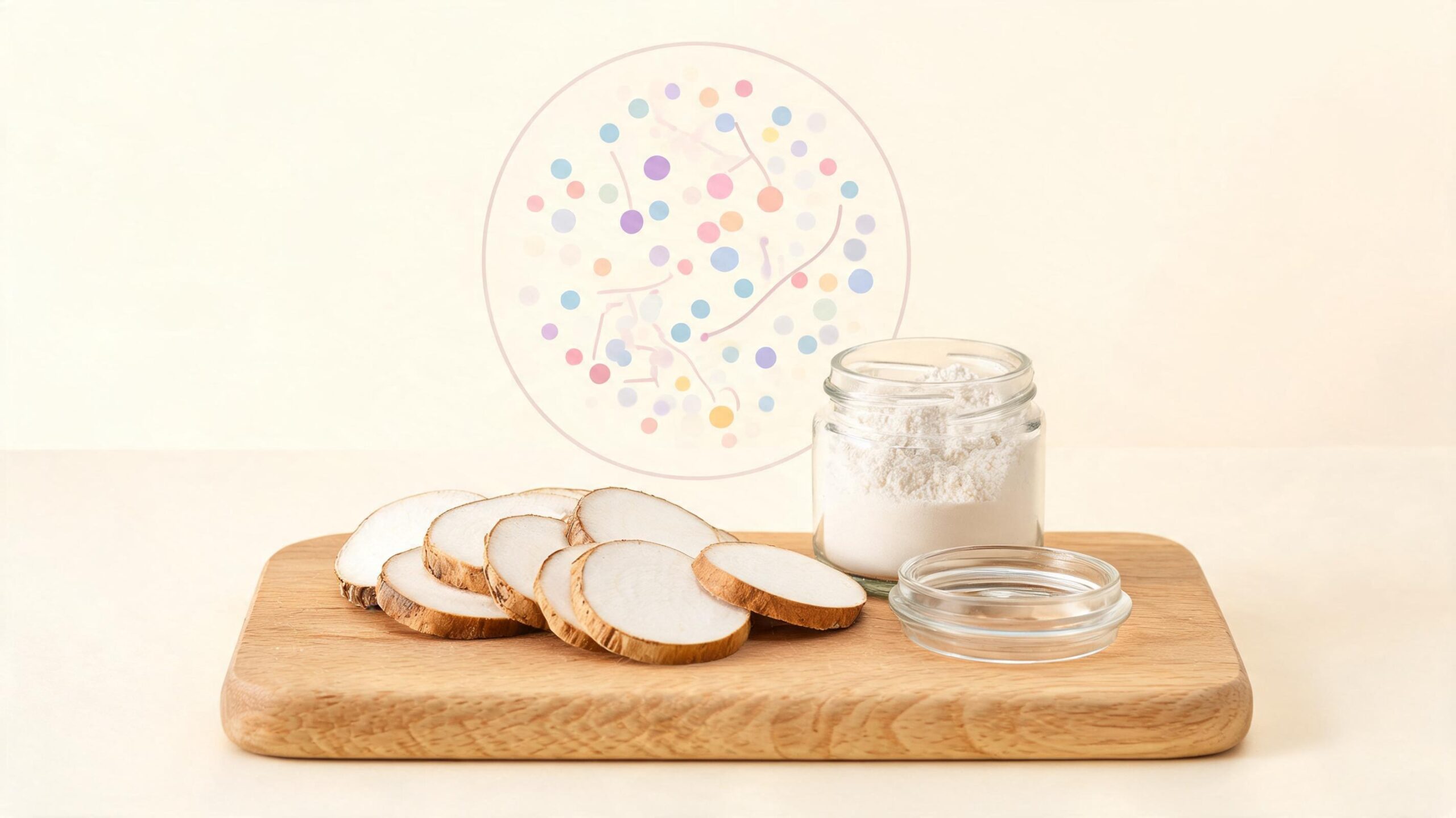
Not all inulin is the same. Chicory root inulin is the highest-FOS-concentration natural source — typically 60 to 70 percent FOS with the remainder as longer-chain inulin polymers. Jerusalem artichoke inulin has a similar FOS profile but a different polymer-length distribution. Banana inulin is much lower in FOS concentration. Synthetic inulin supplements vary widely in their FOS-to-polymer ratio, and the labelling is often not transparent.
The practical takeaway: if you are buying a chicory-root or FOS supplement for the butyrate signal, look for a product that specifies its FOS percentage. The butyrate-producing bacterial selectivity is well-characterised for chicory-source FOS at 10 to 15 grams per day, and the published evidence uses chicory-source FOS almost exclusively.
How Inulin Complements the Mulberry-Leaf and Bitter-Melon Arms
A “blood-sugar stack” works at three different sites: pre-absorptive in the small intestine, cellular at the periphery, and post-absorptive in the colon. The mulberry-leaf 1-deoxynojirimycin (1-DNJ) layer works pre-absorptively — it inhibits the alpha-glucosidase enzymes in the brush border of the small intestine, slowing carb breakdown before glucose ever enters the bloodstream. The bitter-melon charantin and polypeptide-P layer works at the cellular periphery, supporting the insulin-signalling cascade and peripheral glucose uptake. And the inulin-butyrate layer works post-absorptively in the colon, feeding the bacteria that produce the SCFA signal your insulin sensitivity depends on.
These three sites are not redundant — they are complementary. A stack that hits only the pre-absorptive site slows the post-meal spike but does nothing for the underlying insulin-sensitivity substrate. A stack that hits only the cellular periphery depends on the insulin signal being intact, which is the very thing the visceral-fat-driven insulin-resistance pattern disrupts. The inulin-butyrate layer is what ties the pre-meal spike control back to the long-term insulin-sensitivity substrate.
The Safety Boundary
Initial bloating and flatulence are common in the first 1 to 2 weeks at higher doses — this is the gut microbiome adjusting to the new substrate, not a sign to stop. Dose escalation over 2 to 3 weeks minimises this. Inulin is not a substitute for prescribed T2D medication, and the inulin-gut-axis can interact with metformin absorption and SGLT2 inhibitors — coordinate with your clinician if you are on either.
For the healthy-weight, normal-BMI adult whose fasting glucose and HbA1c look clean but whose post-meal excursions tell a different story — the visceral-fat-driven insulin-resistance pattern the standard screening misses — the inulin-butyrate layer is the piece the “eat less sugar, walk more” advice does not address. It is not a magic bullet. It is the missing substrate that makes the rest of the stack work.
References
- Pedersen HK, et al. Human gut microbes impact host serum metabolome and insulin sensitivity. Nature Microbiology. 2016;1:16180.
- Zhao L, et al. A Combination of Inulin-Type Fructans and Galactooligosaccharides Improves Insulin Sensitivity in Obese Humans: A Randomized Controlled Trial. Science Translational Medicine. 2018;10(467):eaau8092.
- Canfora EE, et al. Short-chain fatty acids in the control of energy homeostasis. Best Practice & Research Clinical Endocrinology & Metabolism. 2017;31(6):617-632.
- Delzenne NM, Cani PD. Gut microbiota and the pathogenesis of insulin resistance. Current Diabetes Reports. 2011;11(3):154-159.
- Tolhurst G, et al. Short-chain fatty acids stimulate glucagon-like peptide-1 secretion via the G-protein-coupled receptor FFAR2. Diabetes. 2012;61(2):364-371.
Also available in Bahasa Malaysia and 中文.
Related Topics
Mulberry Leaf: Nature’s Brilliant Brake on Blood Sugar Spikes
Nature’s Bitter Gift: Could Bitter Melon Help Steady Your Blood Sugar?
Why Fasting Blood Sugar Looks Normal but Your HbA1c Still Creeps Up
Prediabetes IS Reversible – Take Control with GlucoPal
What a Blood Sugar Spike Feels Like and Why It Matters
How Your Daily Choices Quietly Shape Your HbA1c
Importance of Trace Minerals in Insulin Sensitivity & Diabetic Diet
Prediabetes Is Reversible – The Surprising Truth About Prediabetes & Diabetic Diet
Sleep Apnea Is the Missing Piece in Your Blood Sugar Puzzle
Mulberry Leaf Extract (DNJ): Clinical Evidence on Blood Sugar Spikes
Product you may be interested in