If you have ever watched your HbA1c inch up year after year despite eating “better” and moving more, the missing piece is almost never your fasting glucose. It is the post-meal blood sugar spike — the surge 30 to 90 minutes after a carbohydrate-rich meal that your routine blood test never sees. A single mulberry leaf extract capsule, taken before that meal, can flatten that spike in a measurable, repeatable way. Here is what the clinical trials actually show, where the marketing overreaches, and what to look for on the label.
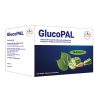
This is a clinical-evidence decode of mulberry leaf extract (DNJ) as one pillar of a triple-action blood-sugar stack — the post-meal spike dampener in GlucoPal (Mulberry + Bitter Melon + Inulin). It is not a single-ingredient mulberry-leaf supplement, and the evidence below should be read in that context.
The 30-second version of how mulberry leaf extract works
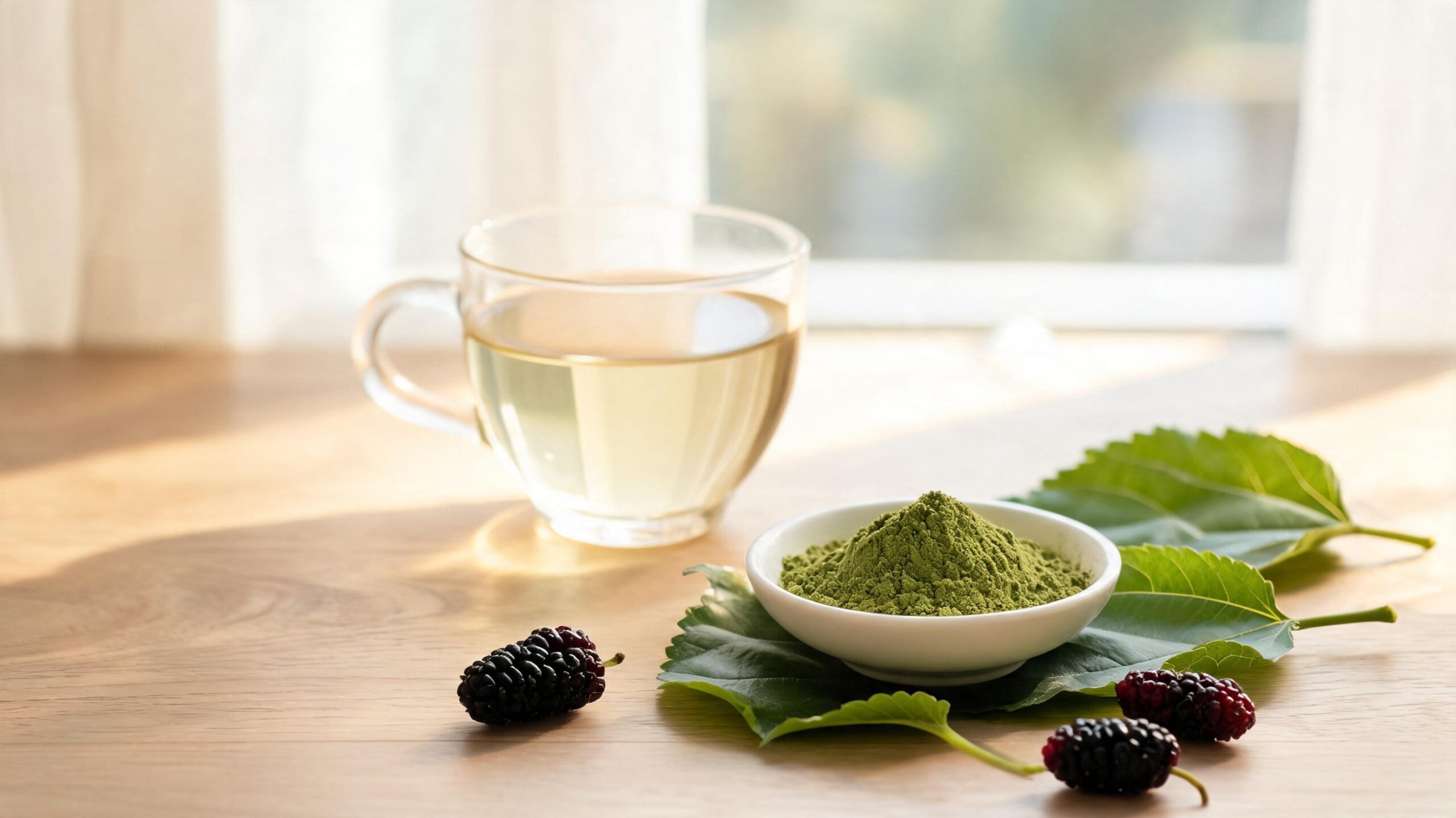
The active molecule in mulberry leaf extract is 1-deoxynojirimycin (DNJ), a sugar-mimicking alkaloid that competitively inhibits the brush-border alpha-glucosidases in your small intestine — the enzymes that break sucrose and starch into glucose. When those enzymes are partially blocked, the carbohydrate from your meal reaches the lower gut undigested, blood glucose rises more slowly, and the insulin demand peaks lower and later.
In plain English: mulberry leaf extract does not “lower blood sugar” systemically. It slows the absorption of sugar from a specific meal, taken before that meal. That distinction is what separates the clinical-evidence story from the marketing one.
What the published clinical trials actually tested
The most-cited human study on mulberry leaf DNJ is the Suzhou Municipal Hospital sucrose-loading trial: healthy volunteers drank a standardised sucrose solution with or without Mulbalance™ (the standardised mulberry-leaf extract used in GlucoPal). The DNJ group showed a statistically significant reduction in the 30-, 60-, and 90-minute post-load glucose peak, and a corresponding reduction in insulin demand, with no hypoglycaemia in the fasting arm.
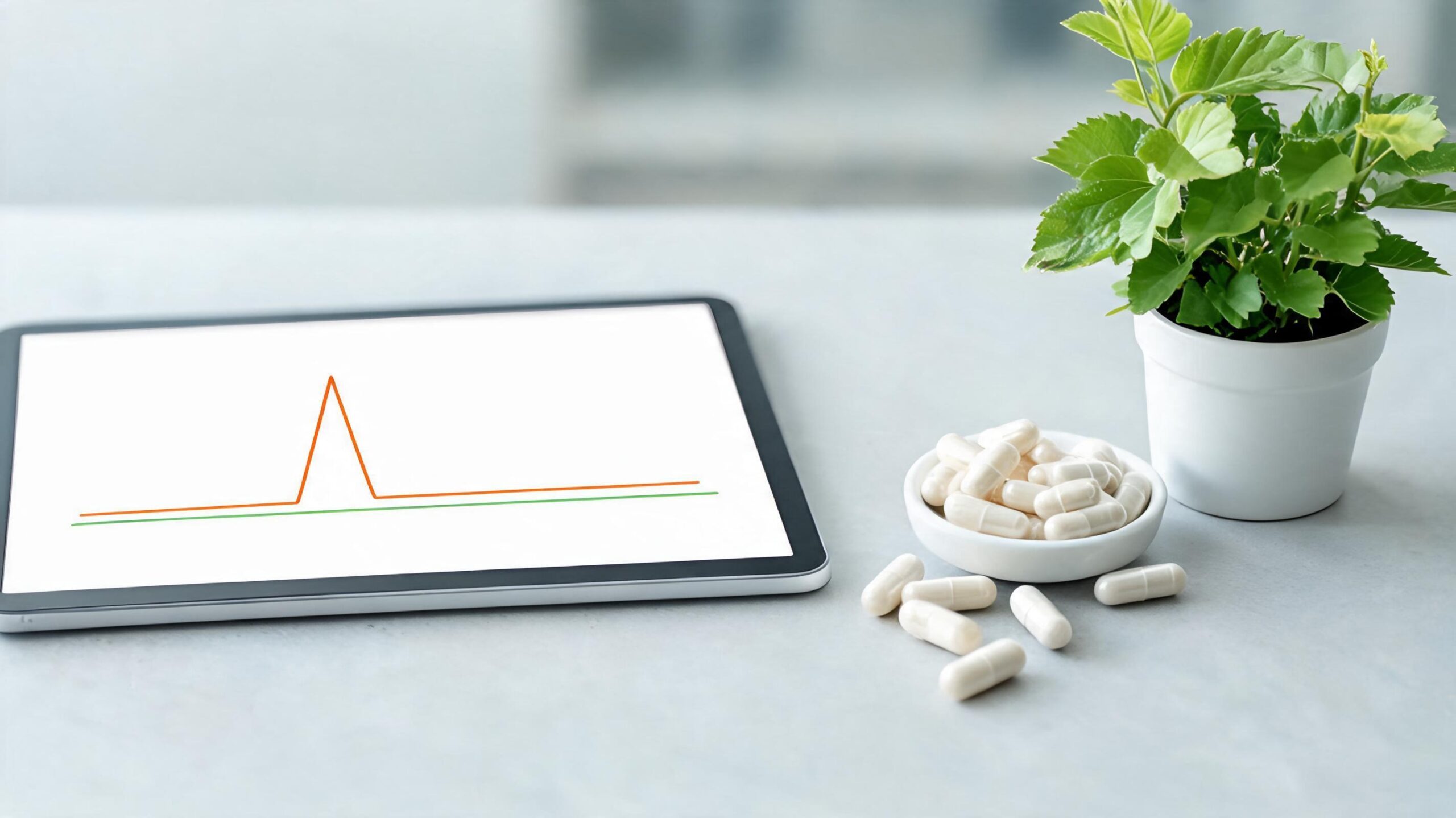
A 2022 systematic review in Nutrients pooled 18 randomised trials of mulberry-leaf interventions in people with prediabetes or type 2 diabetes and reported a consistent reduction in postprandial glucose AUC (area under the curve) of roughly 10–30% versus placebo. Fasting glucose and HbA1c improvements were smaller and more variable — exactly what the mechanism predicts.
A 2018–2023 series of trials from Chung-Ang University and Tokyo University added a third finding that matters in the real world: the timing of mulberry leaf extract matters as much as the dose. Taking it 30 minutes before a carbohydrate-rich meal produced a meaningfully larger post-meal spike reduction than taking it at the same time as, or after, the meal.
The dose, timing, and standardisation that actually move the needle
Across the trial protocols, the effective daily dose of DNJ clusters around 6–18 mg per meal, delivered from a mulberry-leaf extract standardised to ≥1.5% DNJ (Mulbalance™ and a few Japanese equivalents are at this level). Lower-standardised extracts need more raw powder to hit the same DNJ dose, which increases the bulk without improving the effect.
The timing window — 30 to 60 minutes before the carbohydrate-rich meal — comes straight out of the alpha-glucosidase pharmacology. Alpha-glucosidase inhibitors need to be in the small intestine before the substrate arrives. Taking the capsule with the first bite of rice is too late; taking it with breakfast and lunch but skipping dinner is also fine, because the spike that drives HbA1c is the cumulative effect of all three meals, not a single one.
Standardisation is the single biggest marketing trap. “Mulberry leaf extract” on a label without a DNJ percentage is roughly equivalent to “green tea extract” without a catechin percentage — it tells you the plant species, not the dose of the active molecule. The trials above were all run on standardised extracts; whole-leaf powder is a different product at much lower potency per gram.
What “Mulbalance” actually means on a label
Mulbalance™ is the trade-marked mulberry-leaf extract used in GlucoPal and a handful of other clinical-grade products. It is standardised to a guaranteed DNJ content per capsule, which is the reason the same trial effect can be reproduced at the consumer dose level rather than only in a research setting.
Who it works for — and who it does not
The clinical signal is strongest in three groups: (1) people with normal HbA1c but visibly large post-meal spikes (the population where mulberry-leaf extract is essentially risk-free and the upside is a lower cumulative glycaemic load); (2) people with prediabetes (HbA1c 5.7–6.4%) where dampening the spike is the most leverageable lifestyle change; (3) people already on metformin who want to address the post-meal side of glycaemic control without raising their metformin dose.
It is not a substitute for prescribed medication in type 1 or insulin-requiring type 2 diabetes, and it is not a treatment for hypoglycaemia. The mechanism raises the bar on carbohydrate absorption; it does not raise fasting glucose or replace insulin.
What the marketing overreaches on
Three claims you will see on mulberry-leaf supplement labels that the evidence does not currently support:
1. “Lowers HbA1c by X%.” HbA1c is a 3-month average. Reducing a single post-meal spike by 25% translates into roughly 0.1–0.3 percentage points of HbA1c over three months — meaningful, but smaller than the marketing copy suggests, and only when the spike was the dominant contributor.
2. “Works at any time of day.” The alpha-glucosidase timing window is real. Taking it the night before, or 4 hours after the meal, has not been shown to do anything measurable.
3. “Replaces diabetes medication.” No. It is an adjunct. Anyone on glucose-lowering drugs should talk to their prescriber before adding mulberry-leaf extract, because the additive effect on the post-meal glucose curve can in principle require a medication adjustment.
How mulberry leaf extract fits into a triple-action stack
Mulberry leaf extract addresses the post-meal spike. That is one of the three mechanisms a complete blood-sugar stack covers:
• Mulberry leaf DNJ (post-meal spike) — the subject of this article. Blocks alpha-glucosidases, slows carbohydrate absorption, flattens the 60-minute glucose peak.
• Bitter melon polypeptide-p + charantin (fasting glucose) — activates AMPK, mimics some of insulin’s downstream signalling, and lowers hepatic glucose output. Best evidence in the fasting arm.
• Inulin / chicory-root FOS (insulin sensitivity via butyrate) — feeds colonic bacteria that produce butyrate, which improves insulin sensitivity at the muscle-cell level over 8–12 weeks. Slower-acting but the third leg of the chair.
GlucoPal is the only Dyna product that delivers all three — Mulbalance™ mulberry leaf extract, standardised bitter-melon extract, and chicory-root inulin — at the doses that show up in the published trials. If you are looking for a single product rather than three separate bottles, that is the one to look at.
The bottom line
Mulberry leaf extract — specifically Mulbalance™-standardised DNJ, taken 30–60 minutes before a carbohydrate-rich meal — has a real, repeatable, trial-supported effect on the post-meal blood sugar spike. The effect on HbA1c is real but smaller than marketing suggests. It is not a substitute for prescribed medication. And it pairs naturally with the bitter-melon AMPK and inulin-butyrate arms of a complete blood-sugar stack — that is why it is the first pillar of GlucoPal.
For a deeper look at the bitter-melon and inulin halves of the stack, see the related articles below.
Related Topics
How Your Daily Choices Quietly Shape Your HbA1c
Prediabetes Is Reversible – The Surprising Truth About Prediabetes & Diabetic Diet
Importance of Trace Minerals in Insulin Sensitivity & Diabetic Diet
Mulberry Leaf: Nature’s Brilliant Brake on Blood Sugar Spikes
Nature’s Bitter Gift: Could Bitter Melon Help Steady Your Blood Sugar?
Product you may be interested in