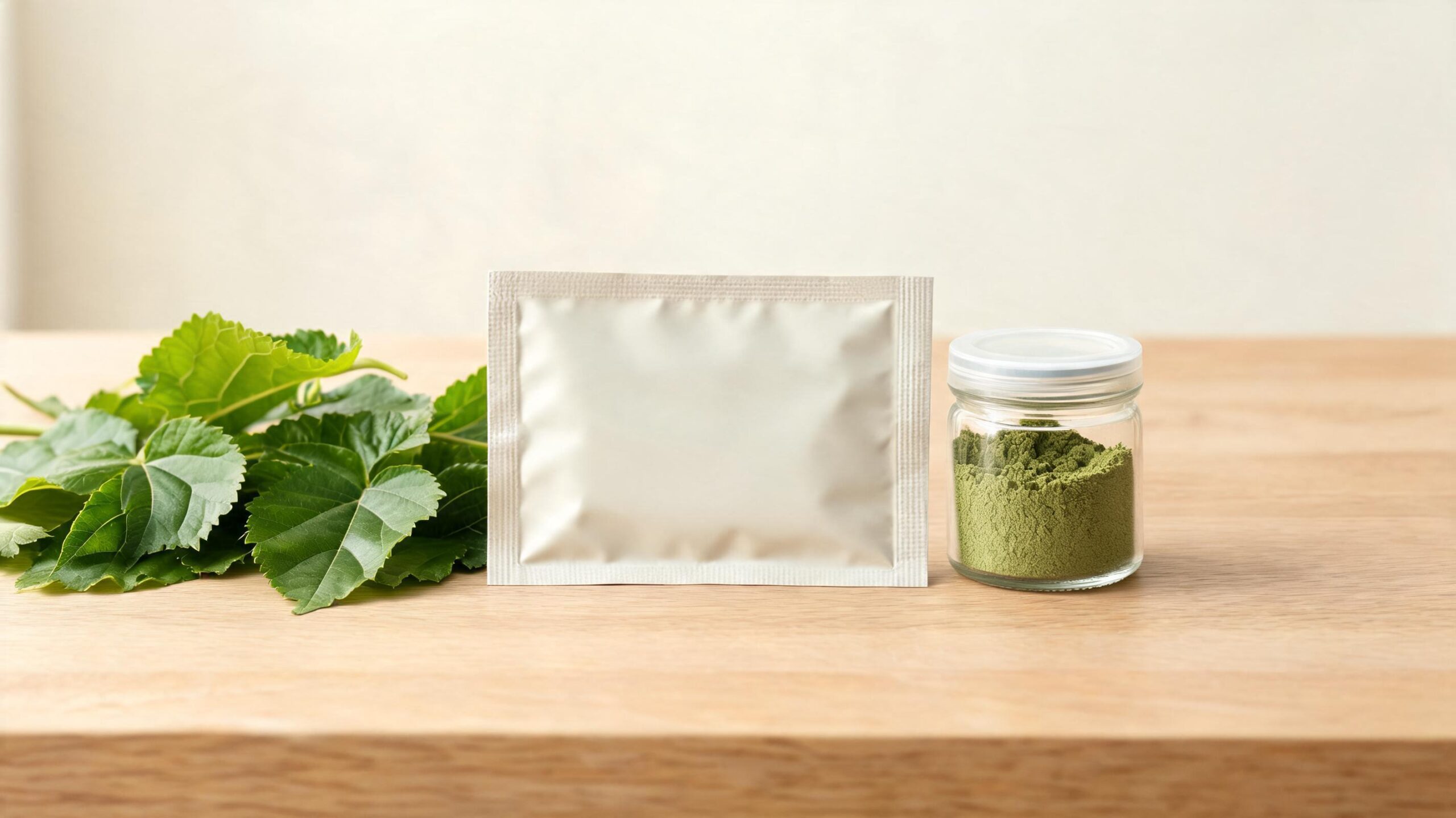
Shopping for a mulberry leaf supplement in Malaysia is harder than it looks. Every brand puts the word mulberry on the front of the box, almost every brand puts a blood-sugar arrow or a glucose curve somewhere on the pack, and the boxes sit side by side in the supplement aisle looking like the same product. They are not the same product. Some contain a standardised extract with a stated amount of the active compound. Some contain leaf powder in a dose too small to matter. Some are a single ingredient. Some are three or four ingredients wearing a single-ingredient name.
The difference between those four things is printed on the label, and once you know the handful of lines to read, you can compare any two boxes in about a minute. This guide is about reading the label, not about promising you a result. It also does not quote prices or name stores, because both move faster than any article — confirm the current price, the current stock and the current shelf life at the point of purchase.
One note before you start: this is label literacy, not medical advice. If you are already taking glucose-lowering medication, or you have been told you have prediabetes or diabetes, talk to your doctor or pharmacist before starting any supplement, and keep taking your prescribed medicine as directed.
Why Malaysian labels are worth reading carefully
Malaysia does not leave the packaging to the marketer. Food sold in Malaysia falls under the Food Act 1983 and the Food Regulations 1985, which set out what has to appear on the label of a packaged food, in what order, and in what language.1
The parts that matter when you are standing in front of a mulberry leaf box:
- Ingredient order is by weight. Every ingredient has to be listed in descending order of proportion by weight, so the first item on the panel is the one the product contains most of. If mulberry leaf is third on the list, it is the third-largest thing in the sachet.1
- Blends have to say so. A mixed or blended product must carry the word mixed or blended conjoined with the name of the food.1
- Percentages mean percentages by weight. Where a label states the strength of an ingredient, per cent means per cent by weight.1
- Allergen ingredients must be declared. If an ingredient is known to cause hypersensitivity, it has to be named on the label.1
- The language is fixed too. Food produced, prepared or packaged in Malaysia has to be labelled in Bahasa Malaysia; imported food may be in Bahasa Malaysia or English.1
- Nutrition labelling has its own rules. Energy has to be declared in kilocalories or kilojoules per 100 g or 100 ml, or per package if the package holds a single portion, and per serving as stated on the label, alongside protein, available carbohydrate and fat.1
Regulation 18 also blocks descriptive material on a pack that contradicts, qualifies or modifies a required statement, and Regulation 18A governs absence and non-addition claims such as sugar-free or no added sugar — and treats them as nutrition claims, which pulls the nutrition information panel back into scope.1 So a pack that makes a claim about what is not in it owes you a full panel to go with it.
The 2020-amendment copy of the same regulations is also publicly available if you want to read the clauses yourself.2
What to check on a mulberry leaf label, line by line
1. Is it an extract, or is it raw mulberry leaf powder?
This is the first fork in the road and the most consequential. An extract is a concentrated fraction of the leaf; leaf powder is the ground leaf. Trials on mulberry leaf are run on extracts, so a bag of powder is a different product from the one that was studied, even when both are sold as mulberry leaf.
2. Does the label state the DNJ amount, or only the extract weight?
The active compound in mulberry leaf is 1-deoxynojirimycin (DNJ), an alpha-glucosidase inhibitor. Mulberry leaf extract: 250 mg tells you the weight of the extract and nothing about how much DNJ is inside it. Standardised to 1.5% DNJ tells you the ratio. A label with no DNJ figure at all is the one to put back on the shelf.
This matters because the studied doses are specific. In the 2020 dose-finding trial, 12 mg of DNJ was the minimum effective single dose for blunting post-meal glucose, and 12 mg three times daily was the dose carried into the 12-week arm; the same trial recorded bloating, flatulence and loose stools as the common adverse effects.3 Earlier work tested single doses of 3, 6 and 9 mg of DNJ and found the post-load effect rose with dose, with a 12-week arm using 6 mg three times daily.4 A more recent head-to-head trial compared 0.75 g of mulberry fruit extract containing 2.90 mg of DNJ against 2.90 mg of DNJ on its own, and the two were bioequivalent for post-meal glucose and insulin.5 Another 4-week trial in prediabetic adults used 5 g per day of mulberry leaf aqueous extract and saw an improved post-meal glucose response.6
Read those numbers as a yardstick for the label, not as a dose to take. The question the label has to answer is simple: is the DNJ amount stated? If it is, you can do arithmetic. If it is not, you are being asked to buy on the front of the pack.
3. What else is in the sachet?
Read the panel top to bottom. On a single-ingredient mulberry product you should find little else — a capsule filler, or nothing at all if it is a loose powder. If you see sweeteners, flavour carriers or colour, they are on the panel in weight order, which means they may be doing more work in the product than the mulberry.
4. Single ingredient, or a blend wearing a single-ingredient name?
This is where the regulations do you a favour: a blend has to say mixed or blended. So read the top of the panel for those words, then read the ingredient list underneath. A product that also contains bitter melon, inulin, chromium, berberine or vitamin D is a combination product, and it should be judged as one — including the fact that you are paying for those other ingredients, and that its evidence base is the evidence base of its components, not of mulberry leaf alone.1
If your reason for buying mulberry leaf is a specific reason — say you want the post-meal spike effect, and nothing else — a single-ingredient product is the one that matches the request. A blend may be a perfectly sensible product, but it is a different purchase, and a label comparison should compare like with like.
5. Is there a nutrition information panel?
If the pack makes any nutrition claim at all, a panel is required.1 Look for energy per serving in kilocalories and kilojoules, plus protein, available carbohydrate and fat. Available carbohydrate matters here: a sachet of a carbohydrate-containing blend can carry real sugar, and a pack heavy in fruit or inulin powder will not show the same numbers as a nearly single-ingredient extract.
6. Batch, expiry, storage and who is behind it
Check the batch number and expiry, and check the storage instruction. Green-powder products and anything containing plant extracts can pick up moisture, and a sachet that has been sitting in a hot car or a humid kitchen is not the same product as the one on the shelf. A Malaysian or Singaporean manufacturer address on the pack means there is a local entity behind it when something goes wrong.
How to compare two labels in sixty seconds
When you have two boxes in your hands, work through this in order. It is deliberately short, because the point is to leave with one box and a reason.
- Extract or powder? If the panel says powder, that is already a different product from the studied ones.
- Is the DNJ percentage stated? If not, that is your answer: put it back.
- Do the arithmetic. Multiply the extract weight by the DNJ percentage. A 250 mg extract standardised to 1.5% DNJ gives you 3.75 mg of DNJ per serving; a 500 mg extract at 1.5% gives you 7.5 mg. Now you can compare that against the single doses that showed measurable effects in the trials cited above.
- How many other ingredients, and how much of the panel is not mulberry? A long panel under a bold mulberry leaf heading is a blend.1
- Is there a nutrition panel, and what does the carbohydrate line say? For a blend, this is where the added sugar shows up.1
- Check the claims on the front against the facts on the back. Regulation 18 stops front-of-pack wording from contradicting the label, but a vague front claim is not a specification, however loud it is.1
And then compare what you have found with what the research actually used, because that is the only honest way to know whether the product in front of you resembles the products that were studied.
What the published trials used, so you know what you are comparing against
Four things came out of the human trials that are useful as a shopping reference.
- Extract, not powder, and a stated DNJ amount. Every one of the trials above worked with a mulberry-leaf extract whose DNJ content was measured rather than assumed.
- Single doses in the 3–12 mg DNJ range. 12 mg was the minimum effective dose in the dose-finding work.3 The earlier trials behind that range tested single doses of 3, 6 and 9 mg of DNJ, with a 12-week arm using 6 mg three times daily.4
- Extract weights in fractions of a gram. A head-to-head trial found 0.75 g of mulberry fruit extract containing 2.90 mg of DNJ bioequivalent to 2.90 mg of pure DNJ.5 A dose-response trial in healthy adults found 0.37 g of mulberry fruit extract was the lowest dose that reliably reduced post-meal glucose and insulin, with larger reductions at 1.5 g.7
- Extracts, not leaves, carry the effect — and DNJ is the main driver, but not the only one. The same bioequivalence work noted that other components of mulberry fruit extract, including a DNJ precursor, may contribute to the effect.
None of that tells you what a particular product will do for you, and none of it is a reason to take a supplement instead of following medical advice. It tells you what to look for on a label so that you are not comparing a bottle of powder with a bottle of standardised extract and assuming they are the same thing.
Questions worth asking before you buy
- Is the DNJ content stated, and what is it? If the seller cannot answer, that is your answer.
- Is this single-ingredient or a blend, and is the pack honest about it? Regulation 11 requires blends to be labelled as mixed or blended.1
- How many sachets a day, and what does that work out at per month? Per-serving price is the only price that matters, and per-day price is the only price that matters over time.
- What is the current price and who actually stocks it? Check it live, at the seller, on the day you buy. Prices, promotions and stock move, and an article that quotes them goes out of date quickly.
- How should it be stored, and how long is the batch good for?
- Does it interact with anything I take? Ask a pharmacist, and name the medicines you are on. If you are on medication for blood sugar, this is not a question to skip.
The bottom line
A mulberry leaf label tells you almost everything you need, if you know which four lines to read: the ingredient panel and its order, the DNJ percentage, the words mixed or blended, and the nutrition information panel. If the DNJ amount is not stated, you cannot compare the product against any published research, because you do not know what dose of the active compound you are getting.
Check the price and availability yourself at the point of purchase, keep your prescribed medication as directed, and speak to your doctor or pharmacist before starting anything new.
References
- Ministry of Health Malaysia — Food Regulations 1985 (P.U. (A) 437/85), incorporating the latest amendment — https://faolex.fao.org/docs/pdf/mal27305.pdf
- Ministry of Health Malaysia — Food Regulations 1985 (P.U. (A) 437/85), incorporating the latest amendment (2020 amendment copy) — https://www.foodipedia.my/food-regulations-1985.pdf
- Complementary Therapies in Medicine — A randomized controlled study of dose-finding, efficacy, and safety of mulberry leaves on glycemic profiles in obese persons with borderline diabetes — https://pubmed.ncbi.nlm.nih.gov/32147046/
- Journal of Diabetes Investigation — Effect of mulberry leaf extract with enriched 1-deoxynojirimycin content on postprandial glycemic control in subjects with impaired glucose metabolism — https://pubmed.ncbi.nlm.nih.gov/24843505/
- The Journal of Nutrition — Bioequivalence of Mulberry Fruit Extract and 1-Deoxynojirimycin for Postprandial Blood Glucose Lowering: A Randomized Trial in Humans — https://pubmed.ncbi.nlm.nih.gov/40419090/
- Journal of Medicinal Food — Mulberry leaf extract improves postprandial glucose response in prediabetic subjects: a randomized, double-blind placebo-controlled trial — https://pubmed.ncbi.nlm.nih.gov/25343729/
- British Journal of Nutrition — Dose-response efficacy of mulberry fruit extract for reducing post-prandial blood glucose and insulin responses: randomised trial evidence in healthy adults — https://pubmed.ncbi.nlm.nih.gov/35272722/
Related Topics
How Your Daily Choices Quietly Shape Your HbA1c
Prediabetes Is Reversible – The Surprising Truth About Prediabetes & Diabetic Diet
Importance of Trace Minerals in Insulin Sensitivity & Diabetic Diet
Mulberry Leaf: Nature’s Brilliant Brake on Blood Sugar Spikes
Nature’s Bitter Gift: Could Bitter Melon Help Steady Your Blood Sugar?
Product you may be interested in