Most mulberry leaf articles tell you what the extract is and what it was tested against. Very few tell you the thing people actually ask at the shelf: when do I take it? Before the meal, with the first bite, or after the plate is finished?
The honest answer is that the human trials answer this question sideways, not on purpose. Nobody has run a trial that randomises one group to take mulberry leaf before a meal, another with the first bite, and another after, then compares the three. What the trials did do is give you their methods, and when you read those methods closely the timing they chose turns out to follow a logic: they put the extract in the gut at the same moment the carbohydrate arrived. That is not the same as proof that a particular moment is best. It is the difference between what was tested and what was merely assumed.
This article walks through the timing in each human study, states plainly what was measured and what was not, and then says where a 750 mg mulberry leaf sachet sits inside that evidence. It is not a promise of a smaller spike. Nothing here is a substitute for the medication your doctor prescribed, and if you are on glucose-lowering treatment, talk to your doctor or pharmacist before starting any supplement and keep taking your prescribed medicine as directed.
Why the timing question has a mechanism behind it
Mulberry leaf works through 1-deoxynojirimycin, usually shortened to DNJ, an iminosugar that inhibits alpha-glucosidase, the enzyme family in the small intestine that breaks starches and sugars down into absorbable glucose. It is the same broad mechanism as acarbose and miglitol, the established medicines built on it, and it is why timing is not a lifestyle preference but a mechanistic question: an enzyme inhibitor sitting in the gut has to be present while the carbohydrate is being digested in order to have anything to act on.
This also sets the boundary of the question. The effect is local to the gut and it is short-lived. Once a meal has been digested and its glucose has been absorbed, there is no remaining carbohydrate for a gut enzyme inhibitor to slow down. That is the reason “after the meal” is a genuinely different proposition from “with the first bite”, and not just a later version of the same idea.
What the acute trials actually did: extract and carbohydrate together
The single-dose studies are the most useful for this question, because they deliberately put the extract and the carbohydrate in the same session.
In the Minnesota crossover study that is the most-cited trial in this field, healthy volunteers and people with type 2 diabetes drank 75 g of sucrose either with or without a gram of mulberry leaf extract, and their glucose was followed for the first two hours.1 The extract was not taken before the drink and not after it. It was in the drink, at the moment the sugar was. Compared with placebo, the rise in blood glucose over those first 120 minutes was clearly smaller: about 15 versus 22 mg/dL in the control subjects and 42 versus 54 mg/dL in the type 2 group.1 The same study also recorded more hydrogen in the breath, which is the signature of undigested carbohydrate reaching the colon, and that is the gastrointestinal trade-off that runs alongside this whole family of ingredients.
The Japanese crossover trial from the same era works the same way, and adds a dose dimension: a single ingestion of mulberry leaf extract delivering 3, 6 or 9 mg of DNJ was taken with a carbohydrate challenge of 200 g of boiled white rice, and the acute glucose response fell in a dose-dependent manner.2 The follow-up arm of that study gave 6 mg of DNJ three times a day for twelve weeks.
A newer American pilot used mulberry fruit extract rather than leaf extract, at a much lower dose, mixed directly into a 50 g-carbohydrate portion of boiled white rice. At 0.75 g of the extract the two-hour incremental glucose response was about 22% lower than the rice alone, and the insulin response about 18% lower.6 The same paper is useful for a second reason: it notes that most mulberry leaf research uses extract doses roughly two to ten times higher than its own, typically 0.4 g to over 3 g, carrying 6 to 25 mg of DNJ where the content was reported.6 A systematic review of mulberry for blood sugar reaches a similar summary of the doses in the human literature.7
What the longer trials actually did: fixed schedules, not timed comparisons
The longer studies answer the question less well, and it is worth being clear about why. They were designed to test daily supplementation over weeks, not to compare two timing windows.
In the Korean trial that ran for four weeks, 36 people with impaired fasting glucose took 5 g of mulberry leaf aqueous extract a day. The post-meal response was then measured with a carbohydrate load at the end of the treatment period and compared with the same load at baseline.3 The improvement was most visible at 30 and 60 minutes after the load. Note what the design does and does not say: the daily dose was scheduled, the measurement was a standardised load, and no comparison of morning against mealtime dosing was ever attempted.
The Mul-DM pilot in the United States is the only one of these long studies to look at mealtime glucose directly in people already on diabetes medication. Twenty-four people with type 2 diabetes took a standardised 1 g dose of mulberry leaf extract three times daily, with meals, for three months. Post-meal self-monitored glucose fell about 16% against the group’s own baseline and 18% against placebo, while HbA1c moved in the right direction but did not reach statistical significance.4 Two findings from that trial are worth carrying forward honestly. First, “with meals” was the schedule, so the trial supports mealtime dosing as a practice rather than proving it is optimal. Second, the group taking the extract had a measurable 15% rise in serum creatinine.4 That is why a pilot study on top of prescribed medication deserves a conversation with your doctor rather than a quiet addition to your routine.
The most recent study to address timing head-on is a Japanese crossover trial from 2025, and it is the reason the “before the meal” option cannot simply be waved away. Participants drank a mulberry leaf and water chestnut tea before every meal for two weeks, switched to a matched placebo for a further two weeks, and wore continuous glucose monitors throughout. Each 3 g sachet contained 2.85 g of mulberry leaf with 5.1 mg of DNJ and 87.3 mg of polyphenols. The coefficient of variation of glucose, a measure of how much the readings swing rather than how high they go, was significantly lower during the tea period, and the 1,5-anhydroglucitol marker of post-meal control rose more than it did on placebo.5 That is real evidence for a before-meal protocol, measured over days rather than minutes, in a beverage that also contained a second active ingredient.
So: before the meal, with the first bite, or after?
Pulling the methods together gives a defensible order, with the caveats attached to each line.
- With the first bite, or at the start of the meal, is the timing with the most direct human support. Every acute trial that measured a post-meal response administered the extract at the same time as the carbohydrate, and the effect appeared in the first hour or two. This is also the timing that matches the mechanism, because it puts the inhibitor in the gut while the carbohydrate is being digested.12
- Shortly before the meal has support too, from a different kind of study. The 2025 tea trial used a before-each-meal schedule for two weeks and found better glucose stability, though it measured variability rather than a single spike, and it used a blend with water chestnut husk.5
- After the meal is the option with no trial behind it. Not one of the studies above administered mulberry leaf after the carbohydrate had been eaten, and the mechanism gives a reason to think it would do little for that meal: the carbohydrate is already being digested and absorbed, which is the only window an alpha-glucosidase inhibitor can work in. If your reason for taking it after is that a sachet is easier to remember once the meal is finished, that is a real practical consideration, but it is not a finding from the literature.
- Timing was protocol-driven, not lifestyle-driven. This is the single most important caveat. The trials used fixed carbohydrate loads, fixed clocks and fixed schedules because that is how a controlled study is built. Their timings are evidence about how the research was conducted, not a verdict on how you should schedule a sachet around a variable day.
Where a 750 mg sachet sits inside that evidence
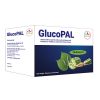
One sachet of GlucoPal contains Mulbalance™ mulberry leaf extract at 750 mg, inulin (chicory root) at 1,890 mg and bitter melon extract at 150 mg, in a 3 g packet, with 30 packets per box.
Set that 750 mg of mulberry leaf extract against the doses in the human trials and it lands at the lower end. The acute studies ran from about 0.4 g up to over 3 g, with 6 to 25 mg of DNJ where the content was stated.67 The Minneapolis trial used 1 g in one sitting.1 The three-times-daily mealtime trial used 1 g per dose, three times a day.4 The four-week Korean study used 5 g a day of leaf aqueous extract.3 So a single 750 mg sachet is a smaller amount of leaf extract than the published work generally used.
There is a second gap worth naming, and it is the one that matters most for judging the dose. DNJ content is what a milligram of extract is really standing in for, and the product page for Mulbalance™ describes the extract as standardised in DNJ without publishing a percentage. Without that number, a 750 mg packet cannot be mapped onto the 3 to 12 mg DNJ single doses used in the Japanese crossover work. If you want to compare a product against the published trials, that is the line to read first on the label.
On quantity, the arithmetic is straightforward and worth doing before you start: 30 packets at one a day is about a month, which lines up with how the longer trials were run, at three months or less. At one a day, the box is gone in a month, so it is worth deciding in advance whether you are buying a month of a habit or a month of an experiment. And if you take more than one a day, you are no longer following the pattern any of the studies used.
What this does not settle
Three honest gaps remain, and they are worth more than any number in this article.
No trial has compared the three timings head to head. Every timing statement above is an inference from methods, not from a comparison. A study that randomised pre-meal against mealtime dosing, in the same people, with the same meals, is the study that would settle the question, and it does not exist.
Most of the trials are small. The acute crossover studies ran with 12 to 20 people.12 The longer studies ran with 24 to 36 people.34 These are exploratory-sized samples, and they were not designed to detect differences in timing.
Two safety signals run through this literature. Breath hydrogen rises in the acute studies, which is gas and bloating rather than anything dangerous, but it is real and it is dose-related.16 And the Mul-DM trial recorded a 15% rise in serum creatinine in the mulberry leaf group.4 Neither finding is a reason to avoid the ingredient; both are reasons to tell your doctor, especially if you already have kidney concerns or take medication.
How to use this without over-reading it
If you want to try a mulberry leaf product, the timing that the published human work most directly supports is with the first bite of the meal, or at the start of the meal with the most carbohydrate in it. That is the closest match to what was actually tested, and it is also the timing that fits the mechanism.
Take it consistently rather than cleverly, and give it long enough to judge. The trials that produced measurable changes ran for weeks, not days, and the markers that moved were subtle: glucose variability, post-meal markers like 1,5-anhydroglucitol, and post-meal self-monitored readings, rather than dramatic swings on a single plate of rice.
Keep your own record. Before you start, note your usual meal pattern and, if you already monitor your blood glucose, take a few baseline readings after your heaviest meal for a week. Then change one thing, which in this case would be the timing, and keep everything else the same. Most of what gets written about these ingredients is marketing copy attached to a real but modest biochemical effect, and a personal baseline is the only thing that will tell you whether you are one of the people who responds to it.
And if you are on medication for diabetes or prediabetes, none of this changes what your doctor has prescribed.
The bottom line
The trials did not test “before versus with versus after”. They administered mulberry leaf extract at the moment the carbohydrate arrived, and the glucose rise over the following two hours was smaller. One recent study did use a before-each-meal schedule and found better glucose stability over two weeks, which is a different measurement from a single spike and a blend of two ingredients rather than mulberry leaf alone.
So the timing with the best support is with the first bite, the timing with some support is shortly before the meal, and the timing with none is after it, for a mechanistic reason rather than a tested one. A 750 mg sachet of mulberry leaf extract sits at the low end of the doses used in the published work, and without a published DNJ percentage it cannot be mapped precisely onto those trials. Take it consistently, judge it over weeks, keep taking your prescribed medication, and talk to your doctor before you add anything to a regimen that already works.
References
- Diabetes Care — Influence of mulberry leaf extract on the blood glucose and breath hydrogen response to ingestion of 75 g sucrose by type 2 diabetic and control subjects — https://pubmed.ncbi.nlm.nih.gov/17303787/
- Journal of Diabetes Investigation — Effect of mulberry leaf extract with enriched 1-deoxynojirimycin content on postprandial glycemic control in subjects with impaired glucose metabolism — https://pmc.ncbi.nlm.nih.gov/articles/PMC4014974/
- Journal of Medicinal Food — Mulberry leaf extract improves postprandial glucose response in prediabetic subjects: a randomized, double-blind placebo-controlled trial — https://pubmed.ncbi.nlm.nih.gov/25343729/
- Complementary Therapies in Medicine — Impact of mulberry leaf extract on type 2 diabetes (Mul-DM): A randomized, placebo-controlled pilot study — https://pubmed.ncbi.nlm.nih.gov/28619294/
- Nutrients — Evaluation of the Postprandial-Hyperglycemia-Suppressing Effects and Safety of Short-Term Intake of Mulberry Leaf and Water Chestnut Tea: A Randomized Double-Blind Placebo-Controlled Crossover Trial — https://pmc.ncbi.nlm.nih.gov/articles/PMC12300009/
- Nutrients — Effect of Low-Dose Mulberry Fruit Extract on Postprandial Glucose and Insulin Responses: A Randomized Pilot Trial in Individuals with Type 2 Diabetes — https://pmc.ncbi.nlm.nih.gov/articles/PMC11280168/
- Morus alba L. for Blood Sugar Management: A Systematic Review and Meta-Analysis — Morus alba L. for Blood Sugar Management: A Systematic Review and Meta-Analysis — https://pmc.ncbi.nlm.nih.gov/articles/PMC9152381/
Also available in Bahasa Malaysia and 中文.
Related Topics
Mulberry Leaf Supplement Malaysia: How to Read the Label Before You Buy
Mulberry Leaf Extract (DNJ): Clinical Evidence on Blood Sugar Spikes
Mulberry Leaf: Nature’s Brilliant Brake on Blood Sugar Spikes
Inulin for Insulin Sensitivity: The Butyrate Layer
What a Blood Sugar Spike Feels Like and Why It Matters
Why Fasting Blood Sugar Looks Normal but Your HbA1c Still Creeps Up
Nature’s Bitter Gift: Could Bitter Melon Help Steady Your Blood Sugar?
Product you may be interested in