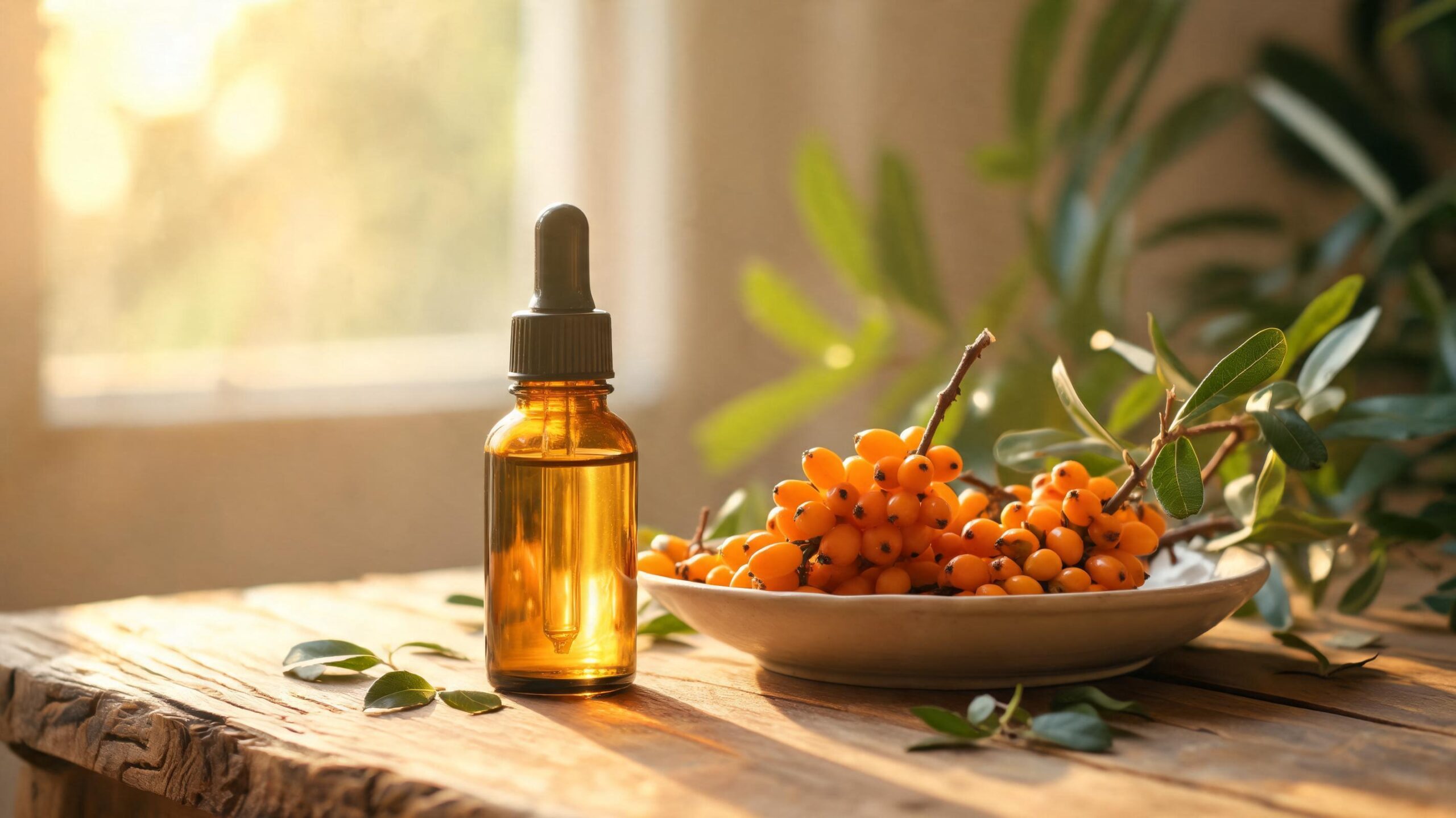
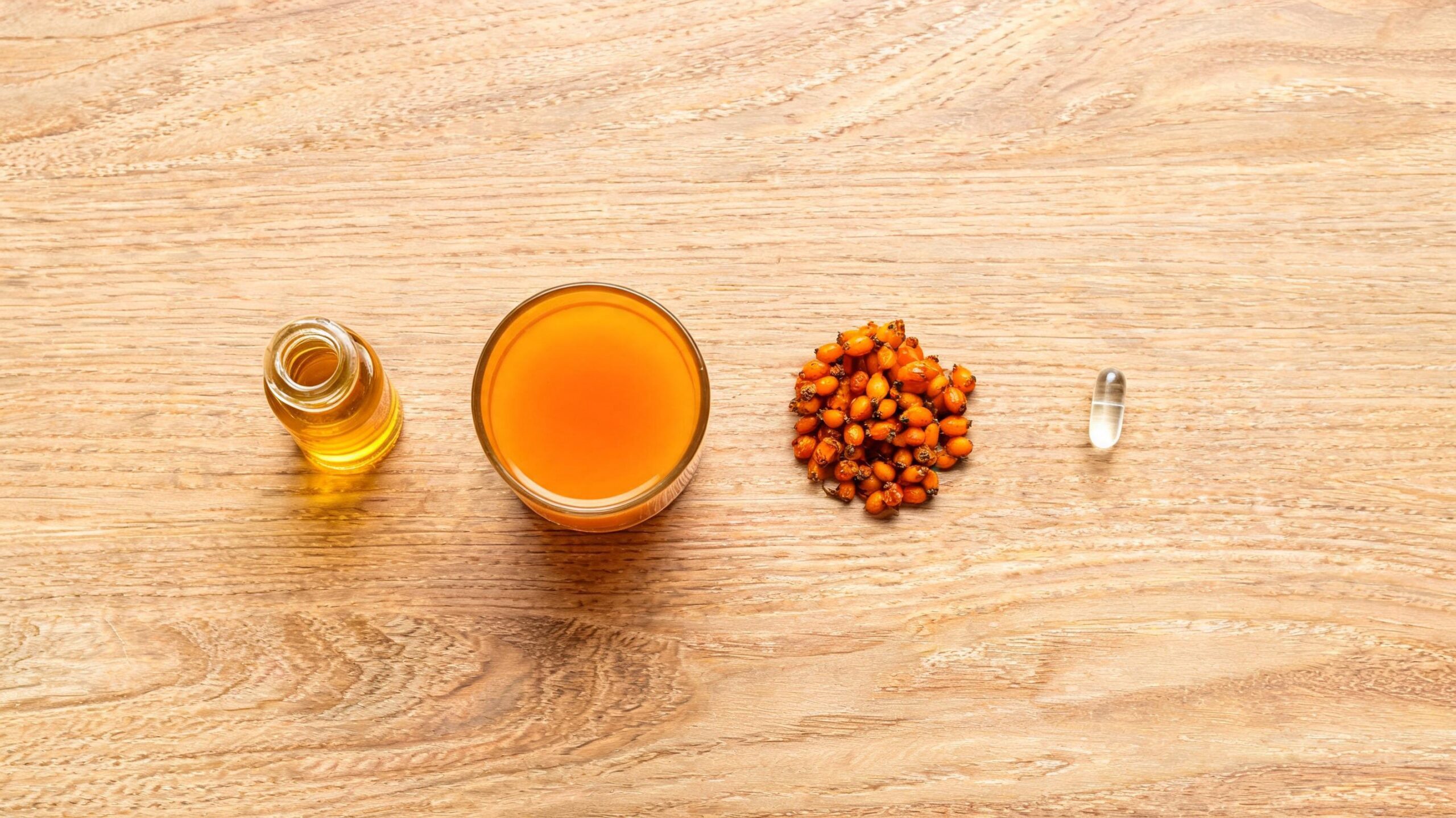
If you have ever stood in a supplement aisle holding two sea buckthorn products and wondering which one is actually doing anything, you are asking the right question — but almost every page answers the wrong one. Most compare sea buckthorn to other supplements. Very few compare the forms of sea buckthorn to each other, which is the decision you are genuinely making when you pick oil, juice, dried berries or a capsule off the shelf.
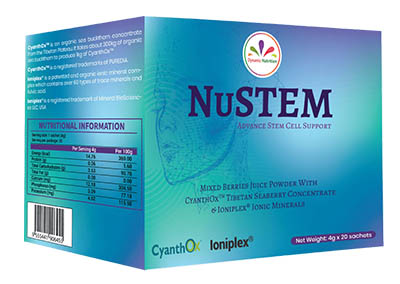
The forms are not interchangeable. They differ in how much of the fatty acid the plant is famous for — palmitoleic acid, the omega-7 that no other plant carries in meaningful quantity1 — they actually deliver in a normal serving, and they differ in how fast the oil goes rancid on a shelf. On our own product line, CyanthOx™ is the cold-pressed Tibetan sea buckthorn concentrate, which is why NuSTEM uses it as the oil-standard reference point when we talk about what a label should say. This article is the comparison we think shoppers are owed.
One framing note before we start. The primary human trial in this space tests palmitoleic acid itself, not sea buckthorn as a fruit3. That distinction matters for every claim below: when a trial uses a purified single fatty acid at a defined milligram dose, it does not license a claim about a berry powder, and it certainly does not license one about a juice drink.
The short answer: which form delivers the most omega-7 per serving
Ranked by what a lab actually measures in the product1:
1. Cold-pressed sea buckthorn oil — the only form where omega-7 is the point. Measured commercial sea buckthorn oils ran from 25.5% to 46.8% total omega-7 across the products studied1. This is the form to buy if palmitoleic acid is your goal.
2. Capsules — only as good as the oil inside them. A capsule is a delivery vehicle, not a dose. The back label’s total omega-7 figure is the whole story; the softgel shell tells you nothing.
3. Sea buckthorn juice — pleasant, hydrating, whole-fruit spectrum, and low in oil per serving. Fine as a food. Not an omega-7 strategy.
4. Dried berries — carotenoid-rich and genuinely good food, with oil content that swings widely by drying method and storage. Also fine as a food. Also not an omega-7 strategy.
The critical finding from the composition study is that commercial sea buckthorn supplements ranged from omega-7-rich (25.5–35.5% palmitoleic acid) down to 0.2–8.3%1 — that is, across the same shelf, in the same product category, one product had roughly one hundred times the palmitoleic acid of another. The category is not standardised, so the buyer has to do the comparing. That is what the rest of this article is for.
Why sea buckthorn is the only plant with meaningful omega-7
Sea buckthorn (Hippophae rhamnoides) is unusual among plants in carrying the omega-7 group — palmitoleic acid (16:1 n-7) and cis-vaccenic acid (18:1 n-7) — at a level higher than any other plant1. Palmitoleic acid is also a component of human skin lipids, which is the biological reason it ended up in the skin-barrier literature in the first place3.
But there is a second structural point that decides your purchase, and most articles skip it: the oil fraction matters more than the plant. Within the same berry, pulp and peel oil carry the omega-7 while seed oil carries almost none of it — pulp and peel oil runs up to roughly 43% palmitoleic acid, while seed oil sits below 0.5%2. Seed oil is instead rich in linoleic and alpha-linolenic acid, which makes it a broad polyunsaturated botanical oil rather than an omega-7 ingredient at all2.
This is the trap behind a lot of disappointing sea buckthorn products. A product can be entirely genuine sea buckthorn and still be a poor omega-7 source, simply because the fraction used is the seed rather than the pulp. Ask which fraction, not just which plant.
Cold-pressed oil — the highest delivery, and the one that spoils
Oil is the reference format because it is the format the plant’s actives concentrate in. In the comparison study, sea buckthorn oil products were the omega-7-rich end of the category, and — importantly — the studies that distinguish sea buckthorn from other botanicals separate on this fraction2. Sea buckthorn oil is also the only oil commonly described as carrying a naturally close to 1:1 omega-3 to omega-6 ratio2, with tocopherols and carotenoids arriving alongside.
The honest drawback is oxidation. Palmitoleic acid is a monounsaturated fatty acid with one double bond, which makes it more resistant to oxidation than a polyunsaturated oil but not immune to it. Oil that has been warm, or shipped unrefrigerated, or sat in a sunlit cupboard for months, degrades. Once it degrades, the fatty acid profile on the label stops describing the bottle in your hand.
Three label checks that settle it, none of which require a laboratory:
- Is a total oil-per-serving figure in grams printed? A product quoting only a powder weight or a berry weight is telling you nothing about oil delivery.
- Is it described as cold-pressed, and is there any heat or hexane mention? Cold pressing is a mechanical method; heat extraction and solvent extraction are not the same claim.
- Does it mention storage away from heat and light, or a refrigerated range? A brand that says nothing about storage is telling you it has not thought about it.
Where a tocopherol or vitamin E figure appears alongside the oil, treat it as what it is — an oxidation-protection marker and a mild quality signal — rather than as a therapeutic dose.
Juice and pulp drinks — the whole-fruit option, low in oil
Sea buckthorn juice is a genuinely different product with a genuinely different purpose. It carries the whole-fruit spectrum: the carotenoids, the polyphenols, the soluble solids, in a pleasant drinkable format that people will actually take daily. It hydrates. It is a food first.
What it is not is an omega-7 delivery vehicle. Fruit juice is mostly water and sugar solids; the oil fraction is small per serving, and there is no standardisation requirement that puts a palmitoleic acid number on the label. If your goal is the fatty acid, juice is the wrong instrument. If your goal is a daily fruit-derived drink with the antioxidant fraction, it may be exactly right — just do not buy it expecting an omega-7 trial result.
Dried berries — good food, variable oil
Dried sea buckthorn berries are a traditional food and, eaten as food, a good one. They retain carotenoids well. What varies is the oil: drying temperature, time and subsequent storage all move the residual oil content, and a dried berry is a whole fruit, so its palmitoleic acid is diluted across pulp, peel and seed alike — including the seed fraction, which is the omega-7-poor part2.
The realistic position: dried berries are a nutrient-dense snack, and a form-comparison shopping decision that treats them as an omega-7 supplement is comparing apples to a labelled dose. If you eat them as food, eat them. If you are dosing omega-7, use an oil or a capsule with a stated omega-7 figure.
Capsules — a delivery format, not a dose
Capsules are how most people meet sea buckthorn, and they are useful for one specific reason: a softgel or a filled capsule puts a stated quantity of oil in a unit that is easy to take daily. That is the entire argument for the format.
The risk is entirely in what is inside. The composition study found sea buckthorn supplements spanning from rich oils down to powders carrying trace amounts of omega-71 — a powder-filled capsule is a different product from an oil-filled one, and both can legitimately be sold as “sea buckthorn capsule”. So the capsule tells you nothing on its own. Three things to read:
Total omega-7 per capsule, in milligrams. This is the number that decides the product. If it is absent, the capsule has not been characterised for the fatty acid you are buying it for.
Whether the oil is from pulp/peel or seed. Seed-derived oil in a capsule is a broad PUFA oil that happens to come from a sea buckthorn plant, not an omega-7 product2.
Whether it is blended with cheaper filler oils. Blending is legal and common. It is also the most common way an omega-7 claim quietly shrinks — read the full ingredient panel, not the front of the bottle.
On dosage: the one substantial human trial of the fatty acid used 500 mg/day of palmitoleic acid for 12 weeks, and reported improved skin hydration and reduced transepidermal water loss against a control oil3. That is the closest thing to a dosing anchor in this category. Note what it was: a randomised, double-blinded, placebo-controlled trial of purified palmitoleic acid — 90 healthy participants, a defined endpoint, a comparator oil. It is a real result, and it is also a specific, narrow one.
What that trial does and does not support
It supports a modest, defensible claim: oral palmitoleic acid at 500 mg/day for 12 weeks improved skin hydration and skin-barrier water loss in healthy adults3. Skin is mechanistically sensible here — palmitoleic acid is part of skin lipids, so a fatty-acid intervention acting on the barrier is a coherent hypothesis, not a leap.
It does not support several claims you will see attached to sea buckthorn products. It tested purified palmitoleic acid, not a berry, a powder, a juice or a whole-plant extract, so it cannot be transferred to any of them at an equivalent label claim. It measured skin hydration and water loss, not wound healing, not “cell regeneration”, and not any systemic disease outcome. It ran 12 weeks in 90 healthy adults, which is short and small. And the study material was supplied by a supplements manufacturer3, which is a disclosed funding relationship worth noting, not a disqualification.
The wider review literature reaches a similar tempered position: sea buckthorn oil is promising and compositionally unusual, but the authors of the major review note that most supporting results come from studies of the isolated fatty acids rather than from the oil itself, which limits claims about synergy between the fatty acids and the other compounds present2. That is the honest summary of the whole category in one sentence: strong compositional uniqueness, thin whole-product clinical evidence.
The four-question label checklist
Before you buy any sea buckthorn product, in order:
1. Does it state total omega-7 (or palmitoleic acid) in mg per serving? No number, no answer. Everything else is marketing.
2. Is the oil from pulp and peel, or from seed? Pulp and peel is the omega-7 fraction. Seed is a different oil2.
3. Is it cold-pressed, and is storage specified? Cold pressing and a stated storage condition are the two cheapest quality signals on the label.
4. Is the capsule an oil fill or a powder fill? Oil fill with a stated omega-7 figure, or it is not the product you think it is1.
And one question to ask the seller: what is the source batch for the omega-7 figure? If the number cannot be traced to a compositional analysis rather than to the plant species, you are reading a species claim, not a dose1.
Where NuSTEM’s CyanthOx sits in this comparison
NuSTEM combines CyanthOx™ Tibetan sea buckthorn concentrate with Ioniplex® ionic fulvic minerals, and it is a stem-cell-support product rather than an omega-7 dosing product — so let us be clear about what the CyanthOx component is and is not doing there. It contributes the sea buckthorn fatty-acid and carotenoid fraction as part of a broader formula; it is not positioned as a therapeutic omega-7 replacement, and nothing here should be read as a claim that the product treats any condition.
Where it is genuinely relevant to this article is the form question. CyanthOx is a cold-pressed concentrate from the pulp of a named region, not a seed-derived carrier oil and not a filler blend — which is the distinction at the centre of the comparison above. If you are choosing a sea buckthorn format on composition grounds, that is the reasoning to apply to any brand, including this one.
Safety and who should not self-dose
Sea buckthorn oil is a food-derived oil with a benign safety profile at culinary and moderate supplemental doses. Three practical cautions:
Blood-thinning medications. Sea buckthorn oil is discussed alongside platelet and coagulation effects. Anyone on warfarin, antiplatelet therapy, or preparing for surgery should ask their prescriber before adding a concentrated oil2.
Pregnancy and breastfeeding. There is not the trial base to support self-supplementation in pregnancy. Food use is a different question from concentrated-dose use.
Active skin disease. If you are using a topical product for eczema, a retinoid protocol or an actinic-damage regimen, adding an oral fatty acid is a decision for your dermatologist, not a label claim.
Anyone with diagnosed hypertension, a lipid disorder, or an existing condition on a treatment plan should treat any supplement as something to mention at the next appointment — including this one.
The evidence-tiered verdict
What is solid: sea buckthorn pulp and peel oil is compositionally unique, carrying an omega-7 profile higher than any other plant, and commercial products in this category vary enormously — from roughly 46% total omega-7 down to trace amounts in the same shelf1. That alone justifies reading labels rather than trusting the species name.
What is thin but real: a 12-week randomised controlled trial of purified palmitoleic acid at 500 mg/day improved skin hydration and barrier water loss in 90 healthy adults3. One good trial, narrow endpoint, narrow population.
What is not supported: transferring that result to berries, juice or powders; any claim of wound healing or cell regeneration from an oral fatty acid; any promise that a sea buckthorn format moves a cardiovascular or metabolic outcome. Review authors are explicit that most positive findings in this literature come from isolated fatty acids rather than the whole oil2, which caps what any whole-product claim can honestly carry.
So which form? If you are buying sea buckthorn for its omega-7, buy the format that states the omega-7 number per serving — which in practice means oil or an oil-filled capsule — and buy the one whose oil comes from pulp and peel. If you are buying sea buckthorn as a food, a juice or dried berries are perfectly good food and no comparison is required. The mistake is buying a food and paying for a supplement claim, or buying a supplement that never states the number that would make the claim checkable.
References
- Palmitoleic acid content and composition-based nutritional quality of commercial omega-7 oils and supplements, https://pmc.ncbi.nlm.nih.gov/articles/PMC13371309/
- The impact of sea buckthorn oil fatty acids on human health, Lipids in Health and Disease, https://pmc.ncbi.nlm.nih.gov/articles/PMC6589177/
- Efficacy and safety of oral palmitoleic acid supplementation for skin barrier improvement: A 12-week, randomized, double-blinded, placebo-controlled study, Heliyon, https://pmc.ncbi.nlm.nih.gov/articles/PMC10245245/
Also available in Bahasa Malaysia and 中文.
Related Topics
NuSTEM CyanthOx + Ioniplex: what the Drapeau 2019 +40% circulating-stem-cell evidence actually shows
Sea Buckthorn for Menopause: 5 Science-Backed Benefits for Women
NuSTEM – A Vegan Approach To Stem Cell Support
3 Keys to Anti-Aging – CyanthOx™
The longevity term nobody’s measuring — but your 60s will thank you for tracking
Product you may be interested in