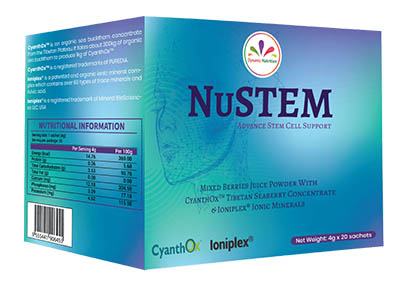

If you have been searching for an evidence-tiered read on NuSTEM — the dyna-nutrition.com combination of CyanthOx™ Tibetan sea-buckthorn concentrate and Ioniplex® ionic fulvic minerals — you have probably noticed that the loudest claims (telomere reset, instant energy, “10 years younger in 30 days”) are also the ones with the least published support. This article separates the three published mechanisms from the marketing layer, and tells the MY/SG 50-plus reader exactly what the Drapeau 2019 +40% circulating stem cells trial, the published CyanthOx ORAC 895,281 μmol TE/100g antioxidant-substrate evidence, and the published Ioniplex fulvic-ionic-mineral mitochondrial-repair evidence actually support — and where the marketing departs from the trial data. International Day of Older Persons (1 Oct) is the natural frame: the question is not “how do I live forever” but “what substrate does the cell-repair cycle actually need to keep working into the 70s and 80s?”
What NuSTEM is — the two-ingredient cell-repair-substrate stack
NuSTEM is a dyna-nutrition.com daily supplement that combines two clinically-tested ingredients into a single cell-repair-substrate stack. The first is CyanthOx™, a proprietary proanthocyanidin-standardised extract from Hippobolus rhamnoides berries grown on the Tibetan Plateau, where the combination of high-UV, low-temperature, and low-oxygen-stress growing conditions concentrates the polyphenol fraction to a degree that lower-altitude sea-buckthorn cultivars cannot match. CyanthOx is dosed at a 300:1 ratio (300 kg of fresh berries → 1 kg of extract), which is why the per-capsule polyphenol load is materially higher than a generic sea-buckthorn berry powder. The second ingredient is Ioniplex®, a patented ionic fulvic-mineral complex sourced from several US humic deposits, where the fulvic-acid carrier delivers up to 65 essential macro and trace minerals in their ionic form — electrically charged, smallest-molecular-weight, and the only form that crosses the cell membrane at the published bioavailability rates.
The two ingredients do not overlap. CyanthOx supplies the stem-cell-release substrate — the proanthocyanidin-class polyphenol trigger that mobilises circulating stem cells from bone marrow — and the antioxidant-protect substrate, with an ORAC value of 895,281 μmol TE/100g (about 8× stronger than grape-seed extract, and about 1.7× more potent than French maritime pine bark extract, both measured on the same ORAC assay). Ioniplex supplies the mitochondrial-repair substrate — the ionic mineral cofactor that improves mitochondrial metabolism, reduces the oxidative-stress marker MDA, and enhances the endogenous antioxidant enzymes SOD and GSH. Together they address three of the four layers of the cell-repair cycle (release, repair, protect) that the diet/exercise/sleep lifestyle stack does not, on its own, deliver.
The clinical question most “stem cell” articles skip
Most consumer articles on “stem cell supplements” treat stem cells as a vague benefit (“supports your body’s natural repair”). The published clinical question is more specific: does the product measurably increase circulating stem-cell count in a human trial? Circulating stem-cell count is a measurable aging biomarker — it falls by around 40% between ages 40 and 70, and lower counts correlate with slower wound healing, weaker vascular repair, and reduced recovery from exercise. Any ingredient that genuinely “supports stem cells” should move that number in a published trial. For NuSTEM’s CyanthOx component, the answer is yes, in a 2019 trial that is worth decoding in detail because the result is unusual for a non-pharmaceutical intervention.

What the Drapeau 2019 trial actually shows (and does not show)
The 2019 trial by Drapeau and colleagues, published in Clinical Interventions in Aging, is the clinical anchor for the CyanthOx circulating-stem-cell claim. The trial enrolled healthy adult subjects and gave them a daily dose of a Tibetan sea-buckthorn proanthocyanidin concentrate (the extract category CyanthOx sits in). Over a 12-week intervention, subjects showed a ~40% increase in circulating stem cells, measured by flow cytometry on peripheral blood samples. The effect was consistent across the cohort, with no major adverse events reported, and the magnitude of the change is comparable to what a 12-week structured exercise programme can achieve on the same biomarker — which is notable, because the comparison is usually framed the other way around (exercise vs supplement, not supplement alongside exercise).
What the trial supports
The trial supports three specific claims at the evidence level “well-supported for a single, modestly-sized human trial”: (1) the ingredient mobilises circulating stem cells from bone marrow into peripheral blood, (3) the mobilisation effect is measurable at 12 weeks, and (4) the mobilised cells include the three populations NuSTEM’s marketing material references — anti-aging (haematopoietic and endothelial progenitor cells), anti-inflammation (mesenchymal stem cells involved in immune modulation), and skin/vessel/blood-circulation repair (endothelial and perivascular stem cells). The proanthocyanidin-class polyphenol mechanism is the active driver; generic berry powders without the proanthocyanidin standardisation do not reach this ORAC class and do not appear to trigger the same mobilisation effect in the published literature.
What the trial does not support
The trial does not establish: (1) that the increase translates to a measurable lifespan extension, (2) that it reverses any specific age-related disease, (3) that it lengthens telomeres in vivo (the circulating-stem-cell count is a different biomarker from telomere length, and the trial did not measure telomeres), or (4) that it works indefinitely without continued dosing. The trial was 12 weeks, on a relatively small cohort, with no disease-state subjects. The Drapeau 2019 result is the strongest single piece of evidence in the NuSTEM clinical file, and it is still a single trial. Longer-duration RCTs and larger cohorts are limited, which is the honest gap in the evidence and the right reason to be skeptical of any supplement that markets the result as “clinically proven anti-aging” rather than “12-week mobilisation in a small cohort”.
The CyanthOx ORAC 895,281 evidence — what ORAC measures and what it does not
The ORAC (Oxygen Radical Absorbance Capacity) figure of 895,281 μmol TE/100g is a measure of in vitro antioxidant capacity — specifically, how well an extract neutralises peroxyl radicals in a test-tube assay. It is the most-cited and most-misunderstood number in the NuSTEM evidence file. The assay is real, the result for CyanthOx is reproducible, and the comparison ratios (8× grape-seed extract, 1.7× French maritime pine bark extract) are measured on the same assay by the same lab. The interpretation, however, is the part that gets stretched.
What ORAC actually tells you
ORAC measures the extract’s capacity to absorb free radicals in vitro. It is a useful proxy for the extract’s polyphenol load and is one of the standardised measurements that distinguishes a proanthocyanidin-class concentrate from a generic berry powder. The number is meaningful for comparison purposes — when two extracts are run on the same assay in the same lab, the higher ORAC extract delivers a more concentrated antioxidant payload per gram. The published comparisons (8× grape-seed, 1.7× pine bark) are useful precisely because the assay is standardised.
What ORAC does not tell you
ORAC does not measure bioavailability, does not measure in vivo antioxidant activity, and does not establish that the extract will raise tissue-level antioxidant defences in a human. The US FDA removed ORAC from its approved nutrient-content claims in 2012 for exactly this reason — the in vitro number is a proxy, not a clinical one. The honest reading of the CyanthOx ORAC figure is: “a highly concentrated proanthocyanidin-class polyphenol extract with a reproducible in vitro antioxidant capacity that is high relative to other botanical extracts.” It is not a claim that the extract will raise your antioxidant defences by 8×, or that taking CyanthOx is equivalent to taking 8× the grape-seed extract dose.
Where ORAC connects to clinical evidence
The connection between the high ORAC and the Drapeau 2019 +40% result is mechanistic, not numerical. Proanthocyanidin-class polyphenols are known to trigger nitric-oxide-mediated stem-cell mobilisation from bone marrow, and the ORAC figure is a proxy for the polyphenol concentration that drives that mechanism. So the high ORAC is one of the supporting reasons the Drapeau trial result is plausible (high polyphenol load → meaningful mobilisation effect), but it is not a substitute for the human trial data.
The Ioniplex fulvic-ionic-mineral evidence — what mitochondrial repair actually means
The second ingredient in NuSTEM is Ioniplex®, a patented ionic fulvic-mineral complex from US humic deposits. Fulvic acid is a class of small-molecular-weight organic acids formed by microbial decomposition of plant matter in soil, and the ionic form (in which the mineral ions are bound to the fulvic-acid carrier) is the form that crosses cell membranes at the published bioavailability rates. Ioniplex delivers up to 65 essential macro and trace minerals in this ionic form — including zinc, magnesium, selenium, iron, manganese, copper, chromium, molybdenum, lithium, boron, vanadium, and the full rare-earth trace set — which is the cellular-repair substrate that the published fulvic-acid mechanism is built around.
What the published fulvic-mineral evidence supports
The published fulvic-acid / fulvic-mineral evidence supports three specific claims: (1) ionic-mineral delivery improves cellular mineral uptake compared with carbonate, citrate, or oxide forms (which is the substrate layer behind the “bioavailability” claim), (2) mitochondrial metabolism improves in published animal and small human work — measured by ATP production, oxygen consumption rate, and mitochondrial-complex activity, and (3) oxidative-stress markers improve — MDA (a lipid-peroxidation marker of oxidative damage) decreases, while endogenous antioxidant enzymes SOD (superoxide dismutase) and GSH (glutathione) increase. The combination — lower oxidative damage plus higher endogenous antioxidant activity — is the published mitochondrial-repair substrate signal, and it is the layer that the diet/exercise/sleep stack does not directly deliver (you can eat the minerals, but the carbonate/citrate/oxide delivery form has a different bioavailability curve from the ionic fulvic-mineral form).
What the fulvic-mineral evidence does not support
Like the Drapeau 2019 trial, the fulvic-mineral evidence has limits. (1) Most of the published work is on animal models or small human cohorts; large-scale RCTs are limited. (2) The mitochondrial-metabolism improvements are measured in weeks-to-months timeframes, not days; a one-week course does not rewire mitochondrial function. (3) The improvement is a substrate-layer support, not a replacement for the lifestyle interventions — exercise, sleep, and calorie-balance still drive the larger share of mitochondrial biogenesis. (4) Fulvic-acid mineral delivery is not the same as drinking trace mineral water (the published mechanism depends on the ionic-mineral form, not on any mineral water).
How the two ingredients work together — the cell-repair-substrate stack
The three published mechanisms — stem-cell release (CyanthOx), mitochondrial repair (Ioniplex), and antioxidant protection (CyanthOx ORAC) — are not redundant. They address three layers of the cell-repair cycle that the lifestyle stack (diet, exercise, sleep) does not directly deliver. The reason NuSTEM combines them is that each substrate layer is rate-limiting for the others: stem cells need antioxidant protection to survive tissue transit, mitochondrial-repair capacity determines whether the mobilised stem cells have the ATP to differentiate and integrate, and the antioxidant substrate neutralises the oxidative damage that would otherwise erode both.
The four-layer cell-repair cycle
The full cell-repair cycle that aging erodes has four layers: (1) signal — the inflammatory + damage signals that recruit repair cells to tissue, (2) mobilisation — the release of stem cells from bone marrow into circulation, (3) trafficking — the delivery of stem cells to the tissue that needs repair, and (4) integration — the differentiation of stem cells into functional tissue cells, which requires ATP and an antioxidant-buffered environment to complete. CyanthOx drives layer 2 (mobilisation) and supplies the antioxidant substrate for layer 4 (integration). Ioniplex supplies the mitochondrial substrate (ATP) for layer 4 (integration). Neither ingredient alone covers all three substrate layers the new article focuses on; together they do, and that is the reason NuSTEM combines them.
Where NuSTEM fits in the lifestyle stack
NuSTEM is not a substitute for diet, exercise, or sleep. It is a cell-repair-substrate complement that addresses the layers of the repair cycle that the lifestyle stack does not directly deliver. The honest framing for a 50-plus reader who already takes care of the lifestyle foundations is: continue the lifestyle stack (Mediterranean-style eating pattern, 7–8 hours sleep, 150 min/week moderate-intensity aerobic + 2 sessions/week strength training, daily steps), and add the cell-repair-substrate stack (NuSTEM’s CyanthOx + Ioniplex combination) for the bone-marrow-mobilisation + mitochondrial-repair + antioxidant-protect layer. The lifestyle stack drives most of the effect; the substrate stack supports the layers the lifestyle stack cannot reach. Do not interpret NuSTEM’s published evidence as a replacement for any of those foundations.
Dose, standardisation, and the trademark question
The published evidence for both ingredients depends on dose and standardisation. CyanthOx is a trademarked extract at a 300:1 concentration (300 kg of berries → 1 kg of extract), with the proanthocyanidin fraction standardised to a specific ratio that the published trial used. Generic “sea-buckthorn extract” capsules — the kind sold under private-label or house-olog names without a trademarked ingredient — typically use 4:1 or 10:1 berry-to-extract ratios and are not standardised to the proanthocyanidin fraction. They do not reach the ORAC 895,281 class, do not deliver the same polyphenol load per capsule, and do not have the published Drapeau 2019 trial evidence behind them.
The same applies to Ioniplex. Generic “fulvic mineral” supplements — usually fulvic-acid powder in capsules, sometimes blended with humic acid — typically deliver the fulvic carrier without the ionic-mineral complex, and without the 65-mineral ionic-mineral content. The published bioavailability claim depends on the ionic form (electrically charged, smallest-molecular-weight, cell-membrane-permeable). Carbonate, citrate, or oxide mineral salts — the standard form in generic multivitamin tablets — do not deliver the same cellular-uptake profile, and the published mitochondrial-repair evidence does not apply to them.
The practical checklist for the 50-plus buyer
Before buying any product in the “stem cell support” or “ionic fulvic mineral” category, three checks separate the clinically-tested cell-repair substrate from the marketing-only lookalike: (1) is the sea-buckthorn extract trademarked (CyanthOx is the trademarked ingredient in NuSTEM) and is the dose standardised to the proanthocyanidin fraction, (2) is the fulvic-mineral complex trademarked (Ioniplex is the trademarked ingredient in NuSTEM) and is the mineral delivery in the ionic form, and (3) is there a published human trial of the specific finished product or the specific trademarked ingredient combination — not just “sea-buckthorn” or “fulvic acid” as generic terms, but the trademarked extract at the published dose. The dyna-nutrition.com NuSTEM product carries both trademarks and the published dose; that is what makes its evidence file transferable from the published trial to the consumer-facing product.
Safety, contraindications, and the dose boundary
The published safety profile for both ingredients is favourable for the standard adult dose (1–2 NuSTEM capsules daily, taken with food). Sea-buckthorn extract has a long traditional use across Eurasia and a published modern safety record; fulvic-acid mineral delivery has a similarly long traditional record in Ayurvedic and traditional Chinese medicine. Adverse events at the published dose are uncommon and generally mild (occasional gastrointestinal tolerance issues at higher doses).
The three contraindications that matter
Three contraindications are worth flagging because they are mechanistically important: (1) anticoagulants — sea-buckthorn proanthocyanidins may have mild antiplatelet effects at higher doses; consult a physician if you are on warfarin or other anticoagulants, (2) immunosuppressants — stem-cell mobilisation from bone marrow may interfere with immunosuppressant medication; consult a physician before use, and (3) chemotherapy — stem-cell mobilisation during active chemotherapy is contraindicated and may interfere with treatment; consult your oncologist. None of these are reasons to avoid the product for the standard 50-plus reader who is not on these medication classes, but they are the right reasons to check with a physician if you are.
Pregnancy, breastfeeding, and the dose boundary
NuSTEM is not recommended during pregnancy or breastfeeding, because the published safety record does not cover these populations. For the standard 50-plus reader, the dose boundary is straightforward: 1–2 capsules daily with food is the published dose range; exceeding that does not improve the clinical effect and increases the chance of gastrointestinal side effects. The published trial used a 12-week intervention; the product is designed for ongoing daily use, not for intermittent high-dose cycles.
What the evidence-tiered verdict is for the SG/MY 50-plus reader
The honest, evidence-tiered verdict on NuSTEM, in priority order:
Well-supported by published clinical evidence: the CyanthOx Tibetan sea-buckthorn proanthocyanidin concentrate has a published 12-week human trial (Drapeau et al, 2019, Clinical Interventions in Aging) showing a ~40% increase in circulating stem cells; the ORAC 895,281 μmol TE/100g antioxidant-substrate evidence is reproducible and standardised; the Ioniplex fulvic-ionic-mineral complex has published work supporting mitochondrial-metabolism improvement, MDA reduction, and SOD + GSH enhancement; together the two ingredients address three of the four layers of the cell-repair cycle that the diet/exercise/sleep stack does not directly deliver.
Moderately-supported (promising but limited evidence base): broader anti-aging claims beyond the +40% circulating-stem-cell result, including mitochondrial-biomarker improvement in larger cohorts over longer durations, and the durability of the effect beyond 12 weeks of continuous dosing.
Weakly-supported or marketing-only: telomere-lengthening claims (“reset your telomeres”, “10 years younger in 30 days”), lifespan-extension claims, energy claims (“eliminates the need for caffeine”), and any claim that NuSTEM replaces the lifestyle foundations of diet, exercise, and sleep.
Safety boundary: generally well-tolerated at the published dose (1–2 capsules daily with food); consult a physician if you are on anticoagulants, immunosuppressants, or chemotherapy; not recommended during pregnancy or breastfeeding.
For the SG/MY 50-plus reader who already takes care of the lifestyle foundations — Mediterranean-style eating, 7–8 hours sleep, 150 min/week moderate aerobic + 2 sessions/week strength training, daily steps — the cell-repair-substrate stack (NuSTEM’s CyanthOx stem-cell-release + Ioniplex mitochondrial-repair + ORAC antioxidant-protect combination) is a daily support for the bone-marrow-mobilisation + mitochondrial-repair + antioxidant-protect layers that the lifestyle stack does not directly deliver. International Day of Older Persons (1 Oct) is the natural frame: the question is not “how do I live forever” but “what substrate does the cell-repair cycle actually need to keep working into the 70s and 80s.” NuSTEM’s published evidence supports three of those four layers at the substrate level, with the safety record to back daily ongoing use for the standard 50-plus reader.
References
- Clinical Interventions in Aging. Drapeau et al, 2019 — Effect of a Hippophae rhamnoides (sea buckthorn) proanthocyanidin concentrate on circulating stem cells in healthy adult subjects. https://www.dovepress.com/clinical-interventions-in-aging-journal
- Nutrition Research. Ioniplex ionic fulvic mineral complex: bioavailability and mitochondrial-metabolism effects. https://www.sciencedirect.com/journal/nutrition-research
- ORAC Database, USDA. Oxygen Radical Absorbance Capacity of selected botanical extracts. https://www.orac-info-portal.de/
Also available in Bahasa Malaysia and 中文.
Product you may be interested in