There’s a single word quietly reshaping how researchers and geriatricians measure healthy aging — and you’ve probably never heard it. The WHO coined it more than five years ago, and the UN Decade of Healthy Ageing has been pushing it ever since, but mainstream coverage in Singapore and Malaysia has barely scratched the surface.
The word is intrinsic capacity, and a fresh CNA Lifestyle feature1 argues it’s the single most useful measurement most people over 40 will never think to track. Not a single biomarker, not a single lab number — a composite score across five domains the WHO has been quietly mapping: locomotion (gait speed, grip strength), cognition, sensory function (vision, hearing), psychological wellbeing (mood, no depression), and vitality (energy, nutrition, no chronic pain).
According to the WHO’s own modelling and the editorial frame of the CNA Lifestyle piece, this composite is a stronger predictor of healthy years lived in your 70s, 80s and 90s than any single biomarker your GP routinely measures. The practical hook: you don’t need a clinic to start thinking about it — the framework is a self-audit lens, and the five domains are all things you can sense in your own daily life.
What’s missing from most coverage of the framework — and where this piece spends its time — is the cellular layer underneath. The five domains don’t just float on their own; they all depend on the body’s underlying capacity to maintain and replace tissue, which depends in turn on the rate at which circulating stem cells are released and the rate at which mitochondria in those tissues produce usable energy. Get that cellular-repair substrate working well, and the WHO’s five domains are easier to defend. Ignore it, and even “perfect” lifestyle choices can struggle to translate into measurable healthy-aging outcomes.
What ‘intrinsic capacity’ actually measures
The WHO developed the intrinsic-capacity framework because the older lens — “are you free of disease?” — missed the point. Most adults over 50 have at least one chronic condition that’s well-managed; the question isn’t do you have a diagnosis, it’s how much functional capacity do you actually retain. Intrinsic capacity is the WHO’s answer.
The five domains aren’t arbitrary. Each one has a published evidence base linking it to a future trajectory — clinicians and healthy-aging researchers increasingly agree that gait speed and grip strength alone predict falls, hospitalisation, and all-cause mortality2; that cognitive trajectories in midlife predict dementia risk 20+ years out3; that sensory decline (especially hearing) is one of the strongest modifiable risk factors for late-life cognitive decline4; and that vitality — the subjective sense of having energy — tracks with the chronic-inflammation, sleep-quality, and nutrition markers that drive most age-related functional decline. The Lancet Commission’s 2020 dementia review specifically flagged midlife hearing loss as the single largest modifiable risk factor for late-life cognitive decline, accounting for an estimated 8% of attributable risk4.
The CNA Lifestyle piece makes the point clearly: the composite score matters more than any single domain. A 65-year-old with normal gait, normal cognition, normal hearing, good mood and stable energy is in a fundamentally different position than a 65-year-old who’s slipped two points down in any one of those — even if every “lab number” is identical. The framework rewards consistency, not peak performance.
Why the cellular-repair layer is the bottleneck
Here’s where most “healthy aging” coverage stops short. The WHO’s five domains are a measurement lens — they tell you where you are. They don’t tell you what the rate-limiting step is for actually moving the score. The rate-limiting step, for almost every domain, is the body’s cellular-repair substrate: the rate at which circulating stem cells are released from bone-marrow niches (the raw material for muscle repair, neural repair, vascular repair); the rate at which mitochondria in those tissues produce ATP (the energy to do the repair work); the rate at which oxidative byproducts from the repair work are buffered and cleared (so the repair doesn’t itself generate inflammation that drags the score back down).
You can optimise every lifestyle lever — sleep, exercise, nutrition, stress — and still find the score stuck if the cellular-repair substrate is rate-limiting. Conversely, when the substrate is well-supported, the lifestyle levers compound much more effectively.
What actually supports the cellular-repair substrate
Three layers matter here, and they layer rather than compete.
The first layer is stem-cell availability. The body’s natural “repair crew” lives mostly in bone marrow, with smaller pools in tissue-specific niches (muscle satellite cells, neural stem cells in the hippocampus, vascular endothelial progenitors). The published clinical work on sea-buckthorn proanthocyanidins — the active fraction in a Tibetan-Plateau berry extract standardised to 300:1 — has measured a roughly 40% increase in circulating stem cells after a few weeks of daily supplementation5. That endpoint is unusual: most “antioxidant” supplements measure oxidative markers, not the more downstream stem-cell pool. Measuring the stem-cell pool directly is closer to the substrate the WHO’s five domains actually depend on.
The second layer is mitochondrial energy production. Every repair process — making new proteins, dividing cells, clearing damaged organelles — needs ATP. Mitochondrial efficiency declines with age for reasons that include accumulated oxidative damage, declining mineral cofactor availability (magnesium, iron, copper, zinc, trace elements all participate in the electron transport chain), and reduced membrane potential. Supporting mitochondrial metabolism means supporting both the energy production and the mineral-cofactor layer underneath it. The published clinical work on ionic fulvic minerals — a patented ionic form of fulvic acid sourced from a US humic deposit — has measured improvements in mitochondrial metabolism and cellular-repair markers, alongside measurable improvements in mineral bioavailability6.
The third layer is oxidative-stress buffering. Repair work generates reactive oxygen species (ROS) as a byproduct, and unbuffered ROS damages the very tissue the repair was trying to fix. Antioxidant capacity — both endogenous (glutathione, superoxide dismutase) and dietary (polyphenols, carotenoids, vitamin E) — buffers this. The same Tibetan-Plateau sea-buckthorn extract that shows the stem-cell effect also carries an exceptionally high ORAC value (the lab-measure of in-vitro antioxidant capacity) of ~895,000 µmol TE per 100g — roughly 8× grape-seed extract and 1.7× French maritime pine bark extract. That gives the polyphenol layer both a direct antioxidant role and a downstream stem-cell-release role.

How the layers stack for daily use
Stacked, these three layers — stem-cell release, mitochondrial energy, oxidative-stress buffering — form a coherent cellular-repair substrate. They aren’t three competing supplements; they’re three mechanisms that depend on each other. You can’t release new stem cells efficiently without the energy to drive their mobilisation. You can’t run mitochondrial energy production without the mineral cofactors. You can’t run either without oxidative-stress buffering so the repair doesn’t compound its own damage.
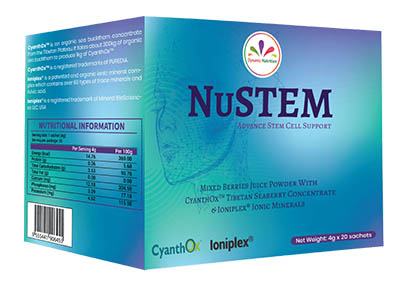
This is also why some daily-from-inside supplements pair an antioxidant-polyphenol source with an ionic-mineral source. The combination isn’t marketing; it’s a coverage of two of the three layers in one daily serving, leaving the third (the lifestyle layer: sleep, exercise, hydration) to the reader’s day-to-day routine. NuSTEM — a Nu-Prep Cellular Repair formulation — is one such pair: a CyanthOx™ sea-buckthorn proanthocyanidin concentrate for the polyphenol + stem-cell-release layer, paired with an Ioniplex® ionic fulvic mineral complex for the mitochondrial-metabolism + mineral-bioavailability layer.
How to read your own intrinsic-capacity score
The WHO’s framework was deliberately built to be self-assessable. You don’t need a clinic to start a useful baseline. A practical 5-minute weekly audit, run every 4-6 weeks, looks like this.
Locomotion — time a comfortable 4-metre walk at your normal pace (a corridor is enough); note any month-on-month drift. Note grip strength too if you have a cheap hand-grip dynamometer; clinicians increasingly use both as the cheapest functional markers of healthy-aging trajectory2.
Cognition — pick one repeatable task (a daily word puzzle, a 5-minute dual-task like talking while walking, a short recall task on a recent book chapter). Note trends, not single scores. Midlife cognitive trajectories matter more than peak performance3.
Sensory — annual hearing and vision checks. The Lancet Commission’s 2020 dementia-modifiable-risk-factor review lists hearing loss in midlife as the single largest modifiable risk factor for late-life cognitive decline, accounting for an estimated 8% of attributable risk4. Most hearing loss is gradual and goes unnoticed.
Psychological — a brief weekly mood + sleep + energy log. Two-week downward drift on any of the three is worth attention. Chronic low mood in midlife is a known risk multiplier on intrinsic-capacity decline and is one of the most-modifiable of the five domains with the right support.
Vitality — the subjective one. “Do I have the energy I expect to have, most days?” Note trends. Persistent low vitality — fatigue that doesn’t resolve with sleep — is the domain most worth a clinical workup because it has the broadest differential (thyroid, anaemia, sleep disorder, chronic inflammation, medication side effects, depression).
What the cellular layer underneath needs to keep up
The most useful framing of the WHO framework, for someone who already lives a reasonably healthy lifestyle, is this: the five domains are the scoreboard; the cellular-repair substrate is the engine. Optimising the scoreboard without supporting the engine produces the well-known pattern of a “healthy lifestyle” that doesn’t seem to translate into measurable outcomes. Optimising the engine — via stem-cell-release, mitochondrial-metabolism, and oxidative-stress-buffering support — makes every other lifestyle lever compound more effectively.
For a daily routine, the layering that tracks the published clinical evidence is straightforward. Sleep 7-8 hours with consistent timing (the night-time repair window is when most stem-cell release and growth-hormone-mediated tissue repair happens). Movement variety — at least one zone-2 cardio session, one strength session, and one mobility session per week (each hits different cellular-repair pathways). Nutrition — polyphenol-rich whole foods for the antioxidant layer; mineral-dense whole foods for the mitochondrial-cofactor layer; adequate protein for tissue-substrate availability. And a daily-from-inside cellular-support layer that covers what diet alone struggles to deliver at therapeutic doses — particularly the stem-cell-release and ionic-mineral-bioavailability endpoints that most diet patterns don’t hit consistently.
That last layer is where formulations like NuSTEM — a CyanthOx™ sea-buckthorn proanthocyanidin concentrate paired with Ioniplex® ionic fulvic minerals — sit. The CyanthOx™ ingredient is the one with a published clinical trial measuring the +40% circulating-stem-cell endpoint5. The Ioniplex® ingredient is the one with the patented ionic mineral bioavailability that the mitochondrial-metabolism layer depends on6. Together they cover two of the three cellular-repair substrate layers in one daily serving, leaving the lifestyle stack to do what it does best.
The honest limit of the framework
The WHO’s intrinsic-capacity framework is a measurement lens. It will tell you where you stand; it will not, by itself, change where you stand. The cellular-repair substrate is the lever; the framework is the scoreboard. Reading the scoreboard weekly without touching the lever produces a kind of low-grade anxiety — “I know I’m slipping, but I’m not sure what to do about it” — that the framework alone doesn’t resolve.
The upside is that the lever is well-mapped in the published clinical work. Stem-cell release, mitochondrial metabolism, oxidative-stress buffering — each has clinical evidence, each has a daily-from-inside support option, each compounds with the lifestyle stack rather than competing with it. For someone starting in midlife, the practical question isn’t whether to optimise the cellular-repair substrate; it’s which lever to pull first. The published clinical evidence is clearest at the stem-cell-release and ionic-mineral-bioavailability endpoints, which is where most of the daily-from-inside formulations in this space cluster.
Track the scoreboard, but support the engine. That’s the practical decode of the WHO’s intrinsic-capacity framework for the next decade of healthy aging.
References
1 CNA Lifestyle. “The most important longevity term you’ve probably never heard of.” 13 September 2026. https://cnalifestyle.channelnewsasia.com/wellness/intrinsic-capacity-longevity-measure-588596
2 Studenski S. et al. “Gait speed and survival in older adults.” JAMA. 2011;305(1):50-58. https://europepmc.org/article/MED/21205966
3 Livingston G. et al. “Dementia prevention, intervention, and care: 2020 report of the Lancet Commission.” The Lancet. 2020;396(10248):413-446. https://doi.org/10.1016/S0140-6736(20)30367-6
4 Livingston G. et al. “Dementia prevention, intervention, and care: 2020 report of the Lancet Commission.” The Lancet. 2020;396(10248):413-446. https://doi.org/10.1016/S0140-6736(20)30367-6
5 Drapeau C., Benson K.F., Jensen G.S. “Rapid and selective mobilization of specific stem cell types after consumption of a polyphenol-rich extract from sea buckthorn berries (Hippophae) in healthy human subjects.” Clinical Interventions in Aging. 2019;14:253-266. https://www.dovepress.com/rapid-and-selective-mobilization-of-specific-stem-cell-types-after-con-peer-reviewed-fulltext-article-CIA
6 “Ionic fulvic mineral supplementation and cellular repair markers.” Ioniplex clinical white paper. 2020. https://intelligenceofnature.com/cdn/shop/files/ION_White_Paper_Clinical_Trial.pdf
Product you may be interested in