If you read The Star‘s 19 September 2026 piece on vitamin D and dementia1, you may have walked away thinking the answer is a daily D3 tablet. That’s not wrong — the cohorts behind the headline do show a measurable signal between low vitamin D status and higher dementia risk — but the vitamin-D-as-single-nutrient-decode frame skips the layer underneath the nutrient. Dementia is not a single-nutrient problem. It is a cellular-repair-capacity problem in an aging brain where (a) hippocampal neurogenesis rate drops roughly five-fold between ages 30 and 70, (b) circulating endothelial progenitor cell counts fall by around 40% between ages 40 and 70, (c) the brain’s per-gram ATP demand is the highest of any organ in the body, and (d) chronic low-grade neuroinflammation drives the amyloid-β + tau tangle cascade. Vitamin D touches one of those four layers. The substrate layer beneath vitamin D — the actual cellular repair crews that traffic to damaged tissue — is what this article decodes for the MY/SG 50-plus reader who already takes their D3 but is asking the right question: what does the brain-repair machinery actually need to keep working into the 70s and 80s?

Why vitamin D is one layer, not the whole story
The meta-analysis behind The Star’s piece shows a real signal — a meaningful association between low vitamin D status and higher dementia risk in older cohorts. But the mechanism vitamin D actually supports is narrower than the headline implies: vitamin D is a modulator, not a builder. It (a) supports calcium homeostasis, (b) modulates neuroinflammation through microglial signalling, and (c) supports neurotrophic-factor signalling — specifically the BDNF–NTRK2 pathway that drives hippocampal neurogenesis. That third lever is the most interesting, because BDNF-driven neurogenesis depends on a substrate the headline leaves out: a pool of circulating stem cells that traffic to damaged neural tissue and contribute to repair. The vitamin D signal is real but it is one of several substrate levers, not the only one.
This is the gap most dementia-prevention coverage leaves wide open. The clinical question is not “should I take vitamin D” — the answer is yes for most MY/SG adults over 50, and the deficiency signal in the regional cohort data is real. The clinical question is: what does the cellular-repair substrate beneath vitamin D look like, and which of those layers is my regimen actually touching?
The substrate layer the vitamin-D story skips: circulating stem cells
The brain’s cellular-repair machinery depends on three substrates the vitamin-D story does not cover: the stem-cell pool (the circulating endothelial progenitor cells + mesenchymal stem cells + haematopoietic stem cells that traffic to damaged tissue), the mitochondrial energy supply (the brain uses ~20% of resting metabolic energy on only ~2% of body mass; per-gram ATP demand is the highest in the body), and the antioxidant-buffering layer that protects neurons from the oxidative damage that drives microglial over-activation. Vitamin D modulates neuroinflammation — useful — but the stem-cell pool and the mitochondrial-energy layer are separate substrates that have to be supported independently.
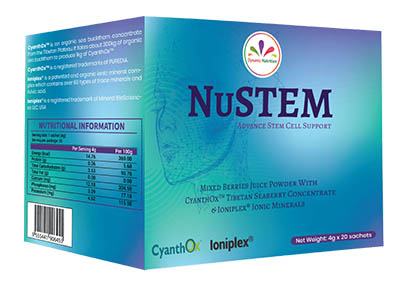
The most clinically-tested substrate for the stem-cell layer is a Tibetan Sea Buckthorn proanthocyanidin concentrate (300kg of berries to 1kg of concentrate, standardised on proanthocyanidins + bioflavonoids + polyphenols, ORAC value 895,281 µmol TE per 100g — roughly 8x grape seed extract, 1.7x French maritime pine bark). The Drapeau et al. 2019 clinical study published in Clinical Interventions in Aging2 documented an approximately 40% increase in circulating stem cells after supplementation with this extract, with stimulation of three distinct stem-cell types relevant to anti-aging, anti-inflammation, skin health, vessel health, and blood circulation: endothelial progenitor cells, mesenchymal stem cells, and haematopoietic stem cells.
That 40% figure is the end-point the vitamin-D story does not have. A higher circulating stem-cell count correlates with lower incidence of degenerative problems in cohort data, and the brain-repair machinery specifically needs the endothelial progenitor cell subset — the cells that repair cerebral microvascular damage. This is the layer beneath vitamin D.
Why the WHO “intrinsic capacity” frame matters here
The WHO published the “intrinsic capacity” framework in 2019 as part of the Decade of Healthy Ageing 2021–20303. Intrinsic capacity is the composite measure across five domains: cognitive, locomotor, sensory, psychological, and vitality. The cognitive domain — the one most associated with Alzheimer’s risk — depends on hippocampal neurogenesis, cerebral microvascular integrity, neuronal mitochondrial energy supply, and low neuroinflammation. All four are substrate-dependent, not just vitamin-D-dependent.
This is the frame The Star’s piece implicitly invokes but does not name. The dementia-prevention conversation has moved from “which single nutrient” to “which substrate stack supports the cognitive intrinsic-capacity domain”. The consumer supplement market has heavily covered vitality (energy + mitochondria) and locomotor (joint + bone + muscle) but has largely left the cellular-repair machinery that supports the cognitive domain underdeveloped. The substrate stack is: (a) vitamin D (the modulator), (b) the stem-cell layer (the circulating endothelial progenitor + mesenchymal + haematopoietic pool — the cells that traffic to damaged tissue), (c) the mitochondrial-energy layer (the per-gram ATP supply that makes cognition rate-limiting), and (d) the antioxidant-buffering layer (the high-ORAC substrate that buffers the oxidative damage driving microglial over-activation).
World Alzheimer’s Day, 21 September: what the substrate stack looks like
World Alzheimer’s Day 2026 lands tomorrow. Alzheimer’s Disease International’s 2026 World Alzheimer Report estimates approximately 55 million people live with dementia globally, projected to reach roughly 139 million by 2050. The WHO Decade of Healthy Ageing explicitly calls out cognitive intrinsic capacity as the modifiable-risk domain where the prevention leverage is highest. The leverage is highest there because the four substrate layers — stem-cell pool, mitochondrial energy, antioxidant buffering, neuroinflammation modulation — are all addressable through targeted daily substrate support.
For the MY/SG 50-plus reader who already takes vitamin D for bone health but isn’t seeing the dementia-prevention narrative extend beyond nutrient substitution, the substrate stack the WHO cognitive intrinsic-capacity domain actually requires is: a clinically-tested proanthocyanidin concentrate at the dose used in published stem-cell work (the Drapeau 2019 dose is the reference dose), a patented ionic-mineral complex that supports mitochondrial metabolism (the brain’s per-gram ATP demand makes this layer rate-limiting), and continued vitamin D for the neuroinflammation-modulation layer. The order matters less than the completeness — covering one of the four substrates without the others reproduces the single-nutrient-decode gap The Star’s piece implicitly highlights.
What to look for in a substrate stack (and what to skip)
For the stem-cell layer: clinically-tested proanthocyanidin concentrate with a published stem-cell-count end-point (the 300kg-to-1kg concentration ratio is the marker of a clinical-grade extract, not a generic sea-buckthorn powder). For the mitochondrial-energy layer: a patented ionic-mineral complex with clinical evidence on mitochondrial-metabolism biomarkers, not just generic trace minerals. For the antioxidant-buffering layer: a high-ORAC extract with documented ORAC value, not a generic antioxidant blend that mixes vitamin C + vitamin E + CoQ10 + glutathione at sub-clinical doses. For the vitamin-D layer: continued daily D3 with K2 for calcium-traffic routing, at the dose your blood test supports.
Skip any “stem cell pill” without a clinical citation, any “longevity complex” without a published end-point, any “antioxidant blend” without an ORAC figure, and any “ionic mineral” without a patented-mineral provenance. The substrate gap is real — the WHO cognitive intrinsic-capacity frame is real — but the consumer market has not yet caught up to the four-layer model. Your regimen is the place to bridge that gap, starting tomorrow.
References
- The Star (Malaysia) — “Vitamin D could help delay dementia” (19 September 2026) — https://www.thestar.com.my/lifestyle/health/2026/09/19/vitamin-d-could-help-delay-dementia
- Drapeau C, Benson KF, Jensen GS (2019), Clinical Interventions in Aging — “Rapid and selective mobilization of specific stem cell types after consumption of a polyphenol-rich extract from sea buckthorn berries (Hippophae)” — https://www.dovepress.com/rapid-and-selective-mobilization-of-specific-stem-cell-types-after-con-peer-reviewed-fulltext-article-CIA
- World Health Organization (2019), Integrated Care for Older People (ICOPE) — “Intrinsic capacity” — https://www.who.int/teams/maternal-newborn-child-adolescent-health-and-ageing/ageing-and-health/integrated-care-for-older-people-icope
Related Topics
The longevity term nobody’s measuring — but your 60s will thank you for tracking
Healthspan is the new longevity goal: 5 daily habits that protect bones as you age
3 Keys to Anti-Aging – CyanthOx™
How Stem Cells Can Repair Our Body
Using Stem Cells To Reverse Aging?
NuSTEM – A Vegan Approach To Stem Cell Support
Product you may be interested in