If you’ve caught the healthspan conversation this year, you’ve probably noticed it shifting away from “live longer” and toward “live better for longer”. The recent Amway Healthspan Summit coverage in The Star1 made the same point: the goal is no longer about adding years to a life where the last decade is spent managing falls, fractures and slow-healing bones — it is about protecting the musculoskeletal frame that lets you keep doing the things you care about well into your 70s and 80s. Bones are the part of that frame most people stop thinking about until something goes wrong, which is exactly the wrong time to start.
Peak bone mass is built roughly between the late teens and the early 30s. After about age 35, bone density starts to drift downward — slowly for most, faster for women in the first few years after menopause, and faster still for anyone whose diet, training or sleep has been consistently under-supportive. The good news from the healthspan literature is that the rate of loss is far more modifiable than most people assume. The five habits below are the ones that consistently appear in the strongest evidence, including the bone-density, fall-prevention and protein-intake studies that have shaped the current guidance for older adults.
1. Treat resistance training as a non-negotiable, not a nice-to-have
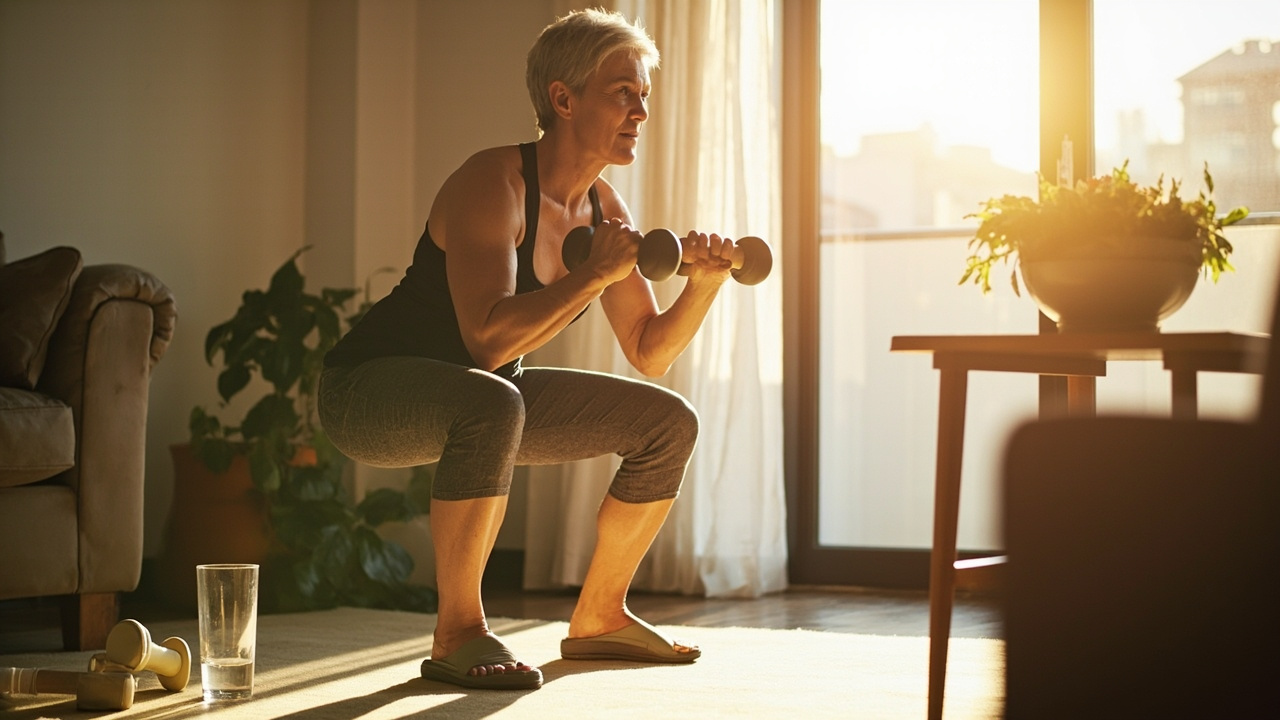
If you do one thing for your bones after reading this article, make it this. Resistance training — lifting weights, doing bodyweight squats, lunges, push-ups, rows, step-ups, even heavy gardening — is the single most consistently supported stimulus for keeping bone density up in the post-40 years. Bones respond to mechanical load the way muscles do: use them or lose them. A 2018 meta-analysis in the Journal of Bone and Mineral Research found that progressive resistance training improved femoral neck bone mineral density in postmenopausal women by roughly 1 to 2 percent over 12 months — small in absolute terms, but enough to shift fracture risk meaningfully over a decade.
The practical version: two to three sessions a week of 30 to 45 minutes, hitting the major muscle groups (legs, back, chest, hips, shoulders, core), with weight or resistance heavy enough that the last 3 to 5 reps of a set feel genuinely challenging. Walking alone is good for the cardiovascular system and for mood, but it does not load the skeleton enough to drive bone adaptation. You need impact or load — the kind your skeleton has to actually brace against.
How much is enough?
Most of the positive studies use loads in the 60 to 85 percent of one-rep-max range, or bodyweight movements done close to fatigue. You don’t need a gym membership to start — a pair of adjustable dumbbells, a backpack full of books, and a sturdy chair are enough for the first six months. The point is consistent mechanical challenge, not heroic training sessions.
2. Anchor your daily calcium to food first, supplements second
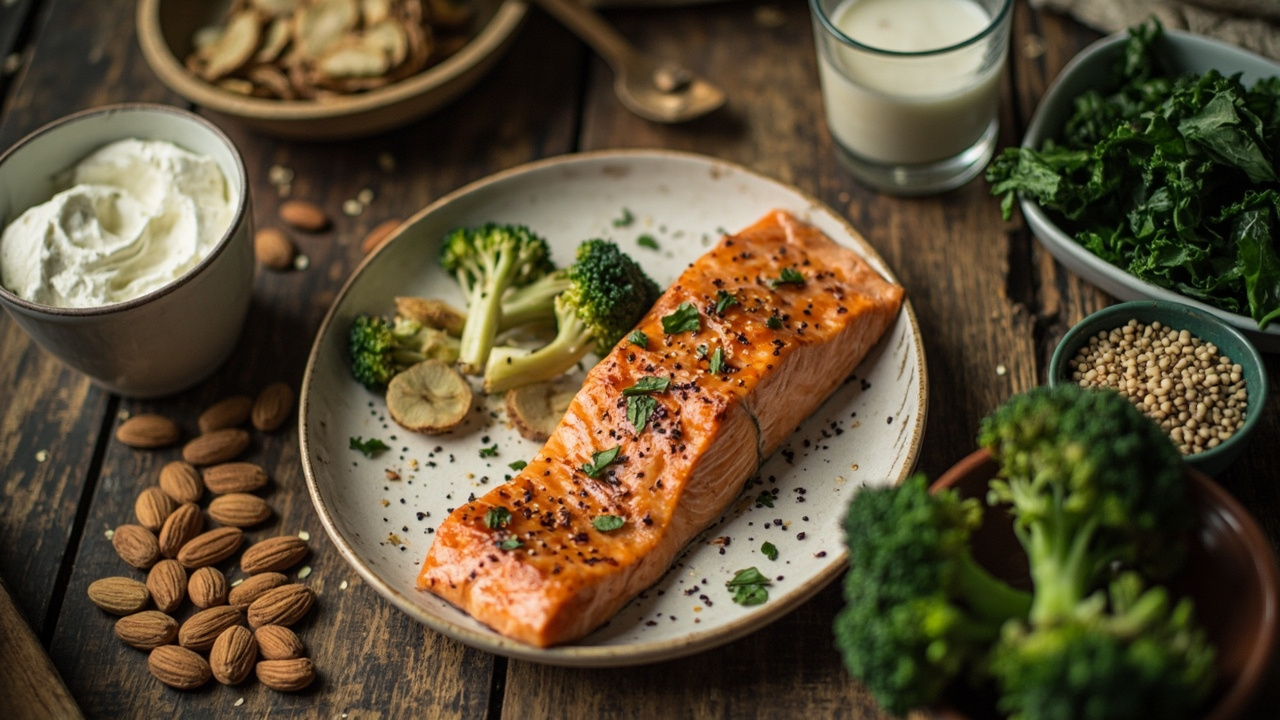
Calcium is not a deficiency most adults need to “fix” with a pill — it’s a daily intake number most adults fail to hit consistently. The current guidance for adults over 50 is roughly 1,200 mg per day from food and supplements combined, with an emphasis on dietary sources because they come packaged with the protein, vitamin D, magnesium and other cofactors bones need to actually use the calcium you take in. A cup of milk has about 300 mg; a serving of tinned sardines with bones about 350; a cup of cooked kale about 90; a cup of fortified plant milk about 300 to 400. Adding these across a normal day gets most people to the recommended intake without a pill.
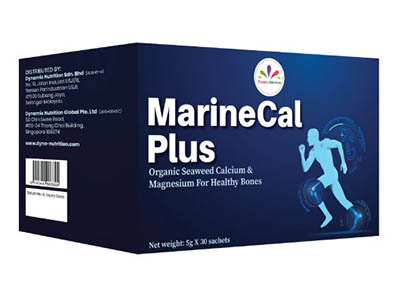
When diet alone doesn’t close the gap, the form of calcium matters more than the brand name. Calcium carbonate is the cheapest and most concentrated form but requires stomach acid to absorb — take it with food. Calcium citrate absorbs well on an empty stomach and is gentler on people who take acid-suppressing medication. Whole-food sources of calcium — like the Aquamin™ marine seaweed calcium used in some premium formulations — provide the mineral in a matrix with trace cofactors (magnesium, silica, trace minerals) that some researchers argue supports absorption and tolerability, though the head-to-head evidence in healthy adults is still developing. Marine-source calcium is also a useful option for vegans and people who don’t tolerate dairy well.
Spread it across the day
The body absorbs calcium most efficiently in doses of 500 mg or less at a time. Taking 1,200 mg in one sitting wastes much of the dose. Two or three smaller servings across the day — a calcium-rich food at each, plus a smaller supplement if needed — work better than one mega-dose.
3. Don’t forget the cofactors: vitamin D, magnesium, protein
Calcium without vitamin D is like filling a bathtub with the drain open. Vitamin D drives the absorption of calcium from the gut, regulates its deposition into bone, and supports the muscle strength that prevents falls in the first place. Most adults in temperate climates — and pretty much everyone in tropical urban environments who spends workdays indoors — have sub-optimal vitamin D status. The practical fix: a daily supplement of 1,000 to 2,000 IU of D3 for most adults, higher if a blood test shows deficiency. Get a 25-hydroxyvitamin D test once a year if you can; aim for a level in the 30 to 50 ng/mL range.
Magnesium is the second most-abundant mineral in bone after calcium, and it is also routinely under-consumed. Adult requirements are around 320 mg per day for women and 420 mg per day for men — easily hit with a diet that includes nuts, seeds, dark chocolate, legumes and whole grains. Magnesium glycinate is the gentlest supplemental form for people who notice loose stools from magnesium citrate or oxide.
Protein is the third leg of the stool and the one most bone-health articles under-emphasise. Bones are roughly 50 percent protein by volume; the collagen matrix that holds the mineral crystals needs ongoing amino-acid supply to be maintained. Older adults need more protein than the old “0.8 g per kg” guideline suggested — current evidence supports 1.0 to 1.2 g per kg of body weight per day, going up to 1.2 to 1.6 g per kg during illness or recovery. Spread across meals rather than loaded into one.
4. Train your balance and your reflexes
Bone density matters, but most fractures in older adults don’t happen because the bone failed under normal load — they happen because a fall happened. The strongest predictor of a hip fracture in an 80-year-old is not their DEXA score; it is whether they have fallen in the past year. Balance work is unglamorous and rarely makes it into a fitness routine, but the evidence for fall reduction is unusually strong: programmes that include balance, gait and strength training reduce falls in community-dwelling older adults by roughly 24 percent, according to a 2019 Cochrane review of 59 trials.
The minimum effective dose: a few minutes a day of single-leg standing (hold a chair for safety, work up to 30 seconds unsupported on each side), heel-to-toe walking along a counter, gentle tai chi or yoga, and standing up from a chair without using your hands. None of these take long, none require a gym, and they add up. Combining balance work with the resistance training from habit 1 is the highest-leverage pair.
5. Screen early and screen on schedule
Osteoporosis is silent until it isn’t. Most people who get a fracture from a minor fall had no idea their bone density was already in the osteopenic range, because no one had ever measured it. The current guidance from most bone-health societies is for women to have a baseline DEXA scan at age 65 (or earlier if they have additional risk factors — early menopause, family history of hip fracture, low body weight, long-term corticosteroid use, certain medical conditions), and for men to discuss screening with their doctor from about age 70.
Screening only matters if it leads to action. A low DEXA score is information, not a verdict: it tells you that habits 1 to 4 above are now non-negotiable, and it gives your doctor a baseline for any future treatment decision. If your result comes back in the osteopenic range (T-score between -1.0 and -2.5), it is a useful early warning — not a reason to panic, and not a reason to ignore.
Putting it all together — the daily bone-health framework
Five habits, none of them complicated, all of them supported by the same evidence base the healthspan conversation keeps pointing at:
Resistance training two to three times a week, with load that challenges the last few reps of a set. Calcium-rich food at every meal (or a well-chosen supplement if diet can’t close the gap), spread across the day in 500-mg-or-smaller doses. Vitamin D daily, plus adequate magnesium and 1.0 to 1.6 g of protein per kg of body weight. Balance work every day, even if it’s just two minutes. Screening on schedule, with a baseline DEXA by 65 for women and a conversation with the doctor by 70 for men.
None of these are a substitute for medical care if you already have osteoporosis or have had a low-trauma fracture. But if you’re one of the many adults in your 40s, 50s or 60s who has been treating bones as something the body will just keep maintaining on its own — that is the assumption the healthspan literature is asking you to update. The frame you stand on for the next forty years is being remodelled right now, with whatever you put on the plate and whatever you ask it to carry.
References
- The Star. More years, better years: Why the Amway Healthspan Summit is putting healthspan first. https://www.thestar.com.my/starpicks/2026/09/04/more-years-better-years-why-the-amway-healthspan-summit-is-putting-healthspan-first
Related Topics
Stop Swallowing Rocks: Why Seaweed Calcium Is Much Better
Silica – The Crucial Ingredient For Stronger Bones, Hair and Nails
The Problem With Taking Too Much Calcium Carbonate
5 Ways To Keep Our Bones Healthy As We Age
Alkaline-Forming Food For Bone Health
Aquamin seaweed calcium: how a multi-substrate bone-density stack differs from a calcium-only pill
Nutrition For Elderly People: A Complete Guide To Healthy Aging
Product you may be interested in