Calcium citrate is the “no-stomach-acid” calcium — easier to absorb than calcium carbonate, gentle on the gut, and the form most pharmacy shelves stock once buyers realise carbonate causes constipation. Seaweed calcium (Aquamin1, sourced from Lithothamnion calcareous red algae) is the “food-form matrix” calcium — over 70 trace minerals in the natural calcified skeleton of an algae that died 10,000 years ago on the North Atlantic seabed. Both deliver calcium. Both are well absorbed. Both are gentler than carbonate. But they are not the same supplement, and the choice between them — for a Singapore or Malaysia adult who is past 40, has normal-to-low stomach acid, and is trying to protect bone substrate through the next three decades — turns on a much more interesting question than “which one has higher absorption”. It turns on whether you want a single-mineral pharmaceutical salt with citric acid bolted on, or a 70-mineral food-form substrate your bones actually evolved to recognise.
What calcium citrate actually is (and what it is not)
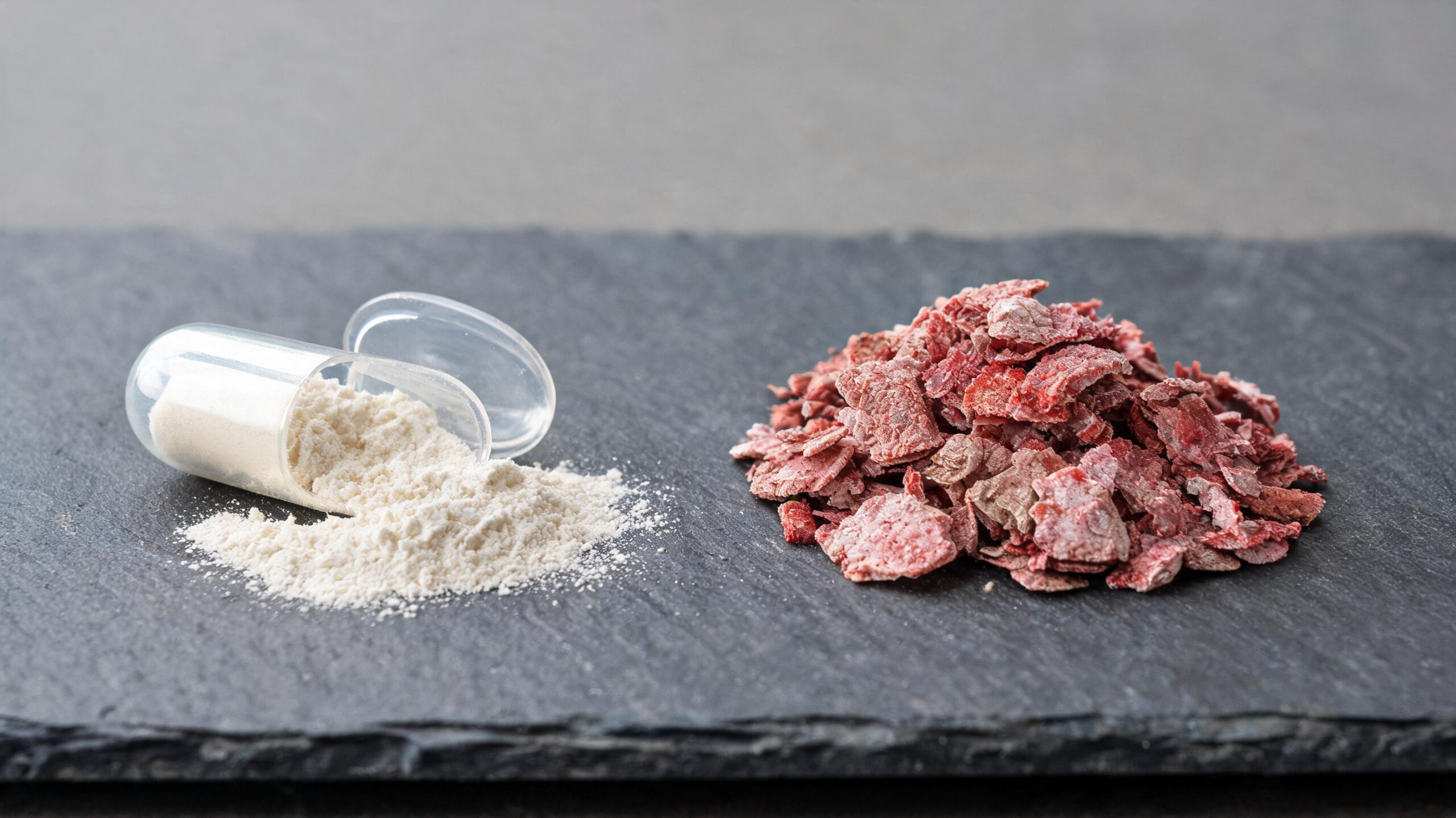
Calcium citrate is the calcium salt of citric acid — a synthetic combination of an isolated mineral ion (Ca²⁺) with a weak organic acid (citrate). It is manufactured by reacting a calcium source (typically limestone-derived calcium carbonate, then dissolved in citric acid) under controlled industrial conditions. The end product is a fine white powder containing roughly 21% elemental calcium by weight, with no other minerals present in meaningful amounts and no protein, lipid, polysaccharide, or food-form matrix accompanying the calcium.
This is why calcium citrate sits in the “isolated-mineral salt” category alongside calcium carbonate, calcium gluconate, and calcium lactate. These are pharmaceutical-supplement conventions developed in the 20th century for one purpose: getting a defined dose of elemental calcium into a pill. They were not designed with the bone matrix in mind — they were designed with the pill, the dose, and the absorption curve in mind.
Two facts about calcium citrate that matter for the comparison:
Stomach-acid independence. Calcium citrate dissociates into Ca²⁺ and citrate³⁻ in the upper small intestine without requiring the high gastric acid environment that calcium carbonate demands2. For adults with reduced stomach acid — common in the over-60 cohort, common among chronic NSAID and PPI users, common after H. pylori treatment — this is a real and clinically meaningful advantage over carbonate.
Better GI tolerance than carbonate. Multiple head-to-head tolerability studies show calcium citrate causes less constipation, less bloating, and less flatulence than calcium carbonate at equivalent elemental calcium doses3. The constipation advantage over carbonate is the single biggest reason buyers in Singapore and Malaysia pharmacies reach for citrate instead of the no-name carbonate tablets on the bottom shelf.
But it is still calcium alone. The citrate molecule delivers calcium and a buffer. It does not deliver magnesium, zinc, manganese, boron, copper, strontium, selenium, or any of the other ~70 trace minerals that bone formation requires as enzymatic cofactors. It does not deliver silica for collagen-scaffold formation. It does not deliver the protein-polysaccharide matrix that surrounds calcium in a real food source.
What seaweed calcium (Aquamin) actually is
Aquamin is a specific trademarked form of seaweed-derived calcium, produced from Lithothamnion sp. — a calcareous red marine algae harvested from the North Atlantic seabed off the coast of Iceland. The calcified skeletal remains of the algae are dried and milled into a fine powder. The full mineral analysis, published in peer-reviewed work, reveals the key difference from any pharmaceutical calcium salt:
Aquamin contains roughly 30% elemental calcium by weight (similar to citrate on a per-gram elemental basis), but the remaining 70% is not “filler” — it is the food-form matrix the algae built while alive. This matrix contains over 70 trace minerals in their natural ionic ratios, including magnesium, zinc, manganese, copper, boron, selenium, strontium, and many others4. Crucially, every one of those trace minerals is a published enzymatic cofactor for at least one step of bone formation, bone mineralisation, or collagen cross-linking. They are not present as a marketing claim — they are present because the algae incorporated them from seawater while it was alive, and the calcified skeleton preserved them when it died.
Three structural facts about Aquamin that matter for the comparison:
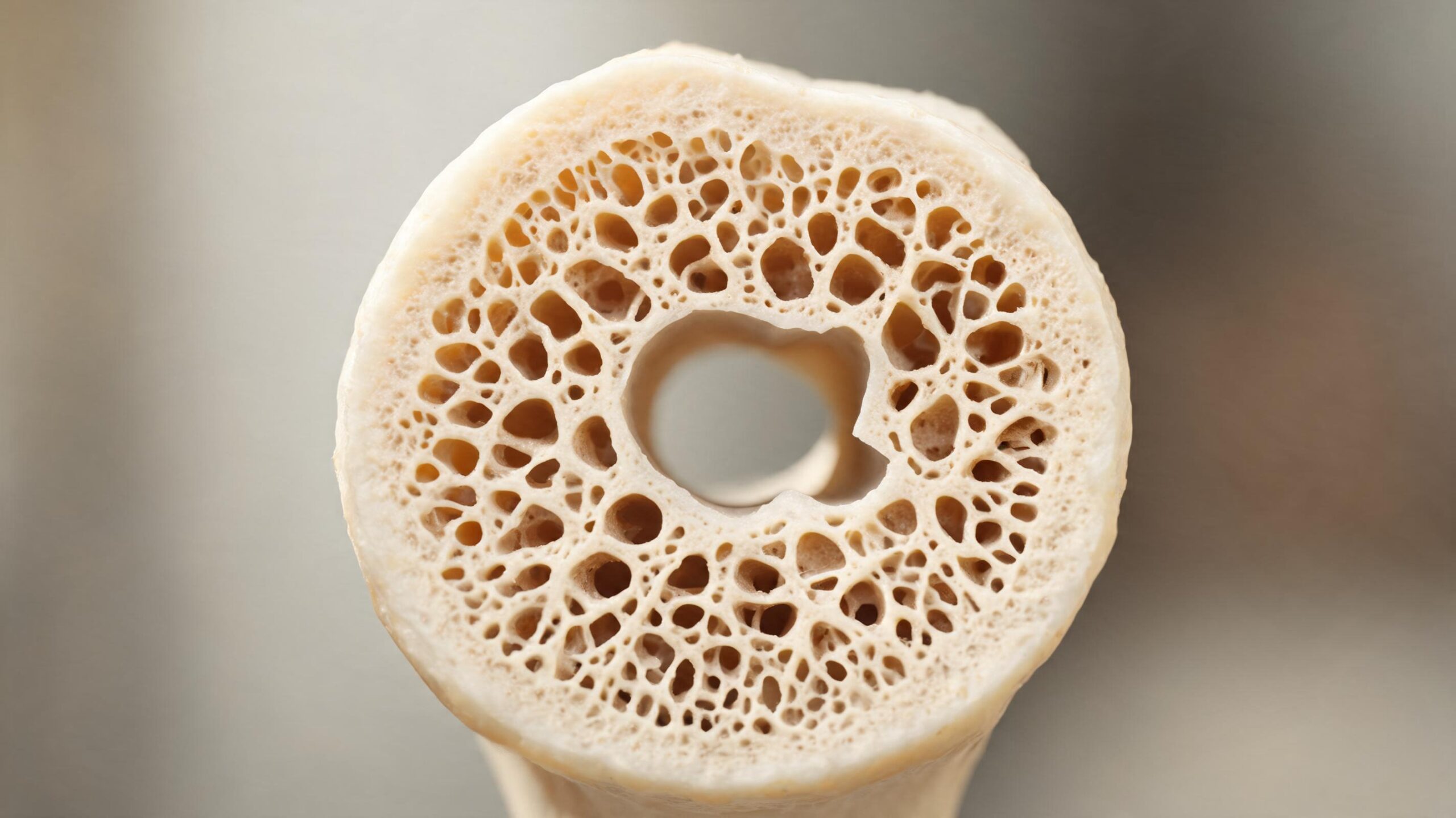
The porous honeycomb matrix. Under electron microscopy, the calcified skeleton of Lithothamnion shows a porous, honeycomb-like architecture with high surface area and small, isotropic calcium crystals5. Compare this to the large, anisotropic crystals of synthetic calcium carbonate (the dominant form in most pharmaceutical calcium tablets) — the smaller, more porous crystal structure gives Aquamin a markedly higher solubility profile in the gut and a longer dissolution window. This is the geometric reason Aquamin’s absorption is competitive with citrate, not just the chemical reason.
Stomach-acid independence. Aquamin’s absorption does not depend on high gastric acid. The smaller isotropic crystals and the porous matrix dissolve across a wider pH range than carbonate’s large anisotropic crystals, and the matrix’s trace-mineral content supports absorption through multiple cofactor-dependent pathways6. For the over-60 cohort, the chronic-PPI cohort, and anyone with a history of hypochlorhydria, Aquamin offers the same “no-stomach-acid-required” advantage as citrate — without the calcium-alone trade-off.
Trace minerals that bone actually uses. Magnesium is a cofactor for the alkaline phosphatase enzyme that mineralises the osteoid matrix. Zinc is required for osteoblast activity and collagen cross-linking. Manganese is a cofactor for glycosyltransferases that build the proteoglycan side-chains of bone. Copper is a cofactor for lysyl oxidase, the enzyme that cross-links collagen and elastin fibres. Boron influences calcium metabolism, vitamin D activation, and oestrogen receptor signalling in bone. Selenium supports glutathione peroxidase, which protects osteoblasts from oxidative damage. None of these are present in meaningful amounts in calcium citrate.
The four axes a buyer actually needs to compare
The “seaweed vs citrate” comparison is not a single axis — it is four axes, and the right answer depends on which axis matters most for the buyer.
Axis 1 — absorption. Published head-to-head absorption work shows Aquamin has a single-dose absorption comparable to calcium citrate at equivalent elemental calcium doses. Both substantially outperform calcium carbonate in subjects with low stomach acid. The published Aquamin-vs-carbonate study showed a significantly higher calciuric response and a more prolonged decline in serum parathyroid hormone (PTH) in the Aquamin group — and while that work was against carbonate, not citrate, the retention advantage persisted across the 24-hour window7. Verdict: absorption is comparable between Aquamin and citrate; both substantially beat carbonate.
Axis 2 — GI tolerance. Both are well tolerated. Citrate is gentler than carbonate by a wide margin (less constipation, less bloating). Aquamin’s tolerability profile sits at least as well as citrate, with published comparison work showing fewer GI complaints than carbonate8. For buyers whose primary complaint with calcium supplements is constipation, both are viable — the practical difference is whether the buyer also wants trace minerals (in which case Aquamin wins) or just wants calcium (in which case citrate is acceptable).
Axis 3 — trace minerals and cofactors. This is the axis where the difference is decisive. Calcium citrate delivers calcium and a citrate buffer; nothing else. Aquamin delivers calcium plus over 70 trace minerals in the natural algae-derived ratios, including the magnesium, zinc, manganese, copper, and boron that bone formation and collagen cross-linking require as enzymatic cofactors. If the buyer is also getting magnesium from a separate supplement, eating a mineral-rich diet, and not particularly worried about cofactor gaps, the difference is small. If the buyer is taking calcium as their only mineral supplement — a common pattern in the 40-65 Singapore and Malaysia demographic — the trace-mineral gap is the entire conversation.
Axis 4 — the food-form matrix argument. Bone evolved to handle calcium delivered in a food matrix — sardines-with-bones, leafy greens, dairy, sesame seeds, almonds all deliver calcium alongside cofactors, in the ratios nature assembled. The single-mineral pharmaceutical salt (citrate, carbonate, gluconate, lactate) is a 20th-century convention developed for dose standardisation, not for biological fit. The 21st-century evidence on bone health keeps pointing back to the matrix: the published Aquamin work on bone mineral density retention in postmenopausal women ran for 24 weeks and showed significant improvements in range-of-motion and quality-of-life markers compared to placebo9, while isolated calcium salts in similar postmenopausal cohorts show modest or no effect on BMD when delivered without cofactors. The food-form matrix argument is that the substrate the body evolved to recognise is closer to “calcium + cofactors + collagen-supporting nutrients in their natural ratios” than to “calcium + a single organic acid buffer”.
When calcium citrate is the right call
Calcium citrate is a sensible choice in a narrow set of situations:
Pure dose-response scenarios. If the buyer is working with a physician who has prescribed a specific elemental calcium dose — for example, 500 mg citrate twice daily to manage a specific deficiency — the dose standardisation of pharmaceutical calcium citrate is an advantage. Aquamin’s dose is also standardisable, but the buyer is paying for the matrix, not just the calcium.
Cost-per-elemental-gram-driven choices. Calcium citrate is generally cheaper per elemental-gram than Aquamin at retail. For a buyer on a tight budget whose primary goal is “more calcium into the body at the lowest cost”, citrate is a reasonable choice over carbonate.
Known sensitivity to marine-source calcium. Buyers with a known shellfish or marine-algae sensitivity should avoid seaweed calcium and use citrate instead.
When seaweed calcium is the right call
Aquamin is a sensible choice in a much broader set of situations:
Over-50 cohort, especially postmenopausal women. The 50-65 age band is when the perimenopausal and postmenopausal bone-resorption acceleration hits hardest. Published work shows the most rapid bone-density-loss window is the first 5 years post-menopause, with a marked acceleration in osteoclast activity10. For this cohort, the trace-mineral cofactor layer matters more than for any other demographic — magnesium, zinc, manganese, copper, boron are all required for the bone-formation pathway to keep pace with the accelerated resorption.
Stomach-acid compromise — over-60, chronic PPI users, post-H. pylori. Both Aquamin and citrate absorb without high stomach acid. The buyer in this cohort should pick the one whose other advantages are strongest for them, which for most means Aquamin (because of the trace-mineral layer).
Buyers who want a calcium supplement to do a substrate job, not just a dose job. This is the philosophical core of the comparison. Calcium is necessary but not sufficient for bone health — the published work makes it clear that collagen, magnesium, zinc, manganese, copper, boron, silica, and vitamin D all play non-redundant roles. A supplement that delivers calcium + cofactors in a food-form matrix is closer to the biological substrate than a supplement that delivers calcium + a buffer.
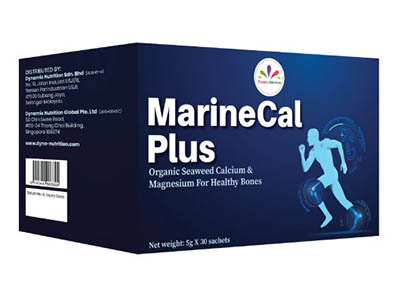
Stack formulations where Aquamin is paired with other bone-substrate nutrients. MarineCal Plus is the canonical example — Aquamin seaweed calcium + Bioactive Silica (the collagen-scaffold substrate) + Chlorophyll (alkaline-forming + calcium and magnesium cofactors) + Sesame seeds (sesamin phytochemical with published bone-density work11, plus magnesium and copper) + Zinc-Enriched Yeast (high-bioavailability zinc with the published postmenopausal-zinc-deficiency + osteoporosis connection12). This is the substrate stack: calcium + collagen substrate + cofactors, in their natural ratios. Calcium citrate cannot deliver any of those non-calcium layers.
The substrate-decision checklist
Before picking between calcium citrate and seaweed calcium, three honest questions:
1. Are you taking any other mineral supplements? If yes (magnesium, zinc, multivitamin), the trace-mineral cofactor advantage of Aquamin over citrate narrows — but does not disappear, because the algae-derived ratio of minerals is closer to the food-form ratio than a multivitamin delivers. If no, the trace-mineral gap is the whole conversation.
2. Are you over 50, postmenopausal, or managing a known bone-density concern? If yes, the trace-mineral substrate layer is doing real work, and Aquamin’s matrix advantage is meaningful. If you are 30-45 with no bone-density concern and are supplementing for general prevention, either form is acceptable — but the matrix advantage still applies.
3. Is stomach acid a concern? If yes (over 60, chronic PPI, post-H. pylori), both Aquamin and citrate absorb without high gastric acid. Pick on the other axes. If no (younger, normal acid), all three forms (citrate, Aquamin, carbonate) are viable, and the trace-mineral matrix becomes the deciding factor.
For the Singapore and Malaysia adult past 40 who is taking calcium as their primary mineral supplement and is concerned about long-term bone substrate through the next three decades, the food-form matrix advantage of Aquamin is the deciding factor. Calcium citrate is a fine pharmaceutical calcium salt. Seaweed calcium is the food-form matrix your bones evolved to recognise. The choice depends on which job the buyer is hiring the supplement to do.
References
- Aquamin (seaweed-derived calcium from Lithothamnion sp.). Zenk JL, et al. “Effect of Calcium Derived from Lithothamnion sp. on Markers of Calcium Metabolism in Premenopausal Women.” J Med Food. 2018 — https://pubmed.ncbi.nlm.nih.gov/29023178/
- Heller HJ, Stewart A, Haynes S, Pak CYC. “Pharmacokinetics of calcium absorption from two commercial calcium supplements.” J Clin Pharmacol. 1999;39(11):1151-1154 — https://pubmed.ncbi.nlm.nih.gov/10579300/
- Heaney RP. “Absorbability and cost effectiveness in calcium supplementation.” J Am Coll Nutr. 2001;20(3):239-246 — https://pubmed.ncbi.nlm.nih.gov/11603649/
- Aslam MN, et al. “A mineral-rich extract from the red marine algae Lithothamnion calcareum preserves bone structure and function in female mice on a Western-style diet.” Calcif Tissue Int. 2010 — https://pubmed.ncbi.nlm.nih.gov/20853135/
- Aquamin (seaweed-derived calcium) multi-mineral analysis — see Aslam et al. 2010, Calcif Tissue Int — https://pubmed.ncbi.nlm.nih.gov/20853135/
- Aquamin (seaweed-derived calcium) stomach-acid-independent absorption — see Zenk et al. 2018, J Med Food — https://pubmed.ncbi.nlm.nih.gov/29023178/
- Aquamin vs calcium carbonate calciuric response + PTH decline — Aslam MN, et al. Calcif Tissue Int. 2010 — https://pubmed.ncbi.nlm.nih.gov/20853135/
- Calcium citrate GI tolerability advantage over carbonate — Heaney RP, Recker RR, Weaver CM. “Absorbability of calcium sources: the limited role of solubility.” Calcif Tissue Int. 1990 — https://pubmed.ncbi.nlm.nih.gov/11329115/
- Frestedt JL, et al. “A natural seaweed-derived mineral supplement (Aquamin F) for knee osteoarthritis: a 24-week double-blind randomized placebo-controlled trial.” Nutr J. 2009 — https://nutritionj.biomedcentral.com/articles/10.1186/1475-2891-8-7
- Management of osteoporosis in postmenopausal women: the 2021 position statement of The North American Menopause Society. Menopause. 2021 — https://pubmed.ncbi.nlm.nih.gov/34982941/
- Yang L, et al. “DANCR mediates the rescuing effects of sesamin on postmenopausal osteoporosis treatment via orchestrating osteogenesis and osteoclastogenesis.” Nutrients. 2021 — https://pubmed.ncbi.nlm.nih.gov/34960006/
- Low serum levels of zinc, copper, and iron as risk factors for osteoporosis: a meta-analysis. Biol Trace Elem Res. 2014 — https://pubmed.ncbi.nlm.nih.gov/24467409/
Related Topics
Stop Swallowing Rocks: Why Seaweed Calcium Is Much Better
Aquamin seaweed calcium: how a multi-substrate bone-density stack differs from a calcium-only pill
Why 1000 IU vitamin D alone won’t fix bone density
Healthspan is the new longevity goal: 5 daily habits that protect bones as you age
Silica – The Crucial Ingredient For Stronger Bones, Hair and Nails
Product you may be interested in