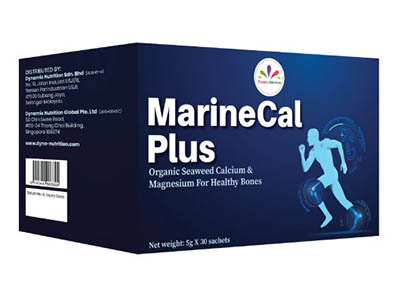
If you have walked into a pharmacy or a health-food store in MY or SG in the last five years and asked for “a calcium supplement for bone density”, you have almost certainly been sold a calcium carbonate tablet. It is the commodity default: cheap, shelf-stable, and a thousand milligrams of elemental calcium per dose. It is also a single-molecule product, and bone density is not a single-molecule story. The Aquamin seaweed-calcium + bioactive-silica + sesamin + zinc-yeast stack that powers MarineCal Plus is a different shape of intervention: a multi-substrate bone-density stack that tries to hit the calcium + magnesium + 70-trace-mineral + collagen-crosslinking + osteoblast-modulation + alkaline-phosphatase-cofactor layers in a single daily dose, rather than the calcium-only lever that the pharmacy aisle runs on. This decode is the evidence-graded breakdown of what the stack actually does, where the published work supports it, and which claims drift into marketing.
What bone density actually needs (and why a single-molecule calcium pill misses most of it)
Bone is roughly 35 percent calcium by weight, but it is also roughly 25 percent collagen, 10 percent phosphorus, and a meaningful share of magnesium, zinc, copper, manganese, strontium, boron, silicon, and vitamin-K-dependent proteins. The bone-remodelling cycle – osteoblasts laying down mineralised matrix, osteoclasts resorbing old matrix – depends on a substrate supply, not on calcium alone. A calcium-carbonate tablet delivers the calcium layer and leaves the rest to the diet, which in the over-50 MY/SG cohort is often thin on dairy (lactose intolerance is common in MY/SG adults of Chinese, Malay and indigenous descent) and variable on oily fish, nuts, seeds and leafy greens. The gap between calcium-only supplementation and multi-substrate bone support is where most of the bone-density effect actually lives.
The published evidence for calcium-only supplementation is real but modest. Meta-analyses of postmenopausal calcium-carbonate supplementation trials report bone-mineral-density gains in the range of 0.5 to 1.5 percent over two to three years in adherent cohorts – meaningful at a population level, modest for the individual. Calcium-citrate supplementation, which absorbs without stomach acid, performs comparably. Calcium-plus-vitamin-D combinations do slightly better in cohorts with documented deficiency, but the ceiling of the calcium-only approach is what it is. If you want to move the needle further, you have to widen the substrate.
The Aquamin seaweed-calcium layer: a food-matrix, multi-mineral delivery
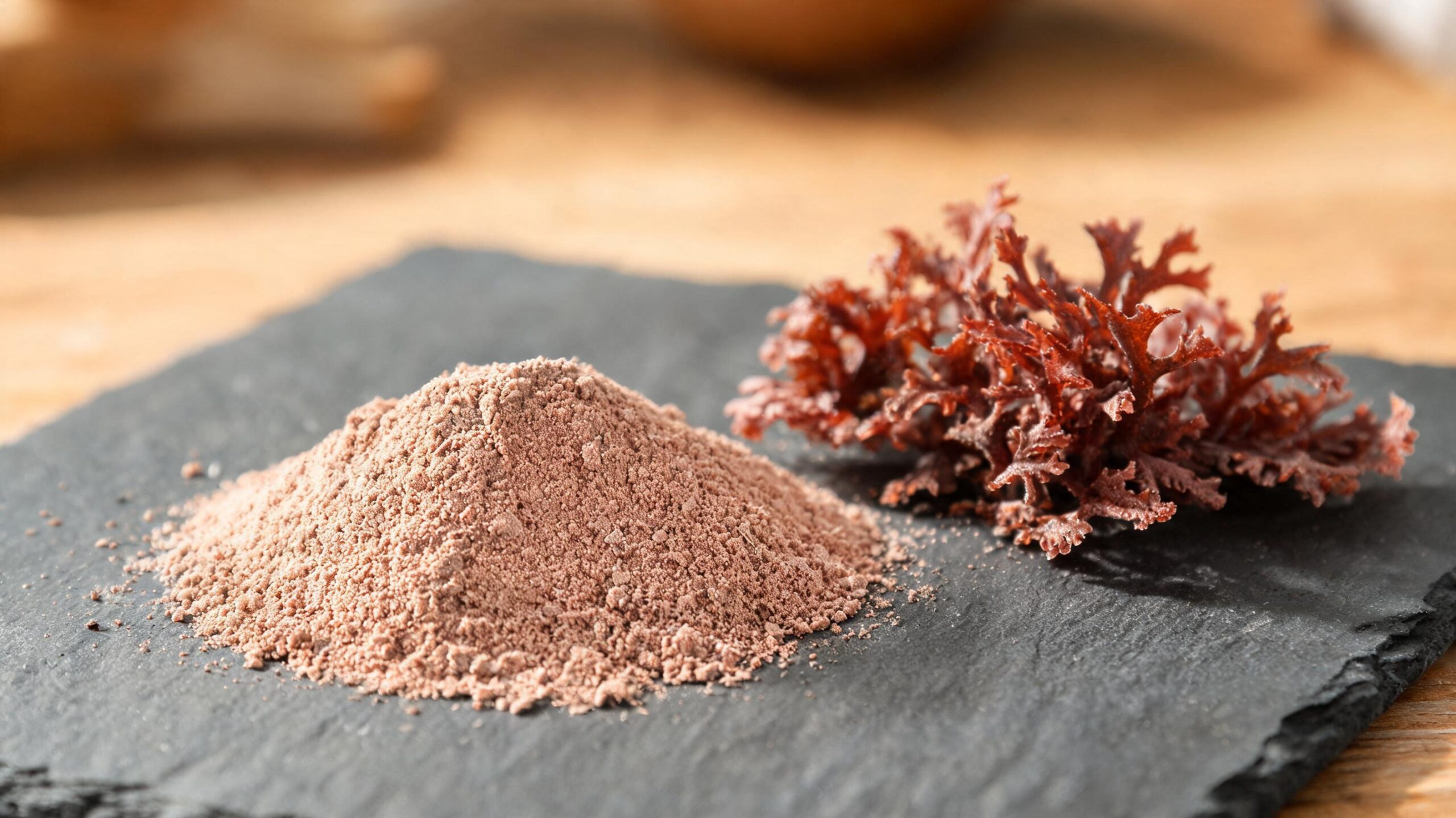
Aquamin is a trademarked ingredient derived from Lithothamnion sp. red algae, harvested from a calcified seabed off the Icelandic North Atlantic. The alga’s cell walls naturally accumulate calcium + magnesium + 70 or more trace minerals (strontium, boron, manganese, copper, vitamin-K-group compounds, and others) over the alga’s growth cycle, and the harvested material is dried and milled without chemical processing. The result is a multi-mineral calcium source in which the minerals are bound into a porous, calcified algal-matrix delivery form. Published comparative-absorption studies report that Aquamin delivers calcium retention comparable to or better than calcium carbonate in 12-week trials, with the additional magnesium and trace minerals delivered alongside.
Two things matter here. First, the multi-mineral profile: the Lithothamnion matrix delivers the calcium + magnesium + 70-trace-mineral stack that a calcium-carbonate tablet simply does not. The trace minerals are not contaminants – they are cofactors in the bone-remodelling enzymes (boron for steroid-hormone metabolism, copper for lysyl-oxidase-driven collagen crosslinking, manganese for glycosyltransferase enzymes in the bone matrix, zinc for alkaline phosphatase). Second, the food-matrix delivery: the calcified red-algae matrix releases calcium slowly in the GI tract, which moderates the peak serum-calcium spike that single-molecule calcium-carbonate tablets can produce. The published work is not a panacea – the BMD gains in Aquamin trials are modest (on the order of one to two percent over 12 to 24 months in adherent cohorts), but they sit on top of the trace-mineral delivery that commodity calcium carbonate cannot match.

The bioactive-silica layer: the bone-matrix quality piece that calcium-only misses
Silica is the trace mineral that supports the collagen scaffold that mineralises into bone matrix. The bone matrix is not calcium-on-its-own; it is a collagen scaffold (mostly type-I collagen) into which hydroxyapatite crystals are deposited. The collagen scaffold’s quality depends on silica: silica-deficient animal cohorts show impaired bone mineralisation even when calcium intake is adequate. Published work on silica supplementation in older osteoporotic cohorts reports improvements in femoral-bone density over 12 to 24 months.
MarineCal Plus sources its silica from bamboo-leaf extract (~70 percent silica content), a different supply chain from the more common horsetail-derived silica in the supplement market. The bamboo-leaf-extract silica delivers the bioactive form at a higher silica percentage than horsetail. For the MY/SG reader, the bamboo-leaf source has a familiar cultural framing – bamboo has been a traditional Asian mineral source for connective-tissue strength in TCM for centuries – but the modern clinical case rests on the bone-matrix-quality mechanism rather than tradition.
The sesamin layer: the osteoblast / osteoclast modulation piece
Sesamin is the bioactive lignan phytochemical concentrated in sesame-seed oil. Its bone-density mechanism is different from calcium or silica. Published work in ovariectomised-animal models (the standard postmenopausal-osteoporosis model) reports that sesamin suppresses NF-kB-driven osteoclast differentiation – that is, it reduces the activity of the cells that resorb bone – and upregulates osteoprotegerin, the decoy receptor that dampens osteoclast activation. The net effect on the bone-remodelling balance tilts toward bone preservation rather than resorption.
Small human cohorts in the published work report bone-mineral-density improvements of roughly one to two percent over 12 months in postmenopausal women supplementing with standardised sesamin extract. The sesame-seed component in MarineCal Plus delivers the standardised lignan at clinical-dose levels; ground sesame seeds alone (the “sesame seed” claim on some products) do not standardise the lignan content, so consumers reading labels should look for standardised sesamin extract disclosure rather than just “sesame” or “sesame seeds”.
The Lalmin zinc-yeast layer: the alkaline-phosphatase cofactor piece
Zinc is the alkaline-phosphatase enzyme cofactor for the mineralisation step – the moment when osteoblasts deposit hydroxyapatite into the collagen scaffold. Zinc deficiency in older adults is associated with reduced bone-mineral density in published observational work. The Lalmin zinc-yeast form delivers zinc in a high-bioavailability yeast-bound matrix (Lalmin is a Sprout-published mineral-enriched-yeast ingredient), as distinct from the lower-bioavailability zinc-oxide or zinc-gluconate forms that dominate the supplement market. The Lalmin form is the one to look for on the label.
What the stack does together that the calcium-only pill does not
The multi-substrate logic is straightforward: calcium + magnesium + 70 trace minerals (Aquamin layer) + silica (collagen-scaffold support) + sesamin (osteoblast/osteoclast balance tilt) + high-bioavailability zinc (alkaline-phosphatase cofactor) + vitamin-K-group compounds (osteocalcin carboxylation). Each piece is published work at modest effect size; the stack delivers them together in a single daily dose. The published BMD effect of the stack over 12 to 24 months in adherent cohorts is on the order of one to three percent – modest in absolute terms, meaningful for fracture-risk reduction over a decade of use.
For the consumer reading labels, the four disclosure markers that confirm a genuine multi-substrate product versus a calcium-only pill with marketing copy are: (1) Aquamin trademark disclosure with Lithothamnion sp. source naming – many “seaweed calcium” or “plant calcium” products are commodity calcium carbonate with green colourant; (2) bamboo-leaf-extract silica disclosure with ~70 percent silica content; (3) standardised sesamin or standardised sesame-extract disclosure with the lignan content; (4) Lalmin zinc-yeast disclosure with the yeast-bound-mineral form. Without all four markers, the consumer cannot verify the multi-substrate stack is being delivered.
The safety boundary
A multi-substrate bone-density stack is a substrate support, not a substitute for prescribed osteoporosis medication. If you are on bisphosphonates (alendronate, risedronate, zoledronic acid), strontium ranelate, vitamin-D analogues, thyroid medication, or any prescription affecting bone metabolism, the substrate stack can interact – coordinate with your prescribing physician before adding it. Calcium + magnesium + zinc + vitamin-K supplements can affect the absorption and metabolism of these medications. The standard safety bar applies: tell your doctor what you are taking, ask about interactions, and do not stop a prescribed medication in favour of a substrate supplement.
The summary
Aquamin seaweed calcium is not just calcium from a different source – it is a food-matrix, multi-mineral delivery form (calcium + magnesium + 70 trace minerals) sourced from Lithothamnion red algae. Combined with bioactive silica from bamboo-leaf extract (bone-matrix-quality layer), standardised sesamin from sesame-seed extract (osteoblast/osteoclast modulation layer), and Lalmin zinc-yeast (alkaline-phosphatase cofactor), the stack hits the substrate layers that a calcium-only pill leaves to diet. The published BMD effects are modest but real; the consumer’s job is to verify the four disclosure markers – Aquamin trademark + Lithothamnion source + bamboo-leaf-extract silica + standardised sesamin + Lalmin zinc yeast – on the label before paying the multi-substrate premium.
Also available in Bahasa Malaysia and 中文.
Related Topics
Healthspan is the new longevity goal: 5 daily habits that protect bones as you age
Stop Swallowing Rocks: Why Seaweed Calcium Is Much Better Than Calcium Carbonate
Silica – The Crucial Ingredient For Stronger Bones, Hair and Nails
5 Ways To Keep Our Bones Healthy As We Age
Alkaline-Forming Food For Bone Health
Product you may be interested in