A recent column in The Straits Times1 flagged a worrying trend: across social media, peptides and compounded “wellness shots” are being marketed as the next frontier of self-care. Some are advertised for immune support, recovery, weight management, even “anti-ageing.” Most have little or no regulatory scrutiny behind them, and the people buying them often don’t realise that.
Flu season in Singapore and Malaysia is approaching fast — August to October is when haze, school reopening, and the first cold snaps in air-conditioned offices combine to push the seasonal curve upwards. Inevitably, that’s when sales of “immunity boosters” spike. Many of those products are not what they seem, and a handful carry real risks.
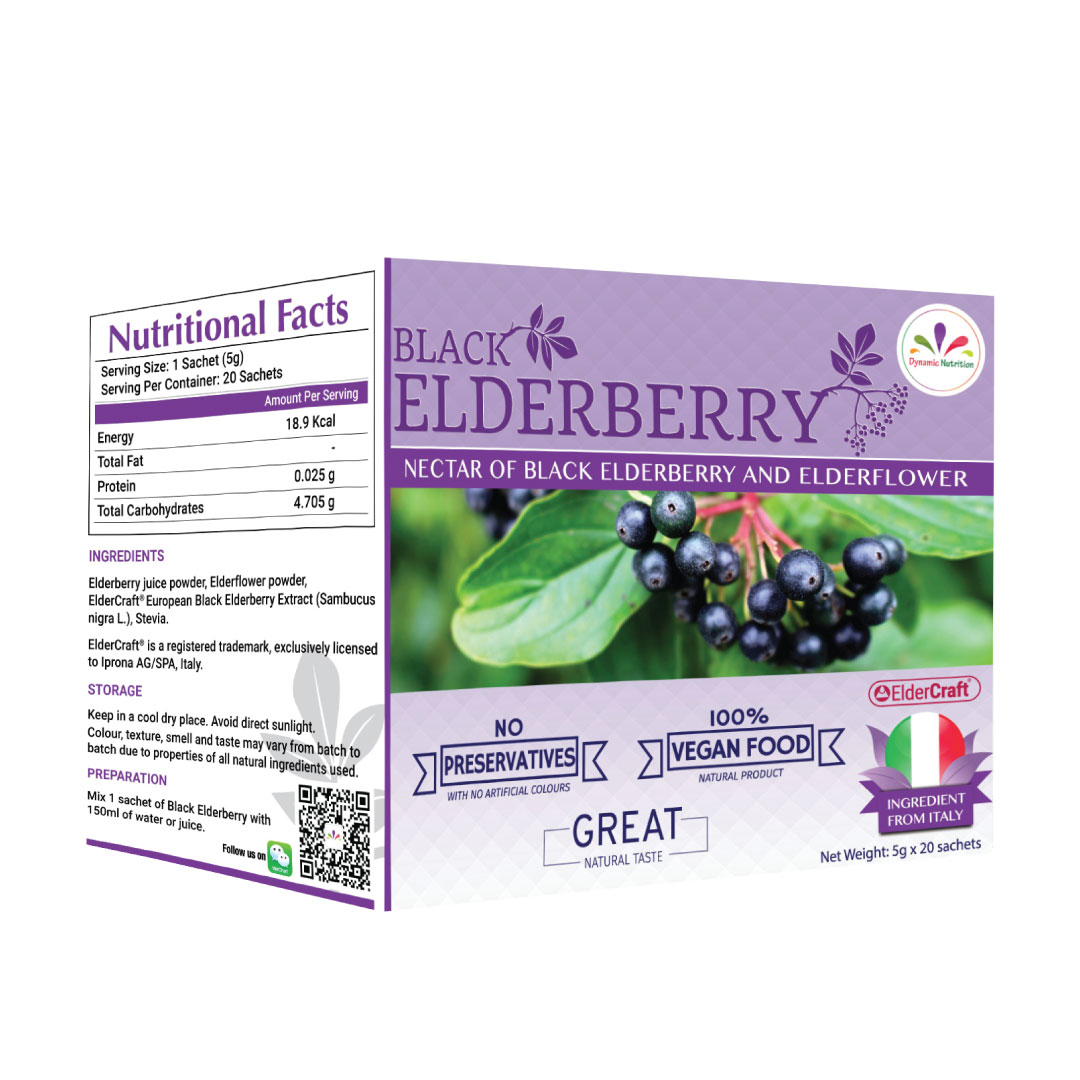
This article walks through what regulators have actually said about consumer peptide use, what the safer, food-grade, clinically-studied alternatives look like, and where black elderberry (Sambucus nigra L.) — the highest-anthocyanin standardised extract — fits as a long-trusted, evidence-supported option for adults and children alike.
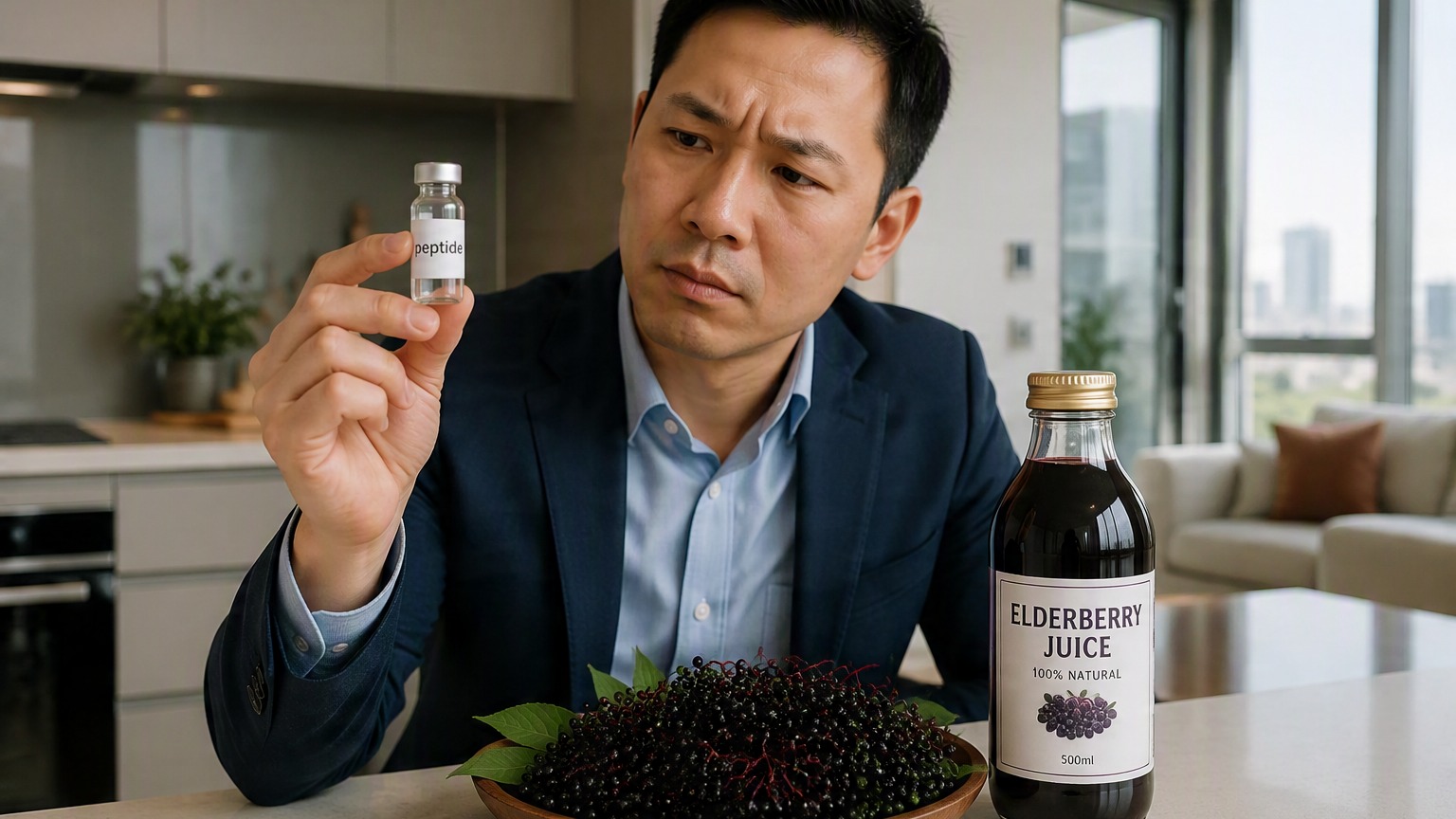
What “consumer peptides” actually are
Peptides are short chains of amino acids — the building blocks proteins are made of. Your body makes them naturally; some medications (insulin, semaglutide) are peptide drugs. The trouble isn’t the molecule. The trouble is who is making the product you’re buying, what dose is in it, and whether it has been independently verified.
The Straits Times column cited above1 flagged a few examples circulating in Singapore:
- BPC-157 — sold as a “recovery” peptide. Not approved as a medicine in Singapore, the US, or the EU for over-the-counter sale.
- Thymosin alpha-1 — promoted as an immune “booster.” Only available as a regulated prescription medication in the jurisdictions where it is approved at all.
- Compounded “wellness shots” — typically a multi-ingredient cocktail from a compounding pharmacy. Dose, purity, and stability are not subject to the same quality controls as registered medicines.
None of these are illegal in the strict sense. But they live in a regulatory grey zone: they’re sold as “supplements,” “wellness products,” or “research compounds,” which removes the safety-net of a registered medicine.
What the regulators are saying
Singapore’s Health Sciences Authority (HSA) maintains a public list of health products found to contain undeclared medicinal ingredients. The pattern is consistent: products sold on social media as “immunity boosters” or “wellness injections” sometimes contain actual pharmaceuticals — steroids, sildenafil analogues, stimulants — without disclosure. The HSA’s standing consumer advice is to buy only from retailers known to be licensed, and to be sceptical of any product whose active ingredient is sold only via DM or Telegram.
The UK’s Medicines and Healthcare products Regulatory Agency (MHRA) has run a parallel campaign on peptides specifically, classifying several popular “wellness peptides” as medicinal products — meaning they can only be supplied against a valid prescription. The US FDA’s立场 is similar: compounding pharmacies cannot mass-produce peptides without an individual patient prescription on file.
In short: if a peptide is being sold to you in a vial without a prescription, in a clinic that does not have your medical history on file, the regulatory net has not caught up to that transaction yet.
The risks nobody is talking about
Three risks deserve more attention than they get.
1. Purity is not guaranteed
Independent lab testing of grey-market peptides has repeatedly found discrepancies between the label and the contents. The published analytical-chemistry literature on compounded research peptides has shown measurable impurities in a meaningful fraction of tested vials, and dose-label mismatches in a smaller but non-trivial fraction. If you’re injecting something into your body weekly, the dose accuracy matters.
2. Drug interactions are real
Many peptides marketed for “wellness” interact with prescription drugs in ways that haven’t been studied at consumer-relevant doses. BPC-157, for example, has documented effects on angiogenesis (blood-vessel formation) — which is why some researchers are interested in it, but also why anyone on blood thinners, cancer therapy, or with a vascular condition should not be self-experimenting.
3. You may not need them
Most people buying peptides for “immune support” during flu season are not actually immune-compromised. They’re responding to marketing. The base of evidence for a healthy adult’s flu-season immune function is much better served by sleep, hydration, hand hygiene, and a few well-studied food-derived compounds than by weekly injectable shots.
What the evidence actually supports for immune-season resilience
If you want to do something during flu season that has published research behind it, here is the short list.
Sleep. Seven to nine hours. Sleep deprivation measurably reduces vaccine response and increases infection susceptibility. This is the highest-yield intervention in the entire immunity literature.
Vitamin D. Deficiency correlates with higher respiratory infection rates, particularly in temperate latitudes during winter. For people with low baseline vitamin D, supplementation is supported by randomised trial data.
Zinc lozenges at the onset of a cold. The Cochrane review on zinc is mixed, but the consistent finding across trials is that zinc taken within 24 hours of symptom onset modestly reduces duration. The effect is small but real.
Black elderberry (Sambucus nigra) extract. This is the one most people miss. Standardised elderberry extracts have been tested in laboratory studies against influenza A and B, and in a randomised human trial in air travellers showing consistent results on duration and severity of cold symptoms23. The 2011 Krawitz laboratory study on the ElderCraft® extract is the most-cited in-vitro work, demonstrating inhibitory activity against influenza A and B virus propagation2; the 2016 Tiralongo randomised controlled trial showed a four-day reduction in cold duration versus placebo in air travellers3.
The reason elderberry works is its very high anthocyanin content — the deep-purple pigments in the skin of the berries. Anthocyanins have documented effects on inflammatory signalling and on the mucous-membrane immune response. This is not folklore. It is a published, peer-reviewed body of work going back over a decade, with the strongest signal in standardised extracts from the Haschberg variety of European black elderberry.
Black elderberry vs the trendy immune “stacks”
If you’ve seen a “wellness stack” being promoted on social media — typically a multi-vial injection kit plus an oral supplement regimen — here’s the direct comparison that matters.
- Elderberry extract: food-grade, registered as a dietary supplement, manufactured under GMP, standardised to a known anthocyanin concentration, safe for adults and children, with published trial data.
- “Wellness peptide stack”: typically compounded, no batch-to-batch standardisation, off-label use of substances regulated as medicines in other jurisdictions, drug-interaction profile incompletely characterised, no published trial data in healthy adults.
For most people reading this — not elite athletes, not cancer patients, not people recovering from surgery — the elderberry option covers the actual use-case for flu-season immune resilience, with a fraction of the risk.
Who should consider elderberry (and how to take it)
The published evidence on standardised elderberry extract supports daily use during flu season for:
- Adults in high-contact settings — teachers, healthcare workers, parents of school-age children.
- Children aged 4 and above — the ElderCraft® trials included paediatric arms with no adverse signals.
- Older adults — anthocyanins have additional circulatory benefits that compound with the immune support.
Dosing in the published trials was typically 500–1000 mg of standardised extract daily for prevention, with a higher loading dose at the onset of symptoms. Look for products that publish their anthocyanin content and that name the cultivar (Haschberg is the European standard) and the extraction process.
What the smart approach looks like this flu season
You don’t need a peptide vial. You need a layered, low-risk set of habits plus one or two well-evidenced supplements if your lifestyle leaves gaps.
Layer one: sleep, hydration, hand hygiene, vaccination. These do the heavy lifting and have the largest body of evidence behind them.
Layer two: vitamin D if you live in a tropical climate with indoor-heavy days (more common than people admit in Singapore and Malaysia, where most office workers spend 90% of waking hours inside).
Layer three: a standardised black elderberry extract as your seasonal immune-support supplement. The Tiralongo 2016 RCT on air travellers, and the Krawitz 2011 laboratory work on ElderCraft® against influenza A and B, make this the best-evidenced non-prescription option for shortening symptom duration when a cold does hit23.
Skip the peptides. Skip the compounded “wellness shots.” Skip the multi-vial regimens sold via social media. The boring, food-grade, peer-reviewed route is the one with the evidence.
References
1 The Straits Times — The peptide craze: Risks of unregulated consumer use. https://www.straitstimes.com/opinion/the-peptide-craze-when-hype-moves-faster-than-science
2 Krawitz C, Abu Mraheil M, Stein M, Imirzalioglu C, Domann E, Pleschka S, et al. (2011) — Inhibitory activity of a standardized elderberry liquid extract against clinically-relevant human respiratory bacterial pathogens and influenza A and B viruses. BMC Complementary & Alternative Medicine. https://doi.org/10.1186/1472-6882-11-16
3 Tiralongo E, Wee S, Lea RA. (2016) — Elderberry Supplementation Reduces Cold Duration and Symptoms in Air-Travellers: A Randomized, Double-Blind Placebo-Controlled Clinical Trial. Nutrients. https://europepmc.org/article/med/27023596
Related Topics
Black Elderberry extract inhibits the replication of SARS-CoV2 in vitro
The Difference between a Cold and Flu
5 Natural Treatments of Cold and Flu
People who are Susceptible to Influenza and How to Strengthen Their Immunity
Novel Coronavirus (2019-nCoV) Advice for the Public
Elderberry – Makanan Super yang mengandungi Kepekatan Quercetin Tertinggi