Type “cordyceps for energy” into a search bar and you get shelf after shelf of bottles promising stamina, endurance and a body that simply keeps going. Type the same phrase into PubMed and you get something much narrower: a few dozen small trials that measured specific, unglamorous numbers in small groups of people, most of them already fit. The gap between those two search results is the real story of cordyceps and energy, and it is worth walking through carefully, because it tells you both what the evidence supports and what no capsule can honestly promise you.
What “more energy” means inside a clinical trial
A trial cannot measure energy. There is no instrument for it and no agreed definition, so researchers measure something else and hope it stands in. The four outcomes that recur in the cordyceps literature are these. Time to exhaustion is how long a person can hold a fixed workload, usually on a cycle ergometer, before they cannot continue. VO2 max is the highest rate at which the body can take up and use oxygen during hard exercise, expressed in millilitres of oxygen per kilogram of body weight per minute; it is the standard laboratory marker of aerobic capacity. Ventilatory threshold and metabolic threshold are the exercise intensities at which breathing and blood lactate begin to rise disproportionately to the workload, which is roughly the point where steady effort stops feeling steady. Subjective fatigue is a score the participant gives themselves on a questionnaire.
Each of those measures a different slice of the same physiology, and none of them measures how you feel at three in the afternoon on an ordinary Tuesday. That distinction is not pedantry. A change in ventilatory threshold in a laboratory is a real finding about a real physiological boundary, but it is not the same experience as “having more energy”, and the trials that exist were designed to test the first thing, not the second.
The trials that actually measured an energy outcome
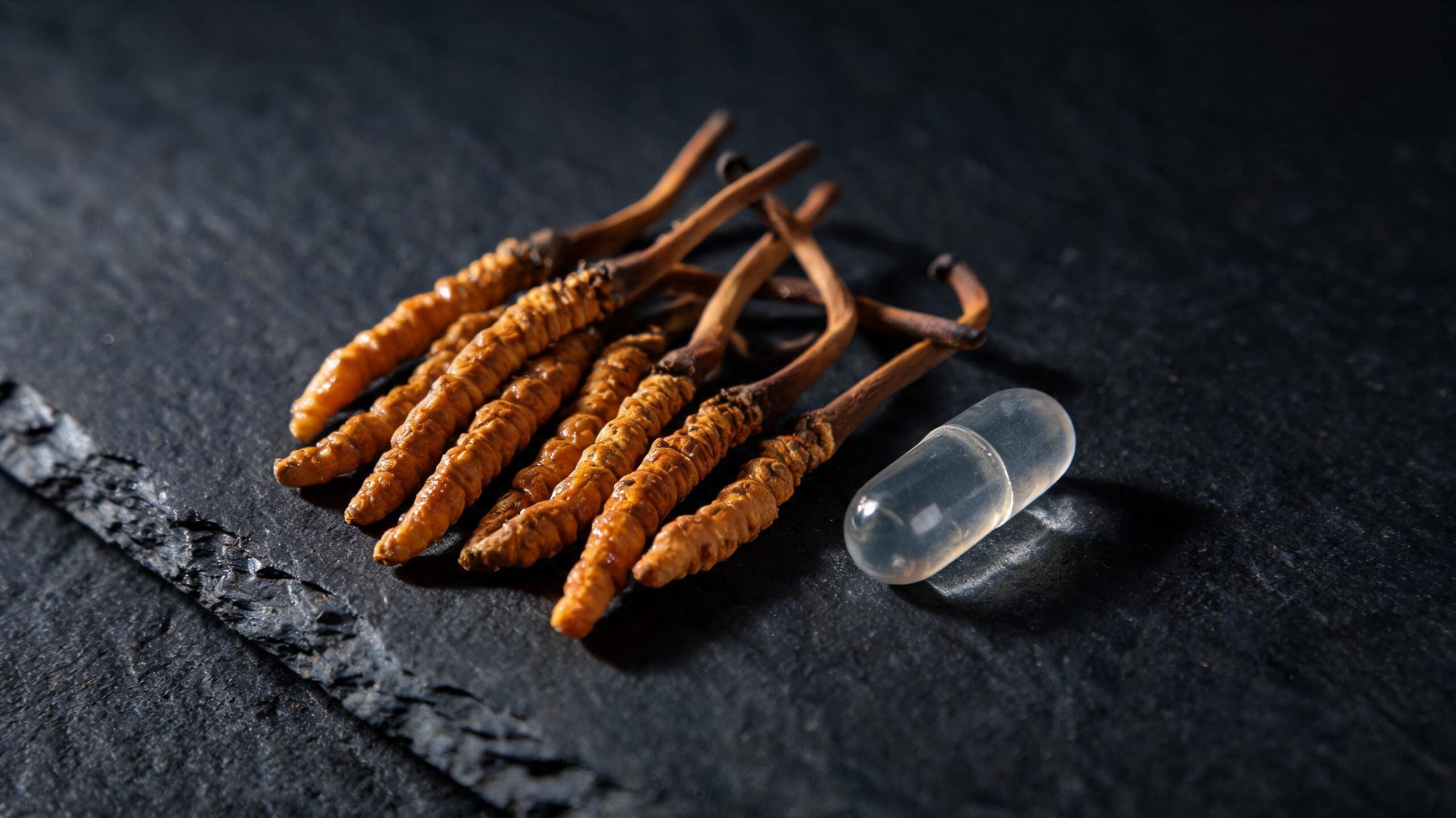
Five trials and one recent review carry most of the weight here. Where a material is named, keep the name in mind, because cordyceps on a label can mean at least three different preparations.
- Cs-4 at about 1 g a day for 12 weeks, in 20 healthy older adults. A double-blind, placebo-controlled pilot gave participants aged 50 to 75 years 333 mg of Cs-4 three times daily. Metabolic threshold rose by about 10.5% and ventilatory threshold by about 8.5%. VO2 max did not change in either the treatment group or the placebo group. Twenty people, one centre.
- A commercial cordyceps and rhodiola formula in 17 amateur cyclists, for two weeks. The three-capsule serving carried 1,000 mg of CS-4 plus 300 mg of rhodiola, taken as six capsules a day for four days and then three a day for eleven. The authors concluded that two weeks of that schedule was not long enough to change cycling performance, and left open whether a longer period would.
- A cordyceps and rhodiola formula in eight male cyclists. No significant difference from placebo in muscle tissue oxygen saturation, VO2 max, ventilatory threshold or time to exhaustion. Eight participants is not a sample size that can detect a small effect.
- A Cordyceps militaris blend at 4 g a day, in 28 healthy adults. One week changed nothing measurable. A three-week arm showed a VO2 max improvement of about 4.8 ml per kg per minute, which the authors themselves describe as exploratory given how many participants remained in the study.
- Cordyceps sinensis at 2 g a day for 12 weeks, in 30 amateur marathoners. Heart rate at the same submaximal intensity was lower by week 8 and 5 km run performance improved by week 12, while the cardiopulmonary exercise test showed no significant difference between groups at any measured point.
- The wider picture across the literature. A 2026 narrative review of cordyceps supplementation and exercise found studied intakes running from about 1 g to 12 g a day across the trials it included, and judged the findings inconsistent with limited certainty in the evidence.
Read that list and notice both what it says and what it does not. It says that the amounts studied were measured in grams, that the trials are small, that several of them found nothing at all, and that the one encouraging result in a larger sample was a threshold shift rather than a change in aerobic capacity. It does not say that more is better, because nobody ran the trial that would let anyone say that, and it does not say that any of these preparations behaves like any other.
Why a positive result in a small trial is not a daily energy boost
Start with the arithmetic that the abstracts leave out. Eight people, twenty people, twenty-eight people, thirty people. In a study that size, a difference has to be large before it can be distinguished from noise, and the confidence intervals around each of these estimates are wide enough that the honest reading of most of them is “possibly a small effect, possibly nothing”. Add the number of outcomes measured in each trial — thresholds, VO2 max, time to exhaustion, heart rate, perceived exertion, blood markers — and the chance that one endpoint crosses the conventional significance line by accident stops being negligible. That is why the exploratory three-week arm of the militaris study is labelled exploratory by its own authors, and why a single improved endpoint in a thirty-person trial should be read as a hypothesis rather than an answer.
Then look at what was actually given. Cs-4 is a fermented mycelial preparation of Cordyceps sinensis grown in a controlled medium. Cordyceps militaris is a different species, cultivated on rice or grain, with a different profile of the compounds usually credited for any effect. Whole-fungus powder containing mycelium, primordia, fruiting bodies and spores is a third thing again. A gram of one is not a gram of another, and no published conversion turns milligrams of one into an equivalent of the others. When a review pools these together and finds inconsistent results, part of the inconsistency may be the supplements rather than the people.
The last thing the trials cannot tell you is what would happen to an ordinary reader. Most of the participants were trained or at least recreationally active adults, tested in a laboratory, over weeks rather than months, on a fixed dose of a named material. None of them took a 450 mg capsule of full-spectrum cordyceps powder. There is no study of that material at any dose, measuring any outcome, which means the question “does this capsule give me energy” has not been asked in a form anyone could answer.
Where the label and the marketing part company
This product’s page makes a deliberately modest claim: that cordyceps is “traditionally used for health and strengthening the body”. Traditional use is a description of a long history of use, not a measured outcome, and it is the honest kind of claim for a supplement to make when the trial evidence is as thin as it is here. The label itself is more concrete and worth reading closely. One capsule is 450 mg of full spectrum organic Cordyceps sinensis described as containing mycelium, primordia, fruiting bodies, spores and extracellular compounds; the directions are one capsule twice daily or two capsules once daily, which makes one serving one capsule and 900 mg the daily amount; and the product carries a Ministry of Health Malaysia registration, MAL19086059TC.
That registration is a market authorisation. It means the product went through Malaysia’s registration process for a traditional or complementary product. It does not mean the product has been tested for any outcome at 900 mg a day, and no registration anywhere converts a serving instruction into evidence of an effect. The same applies to the word adaptogen, which appears on a great many cordyceps pages. It has no agreed regulatory definition and no accepted clinical definition; it is a marketing category that describes a hoped-for behaviour, not a mechanism anyone has demonstrated in a controlled trial.
What a supplement can and cannot promise
A cordyceps product can verifiably promise a few things, and they are worth more than they sound. It can tell you which species and which part of the fungus the powder comes from. It can state the weight of material per capsule and the number of servings per container. It can say whether the batch was tested for heavy metals and other contaminants, and it can show you that test on request. It can tell you how long the material was cultivated, which matters because the interesting compounds accumulate over time and a rushed culture is a different product from a slow one.
What it cannot promise is an outcome. There is no recommended dietary allowance and no established daily intake for cordyceps, because it is a fungus rather than a nutrient, so there is no deficiency for a capsule to correct and no percentage daily value a label could legitimately print. Without a deficiency to fix, the entire claim structure has to rest on trials like the ones above, and those trials are small, mixed in their results, and conducted on materials that are not this one. That is not a reason to dismiss the product; it is a reason to buy it for what it is — a labelled, tested fungal food — rather than for what the category promises.
If you are tired, the order worth checking things in
Persistent tiredness is a symptom with a short list of common causes, and almost none of them are a missing fungus. Working through that list in order will do more for your energy than any bottle, and it costs less.
- Sleep duration and timing. Adults generally need seven to nine hours, and chronic short sleep is the single most common explanation for feeling flat. Fixing a bedtime moves more people than any supplement.
- Bloodwork, if the tiredness has lasted weeks. Iron and ferritin, vitamin B12, thyroid function and, where symptoms fit, testosterone are the standard screen, and they are a doctor’s job rather than a self-test kit’s. Anaemia and hypothyroidism both present as fatigue long before anything else.
- Food and training load. Under-eating calories or protein while training hard produces exactly the flatness people buy stimulants for. So does training with no easy weeks in it.
- Caffeine and alcohol timing. Caffeine after mid-afternoon and alcohol in the evening both cost sleep quality even when total hours look fine, which is a common way to feel tired while technically sleeping enough.
- Supplements last, with realistic expectations. If the four items above are handled and you still want to try cordyceps, the trials suggest the honest expectation is a small possible effect on exercise thresholds over weeks, not a noticeable lift in daily energy.
On safety, the human record for cordyceps is reassuring in the way that a short record can be; Memorial Sloan Kettering’s herb reference reports no major side effects in the studies it reviewed. Two cordyceps-specific cautions are worth raising with a clinician before you start. Cordyceps may lower blood glucose, which matters if you take diabetes medication, and it may increase bleeding risk, which matters if you take a blood thinner such as warfarin. HealthHub in Singapore and the NHS give the same general advice: read the label, do not assume a wellness claim has been through a regulatory review of its effectiveness, and talk to a doctor or pharmacist first if you are pregnant, breastfeeding, taking prescription medicine or managing a condition.
The bottom line
Cordyceps has a real clinical literature and it is much smaller and more equivocal than the shelf suggests. A handful of trials of twenty to thirty people have tested fermented Cs-4, Cordyceps militaris blends and whole C. sinensis at doses between about 1 g and 4 g a day, and the results run from a threshold shift in one pilot, through an exploratory VO2 max gain in a three-week arm, to several trials that found no difference from placebo. Nothing in that body of work tested this product, at this dose, and nothing in it shows a daily experience of “more energy”. What you can hold a supplier to is narrower and more useful: the species, the part of the fungus used, the weight per capsule, the cultivation time and a heavy-metal test. If you are tired, look at sleep, bloodwork, food and training first. If you take diabetes medication or a blood thinner, or you are pregnant or breastfeeding, ask your clinician before adding cordyceps — not because a capsule of fungal powder is dangerous, but because the studies that would tell you what it does for you have not been run.
References
- Steve Chen, Zhaoping Li, Robert Krochmal, Marlon Abrazado, Woosong Kim and Christopher B. Cooper — Effect of Cs-4 (Cordyceps sinensis) on exercise performance in healthy older subjects: a double-blind, placebo-controlled trial (Journal of Alternative and Complementary Medicine, Vol. 16 No. 5, 2010) — https://pubmed.ncbi.nlm.nih.gov/20804368/
- Charles P. Earnest, Gary M. Morss, Frank Wyatt, and colleagues — Effects of a commercial herbal-based formula on exercise performance in cyclists (Medicine & Science in Sports & Exercise, Vol. 36 No. 3, 2004) — https://pubmed.ncbi.nlm.nih.gov/15076794/
- Shane N. Colson, Frank B. Wyatt, David L. Johnston, and colleagues — Cordyceps sinensis- and Rhodiola rosea-based supplementation in male cyclists and its effect on muscle tissue oxygen saturation (Journal of Strength and Conditioning Research, Vol. 19 No. 2, 2005) — https://pubmed.ncbi.nlm.nih.gov/15903375/
- Katie R. Hirsch, Abbie E. Smith-Ryan, Erica J. Roelofs, Eric T. Trexler and Meredith G. Mock — Cordyceps militaris improves tolerance to high intensity exercise after acute and chronic supplementation (Journal of Dietary Supplements, 2017) — https://pmc.ncbi.nlm.nih.gov/articles/PMC5236007/
- Fellipe Pinheiro Savioli, Paulo Zogaib, Eduardo Franco, and colleagues — Effects of cordyceps sinensis supplementation during 12 weeks in amateur marathoners: a randomized, double-blind placebo-controlled trial (Journal of Herbal Medicine, Vol. 34, 2022) — https://www.sciencedirect.com/science/article/pii/S2210803322000392
- Medical University of Warsaw and Jagiellonian University research group — Current Evidence of Ergogenic and Post-Exercise Recovery Effects of Dietary Supplementation with Cordyceps militaris in Humans — A Narrative Review (Nutrients, Vol. 18 No. 5, 2026) — https://pubmed.ncbi.nlm.nih.gov/41829950/
- Memorial Sloan Kettering Cancer Center — Cordyceps (About Herbs, Botanicals & Other Products, last updated 18 January 2023) — https://www.mskcc.org/cancer-care/integrative-medicine/herbs/cordyceps
- HealthHub, Ministry of Health (Singapore) — Understanding Health Supplements — https://www.healthhub.sg/well-being-and-lifestyle/personal-care/understandinghealthsupplements_hsa
- NHS — Vitamins and minerals — https://www.nhs.uk/conditions/vitamins-and-minerals/
Also available in Bahasa Malaysia and 中文.
Product you may be interested in