Every jar of beet crystals comes with a serving size, a scoop, and a suggested number of times a day. Most people read that line once, decide it is either too much or too little, and then guess. This article is for the person who wants to work the label instead of guessing — what a serving actually is, when in the day the published studies placed it, and which numbers on the packet are worth comparing.
We are going to be careful about one thing throughout: how to take a product is not the same as what the product does. Nothing here promises a lower blood-pressure reading, a faster 5K, or a cleaner bloodstream. What we can do is tell you what the research actually dosed, what this particular label says, and how to compare the two honestly.
The short version, before the detail: a serving here is about 10 g — one heaping tablespoon — of freeze-dried beet crystals in a glass of water, taken two to four times a day. That is the manufacturer’s own direction on the packet. The number of times a day is the part most people adjust on their own, and the adjustment is where the interesting questions start.
What “one serving” actually means on this label
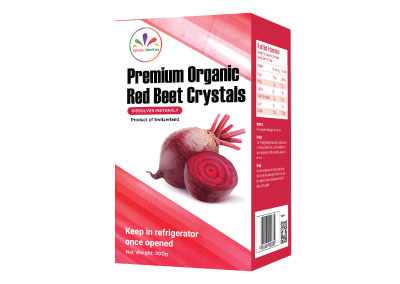
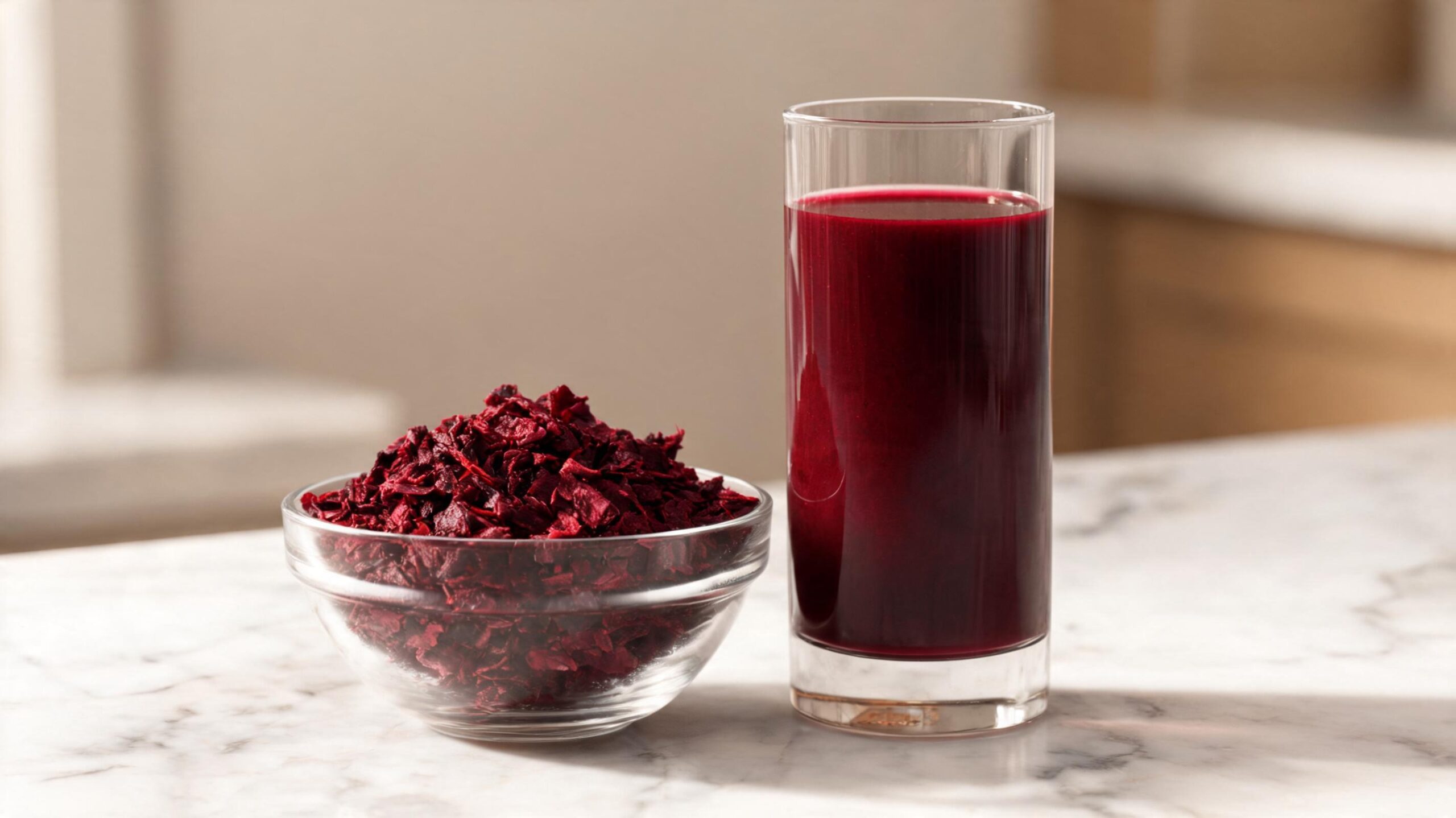
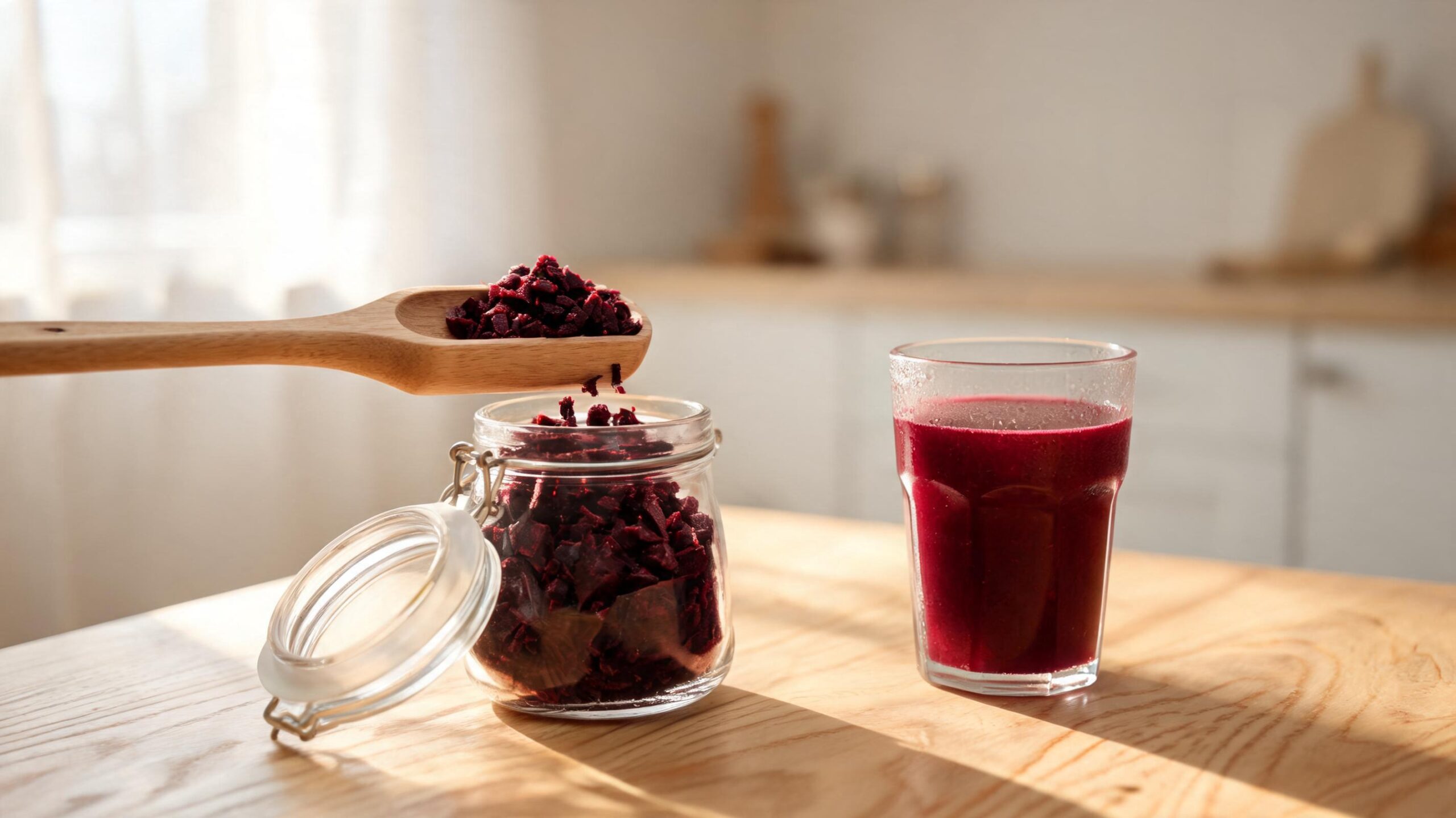
The directions on a 200 g packet of Premium Organic Red Beet Crystals read: take 1 heaping tablespoon (about 10 g) in a glass of water, two to four times daily with meals. The same packet also notes that 200 g is the equivalent of about 2.5 kg of fresh-pressed organic beets, and that the crystals can also go into fruit juice, milk products or cereals, or be taken dry straight from the spoon.
Four details in that direction line are worth pulling apart, because each one is a decision you are making every day:
• The 10 g is a weight, not a “scoop”. A heaping tablespoon is a volume, and beet crystal granule density varies between products and batches. If you want the label’s number, use a kitchen scale. If you are eyeballing a heaped spoon of this product, you are probably within a gram or two of 10 g — but that is an estimate, and it is the difference between 6 and 10 g of nitrate-bearing material if the two products are not the same density.
• It is a weight of dried material, not of nitrate. This is the single most important thing on the label. 10 g of dried beet is not 10 g of nitrate, and the ratio between them is the property that varies most between products. The same 10 g of a different brand could contain meaningfully less inorganic nitrate. This is why the words “beet crystals” on a packet tell you almost nothing about its nitrate content.
• “Two to four times daily” is a range, not a frequency. The packet gives you a range with meals rather than a single daily amount. Two times is the lower end of the manufacturer’s range; four is the upper end. If you are choosing within that range, other things — your own tolerance, whether you are taking it before training, and what your clinician has said — decide which end you sit at, not a marketing claim.
• “With meals” is part of the dose, not a footnote. Timing relative to meals changes how much nitrate is available in a given window, and it is the same variable the exercise studies moved deliberately. We come back to this below.
When to take it: the timing the studies actually used
The published human work on beetroot and nitrate falls into two families, and they dosed differently.
The blood-pressure trials generally ran a daily dose over a series of days to weeks — not a single hit, and not a missed day here and there. Effects in those studies are measured on days of consistent intake. This is the family of evidence covered in our article on beetroot for blood pressure and what the nitrate trials and meta-analyses actually support.
The exercise trials are where timing becomes a single, specific decision. In this literature the dose was typically given as a single serving roughly two to three hours before the effort — long enough for the nitrate to be converted in the mouth and the stomach, and to reach the bloodstream as nitrite, and short enough that it is still there when the session starts. That window is the most-cited number in the exercise literature and it is not arbitrary: it reflects the conversion step, not a marketing preference.
Practically, that gives you three common patterns, and none of them is prescribed:
• Split across the day with meals. Two to four times daily, which is what this label directs, spread across waking hours rather than taken in one go. This is the pattern that fits the blood-pressure style of trial.
• One serving a few hours before training. The pattern that matches the exercise trials, for the days you want that protocol.
• A daily amount, taken consistently. The honest summary of the blood-pressure evidence: what was measured was sustained daily intake, and skipping days is not something the studies tested in a way that supports “you still get the benefit”.
One timing point that is easy to get wrong: the two-to-three-hour pre-exercise window applies to the dose, not to the meal. People often move the serving to just before training because it is more convenient, which collapses the conversion window. If you are borrowing the exercise-trial protocol, move the serving, and eat around it however suits you.
The label numbers worth comparing
Given a packet that says “1 heaping tablespoon, 2-4 times daily”, the question that follows is: what is in the tablespoon? Here are the readings that answer it, in the order to take them.
1. Nitrate content per serving, in milligrams. This is the number that lets you compare two packets honestly. Beetroot nitrate is usually measured as inorganic nitrate, and the useful comparison is nitrate per serving, because that is what you would swallow in one go. If the packet does not state a nitrate figure at all, treat it as a product you cannot compare against a trial — you can still use it as directed, you just cannot reason about it from the published doses.
2. Whether the figure is per serving or per 100 g. This is the most common arithmetic trap on these labels. A per-100 g figure has to be multiplied by 0.1 to get a serving, because a serving is about 10 g. A per-100 g number that looks impressive is usually the same product as a modest per-serving number.
3. The standardised extract ratio. If the packet is “standardised”, the figure is normally expressed as a ratio — for example a stated percentage of extract, or the nitrate content per 100 g that the batch was held to. Standardisation is a quality-control claim about consistency between batches, which is genuinely useful, and it is not the same claim as a high nitrate content. A product can be very well standardised and still modest per serving. Read the ratio, then convert it to per-serving, then compare.
4. Added sugars and sweeteners. Beetroot is naturally sweet, so the sweetener question is not academic for crystals dissolved in water: the carbohydrate load of a serving depends on what has been added on top. This particular packet lists freeze-dried premium organic red beet juice in crystal form as its ingredient, with no artificial flavouring, colouring or sweeteners, which is the cleanest version of that answer.
5. Number of servings in the packet. 200 g at 10 g per serving is 20 servings. At the label’s lower end of two servings a day, that is about ten days. At the upper end of four, about five. This is the number that turns a serving instruction into a cost per day, and it is worth doing before the packet is open rather than after.
How the packet’s dose compares with the published ranges
Here is the honest framing, because it is where most “how to take” articles stop making promises and start inventing them. We are not going to quote a therapeutic dose, because no such dose has been established for this category, and neither the label nor the trials supports one.
What can be said is this. The human trials on nitrate-rich beetroot used doses that were in the order of several hundred milligrams of nitrate per day, given either as a single daily serving of juice or concentrate, or split across the day. The exercise trials used a similar daily amount, delivered roughly two to three hours before the session. The trials were not run on 10 g of an unspecified dried crystal, and they were not run on a scoop-and-a-half of anything.
That is the gap this article exists to close: you cannot compare a packet to a trial until you convert the packet into the unit the trial used — milligrams of nitrate per day, not grams of powder per day. Take the label’s nitrate figure, multiply by the number of servings you actually take in a day, and compare that daily milligram total against the range in the studies. Then decide, with your own reasoning and your doctor’s input where relevant, whether that amount makes sense for you.
If you are the type who wants the underlying comparison rather than a label walkthrough, our article on red beet crystals vs beetroot juice vs beetroot powder works through how the forms deliver the same active compound, and the piece on premium organic beetroot crystals vs powder, on taste and solubility covers what happens to the crystals in the glass.
Who should check with a doctor first
None of this is personal medical advice, and a dosing question deserves more caution for some people than for others. If any of the following apply to you, take the label to a doctor rather than taking it to a search engine:
• You take medication for blood pressure. The blood-pressure literature is exactly the literature where a self-supplement and a prescription can stack in a direction you did not intend.
• You have kidney disease or a history of kidney stones. Concentrated daily beet products can raise urinary oxalate in some people, and that is a conversation to have before making it a habit. Our article on beeturia and what red urine after beetroot actually tells you covers the pigment side of that story, which is harmless and separate from the oxalate question.
• You are scheduled for surgery. Dietary nitrate and blood-pressure effects are reasons to flag it to the team beforehand.
• You have a condition affecting red blood cells, or you are pregnant. Ask rather than assume.
And one expectation to set before your first serving: you may notice red or pink urine or stool. That is a harmless pigment effect, not a warning sign, and it is worth knowing about in advance so it does not stop you mid-course.
A short checklist before you start
If you want the whole article as a five-minute routine: read the nitrate milligrams per serving and check whether it is per serving or per 100 g; weigh one serving once so you know what 10 g looks like in your own spoon; decide how many of the label’s two-to-four daily servings you are actually taking, and on which days; work out how many days the packet gives you at that rate; and if any of the medical flags above apply, take the label to a doctor before you start rather than after.
That is the whole of it. Beet crystals are dried beetroot, this label’s serving is about 10 g of it taken two to four times a day with meals, the exercise literature places a serving two to three hours before the session, and the number that makes any of it comparable to a study is the nitrate milligrams per serving on the packet. Everything beyond that is a claim someone is making, and the place to check a claim is the endpoint it was measured on — not the front of the pouch.
Related Topics
Beeturia: what red urine after beetroot actually tells you
Red Beet Crystals vs Beetroot Juice vs Beetroot Powder: Which Form Actually Delivers the Nitrates
Premium Organic Beetroot Crystals vs. Powder: Taste & Solubility
Beetroot for Blood Pressure: What the Nitrate Trials and Meta-Analyses Actually Support
Product you may be interested in