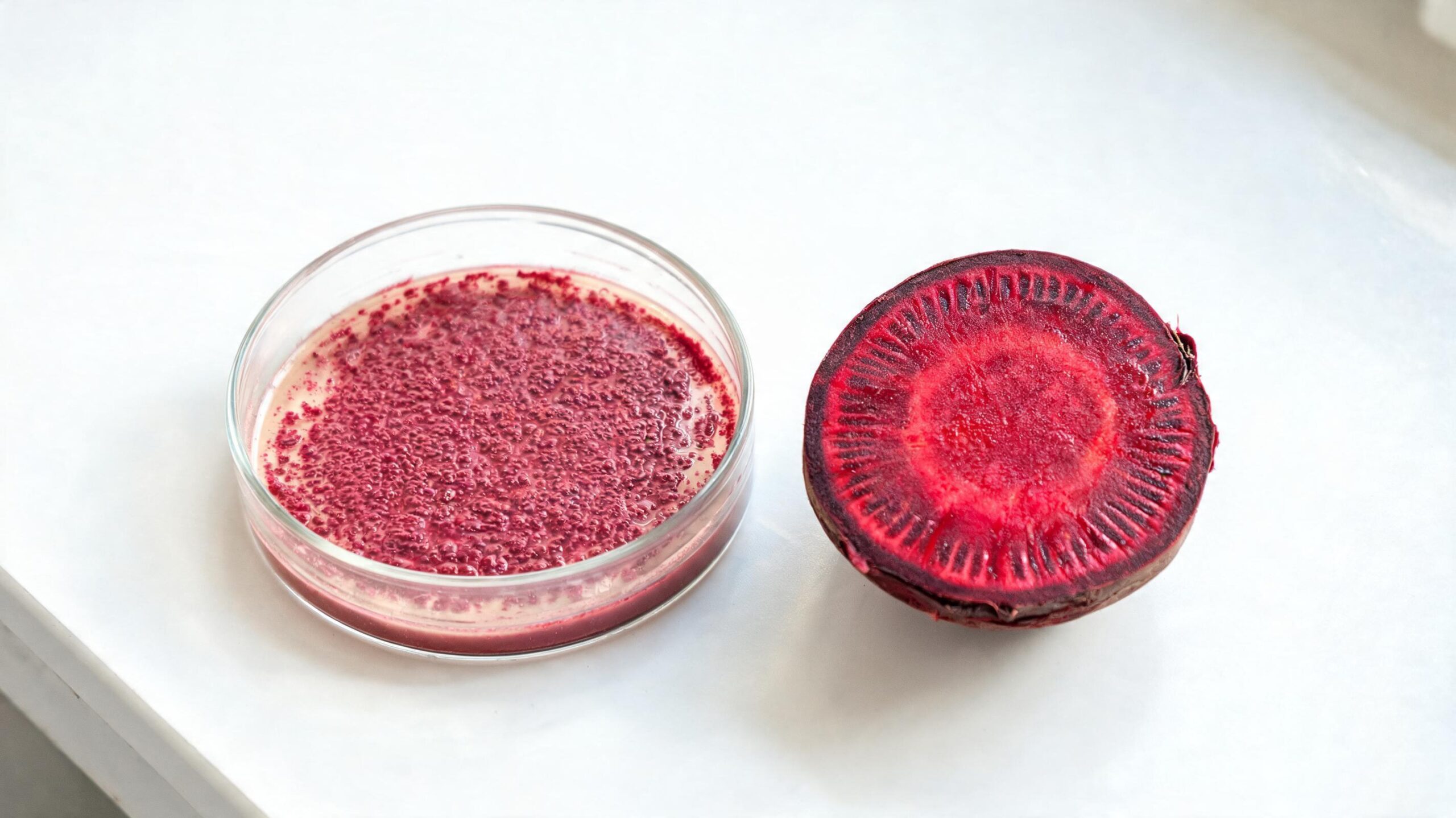
You ate beetroot. Two hours later your urine looks like cranberry juice. Or, on a different occasion, the next-morning stool is a startling shade of magenta. The first time it happens, the rational response is mild alarm: that does not look like the colour urine is supposed to be. The second time, you start to wonder whether something is wrong with you. The third time, you either ignore it forever or you look it up.
This article is for the people who look it up. Beeturia — the medical term for red or pink urine after eating beetroot — is common, harmless in almost everyone, and not a sign of malabsorption. It is a sign of one of three specific things, and the specific thing that explains your beeturia actually tells you a real story about your gut, your iron status, or your stomach acid. There is also a fourth, mostly unreported, substrate layer in beetroot — the red-violet pigment itself — that does biological work most beetroot-benefits articles skip.
The short version: beeturia is not a defect. It is a window. Read this article for what it shows you, what to do if you also notice red stool, and when red urine is something else entirely and needs a doctor today, not a beetroot tomorrow.
What beeturia actually is (and what it is not)
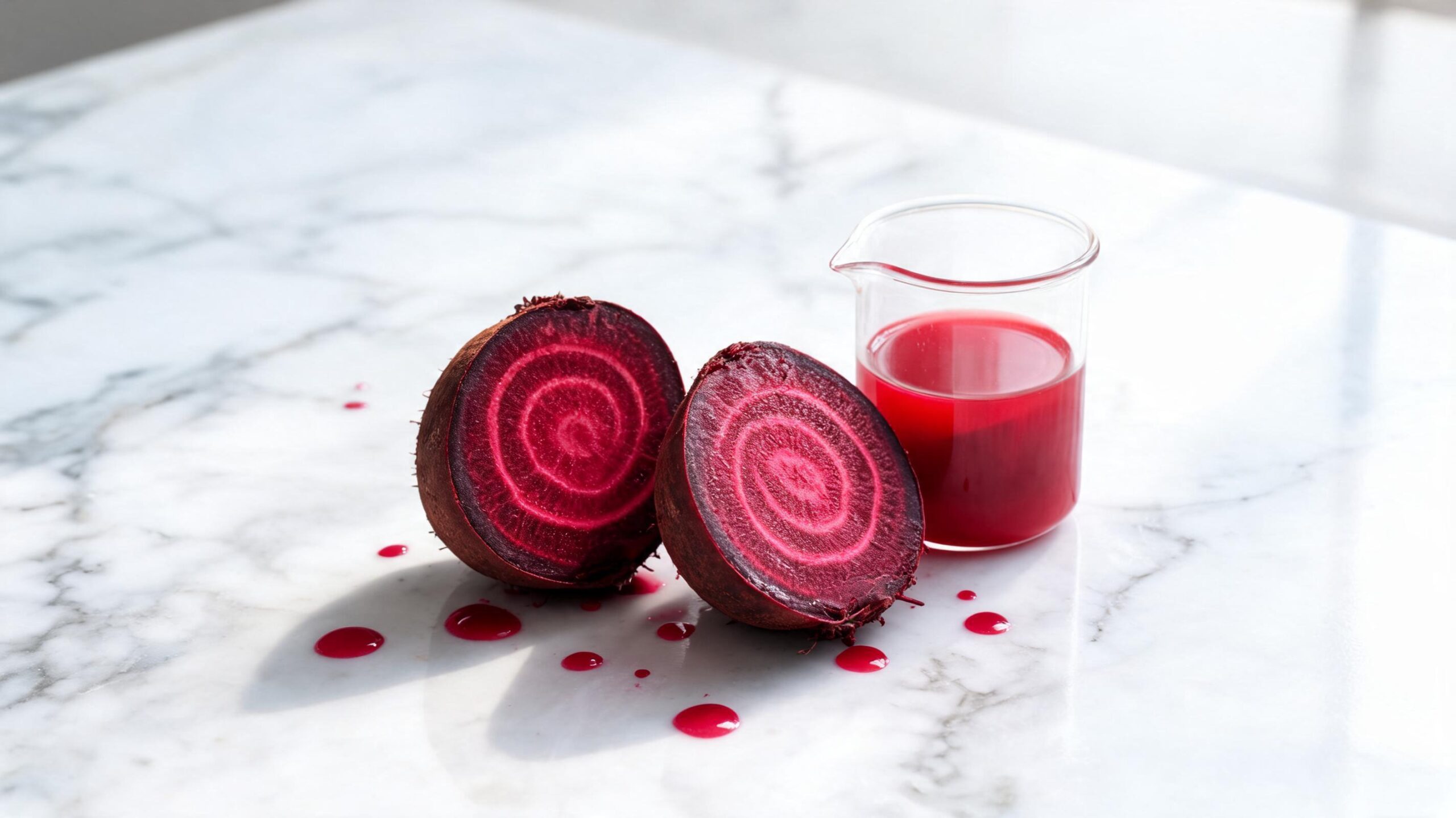
Beeturia is the passage of red or pink urine after eating beetroot. The pigment doing the colouring is betanin, the dominant red-violet betalain in red beetroot (Beta vulgaris). Betanin is not the same compound as the red anthocyanin in berries or the lycopene in tomatoes. It is a nitrogen-containing glycoside — chemically closer to the yellow pigments in saffron than to the red pigments in strawberries — and it survives most of the gut intact enough to reach the kidneys.
The same betalain can also colour stool. Red or pink stool after beetroot is the same pigment, by a different route: the betanin that is not absorbed in the small intestine and not fully metabolised by the colonic microbiota travels through the colon and exits in the faeces. Beeturia and beetroot-coloured stool can happen together or separately, and the visible colour in either is largely a function of dose and transit time.
What beeturia is not: it is not haematuria (blood in the urine), it is not a sign of beetroot allergy, and it is not a sign that your gut is failing to absorb the beetroot. In a 2008 controlled-feeding study by Watts and colleagues, 16 of 32 healthy adults (50%) developed visible beeturia after drinking 500 mL of beetroot juice; a further subset developed coloured stool. The subjects whose urine turned red were not the subjects with poorer nutritional status. They were the subjects with one of three measurable, identifiable traits, all of which we will return to.
The prevalence figure varies. Older estimates put visible beeturia at around 10–15% of the general population after a typical serving of cooked beetroot; with the larger doses used in recent nitrate-supplementation trials (500 mL of concentrated beetroot juice), the figure climbs much higher. The point is not the exact number. The point is that beeturia is common, expected at the doses people take for blood pressure or endurance, and not a reason to stop eating beetroot.
The mechanism: why betalain reaches the urine at all
Betanin absorption is the starting point. After you eat beetroot, betanin is released from the plant cell walls during chewing and stomach acid denaturation. In the small intestine, it is taken up by enterocytes partly intact and partly after bacterial deglycosylation to betanidin — the aglycone form. The absorbed pigment enters the portal circulation, passes through the liver (where most of it is not conjugated), and reaches systemic circulation. From there, the fraction that is not taken up by peripheral tissues is filtered at the glomerulus and excreted renally. The urine colour you see is the renally cleared fraction.
This is the same pathway that governs the colour of betalain-rich drinks such as betacyanin standards, red dragon-fruit juice, and red-pigmented pitaya. The pigment that gets through is small, polar, water-soluble, and not extensively metabolised. The pigment that does not get through is either degraded by the colonic microbiota or simply passes through unabsorbed and shows up in the stool.
Two things follow from this. First, the dose-response curve is steep: a small portion of cooked beetroot (~50 g) produces no visible beeturia in most adults; a large portion or a concentrated beetroot juice (~500 mL) produces visible beeturia in a much higher fraction. Second, the time course is predictable: beeturia peaks roughly 2–4 hours after ingestion and resolves by 12–24 hours in most people. If your red urine does not match that timing, it is not beeturia.
The three reasons beeturia shows up in some people and not others
This is the most useful part of the beeturia story, and the part that the standard “beetroot benefits” articles skip. Beeturia is not random. It is the visible output of one of three specific biological traits. The published literature — going back to Watts and colleagues (1993), and extended by the McGhie and Walton (2014) review of betalain pharmacokinetics — converges on the same three:
1. Low iron status. Iron deficiency increases betalain absorption. The proposed mechanism is that the same divalent-metal-transporter pathways that upregulate non-haem iron absorption in the duodenum when body iron is low also transport betalain more efficiently. Watts 1993 showed that subjects with lower serum ferritin had a higher rate of visible beeturia after a standardised beetroot challenge; the effect reversed with iron repletion in a small within-subject crossover. The clinical-decoding implication: visible beeturia in someone who also feels tired, especially a pre-menopausal woman or a 30–55-year-old man with a “blood test normal but I still feel tired” picture, is a soft signal to ask a doctor for a ferritin + folate + B12 + homocysteine panel — not a CBC.
2. Specific gut-microbiota composition. Not everyone’s colonic bacteria handle betanin the same way. Published work by McGhie and Walton and the broader betalain-microbiota literature shows that individuals with gut microbiota dominated by Bacteroides-type species tend to deglycosylate betanin to betanidin efficiently, which is then re-absorbed or further broken down; individuals with other dominant microbiota profiles leave more intact betanin to be absorbed in the small intestine, which is then renally cleared and visible in the urine. The same microbiota composition that drives this also affects what other plant pigments you absorb — the broader claim, not yet fully characterised, is that “what colour your urine is after beetroot” tracks with the broader capacity of your gut to handle red-pigmented plant foods.
3. Low stomach acid. Hypochlorhydria — including the drug-induced form from long-term proton-pump inhibitor use, and the age-related form that becomes common after 60 — reduces the acid-driven breakdown of betanin in the stomach. The net effect is more intact pigment reaching the small intestine, more intact pigment absorbed, and more pigment available for renal clearance. Watts 1993 again: subjects with documented low stomach acid had a higher rate of visible beeturia.
These three overlap. A 35-year-old woman with low ferritin who has been on a PPI for reflux for two years, and whose gut microbiota reflects a low-fibre Western pattern, is at the high end of the visible-beeturia probability. A 25-year-old male athlete with normal iron status, good stomach acid, and a fibre-rich diet is at the low end. The same beetroot, the same dose.
The iron-status link most beetroot-benefits articles skip
This is the contrarian part of the article. Beetroot articles on the open web dominantly cover the nitric-oxide layer (blood pressure, endurance, cerebral blood flow) and the form-comparison question (juice vs crystals vs powder). Both layers are real and well-evidenced. Neither is what this article is about.
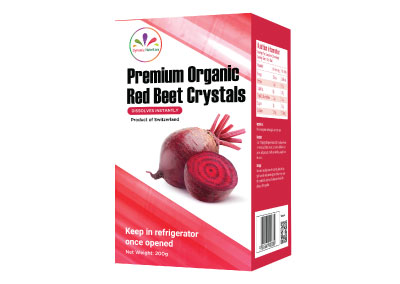
The layer they skip is the non-haem iron + folate + betaine substrate. A 10 g serve of freeze-dried premium organic red beet crystals — the standard one-heaping-tablespoon dose of the Swiss-manufactured Premium Organic Red Beet product — delivers not only ~4–6 mmol of nitrate (the published dose-per-10 g number for premium organic red beet crystals) but also:
• ~0.8–1.2 mg of non-haem iron, modest in absolute terms but meaningful in the context of the ~8–18 mg daily iron requirement for pre-menopausal women, and a useful substrate layer for the reader with marginal ferritin who cannot or does not want to take an isolated iron supplement.
• ~100–150 µg of folate, the form of dietary folate that supports the homocysteine-remethylation pathway; the published folate-content-of-red-beet-crystals number is non-trivial in the periconceptual + perimenopausal demand picture.
• ~250–350 mg of betaine (trimethylglycine), the methyl-donor that runs in parallel to folate in the homocysteine-remethylation cycle. The published betaine-content-of-red-beet-crystals number is, per gram of beetroot, one of the higher dietary betaine concentrations in the vegetable kingdom.
The published MOH Malaysia + HPB Singapore data put ~25–35% of reproductive-age women at ferritin <30 µg/L (the published “low-but-not-anaemic” floor) and ~10–15% at frank iron-deficiency anaemia. The reader who has been told by their GP that their bloods are “normal” on a standard CBC and yet still feels tired is, more often than not, in the low-ferritin + low-folate + high-homocysteine cluster that the standard CBC misses. The same reader who notices beeturia after beetroot has, in the beeturia itself, a soft signal that the iron-status layer is worth investigating.
This is not a recommendation to use beetroot as an iron supplement. It is a recommendation to read the combination of “I feel tired but my bloods are normal” plus “beetroot turns my urine red” as a single coherent picture, and to ask a doctor for the right blood panel rather than the default one.
The betalain substrate layer (the under-reported one)
The final layer most “beetroot benefits” articles skip is the substrate that is doing the colouring in the first place: betalain itself. The nitric-oxide work dominates the beetroot literature because the trials are robust and the effect sizes are measurable. The betalain-substrate literature is younger, smaller, and the human-trial evidence is still emerging.
What is in the published record. In vitro and animal-model work — Reddy and colleagues (2005), Georgiev and colleagues (2010), Esatbeyoglu and colleagues (2014) — has shown that betanin and the related yellow betalain vulgaxanthin have measurable anti-inflammatory, antioxidant, and COX-2-inhibition activity. The published mechanisms include direct free-radical scavenging, modulation of NF-κB signalling, and inhibition of lipid peroxidation in cell-culture and rodent models. These are not yet strong-enough claims for a human-efficacy statement at dietary doses, but they are the published mechanism that makes the betalain-substrate question worth following.
What is not yet in the published record. The betalain-substrate question has not yet been the subject of a large, well-powered, randomised human trial with a clinically meaningful endpoint (the way the nitrate-endurance and nitrate-blood-pressure questions have). The emerging but still-thin published human-trial evidence base is the main reason this layer is “under-reported” — the editorial frame for “beetroot benefits” tends to anchor on what has the strongest human-trial evidence (the nitric-oxide layer), and the substrate layer that is doing the colouring is, by editorial accident, the one that gets the least coverage.
Why the consistency of the source matters. A 10 g serve of freeze-dried premium organic red beet crystals delivers a standardised ~300–500 mg of betalains per serve (the published betalain-content-of-organic-red-beet-crystals number). The same betalain content in fresh beetroot or raw beetroot juice varies by a factor of 3–5 depending on cultivar, harvest timing, and storage — which means a reader who wants the substrate layer in a consistent per-serve form is better served by the freeze-dried form than by the raw form. That is the same argument that applies to the nitric-oxide layer (which is also more consistent in the freeze-dried form), but the substrate layer is the one with the larger per-serve variability in the raw form.
When red urine is NOT beeturia (the safety boundary)
Red urine after beetroot is, in the overwhelming majority of cases, beeturia. But not always. The published differential for red or pink urine in an adult who has eaten beetroot in the preceding 12–24 hours is dominated by beeturia, and the published differential for red urine in an adult who has NOT eaten beetroot recently is dominated by other causes.
The “see a doctor today” set is short:
• Red or pink urine with no beetroot in the preceding 24–48 hours, especially if accompanied by flank pain, urinary frequency, dysuria, or fever — the differential includes urinary tract infection, nephrolithiasis (kidney stone passage), glomerular bleeding, and several others.
• Red or pink urine that does not resolve within 24 hours of the most recent beetroot serving — beeturia is metabolically self-limiting and should clear within a day; persistence is a flag.
• Red or black stool (melena) without beetroot in the preceding 24–48 hours, or any red stool accompanied by abdominal pain, weight loss, or change in bowel habit — the differential includes lower-gastrointestinal bleeding from several sources and is a physician-today question, not a beetroot-tomorrow question.
• Red or pink urine in a child who has not eaten beetroot — paediatric haematuria has its own differential that does not include “beeturia” until it has been ruled out by the absence of recent dietary exposure.
The article is informational; it does not replace a clinical assessment. The “is this beeturia or something else” question is the kind of question worth one phone call to a primary-care doctor, not a forum thread.
What to do with this
Three actionable reads of the beeturia picture.
If you notice beeturia and feel tired. Ask your GP for a ferritin + folate + B12 + homocysteine panel — not just a standard CBC. The “bloods normal” picture that misses low ferritin is the most common diagnostic-omission story in the tired-but-functional adult, and beeturia is a soft signal that the iron layer is worth investigating. Do not start self-supplementing iron without the test; excess iron is its own problem.
If you notice beeturia and are on long-term acid suppression. The PPI + low-stomach-acid + higher-beeturia connection is in the published record. Discuss with your prescriber whether the dose is still indicated, whether the lowest effective dose is being used, and whether periodic attempts at dose reduction are appropriate. PPI use for years without re-evaluation is its own growing body of evidence base.
If you notice beeturia and want the substrate layer. The freeze-dried premium organic red beet crystals in a consistent 10 g-per-serve form delivers the standardised betalain + nitrate + non-haem iron + folate + betaine substrate that the raw form cannot match per-serve. One heaping tablespoon (about 10 g) in a glass of water 1–2 times daily with meals is a substrate-first protocol that addresses all five layers at once. The same product used in the published beetroot-and-blood-pressure work (which is the layer most readers come to beetroot for) is the same product that delivers the betalain-substrate layer the standard “beetroot benefits” articles skip.
Beeturia is not a problem to fix. It is information about your substrate. Read it as such, and you get a small but real picture of how your body handles red-pigmented plant foods — and where the substrate layers in beetroot sit, both the well-evidenced nitric-oxide layer and the under-reported betalain-substrate layer, that the open-web beetroot-benefits articles tend to miss.
Product you may be interested in