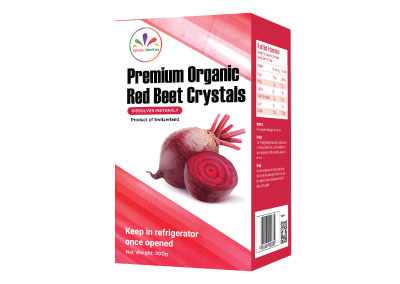
You have seen the word on a jar or a pouch: beet crystals. Beetroot juice is a drink. Beetroot powder is a scoop in a smoothie. Crystals sound like a third thing entirely — something crystallised, refined, closer to a laboratory chemical than to a vegetable. And yet the question people actually type into a search box is the same every time: are beet crystals good for you?
This article is for the person who wants a straight answer rather than a sales page. Beet crystals are not a synthetic compound and they are not a new drug class. They are dried beetroot, and the useful part of that sentence is dried beetroot — you can work out what any given packet is worth by reading the label, and you can work out what the research supports by reading the endpoint the trials measured. Both of those are different questions from the one most marketing copy answers.
So here is the plan. First, what a beet crystal physically is. Second, what it is standardised for — which is usually not the word on the front of the pack. Third, what the human trials actually measured, and where that evidence stops. Fourth, how to read your own label in about thirty seconds. What this article will not do is promise you a blood-pressure number, a faster 5K, or a cleaner bloodstream. Those claims exist in this category, and the trials behind them are more modest than the packaging suggests.
What a beetroot crystal actually is
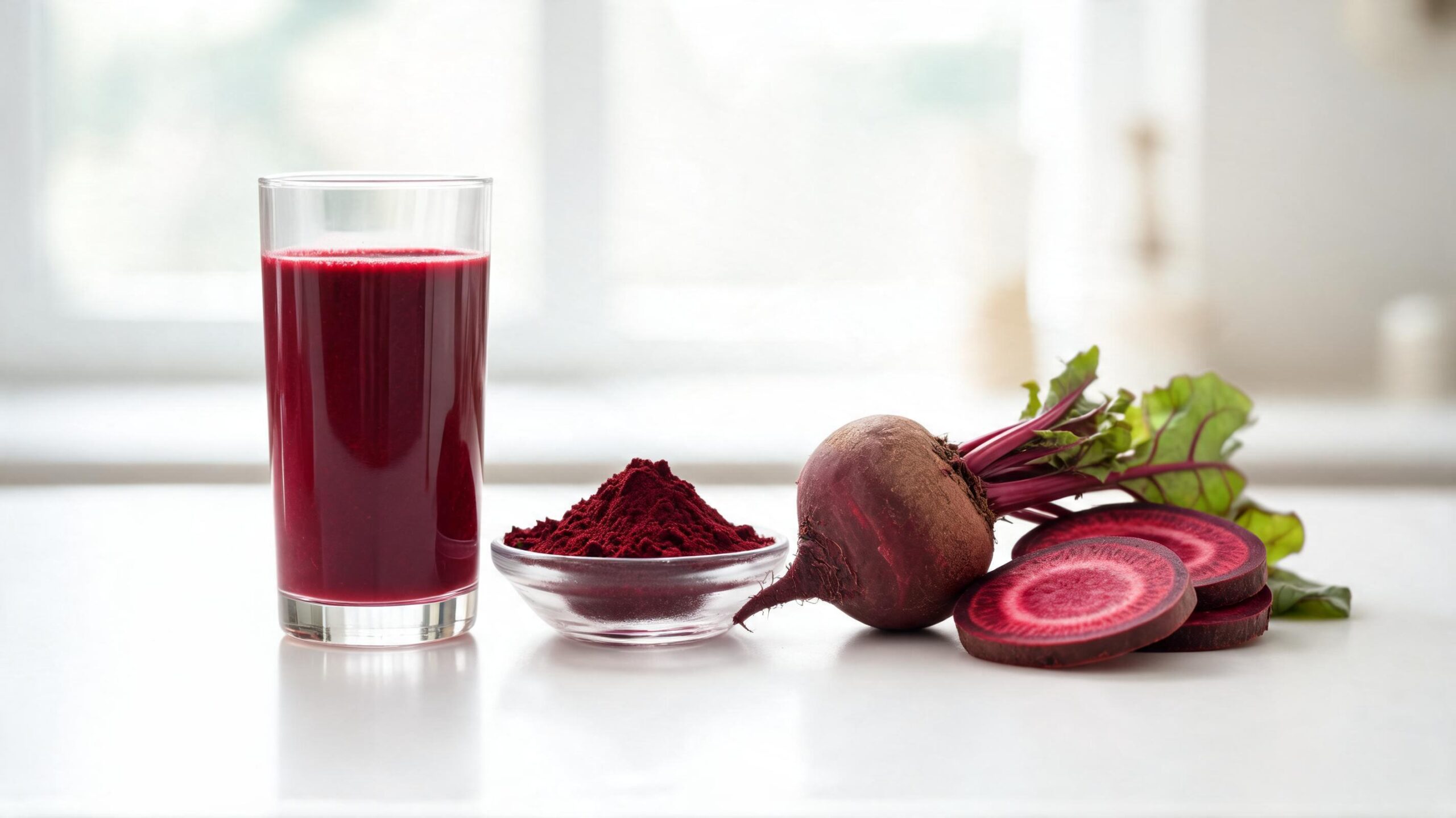
A beetroot crystal is beetroot with the water taken out. The process is straightforward: fresh roots are washed, sliced or diced, dried — usually in industrial dryers or spray dryers — and the dried material is broken into granules. Those granules are what gets sold as beet crystals, beetroot crystals, or crystallised beetroot. The name is a physical description, the same way crystallised sugar describes a shape rather than a new ingredient.
That matters because the word suggests a level of refinement that the product usually does not have. Nothing is distilled out and nothing synthetic is added. The beet’s own cellular structure is partly broken down by the drying, and some heat-sensitive compounds degrade, but the mineral content, the fibre fraction and the pigment survive in reduced, dried form. A beet crystal is closer to dried, concentrated vegetable than to a nutrient extracted and purified into a single molecule.
What survives drying is also what determines what a beet crystal can do. Beetroot is naturally high in inorganic nitrate — the same nitrate found in leafy green vegetables — and it carries the betalain pigments that give red beetroot its colour. Both are preserved to a greater or lesser extent by drying, and the extent differs between products, which is why the label matters more than the front of the pack does.
What “standardised for” means on a beet crystal label
If a beet crystal product says it is standardised, the word is doing a specific job: it means the nitrate content has been measured and held to a stated figure, usually expressed as milligrams of nitrate per serving or per 100 g. Some products are standardised on betalain content instead, which is a different measurement entirely — betalain is the pigment, nitrate is the compound most of the human cardiovascular trials have used. These are not interchangeable, and a label that quotes one while the marketing copy implies the other is worth reading twice.
We are deliberately not quoting a nitrate figure for any brand here. Not because the numbers are secret, but because they vary enormously between products, between batches and between seasons of the same crop, and because the number printed on your packet is the one that applies to you. Check for three things: the nitrate milligrams per serving, the serving size in grams, and how many servings the packet contains. Multiply them out. A product with a respectable per-serving figure and a tiny serving size is not the same as one with a modest figure and a realistic serving.
Two more label details are worth ten seconds. If the ingredients list contains only beetroot, you are looking at the dried vegetable itself. If it lists added vitamin C, that is usually a stabiliser for the betalain pigment, not an active ingredient. Neither list tells you whether the nitrate figure was measured or estimated, so treat an unlabelled nitrate claim with more caution than a quantified one.
What the nitrate trials actually measured
The human research on beetroot and nitrate has a recognisable shape. Most trials have enrolled adults, given a daily dose of nitrate-rich beetroot juice, whole beetroot, or an isolated nitrate supplement, and then measured changes in blood-pressure readings over days to weeks. A second strand of trials has measured exercise endpoints — time to exhaustion, time trial performance, some oxygen-efficiency measures — in trained and untrained participants. These are the two things that show up repeatedly in the published work, and they are the two things that a well-constructed beet-crystal claim should be traceable to.
Two honest caveats sit underneath that. First, the bulk of the trial evidence was generated with juice, whole-root and isolated-nitrate preparations, not with dried crystals specifically. A crystal is a different vehicle with different concentration and different serving conventions, so the sensible way to apply the research to your packet is by the nitrate dose per serving, not by the word on the pouch. Second, the effects that were measured are modest and variable — reductions in blood-pressure numbers in the low single-digit millimetres of mercury in many studies, and inconsistent exercise results that depend on the protocol, the baseline fitness of the participant and the dose used. That is a real effect in a well-run trial, and it is not the same thing as a transformation.
We are not going to re-run the meta-analysis numbers or the per-study breakdown here; that ground is covered in our article on beetroot for blood pressure and what the nitrate trials and meta-analyses actually support. What matters for this article is the shape of the claim: the trials measured endpoints, and endpoints are not the same as promises.
Where the evidence stops
This is the part most benefit pages skip, so it is worth being blunt. The trials behind beetroot nitrate do not support the following claims, and you should treat any copy that makes them as marketing rather than summary:
• It does not “clean your blood” or detox. That is not a measured outcome in this literature, and the phrase has no physiological definition to test. Blood is not a thing that needs cleaning, and no beetroot trial measured a detox endpoint.
• It does not guarantee a lower blood-pressure reading. Where blood-pressure effects have been measured, they are small on average and vary between people. Beetroot is not a substitute for a medication, and it is not a reason to stop one.
• It does not reliably produce a faster race time or a stronger workout. The exercise results are genuinely mixed, and the clearest ones tend to come from specific protocols in specific populations rather than from a general promise to athletes.
• It is not a weight-loss product. No beetroot nitrate trial measured sustained weight loss as an endpoint.
• It is not risk-free in the sense of “always safe for everyone”. There are populations for whom a concentrated nitrate source deserves a conversation with a doctor first — people on blood-pressure medication, people with kidney disease or a history of kidney stones, and anyone with a condition affecting red blood cells.
One side effect is worth naming because it surprises people: some people notice red or pink urine or stool after beetroot. That is a harmless pigment effect rather than a warning sign, and we explain the mechanism in our article on beeturia and what red urine after beetroot actually tells you.
How to read your own label in thirty seconds
You do not need a laboratory or a laboratory vocabulary to make a sensible decision. You need five readings off the packet, and it helps to take them in a fixed order so you do not talk yourself into the first number you see.
First, the form. Juice, powder, crystal and whole root are not interchangeable quantities, and the serving sizes differ by an order of magnitude. Second, the nitrate content per serving, if it is stated at all — and if it is not stated, treat the product as one you cannot compare against a trial. Third, the serving size in grams, because grams per serving is what tells you how concentrated you actually are. Fourth, the ingredient list: one ingredient means the dried vegetable; a longer list means something was added, and you should know what for. Fifth, whether the nitrate figure is per serving or per 100 g, because the second one requires arithmetic before it means anything.
Two final comparisons are worth making. Compare the beet crystal against the beetroot juice you already know: read both nitrate figures and compare them per serving, not per packet. And compare against whole root if that is your baseline — dried product concentrates, so a small spoon of crystals is not equivalent to a small piece of beetroot, and the label is what tells you by how much.
What to do with this
Beet crystals are dried beetroot, standardised usually for nitrate content, and the human evidence for nitrate-rich beetroot is real but bounded: it points at modest blood-pressure changes and inconsistent exercise results in trials of juice, whole root and isolated nitrate. If you are considering a beet crystal product, read the nitrate figure and the serving size, compare the dose against the trials, and treat any claim about detox, guaranteed blood-pressure lowering or a faster race as marketing until someone shows you the endpoint it was measured on. If you are on medication or have a kidney condition, ask your doctor before making it a habit rather than after.
Also available in Bahasa Malaysia and 中文.
Related Topics
Beeturia: what red urine after beetroot actually tells you
Red Beet Crystals vs Beetroot Juice vs Beetroot Powder: Which Form Actually Delivers the Nitrates
Premium Organic Beetroot Crystals vs. Powder: Taste & Solubility
Beetroot for Blood Pressure: What the Nitrate Trials and Meta-Analyses Actually Support
Product you may be interested in