Ask ten people when to take collagen and you will get ten confident answers that do not agree with each other: with breakfast, on an empty stomach, an hour before the gym, at bedtime because the body repairs itself overnight. The shelf copy offers a fourth kind of certainty it cannot support — that one window is the window.
The honest version is narrower than the marketing. A small number of studies have actually tested collagen dosing timing, and almost all of them tested something more specific than “morning or night”: they tested what happened when collagen was taken before a bout of loading exercise, measured with a blood marker of collagen synthesis. That is a real finding, and it is narrower than the question people are actually asking.
This piece separates three things that get run together: what the timing studies measured, what the absorption measurements show about how long a dose is in your bloodstream, and what nobody has tested at all.
What “timing” usually means in a collagen study
Most collagen trials do not test timing at all. They enrol participants, hand them a daily dose, and ask them to take it whenever suits them, then measure an outcome after eight to twelve weeks. That design answers a dose-and-duration question, not a clock-time question. When you read a summary of such a trial saying that collagen improved skin hydration or elasticity, the timing information in it is: unspecified.
That matters because the popular claims about timing are not derived from those trials. They are derived from three separate bodies of evidence that have been stitched together — and the stitching is where the overreach lives.
First, the pre-exercise timing studies. These are the strongest timing evidence that exists, and they are about exercise rather than about the clock. In the best-known of them, eight healthy men took vitamin C-enriched gelatin before rope-skipping in a randomised, double-blind crossover design, with blood drawn every thirty minutes to track amino acids. Circulating glycine, proline, hydroxyproline and hydroxylysine peaked about one hour after the dose, and the elevated collagen-synthesis marker (PINP) measured in engineered ligaments was roughly double what placebo and the lower dose produced. The elevated synthesis signal was still measurable at 72 hours.
A larger dose-response study in resistance-trained men later repeated the shape of that result: 30 g of hydrolysed collagen taken before resistance exercise produced a greater serum PINP response than 15 g, which in turn exceeded 0 g — with the same relationship showing up in blood glycine and proline.
Second, the absorption kinetics. This is what actually constrains the timing question, and it is where the numbers live.
The absorption evidence: what happens in the hours after a dose
Peptide absorption has been measured directly in humans for decades. After oral ingestion of gelatin hydrolysates, food-derived collagen peptides appear in human blood — with prolyl-hydroxyproline (Pro-Hyp) as a major constituent, alongside Ala-Hyp-Gly, Ile-Hyp, Leu-Hyp and Phe-Hyp in smaller proportions.
The dose-dependence is well characterised. In human plasma after collagen hydrolysate ingestion, both the free and the peptide-bound forms of hydroxyproline rise, and the size of that rise scales with the ingested dose. In the study that established this, the peptide-form hydroxyproline response was larger than the free-form response at every dose tested — the signature of di- and tripeptides being taken up intact rather than fully hydrolysed to free amino acids. A more recent randomised, double-blind crossover trial in healthy individuals confirmed the same pattern across collagen hydrolysates from different sources and molecular weights: free hydroxyproline uptake was comparable across all of them, and the excess of total over free hydroxyproline showed that substantial amounts of hydroxyproline-containing di- and tripeptides were being absorbed.
The timing within that response is also measurable. In the pre-exercise study, circulating amino acid content peaked about one hour after a 15 g dose and about 30 minutes after a 5 g dose. More recent work on the kinetics of individual collagen-derived species in blood has shown the same general shape with a species-by-species twist: the peptide form of hydroxyproline-containing dipeptides peaked around one hour after ingestion, while the corresponding tripeptide peaked later, at around two hours.
What this means practically: the collagen-derived signal in your blood is not a one-hour spike that requires precise scheduling to catch. It rises within the first hour, and the dominant components of collagen — glycine and proline in particular — remain available in the circulation for hours afterwards. The upstream precursor that collagen is built from is fed continuously rather than in a narrow window.
There is also a transport detail worth knowing, because it is the mechanistic reason small peptides behave differently from large ones. The intestinal peptide transporter PepT1 handles di- and tripeptides as intact units, moving them across the enterocyte without first disassembling them into free amino acids. Work on its regulation profile describes a transporter capable of handling more than 400 dipeptides and some 8,000 tripeptides derived from dietary protein. A 500-Da collagen tripeptide is three amino acids long — small enough to travel this route intact.

What the timing studies do not show
Here is the gap, and it is a large one: no published trial has tested morning versus evening collagen dosing head-to-head. Not for skin, not for joints, not for sleep. The skin trials that produced the wrinkle, hydration and elasticity results did not randomise time of day, and the meta-analyses that pooled them note the consistency of the benefit across differing timing protocols — which is a good argument that timing is not decisive, but it is not a positive test of any particular window.
The “take it at night because your body repairs itself overnight” argument deserves separate handling, because the biological premise is sound and the clinical conclusion does not follow. Skin collagen turnover does follow a daily rhythm, and growth hormone secretion — which stimulates collagen synthesis — does peak during early sleep. That is a real feature of human physiology. What is missing is any trial showing that oral collagen taken before bed produces a measurably different outcome from the same collagen taken in the morning. The plausible mechanism and the demonstrated effect are two different things, and only the first one has been shown.
Likewise the “empty stomach absorbs better” claim. Peptide transport uses dedicated transporters rather than competing with ordinary dietary amino acids for the same carriers, so the theoretical competition is weaker than for standard protein. Whether that translates into a meaningful difference in blood levels for a fed versus fasted dose has not been established in an outcome trial.
And the sleep argument — that collagen before bed may improve sleep quality — comes from a small study of pre-sleep protein, which is a different question from collagen timing and cannot be borrowed as evidence for it.
Where the collagen in TriCollagen fits
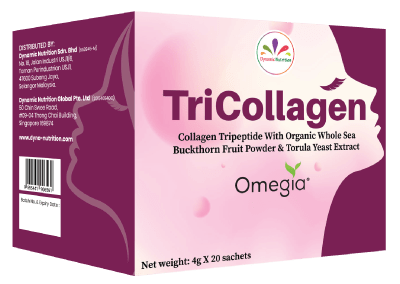
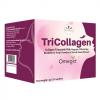
TriCollagen delivers 1,500 mg of 500-Da collagen tripeptide per sachet, in a box of 4 g × 20 sachets, mixed into 125 ml of water or juice. Alongside it sit two cofactors: OPITAC™ torula yeast extract, which is 98% reduced glutathione, and Omegia® Tibetan sea-buckthorn omega-3-6-7-9.
Two things follow from the evidence above. First, the per-sachet dose sits below the 5–15 g used in the pre-exercise timing studies, so those studies describe what a larger loading dose does relative to a loading session — they do not tell you what a single 1,500 mg sachet does at any hour of the day. Second, since a sachet is small, the practical question of “best time” is really a question of consistency and of what the rest of your day looks like.
A defensible reading of the published evidence is narrow and specific: take it daily, at a time you will actually repeat, and treat any claim that one clock window is uniquely optimal as untested rather than as established.
FAQ
Is there a best time to take collagen?
No trial has compared morning with evening dosing head-to-head, so no window has been shown to be superior. The one timing relationship with direct support is relative to loading exercise: collagen taken roughly an hour before a session that stresses connective tissue has been shown to raise collagen-synthesis markers, though at doses of 5–15 g rather than a single sachet.
Does collagen before bed work better because the body repairs overnight?
The premise is right and the conclusion is untested. Collagen turnover and growth hormone do peak in the early hours of sleep, but no published trial has measured whether bedtime collagen outperforms morning collagen on any outcome.
Is collagen better on an empty stomach?
Unproven for outcomes. Small peptides use a dedicated intestinal transporter rather than competing with dietary amino acids for ordinary carriers, so the theoretical downside of taking it with food is smaller than it is for standard protein. No trial has shown a meaningful difference in results between fed and fasted dosing.
Does it matter if I take it with food or in water?
For absorption of collagen-derived peptides, the published kinetics were measured after oral ingestion in controlled settings, and the practical difference for a daily supplement is small. Mixing a sachet into 125 ml of water or juice is a reasonable way to make the daily dose repeatable.
How quickly would I notice anything?
That question is about dose and duration rather than timing. Skin outcomes in the trials were measured at eight weeks and beyond; joint outcomes typically ran 8–12 weeks; bone outcomes were measured over 6–12 months. Nothing in the published work supports expecting a faster result from a better-timed dose.
Should I split my collagen dose across the day?
Splitting is not what the timing studies tested — they used a single dose before a session. Since the collagen-derived amino acids stay available in the circulation for hours and the synthesis signal has been measured as elevated for up to 72 hours after a dose, there is no established basis for splitting over a sachet-sized amount.
References
- Shaw G, Lee-Barthel A, Ross ML, Wang B, Baar K. Vitamin C-enriched gelatin supplementation before intermittent activity augments collagen synthesis. Am J Clin Nutr. 2017;105(1):136-143. https://pubmed.ncbi.nlm.nih.gov/27852613/
- Khatri M, Naughton RJ, Clifford T, Harper LD, Corr L. The effects of collagen peptide supplementation on body composition, collagen synthesis, and recovery from joint injury and exercise: a systematic review. Amino Acids. 2021;53(10):1493-1506. https://link.springer.com/article/10.1007/s00726-021-03072-x
- Iwai K, Hasegawa T, Taguchi Y, Morimatsu F, Sato K, Nakamura Y, et al. Identification of food-derived collagen peptides in human blood after oral ingestion of gelatin hydrolysates. J Agric Food Chem. 2005;53(16):6531-6536. https://pubmed.ncbi.nlm.nih.gov/16076145/
- Shigemura Y, Kubomura D, Sato Y, Sato K. Dose-dependent changes in the levels of free and peptide forms of hydroxyproline in human plasma after collagen hydrolysate ingestion. Food Chem. 2014;159:328-332. https://doi.org/10.1016/j.foodchem.2014.02.091
- Taga Y, Iwasaki Y, Tometsuka C, et al. Identification of a highly stable bioactive 3-hydroxyproline-containing tripeptide in human blood after collagen hydrolysate ingestion. npj Sci Food. 2022;6:14. https://www.nature.com/articles/s41538-022-00144-4
- Virgilio N, Schön C, Mödinger Y, et al. Absorption of bioactive peptides following collagen hydrolysate intake: a randomized, double-blind crossover study in healthy individuals. Front Nutr. 2024;11:1416643. https://www.frontiersin.org/journals/nutrition/articles/10.3389/fnut.2024.1416643/full
- Wang CY, Liu S, Xie XN, Tan ZR. Regulation profile of the intestinal peptide transporter 1 (PepT1). Drug Des Devel Ther. 2017;11:3511-3517. https://www.dovepress.com/regulation-profile-of-the-intestinal-peptide-transporter-1-pept1-peer-reviewed-fulltext-article-DDDT
- Lee J, Tang J, Dutton J, et al. The collagen synthesis response to an acute bout of resistance exercise is greater when ingesting 30 g hydrolyzed collagen compared with 15 g and 0 g in resistance-trained young men. J Nutr. 2024;154(6):2076-2086. https://doi.org/10.1016/j.tjnut.2023.10.030
Product you may be interested in