Walk into any supplement aisle and the collagen shelf is loud about skin — wrinkles, hydration, elasticity, “glow”. Joints get a sentence, if that. Yet cartilage is arguably where the collagen story is structurally most interesting, because cartilage is a collagen structure: a dense mesh of type II collagen that holds proteoglycans and water in a matrix your chondrocytes rebuild very, very slowly.
This piece sets out what collagen tripeptide actually does at that matrix, what the published joint-outcome research does and does not show, and where a 500-Da collagen tripeptide sachet fits into the picture — and, just as importantly, where it does not.
Cartilage is a collagen structure before it is a “joint supplement” category
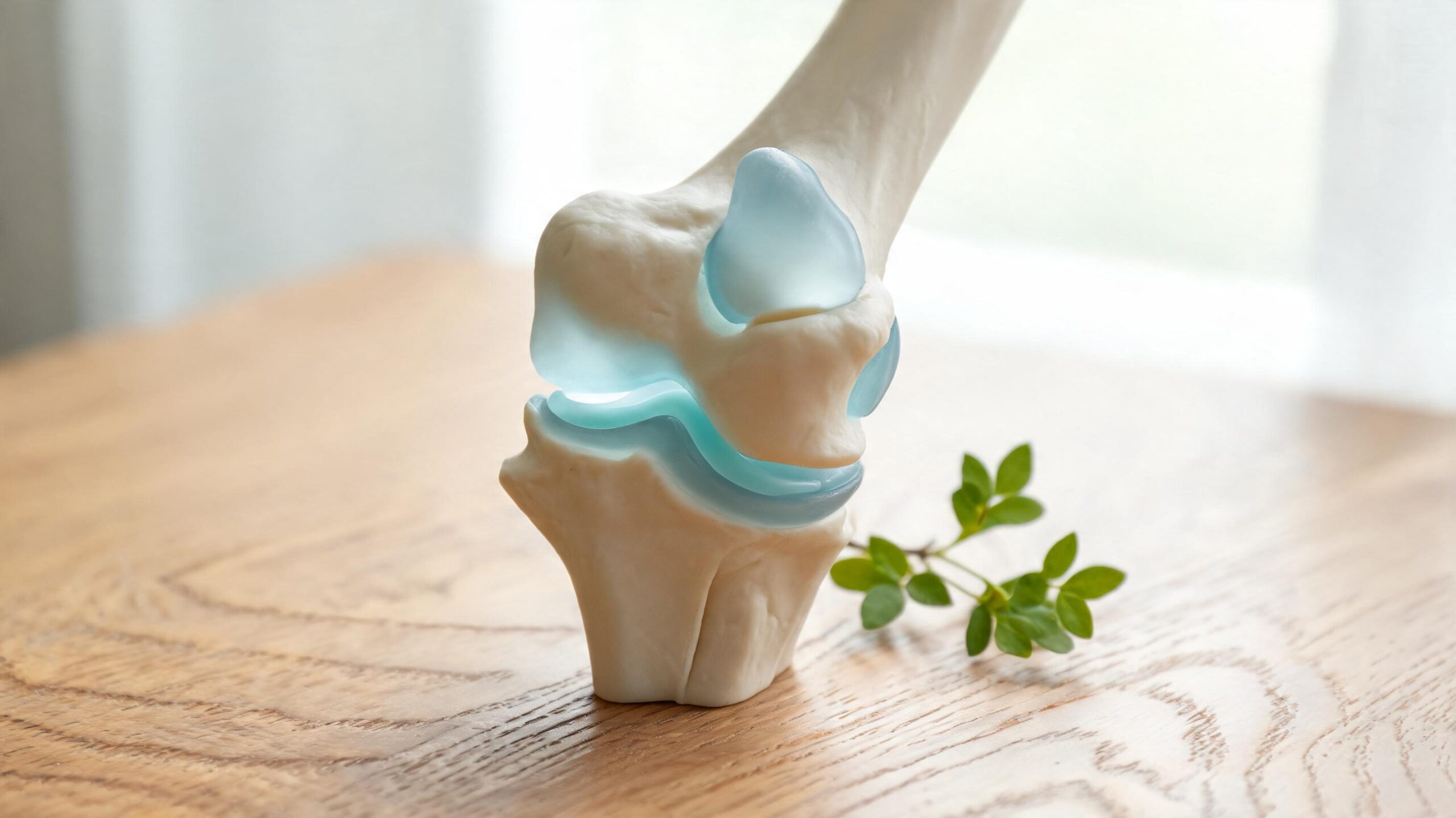
The reason skin and joint collagen marketing drift apart is that the underlying biology does not care about marketing categories. Articular cartilage is a load-bearing tissue with one dominant structural protein: type II collagen. That collagen network holds together the proteoglycans — the large sugar-protein complexes that pull in water and give cartilage its compression resistance. Remove or degrade the collagen mesh and the proteoglycans have nothing to sit in. The tissue degrades.
Two features of that biology set the limits of every claim made about cartilage nutrition.
First, turnover is slow. Unlike bone, which is continuously remodelled, articular cartilage turns over slowly. That is why cartilage damage tends to be cumulative rather than self-repairing, and why the nutrient-supply argument for cartilage is about supporting a slow synthetic process rather than triggering a fast one.
Second, the collagen in cartilage is made in place, from amino acids. Chondrocytes do not absorb finished collagen from your bloodstream. They build type II collagen locally, using the raw materials that reach them: amino acids (glycine, proline and hydroxyproline dominate the collagen sequence), plus vitamin C as an obligate cofactor for the hydroxylation steps, plus a working energy and protein budget.
That is the honest version of the “cartilage support” idea, and it is narrower than most shelf labels. Nutrition supplies substrate for a synthetic process. It does not replace the process, and it cannot reconstruct a joint that has already been structurally damaged.
Where 500-Da collagen tripeptide actually differs
The molecular form matters because of how the gut handles collagen. Native collagen is roughly 300,000 Da — far too large to absorb intact. Enzymatic hydrolysis produces a mixture of peptides and free amino acids, and the label word “collagen peptide” covers chains anywhere from a few thousand daltons down to a few hundred. Those larger fragments are largely broken down to free amino acids during digestion, where they are absorbed by ordinary amino-acid transporters and enter general protein metabolism.
Di- and tripeptides take a different route. The intestinal peptide transporter PepT1 is selective for small peptides — work on its regulation profile describes it as handling more than 400 dipeptides and some 8,000 tripeptides derived from dietary protein — and it moves them into the circulation as intact units rather than first disassembling them. A collagen tripeptide of roughly 500 Da is three amino acids: small enough to travel this route.
So the argument for a 500-Da tripeptide is a bioavailability argument, not a potency argument. The claim is not that tripeptide collagen is “more collagen” per gram. It is that a larger share of what you swallow arrives intact and in a form the body recognises as peptide rather than as generic amino acids.
What the joint-outcome evidence shows — and where it stops
The honest answer is that joint evidence exists, it is not trivial, and it is not clean. Three recent sources are worth reading rather than paraphrasing.
A 2025 systematic review and meta-analysis of 11 randomised controlled trials pooled 870 participants with knee osteoarthritis and reported that collagen supplementation favoured both function (mean difference −6.46) and pain scores (mean difference −13.63) versus placebo. The direction of effect favours collagen. So does the magnitude look impressive until you read the heterogeneity: I2 was 75% for function and 88% for pain. At that level, the pooled result is an average across trials that disagree substantially with each other, and the pooled number should not be read as a predictable effect for any given person.
A 2025 systematic review of 36 randomised trials on type I collagen hydrolysate across bones, muscles and joints found the picture splits by tissue: bone-health studies carried limitations that prevented firm conclusions, while joint-health studies reported beneficial outcomes — pain reduction, improved clinical parameters, increased physical mobility. Muscle findings were inconsistent, with positive effects appearing mainly when supplementation was paired with resistance training.
A 2025 randomised controlled trial in knee osteoarthritis tested a combination of undenatured type II collagen with hydrolysed collagen and noted that most earlier clinical studies of individual collagen formulations were industry-sponsored, which raises bias concerns. That is a useful and fair caveat about the field in general, and it applies with equal force to any specific collagen brand — including the one discussed below.
Three further points keep this grounded. First, none of these interventions is the same thing as a 500-Da collagen tripeptide sachet with added cofactors, so the evidence cannot simply be transferred to one product. Second, none of this displaces the core of osteoarthritis care: NICE guidance makes therapeutic exercise and weight management the foundation of management, and advises against routinely offering glucosamine. Third, and most importantly, the trials measure symptom and function outcomes in people who already have osteoarthritis. None of them demonstrates that a collagen supplement rebuilds cartilage in a healthy joint, and none of them supports a pain-relief or joint-mobility claim for any specific product.
How TriCollagen sits in the joint question
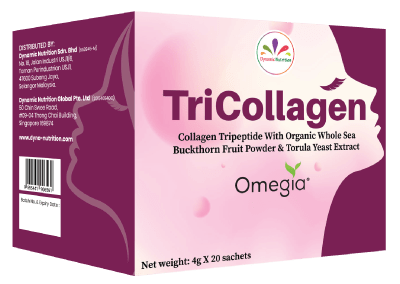
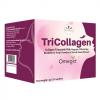
TriCollagen is built around 1,500 mg of 500-Da collagen tripeptide per sachet, in a box of 4 g × 20 sachets, mixed into 125 ml of water or juice. Alongside it sit two cofactors: OPITAC™ torula yeast extract, which is 98% reduced glutathione, and Omegia® Tibetan sea-buckthorn omega-3-6-7-9.
Read against the biology above, the defensible description is narrow and specific. It is a nutrition-support input for a collagen-substrate question: it supplies a concentrated source of small collagen peptides in the molecular form the gut absorbs most efficiently, plus a reduced-glutathione source and a lipid fraction. That is a reasonable thing to want if your reasoning is that slow-turnover connective tissue depends on a steady supply of substrate.
It is not a pain-relief product, it is not an arthritis treatment, and no outcome claim for it has been established in a trial of this product. If a label, a seller or a well-meaning friend tells you a collagen sachet will “fix” joint pain, that is a claim the published evidence does not support — and it is a claim that a product as specific as this one could not support without its own trials, which it does not have.
What to do if joints are the actual goal
Two things are worth more than any supplement if cartilage turnover is your concern, and both are better evidenced than collagen supplements. The first is load: cartilage is maintained by use, and the muscle adaptations that follow resistance training also appear to improve joint-supporting function. The second is body weight when it is relevant, because load scales with mass and weight loss reliably improves pain and function in osteoarthritis. Nutrition — including adequate total protein, vitamin C and, if you want it, a collagen tripeptide — sits alongside those, not above them.
If you have joint pain that is persistent, worsening, or waking you at night, that is a clinical assessment rather than a shopping decision. A clinician can exclude the causes that a supplement cannot address.
FAQ
Is collagen tripeptide better than ordinary collagen for joints?
Different, rather than straightforwardly better. The argument is about absorption: a 500-Da tripeptide can cross the gut via the peptide transporter as an intact unit, where larger hydrolysed fragments are more likely to be broken down to free amino acids first. Whether that difference translates into a better joint outcome is not established for any specific product, because the trials measure other formulations.
Will collagen tripeptide rebuild cartilage?
No evidence supports that claim. Cartilage is rebuilt locally by chondrocytes from amino acids and vitamin C. Collagen supplementation is a nutrient input to that process, not a repair material and not a treatment for damaged cartilage.
Does it help joint pain?
Trials of collagen supplementation in people with knee osteoarthritis have reported improvements in pain and function scores on average, with high variation between trials. That is not the same as a pain-relief effect you can expect from a specific sachet, and it does not extend to people without diagnosed osteoarthritis.
Is marine or bovine collagen better for joints?
Both supply type I collagen, which is the dominant collagen in bone, tendon and skin rather than in cartilage itself. Once hydrolysed to a 500-Da tripeptide, the source difference mostly narrows to allergen profile, dietary and religious considerations, and cost.
Do I need it if I eat plenty of protein?
If your total protein intake already covers your body’s needs, a collagen tripeptide adds a concentrated peptide source rather than filling a genuine gap. Whether that is worth the cost is a personal judgement, not a clinical one.
References
- Simental-Mendía M, Ortega-Mata D, Acosta-Olivo CA, Simental-Mendía LE, Peña-Martínez VM, Vilchez-Cavazos F. Effect of collagen supplementation on knee osteoarthritis: an updated systematic review and meta-analysis of randomised controlled trials. Clin Exp Rheumatol. 2025;43(1):126-134. https://doi.org/10.55563/clinexprheumatol/kflfr5
- Brueckheimer PJ, Costa Silva T, Rodrigues L, Zague V, Isaia Filho C. The Effects of Type I Collagen Hydrolysate Supplementation on Bones, Muscles, and Joints: A Systematic Review. Orthop Rev (Pavia). 2025;17:129086. https://doi.org/10.52965/001c.129086
- Yuenyongviwat V, Anusitviwat C, Tuntarattanapong P, Hongnaparak T, Iamthanaporn K. Efficacy of combined undenatured type II collagen and hydrolysed collagen supplementation in knee osteoarthritis: a randomised controlled trial. Sci Rep. 2025;15(1):32313. https://doi.org/10.1038/s41598-025-17505-0
- Wang CY, Liu S, Xie XN, Tan ZR. Regulation profile of the intestinal peptide transporter 1 (PepT1). Drug Des Devel Ther. 2017;11:3511-3517. https://doi.org/10.2147/DDDT.S151725
- National Institute for Health and Care Excellence. Osteoarthritis in over 16s: diagnosis and management. NICE guideline NG226. https://www.nice.org.uk/guidance/ng226
Also available in Bahasa Malaysia and 中文.
Product you may be interested in