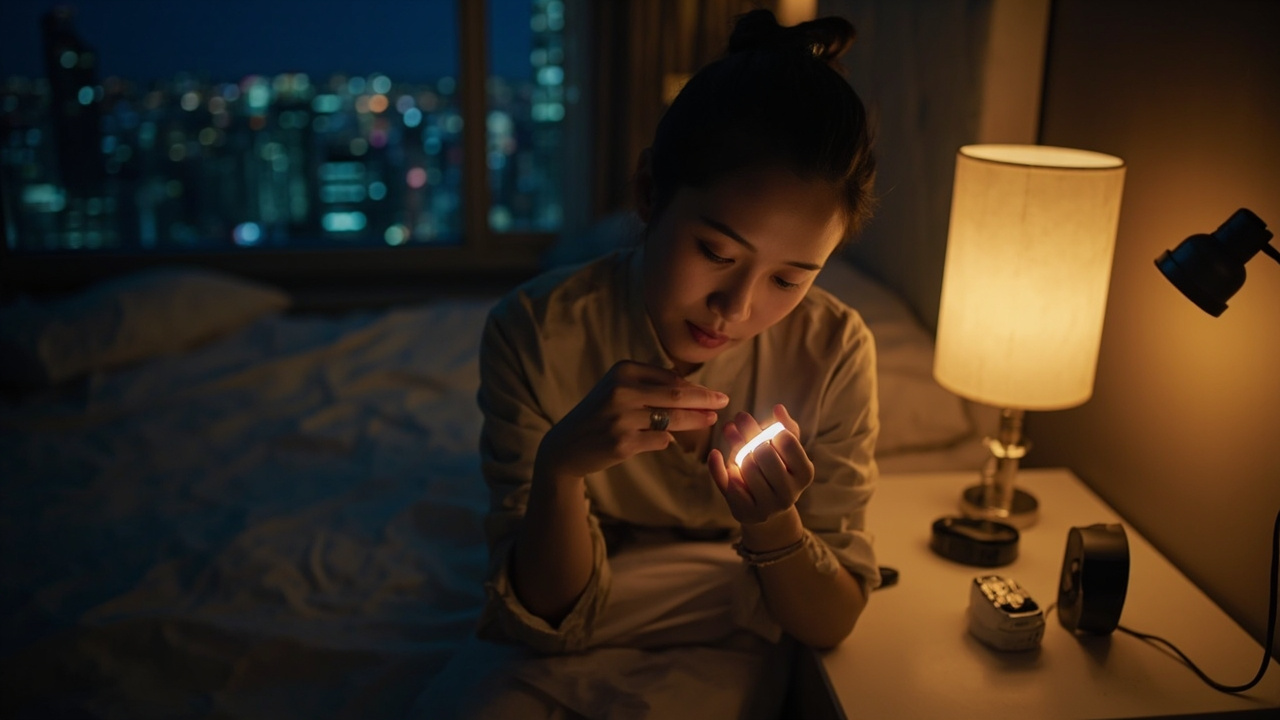
The sleepmaxxing trend — tracking rings, mattress sensors, room-temperature optimisation, blue-light glasses, sleep-coach apps — has produced a quietly absurd scene: a generation that can measure every minute of its sleep, and yet still cannot fall asleep. The 8 September 2026 piece in The Star, “Want a good night’s sleep? Stop worrying about sleepmaxxing — and ditch the fitness trackers”1, captured the clinical contrarian take: for many stressed adults, the obsession with measurement is itself the cause of sleep anxiety, not the solution.
The same insight applies to the broader sleep-and-stress conversation. When you lie awake at 2am because the day was wired, the bedroom temperature is rarely the lever that moves the needle. What shifts is the stress-load itself — the elevated evening cortisol, the sympathetic activation, the mental looping — and that lives below the bedroom and below the wearable. This article decodes what that “below-the-bedroom” layer is, why a daily adaptogen routine built around a clinical-grade ashwagandha extract covers a different kind of repair than any tracker can, and where lemon balm fits into the wired-but-tired pattern.
What the sleepmaxxing trend actually measures
Most sleepmaxxing products — rings, watches, mattress pads, bedside radar — measure surrogates: heart rate variability, skin temperature, motion, snoring. They do not measure sleep architecture directly, and they do not change the underlying stress biology that disrupts sleep in the first place. A wearable can tell you that your deep-sleep minutes dipped on Tuesday; it cannot lower the cortisol curve that produced the dip.
The clinical literature on sleep trackers is increasingly clear. A 2025 systematic review of consumer-grade sleep-tracking devices found that even the most accurate devices still misclassify sleep stages in roughly one in four nights, and that the lowest performers misclassify nearly half. None of the published trials show that wearing a tracker improves sleep quality; several show that wearing one increases sleep anxiety, particularly in already-stressed users2.
The sleep-anxiety feedback loop
When a tracker assigns a low sleep score, the natural reaction is to compensate the next night — earlier bedtime, less caffeine, more wind-down rituals. That compensation works for one or two nights. By the third or fourth night, the compensation itself becomes the stressor: you are now trying to sleep, and effortful sleep is the antagonist of restorative sleep. The clinical literature calls this sleep effort, and it is one of the better-supported mechanisms by which the sleepmaxxing trend entrenches the very problem it is sold to solve3.
What actually shifts a racing mind at night
Three evidence-graded layers move the needle when the cause of the wakefulness is stress, not environment:
1. Lowering baseline cortisol over weeks. A randomized, double-blind, placebo-controlled trial of KSM-66 ashwagandha root extract (300 mg twice daily for eight weeks) in adults with chronic stress showed significant reductions in serum cortisol and perceived stress scores compared with placebo4. A separate eight-week trial in adults with insomnia found improvements in sleep quality, sleep onset latency and sleep efficiency5. The mechanism is the HPA axis — the same system that, when dysregulated, produces the wired-but-tired pattern at night.
2. Calming the racing-thought loop acutely. Lemon balm extract (Melissa officinalis), standardised for rosmarinic acid, has been studied for its action on the GABA pathway — the same calming neurotransmitter system that pharmaceutical sleep aids target, but through a botanical route. Trials of lemon balm extract have shown improvements in self-reported calm and sleep quality when taken in the evening6. The clinical case for combining it with ashwagandha is that the two work on different time horizons: ashwagandha rebuilds the cortisol baseline over weeks, lemon balm offers an acute GABA-pathway nudge in the hour before bed.
3. Sleep hygiene that is actually about stress. The standard sleep-hygiene advice — dark room, cool temperature, no screens — works because it lowers the sensory input to the sympathetic nervous system. It does not directly change cortisol, but it stops adding to the load. For already-stressed adults, the highest-yield hygiene moves are the ones that reduce arousal, not the ones that optimise measurement: a 90-minute screen-off window before bed, a fixed wake time, and avoiding the post-9pm news scroll.

Why the clinical evidence points to the cortisol layer
Sleep is not a single switch. It is the downstream output of several stacked systems: circadian rhythm, sleep pressure (adenosine), sympathetic/parasympathetic balance, and the cortisol curve. Sleepmaxxing products act on the first two by trying to time light exposure and create sleep-pressure cues; they rarely touch the third and fourth. For most stressed adults, the third and fourth are the layer that is dysregulated — which is why a tracker that improves sleep timing does not improve sleep quality.
The cortisol curve is the cleanest example. In a healthy adult, cortisol rises sharply on waking, holds steady through the morning, gradually declines through the afternoon, and reaches its lowest level in the early hours of sleep. In adults with chronic stress, the curve shifts: evening cortisol stays elevated, melatonin is suppressed, and the body’s signal that it is safe to sleep is overridden by the stress signal. A standard sleep tracker cannot see this — and a cool bedroom cannot fix it.
This is the layer that a clinical-grade ashwagandha extract is designed to address. The 8-week KSM-66 trials measured both the cortisol shift and the subjective stress shift, and they moved in the same direction. That is also why the effect takes weeks: the HPA axis is not a switch, it is a recalibration. A product promising calm in minutes is describing something different — typically a fast-acting GABA-pathway agent, which has its own evidence base but a different use case.
The “stressed but tired” cluster
The pattern clinicians increasingly recognise is the stressed but tired cluster: adults who feel exhausted during the day yet cannot switch off at night. The dual signature is elevated evening cortisol plus active mental looping. It does not respond to caffeine cuts (the problem is not stimulation) or to room-temperature tweaks (the problem is not environment). It responds to two things: lowering the cortisol baseline over weeks, and quieting the mental loop acutely. That is the clinical case for pairing a daily ashwagandha extract with an evening lemon balm routine.
How to read a stress supplement label
If you are considering an ashwagandha product for the stressed-but-tired pattern, four checks separate a clinical-grade product from a marketing one:
1. Root extract, not leaf powder. The clinical data is on full-spectrum root extracts. Leaf-powder products have a different withanolide profile and a thinner published evidence base.
2. Withanolides quantified. Clinical-grade extracts typically state a minimum percentage on the label (for example, KSM-66 specifies ≥5% withanolides). If the label cannot tell you the extract ratio or the withanolide percentage, it cannot be compared with the products used in the published trials.
3. A named clinical ingredient. Standardised extracts with published trial data — such as KSM-66 ashwagandha or lemon balm extract standardised to rosmarinic acid — are identifiable by name. A generic “ashwagandha complex” with no named extract is, by definition, not the ingredient used in the trials.
4. Trial-style dosage. The KSM-66 stress and sleep trials used 300 mg twice daily. The lemon balm trials used 300–600 mg of standardised extract in the evening. Anything materially below those doses is unlikely to reproduce the trial outcomes, regardless of how premium the packaging looks.
Where Reswell fits: a KSM-66 plus lemon balm example
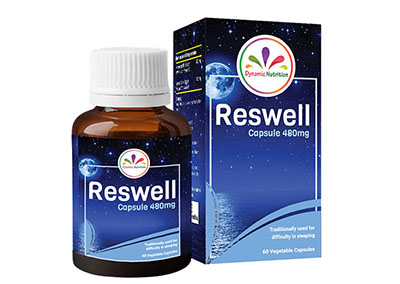
Reswell Capsule is a stress, sleep and memory formula built around the two botanicals covered above. Each capsule pairs 300 mg of KSM-66 — the full-spectrum ashwagandha root extract used in the stress and sleep trials, standardised to ≥5% withanolides — with 180 mg of lemon balm extract (minimum 5% rosmarinic acid). The combination is designed for the stressed-but-tired cluster: KSM-66 works on the cortisol axis over weeks, lemon balm offers an evening GABA-pathway nudge for the acute racing-mind symptom.
Reswell is not a sleepmaxxing product. It will not give you a sleep score, ring you awake at the optimal moment, or adjust your mattress temperature. What it offers is the layer that sits below those tools: a daily routine that addresses the cortisol curve and the GABA pathway, so that by the time you turn the lights off, the body is closer to the state the trackers are trying to measure.
For persistent sleep problems, severe anxiety, or any underlying health condition, speak to a doctor first; supplements support wellness, they do not replace medical care. The right frame for a daily adaptogen routine is not “treats insomnia” — it is a layered support for the stress biology that disrupts sleep in the first place.
References
- Want a good night’s sleep? Stop worrying about sleepmaxxing — and ditch the fitness trackers, The Star (Malaysia), 8 September 2026.
- Sleep tracking technology in daily life: a systematic review of the literature, Journal of Sleep Research, 2024 (open-access review of consumer wearable accuracy and behavioural effects).
- Sleep effort and sleep state misperception: theoretical and clinical implications, Carney et al., Behavioural Sleep Medicine, 2014.
- A Prospective, Randomized Double-Blind, Placebo-Controlled Study of Safety and Efficacy of a High-Concentration Full-Spectrum Extract of Ashwagandha Root in Reducing Stress and Anxiety in Adults, Chandrasekhar et al., Indian Journal of Psychological Medicine, 2012 (KSM-66 8-week trial, 300 mg twice daily).
- Efficacy and Safety of Ashwagandha (Withania somnifera) Root Extract in Insomnia and Anxiety: A Double-blind, Randomized, Placebo-controlled Study, Langade et al., Cureus, 2019 (KSM-66 10-week insomnia trial).
- Attenuation of laboratory-induced stress in humans after acute administration of Melissa officinalis (Lemon Balm), Kennedy et al., Psychosomatic Medicine, 2004 (lemon balm GABA-pathway mechanism).
Product you may be interested in