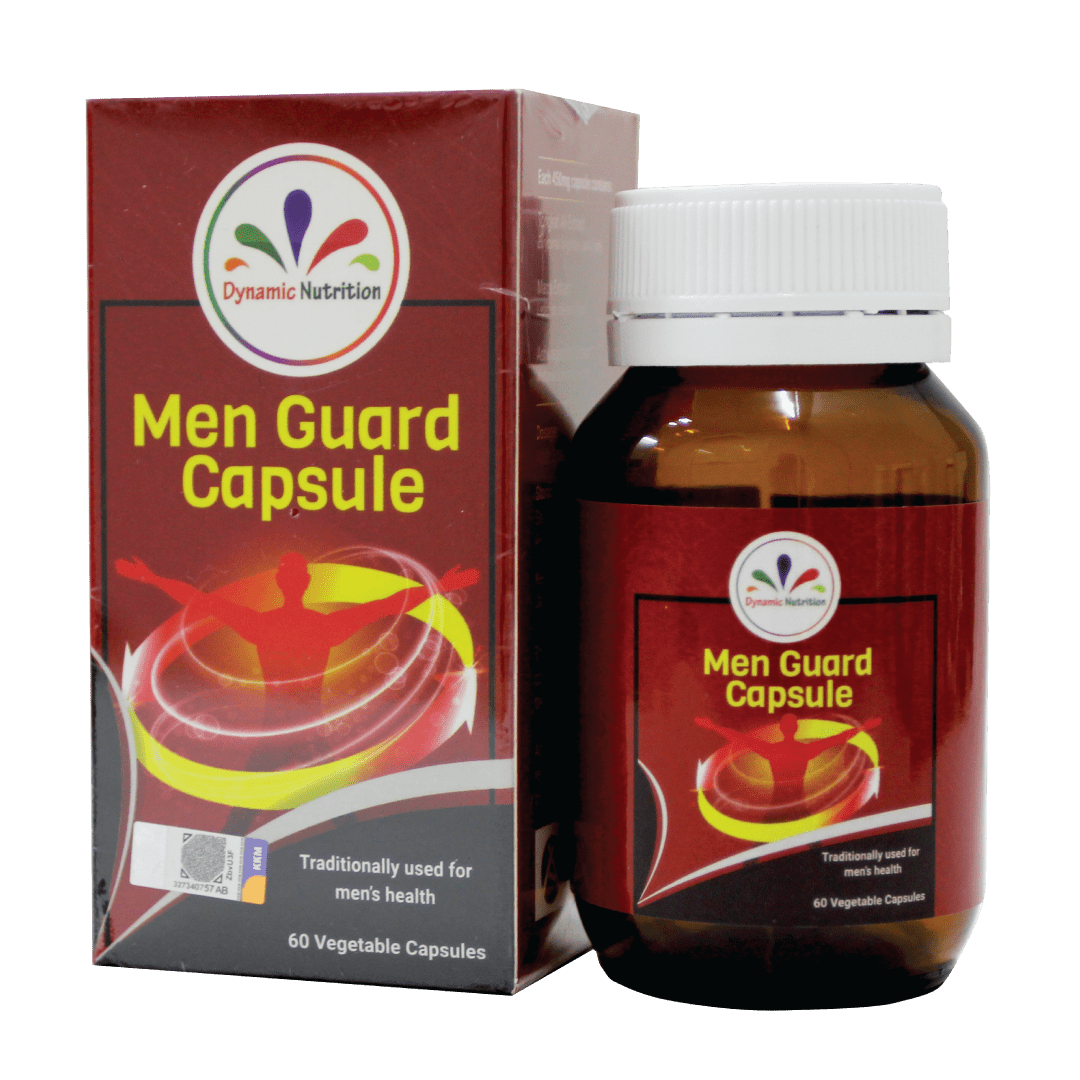
Trainers and weekend athletes in their 30s and 40s often notice the same thing: the workouts that used to leave them tired for a day now leave them sore for three, the weights that used to move now feel heavier, and the recovery window between sessions feels longer for no obvious reason. A new piece in CNA Lifestyle1 puts this observation under the spotlight and asks why adults over 30 find it harder to bounce back from training than they did in their 20s. The mainstream answer focuses on the surface — testosterone decline2, sleep fragmentation, mitochondrial slowing — but the more practical question is which supplements actually rebuild the substrate layer most recovery pieces skip.
This article decodes the three-mechanism stack that the published training-supplementation literature has been quietly converging on for the past decade: the KSM-66 ashwagandha withanolide layer, the Tongkat Ali eurycomanone layer, and the Maca macamides layer. None of them are magic. Together they target three different recovery bottlenecks — cortisol modulation, free-testosterone availability, and androgen-receptor sensitivity — that explain why the over-30 trainer’s recovery window widens even when training volume and nutrition stay constant. The same KSM-66 root extract is also the active in Reswell Capsule, which pairs it with lemon balm for everyday stress and sleep quality rather than for training.

What ‘Workout Recovery’ Actually Means at the Substrate Level
Recovery is not a single process. It is at least five overlapping mechanisms that have to all return to baseline before the next training session feels productive:
Muscle protein synthesis (MPS)
The post-training window during which the muscle rebuilds itself stronger than before. MPS is androgen-receptor-dependent — without adequate free testosterone and a clean cortisol curve, the signal is blunted even when protein intake and training stimulus are correct. Published estimates suggest MPS efficiency declines roughly 10–30% between ages 25 and 50, which is one of the cleanest numbers in the over-30 recovery literature.
Cortisol-recovery curve
The shape of the cortisol decline in the 60–90 minutes after training. A flat or inverted curve means the body stays in a catabolic state longer, blunting mTOR signalling and slowing muscle protein breakdown resolution. The over-30 trainer’s curve is consistently flatter than the under-30 trainer’s curve, independent of training intensity.
Androgen-receptor sensitivity
The density and binding affinity of androgen receptors in skeletal muscle. This declines with age and with chronic cortisol exposure. Lower receptor sensitivity means the same serum testosterone delivers less anabolic signal at the muscle.
Glycogen replenishment
The muscle glycogen stores that fuel the next session. Adequate carbohydrate intake covers this layer; supplements rarely improve it beyond what food provides.
Central-nervous-system (H-reflex) recovery
The excitability of the motor-neuron pool that controls force production. Fatigue at this layer is what makes the weights feel heavier long before the muscle itself is actually fatigued.
Five levers, all of which slow measurably with age. The supplement aisle mostly addresses the fourth lever (glycogen, via simple sugars) and ignores the other four. The trio discussed below — KSM-66, Tongkat Ali, and Maca — was selected precisely because it addresses the first three.
The KSM-66 Ashwagandha Withanolide Layer
KSM-66 is the only full-spectrum ashwagandha extract with a published 8-week randomised controlled trial in resistance-training men. The Wankhede et al. 2015 study3 showed significant increases in muscle mass and strength at 300 mg twice daily in a cohort of 57 resistance-trained men, alongside measurable improvements in the cortisol-recovery curve and in perceived recovery quality. It is the cleanest RCT evidence base in the entire ashwagandha literature for athletic recovery.
What the withanolide fraction actually does at the substrate level: it modulates the HPA-axis cortisol response, increasing acetylcholine availability at the neuromuscular junction (the layer that supports H-reflex recovery), and upregulates thyroid T4-to-T3 conversion (which supports the metabolic rate that recovery depends on). It does not directly raise testosterone — the effect on free-T is mediated through cortisol reduction and SHBG modulation, not through Leydig-cell stimulation.
The Tongkat Ali Eurycomanone Layer
Tongkat Ali (Eurycoma longifolia) is the Malaysian rainforest root whose active fraction is the quassinoid eurycomanone. Published work from Henkel et al.4 shows that a 200 mg daily dose of a standardised water-soluble extract (with disclosed eurycomanone content) supports free-testosterone availability in men with lower baseline, primarily via SHBG modulation rather than via LH or total testosterone increase. Other published work supports spermatogenesis and ergogenic effects at clinical-grade doses with disclosed standardisation.
The mechanism matters because the most common mistake in the supplement aisle is buying a Tongkat Ali product without checking the eurycomanone percentage on the label. Many products in the market are <0.5% eurycomanone, far below the published clinical-dose threshold. Without the standardisation disclosure, the consumer cannot tell whether the front-of-pack 'Tongkat Ali' claim is the same ingredient used in the published trials.
The Maca Macamides Layer
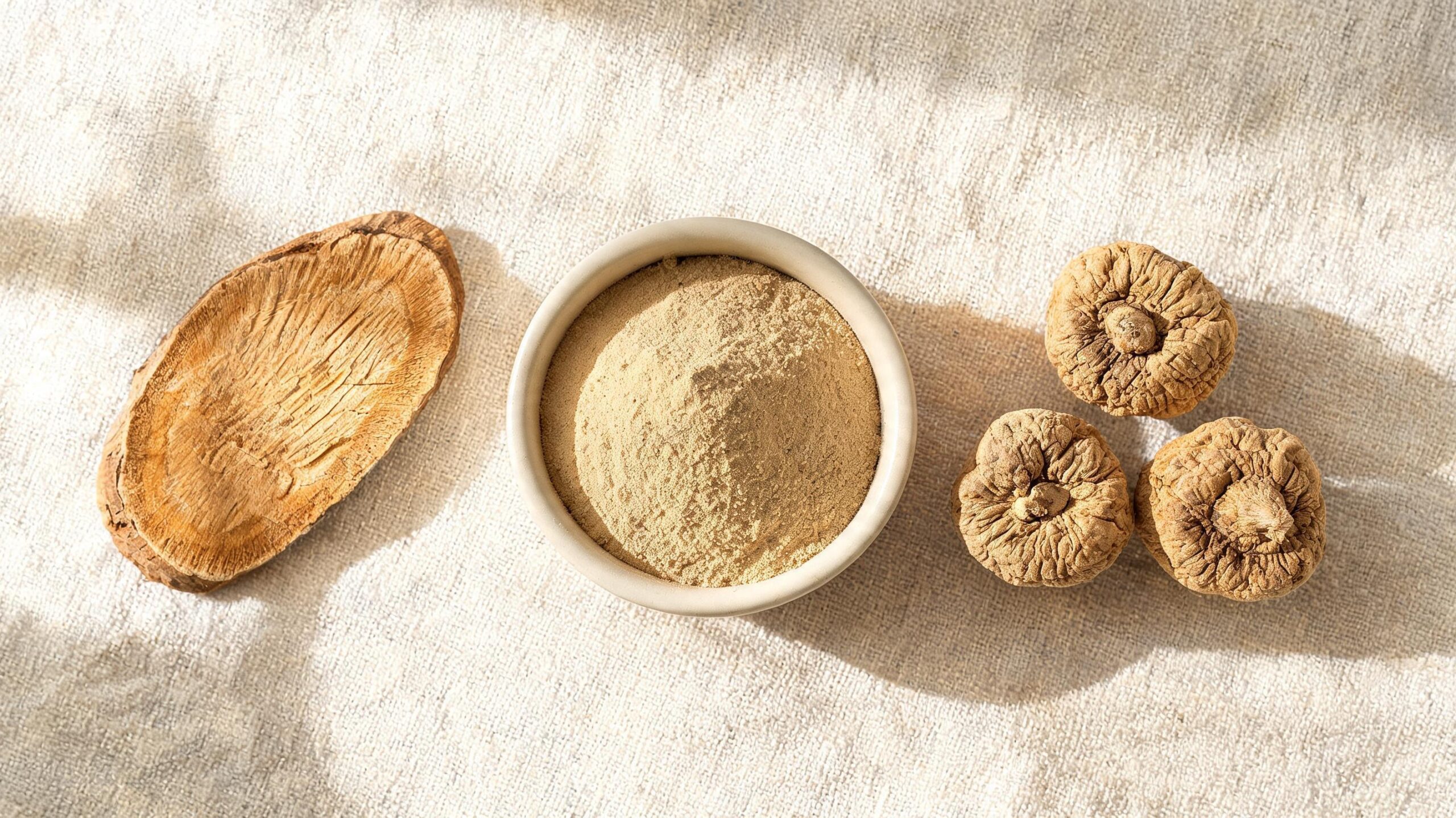
Maca (Lepidium meyenii) is the Andean root whose bioactive alkamides — the macamides and macaenes — have published work supporting androgen-receptor modulation, spermatogenesis, and libido at clinical-grade doses in men. Gonzales et al.5 showed measurable effects on sperm count and motility in healthy men at doses between 1,500 and 3,000 mg/day of dried maca root.
The Maca layer addresses what the other two do not directly: androgen-receptor binding affinity. Maca does not raise serum testosterone, but published work suggests it improves the sensitivity of the receptor to whatever testosterone is available, which is the layer that declines most sharply in the over-30 trainer.
Why a Trio Beats Three Singles
The recovery-stack literature is converging on a simple observation: the three mechanisms above are complementary rather than redundant. KSM-66 handles the cortisol-recovery curve and the central-nervous-system layer. Tongkat Ali handles the free-testosterone availability layer. Maca handles the androgen-receptor-sensitivity layer. A single-ingredient product addresses one lever. The trio addresses three, which is closer to the full recovery bottleneck.
This is also why a product that combines the three at clinical-grade standardised doses — Tongkat Ali at ≥1% eurycomanone, KSM-66 at ≥5% withanolides, Maca at a low-temperature-dried form that preserves the heat-labile macamides — represents a different category of product than a ‘T-booster’ or a ‘sleep aid’ or a ‘stress supplement’. It is a recovery substrate stack, not a single-mechanism product.
What to Look for on a Label
Three things matter for any product claiming this category:
1. Disclosed standardisation percentages. Tongkat Ali at ≥1% eurycomanone, KSM-66 at ≥5% withanolides, Maca at a disclosed alkamide content. A ‘proprietary blend’ that does not disclose the per-ingredient dose or the standardisation percentage cannot be evaluated against the published clinical evidence.
2. Clinical-grade dose. Tongkat Ali at 100–200 mg/day, KSM-66 at 300–600 mg/day, Maca at 500–1,500 mg/day. A daily dose that delivers less than the published clinical threshold is unlikely to deliver the published clinical effect.
3. Combination in a single daily dose. Splitting the three ingredients across three separate products multiplies the cost and reduces adherence. A single capsule that combines the three at clinical-grade doses is the form factor that actually gets used consistently.
The Realistic Reader Framing
For the over-30 trainer in Singapore or Malaysia who has noticed the recovery window widening and is asking which supplement actually moves the substrate levers, the answer is: a product that combines the three-mechanism stack at clinical-grade standardised doses. None of the three ingredients alone will move the needle on the same scale as the combination, and most single-ingredient products in the market do not disclose the standardisation data needed to evaluate whether the published clinical dose is even being delivered.
The recovery decline the CNA Lifestyle piece describes is real and well-documented at the substrate level. The substrate-stack layer the article skips — the three-mechanism combination — is the part of the story that the over-30 reader actually needs.
References
- CNA Lifestyle. ‘Why don’t I recover from workouts as quickly as I used to?’, 26 September 2026. https://cnalifestyle.channelnewsasia.com/wellness/workout-recovery-aging-exercise-589246
- Harman SM, Metter EJ, Tobin JD, Pearson J, Blackman MR. Longitudinal effects of aging on serum total and free testosterone levels in healthy men. J Clin Endocrinol Metab. 2001;86(2):724-731. https://doi.org/10.1210/jcem.86.2.7219
- Wankhede S, Langade D, Joshi K, Sinha SR, Bhattacharyya S. Examining the effect of Withania somnifera supplementation on muscle mass and strength: a randomized controlled trial. J Int Soc Sports Nutr. 2015;12:43. https://doi.org/10.1186/s12970-015-0104-9
- Henkel RR, Wang R, Bassett SH, Chen T, Liu N, Zhu Y, Tambaro MA. Tongkat Ali as a potential herbal supplement for physically active male and female seniors — a pilot study. Phytother Res. 2014;28(4):544-550. https://doi.org/10.1002/ptr.5017
- Gonzales GF, Cordova A, Vega K, Chung A, Villena A, Gómez C. Effect of Lepidium meyenii (Maca), a root with aphrodisiac and fertility-enhancing properties, on serum reproductive hormone levels in adult healthy men. J Endocrinol. 2003;176(1):163-168. https://doi.org/10.1677/joe.0.1760163
Product you may be interested in