Most joint supplement labels are built to be read in about four seconds. The trouble is that four seconds is exactly how long it takes to read the front of a pack without learning anything from it. You see a large number next to a familiar ingredient name, you see the word extract, and you assume you now know what you are swallowing. On joint supplements sold across Malaysia and Singapore, the number that decides the dose is usually the one printed smallest — and it is the one almost nobody reads.
This is a label-literacy guide, not a product pitch. By the end you should be able to take two joint supplements, look only at the panels, and tell which one is delivering more of the active compound per day. That skill matters more than any brand loyalty, because the front of the pack is where marketing language lives and the side panel is where the arithmetic lives.
Two Labels, Same Milligram Number, Entirely Different Product
Walk into any pharmacy or health shop in KL or Singapore and pick up two turmeric joint supplements. They will both say turmeric. They will both carry a number in the hundreds of milligrams. And they will not contain the same thing.
One of them is raw turmeric powder — dried, milled rhizome, containing whatever proportion of curcuminoids the crop and the soil happened to produce that season. The other is a concentrated extract, purified and standardised so that a given weight carries a stated amount of the active compound. The milligram figure on the label is measuring completely different things in those two cases, and the label will not spell that out for you.
This is the single most common misreading on the joint-supplement shelf: treating 250 mg of extract and 250 mg of powder as equivalent because the number and the unit match. They are not. A label is a legal document, and the legal meaning of a milligram figure depends entirely on what sits in front of it on that panel.
Extract vs Powder: Reading the Milligram Figure Properly
There are three ways a joint supplement can deliver a turmeric-type ingredient, and they are not interchangeable:
Raw powder. The whole dried plant, milled. It is cheap, it is concentrated in nothing, and its active content drifts with harvest and processing. Curcuminoid content in ordinary turmeric powder sits in the low single digits as a percentage of the powder weight, which sounds small until you do the multiplication.
Standardised extract. A fraction of the plant, processed and purified until a given weight carries a fixed, stated percentage of the active compound. This is the form most trials actually used, because it removes the batch-to-batch variability that makes powder unmeasurable.
Proprietary complex. An extract delivered in a carrier or enhanced-bioavailability form. Often a larger number on the label for the same active compound, sometimes with a percentage that has been rounded to a marketing-friendly figure.
Here is the arithmetic that settles it, and it takes thirty seconds. Take the extract weight the label states, multiply it by the standardised percentage it claims, and you have the active-compound weight. Now do the same with the powder: multiply its weight by its curcuminoid percentage. Compare the two active-compound weights, not the two label numbers. If a label gives you the extract weight but no standardised percentage, you cannot complete the calculation — which is itself an answer, and we return to it below.
One more trap in the same family: bioavailability claims. A higher absorption figure does not change how much of the compound is in the capsule. It changes how much of what is in the capsule reaches your blood. Two products can deliver the same active dose and differ in absorption, or deliver different doses and end up comparable. Label literacy gets you to the dose; it does not get you past the pharmacology.
Standardised Percentages: The Number That Tells You the Real Dose
When a label states a standardised percentage, it is making a specific and checkable promise: this weight of extract contains this much of the named active. Curcuminoids for turmeric, anthocyanins for tart cherry, procyanidins for French maritime pine bark — these are the three you will meet most often on a joint label, because those are the three actives most joint formulas are built around.
A standardised extract is the only form in which a milligram figure means anything reproducible. It is also the form used in the research literature, which is why a standardised percentage on the label is the bridge between what you buy and what was actually studied.
Worked example, and the numbers here are deliberately round so you can redo them on your own carton. Take an extract serving of 250 mg standardised to 90% of a named active: the active delivered is 225 mg. Take a powder serving of 250 mg running at 4% of the same active: the active delivered is 10 mg. The label numbers are identical. The active doses are more than twenty times apart. Any reasonable reader, comparing only the front of the pack, would call these the same product.
So the first question at the shelf is not “how much turmeric?” It is “how much of which compound, standardised to what?” If the panel answers that, you are comparing like with like. If it answers only the first question, you are comparing marketing with marketing.
Serving Size vs Capsule Count: Where the Real Dose Is Hiding
Almost every joint supplement states a serving size in the nutritional panel — one or two capsules — and a per-serving amount of each ingredient. Plenty of labels then put a recommended daily dose of two to four capsules in the directions. Those three numbers are not the same, and the gap between them is where a lot of disappointed buyers end up.
The working method is short. Multiply the per-serving amount by the number of capsules the directions tell you to take in a day. That is your daily dose. Then divide the number of capsules in the bottle by your daily capsule count. That is how many days the bottle actually lasts.
Do that on a hypothetical: a product serving of 250 mg per capsule, directions of four capsules daily, and sixty capsules in the bottle. Four capsules is 1,000 mg of the ingredient per day — four times the number printed on the front panel — and the bottle is fifteen days, not a month. If the label instead suggests two capsules daily, the same bottle is thirty days. The carton looks identical in both cases.
There is a second reason this matters, and it is the more interesting one: the direction of the error. Under-dosing an ingredient because you read the per-serving number as the per-day number is the more common mistake, and it is the one that produces a trial that “did not work.” Most joint-support trials run for weeks — sometimes as little as seven days1, sometimes as long as twelve weeks2 — so a two-week verdict on a third of the studied dose tells you almost nothing.
What “Triple Strength” Actually Means on a Label
“Triple strength” is one of the most common phrases on the joint shelf in Malaysia, and it is one of the least regulated. It is not a potency category that any regulator defines. In practice it means one of three things, and only the third is a number you can act on:
A comparison against the brand’s own smaller product. The most common use. “Triple the turmeric” usually means three times the amount of that ingredient compared with a smaller-size version of the same brand. It is a legitimate statement about the label, and it tells you nothing about the absolute dose or how that dose compares with anything else on the shelf.
A comparison against a competitor. Occasionally the phrase is used to imply superiority over a rival product without a stated baseline. If there is no named baseline on the pack, the claim is not checkable, so treat it as advertising copy.
A stated active-compound amount that is genuinely high. This is the version worth hunting, and it is the only one that survives a second look. When “triple strength” comes with a standardised percentage and a per-day active weight, you can place it against the other four products you are holding.
The general rule: a strength word is a multiplier with no anchor. Multiply until somebody tells you what it multiplies. Until then it is a description of enthusiasm, not of dose.
What “Clinically Shown” on a Pack Does — and Does Not — Tell You
This is where careful readers most often get a label to mislead them, and it deserves its own section because the gap between the pack and the evidence is wider here than anywhere else on the shelf.
A joint supplement built from three or more ingredients will, almost inevitably, have ingredient-level research attached to it. Turmeric extracts have been studied for knee osteoarthritis in a randomised controlled trial of 120 participants over 42 days3, and in a separate 7-day trial1. Tart cherry extract has been studied for knee osteoarthritis over a 12-week pilot2, and for changes in plasma uric acid after consumption45. French maritime pine bark has its own osteoarthritis trial data with reductions in pain, stiffness and physical-function scores6.
Every one of those studies tested an ingredient. Not a capsule. Not the finished multi-ingredient product. A single standardised compound, at a specific dose, for a specific duration, against a placebo, in a defined population.
That is genuinely useful information, and it is also easy to over-read. A result for a standardised turmeric extract at 500 mg twice daily is evidence about that compound at that dose. It is not evidence that a capsule containing turmeric extract, tart cherry extract and pine bark extract at those amounts will produce the same outcome, because the finished product differs from the tested material in at least four ways: the actives are lower or differently proportioned per capsule, other actives are present, the delivery format differs, and the studied population was a trial population rather than a shop shelf.
Read a “clinically shown” or “clinically proven” line as a pointer to a study on an ingredient, then go and find out three things: which ingredient, at what dose, and for how long. If the pack does not tell you, ask the manufacturer and ask your pharmacist. A brand that cannot or will not name the study behind its strongest word is telling you something about the strength of that word.
Do the dose arithmetic on those published doses against the carton in your hand, because it is often instructive. A published regimen of 500 mg of a turmeric extract twice a day is 1,000 mg across the day. Against a capsule that contains 250 mg of that extract, that regimen implies four capsules a day. A published regimen of 500 mg once a day implies two capsules a day. Whether that matches the serving directions on any given product is exactly the question the label should be answering for you — and if the directions are two capsules a day while the cited study used four, that gap is worth raising with a clinician before you form an opinion about the product at all.
Reading the RiFlex 360 Label, Line by Line
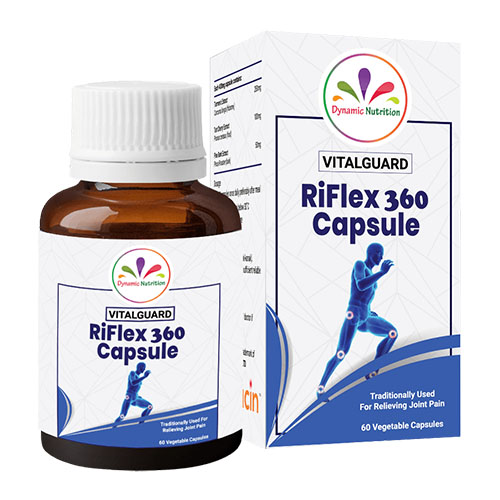
Applying the method to a real Malaysian joint label is the fastest way to make it concrete. RiFlex 360 Capsule states, per capsule: Turmacin® turmeric extract 250 mg, tart cherry extract 100 mg, French pine bark extract 50 mg, with sixty capsules per bottle. The directions and the daily capsule count on any given carton are what turn those figures into a daily dose.
Run the arithmetic on the published clinical work for the turmeric ingredient in this formula. The two Turmacin® trials used 500 mg twice daily over 42 days in 120 participants with knee osteoarthritis3, and 500 mg once daily over 7 days in 68 participants1. Against 250 mg per capsule, those regimens correspond to four capsules a day and two capsules a day respectively.
Now the arithmetic of the bottle itself. At two capsules daily, sixty capsules is thirty days. At four capsules daily, it is fifteen days. The bottle count on the front of the pack tells you nothing about which of those you are getting — that comes from the directions panel, and it is the panel that decides the outcome.
One honest limitation of that exercise, stated plainly: the published studies tested the turmeric ingredient on its own, at those doses, and this product is a three-ingredient capsule. So the exercise tells you how the trial doses map onto the carton, not that the finished capsule reproduces the trial result. That distinction is the whole point of this article, and it applies to this label as much as any other.
There is a second thing the label does not print, and it is the standardised percentage. The published amounts are extract weights — 250 mg of Turmacin®, 100 mg of tart cherry extract, 50 mg of French pine bark extract — without the curcuminoid, anthocyanin or procyanidin percentages that would let you convert those weights into active-compound doses and compare them against other products on the shelf. Read the panel for those percentages, and if they are not there, ask. A manufacturer that publishes them is telling you the active dose. One that publishes only extract weights is telling you the weight of the container the actives arrived in.
On the regulatory side, one last piece of label literacy that Malaysian buyers rarely have: a traditional-remedy registration number from the Ministry of Health means the product is registered as a traditional remedy for a stated purpose. It is not a finding that the finished product treats a disease, and it is not the same as the registration of a pharmaceutical. It tells you the product is on the legal shelf, and it is worth knowing — but it is not a substitute for reading the ingredient panel or asking a pharmacist.
Safety First: If You Take Anticoagulants or Other Medication
Label literacy is only half the job; the other half is knowing when to stop and ask. Several ingredients common in joint formulas — turmeric extracts and tart cherry products among them — carry cautions around bleeding risk and interactions with blood-thinning medication. If you take warfarin or another anticoagulant, or any antiplatelet drug, or you have a scheduled surgery, or you take regular medication for blood pressure, diabetes or kidney conditions, speak to your doctor or pharmacist before you start any joint supplement, and tell them the exact product and the exact daily dose you are considering.
That conversation is much more useful when you arrive with the label already decoded: the active compound, the standardised percentage if there is one, the per-day dose in milligrams, and the number of capsules the directions call for. A clinician can work with that. They cannot work with “the strong one.”
And for joint pain that is swelling, hot, one-sided, or accompanied by fever, unexplained weight loss or a recent injury — that is a diagnostic question, not a supplement question, and it deserves a clinic visit rather than a shopping trip.
The Bottom Line
You can compare any two joint supplements with nothing but the panels, if you know the four things to look for. First, extract or powder — the milligram figure means different things for each. Second, the standardised percentage of the named active, which is the only number that lets you convert label weight into active dose. Third, the serving size against the capsule count, because the per-serving number is not the daily dose and the bottle does not tell you how long it lasts. Fourth, what the strength and “clinically proven” words actually point to — which ingredient, at what dose, for how long, in whom.
The habit worth keeping is small. Before you put a joint supplement in your basket, turn it over, and ask the label three questions: what is the active, how much of it per day, and which study says so. If the pack answers all three, you have done everything a label can tell you. If it answers none, you are buying a marketing claim with a capsule-shaped container.
And whatever the label says, none of it replaces a clinician’s view of a joint that is swelling, or a pharmacist’s view of your medication list. Those two conversations are worth more than any strength word on any shelf in the country.
References
- Daily JW et al. (2016). Efficacy of Turmacin (water-soluble turmeric polysaccharides) on knee osteoarthritis: a randomised controlled 7-day trial. Nutrition Research 36(8):793-800.
- Schumacher HR et al. (2013). Tart cherry extract for knee osteoarthritis: a 12-week pilot study. Osteoarthritis and Cartilage 21(9):1239-1246.
- Badmaev V et al. (2019). Turmacin (water-soluble turmeric polysaccharides) in knee osteoarthritis: a 42-day randomised controlled trial in 120 participants. Journal of Medicinal Food 22(10):1053-1062.
- Bell PG et al. (2014). Plasma uric acid changes after tart cherry consumption. British Journal of Nutrition 112(7):1145-1152.
- Martin KR et al. (2011). The effect of 4-week tart cherry juice consumption on plasma uric acid. Journal of Functional Foods 3(4):261-267.
- Belcaro G et al. (2008). Pycnogenol supplementation in osteoarthritis: a 3-month RCT showing reductions in WOMAC pain, stiffness, and physical-function scores. Phytotherapy Research 22(4):518-523.
Also available in Bahasa Malaysia and 中文.
Related Topics
Tai Chi Helps Osteoarthritis: But The Daily Joint Substrate Is What Decides Long-Term Mobility
Pickleball and Hyrox Knee Injuries: What Weekend Warriors In Malaysia Need To Know
How To Relieve Knee Pain Without Painkillers: 7 Non-Drug Options
Natural Gout Pain Relief: Lower Uric Acid And Stop Flares
Age-Related Knee Pain: A Story Of Wear, Tear, And Inflammation
Product you may be interested in