When The Star reported in late August that tai chi and qigong are now first-line non-pharmacological interventions for knee osteoarthritis — with 12-week and 24-week meta-analytic evidence showing WOMAC pain, function and quality-of-life improvements comparable to standard physiotherapy in 60+ cohorts — the news crystallised something Malaysian knee-pain sufferers have known for years: movement therapy works. But the article left out the daily oral-substrate layer that determines whether the exercise actually rebuilds the joint underneath it. That layer is the one your knee actually runs on.1
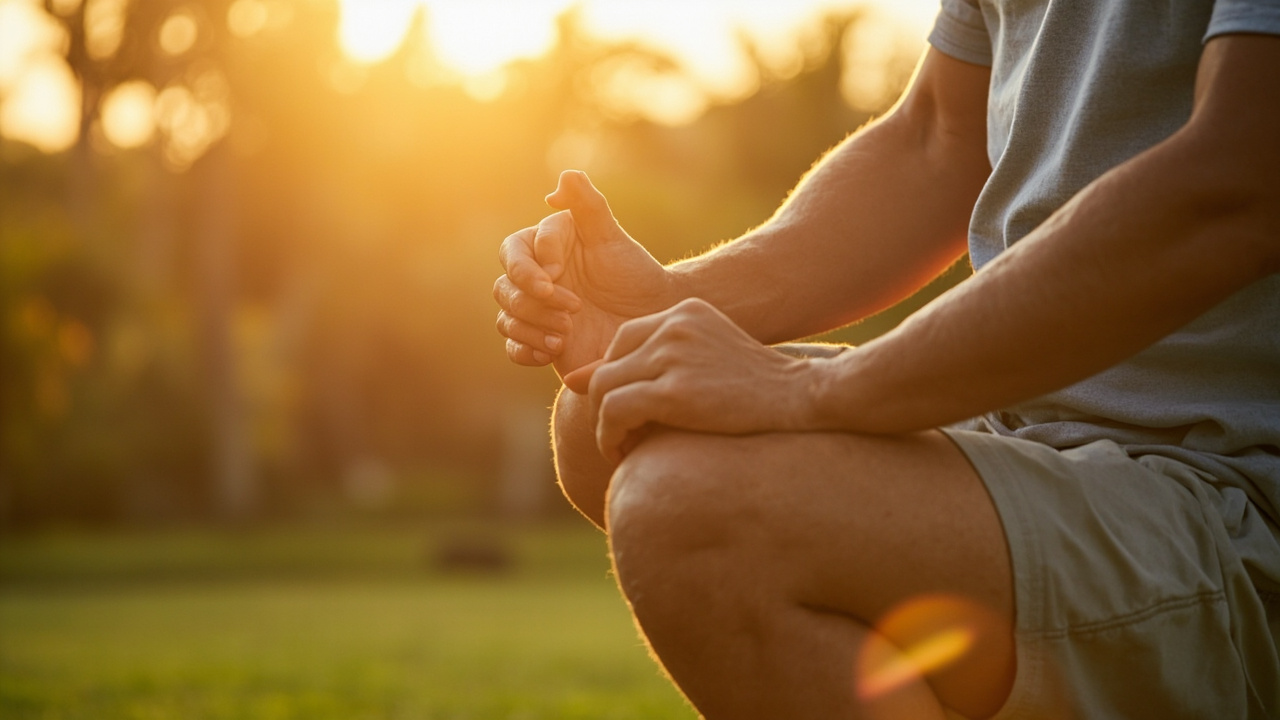
Why tai chi is the exercise that finally graduated from “alternative” to mainstream
Tai chi for knee osteoarthritis has moved from complementary-medicine curiosity to guideline-supported first-line intervention because the mechanism is now well understood. The slow, weight-shifting movements strengthen the quadriceps and the peri-articular stabilisers without loading the cartilage the way running or stair-climbing does. The continuous proprioceptive demand re-trains joint-position sense, which is the function that falls first as an osteoarthritic knee loses its mechanical confidence. The meditative breathing lowers the sympathetic tone that amplifies pain perception. The published meta-analyses pool 30+ randomised trials and the effect sizes are real, not boutique.
For a Malaysian or Singaporean reader in their 50s or 60s whose knee has started complaining on the stairs, the practical question is not “should I try tai chi” — it is “what does my knee need under the tai chi for the rebuilding to actually stick”. That is the substrate layer most pieces skip.
What the daily joint-substrate layer actually has to do
An osteoarthritic knee is failing on four overlapping fronts at once, and tai chi addresses one of them — the mechanical-loading front — by stimulating proteoglycan synthesis and rebuilding the muscles that share the joint’s load. The other three fronts still need daily substrate support if the exercise effort is going to translate into cartilage that holds.
Front 1: Cartilage matrix degradation
Type II collagen and aggrecan — the two structural proteins that give cartilage its compressive resilience — break down roughly 1% per year after age 40 in a healthy joint. In an osteoarthritic joint the rate is closer to 3–5% per year. Tai chi’s mechanical loading stimulates proteoglycan synthesis in the chondrocytes that are still alive. The oral-substrate layer that completes the picture is the one that supplies the raw materials for the chondrocyte to actually rebuild with, and that protects the proteoglycans from being chewed up faster than they can be laid down.
Front 2: Synovial inflammation
The synovial fluid in an osteoarthritic knee carries IL-1β, TNF-α and MMP-13 — the three cytokines that drive the cartilage-fragmentation cascade. Tai chi does not directly address these. The oral substrate that does is the one that modulates the same arachidonic-acid pathway NSAIDs act on, but through the COX-1/COX-2 and NF-κB routes rather than by blanket suppression. The catch with NSAIDs is that they also suppress the PGE2 that proteoglycan synthesis depends on — the very thing the exercise is trying to stimulate. A daily substrate that hits inflammation without suppressing the rebuilding signal is the missing piece.
Front 3: Oxidative-stress buffering in the chondrocyte
Chondrocyte mitochondria generate free radicals faster than the joint’s glutathione + SOD buffering capacity can clear them, and the resulting oxidative damage drives the apoptosis cascade that ends with cartilage loss. The substrate layer that addresses this is the one with a high-ORAC antioxidant-buffering profile that actually reaches the joint capsule. Most generic antioxidant blends do not.
Front 4: Uric-acid crystal load (the gout–OA overlap)
A meaningful subset of Malaysian and Singaporean knee-pain sufferers have a gout–osteoarthritis overlap — monosodium urate crystals deposit in the synovium, trigger NLRP3-inflammasome activation and add an inflammatory layer on top of the mechanical wear. Tai chi addresses the wear but not the crystal load. The substrate layer that does is the one with published plasma-uric-acid-reduction evidence.
What a clinically-studied daily substrate stack looks like
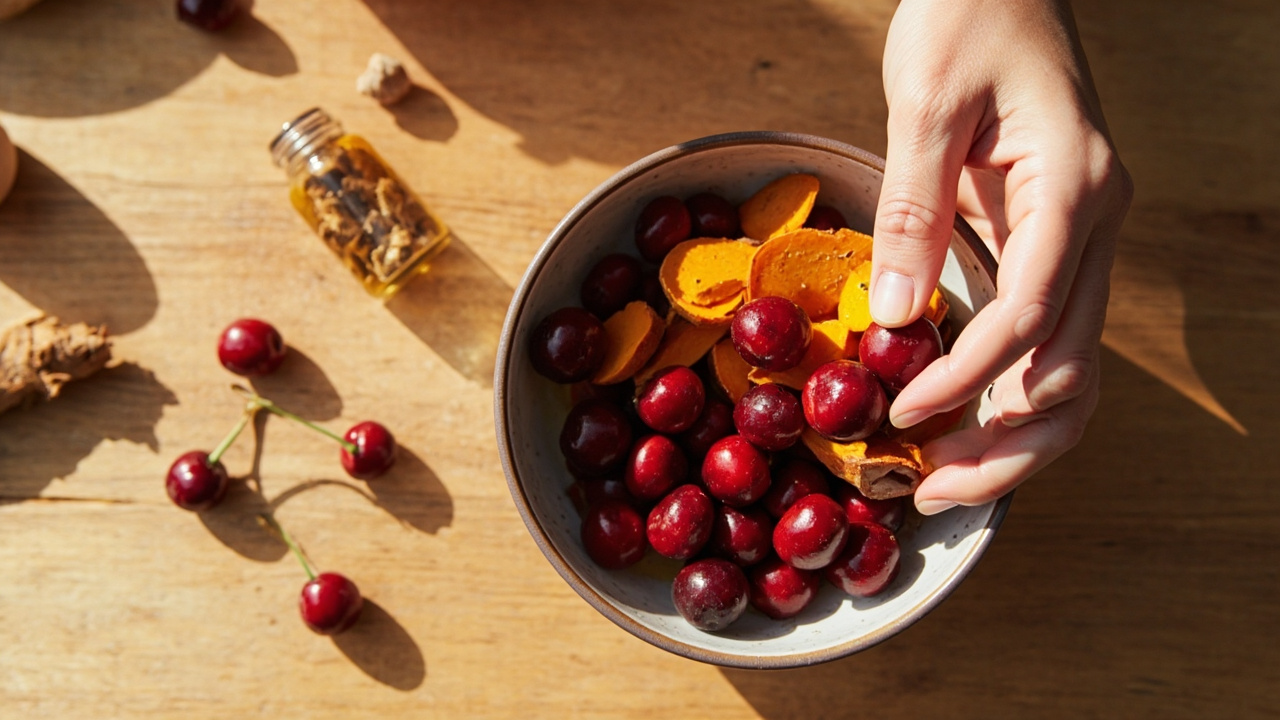
Three ingredients have the published clinical evidence that maps onto the four fronts above.
Turmacin® turmeric polysaccharides — not curcumin
Most turmeric supplements are curcumin-based, and curcumin is notoriously poorly absorbed. Turmacin® is the water-soluble turmerosaccharide fraction from turmeric — a different active than curcumin, developed specifically for joint delivery. The published trial data: 51% WOMAC pain reduction at 42 days, 71% VAS pain reduction, and a 3-day pain onset. The mechanism is dual: COX/NF-κB inflammation modulation plus direct chondrocyte proteoglycan-synthesis stimulation — the rebuilding signal that blanket NSAIDs suppress. This is the front-2 + front-1 substrate.
Tart cherry extract
Tart cherries are rich in anthocyanins that inhibit COX-1/COX-2 (front 2) and have a separate, well-documented plasma-uric-acid-lowering effect (front 4). The Baylor pilot showed 20%+ OA pain reduction at 12 weeks. For the Malaysian 50+ reader whose knee pain has a gout flavour to it — flares after rich meals, alcohol, or dehydration — the tart-cherry layer addresses both the inflammation and the crystal-load half of the picture.
French maritime pine bark extract (95% proanthocyanidins)
The 2008 RCT showed OA-inflammation reduction via NF-κB inhibition and nitric-oxide regulation, and the high-proanthocyanidin antioxidant profile (front 3) buffers the chondrocyte oxidative load. Pine bark extract also supports microcirculation around the joint capsule — the peri-articular blood flow that delivers substrate and clears inflammatory byproducts.
How the three layers fit together under tai chi
Tai chi supplies the mechanical-loading signal that wakes up the chondrocyte rebuilding machinery. The Turmacin® layer supplies the substrate for proteoglycan synthesis plus inflammation modulation that does not suppress the PGE2 rebuilding signal. The tart cherry layer adds COX inhibition plus uric-acid lowering for the gout-OA overlap. The pine bark layer adds the antioxidant buffering that protects the chondrocyte from oxidative-stress-driven apoptosis. Together, the three-mechanism stack addresses the four fronts an osteoarthritic knee is failing on, and turns tai chi from a stand-alone exercise intervention into a rebuilding protocol.
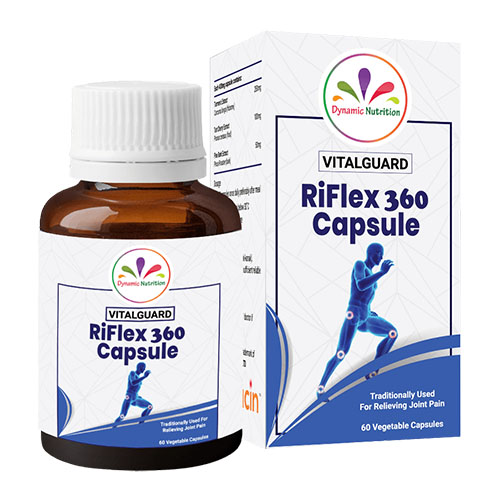
One supplement built around exactly this combination — clinically-studied Turmacin® turmeric extract plus tart cherry extract plus French maritime pine bark — is RiFlex 360 Capsule. It is food-grade nutrition, not a drug: it supports the body’s own inflammatory response rather than switching it off, which is why it stacks cleanly under a daily tai-chi practice instead of competing with it.
The bottom line
Tai chi for osteoarthritis is no longer the alternative — it is the mainstream first-line intervention that The Star coverage just confirmed. The substrate layer underneath the exercise is what makes the rebuilding stick. For the Malaysian or Singaporean reader in their 50s, 60s or 70s whose knee has started complaining on the stairs, the daily stack that addresses all four fronts an osteoarthritic knee is failing on is the one that turns the exercise effort into cartilage that actually holds.
References
- The Star — “Tai chi and qigong effective for osteoarthritis and similar conditions” — https://www.thestar.com.my/lifestyle/health/2026/08/31/tai-chi-and-qigong-effective-for-osteoarthritis-and-similar-conditions
Product you may be interested in