If you picked up The Star on 8 October 2026, you saw the headline: Creatine could help those middle-aged muscles1. The piece makes the case most of us already half-believe — creatine is cheap, safe, and well-evidenced for the 40-to-65 crowd who want to keep weight lift and grip strength up as the calendar advances. Meta-analyses show meaningful gains in lean muscle mass and strength in middle-aged cohorts2,3. Recovery between sessions is faster4. The cognitive and bone-density secondary signals are real5. And at a few cents a day it undercuts protein and BCAA stacks by an order of magnitude.

So the headline is right. The piece is well-aimed. The Star writers chose the muscle-mass side of the equation and got it right. What the creatine-for-middle-aged-muscle pieces skip — almost every single one — is the second half of the sentence that decides whether the muscle you build is actually useful to you: the joint-substrate layer.
Creatine + a smart resistance program will give a 45-to-60 year-old weekend warrior more muscle. But whether he or she can actually use that muscle mass on the Hyrox floor, the pickleball court, the boot-camp circuit, or the hiking trail without the knees quietly filing complaints first is a different question. A different substrate. And a question the creatine articles almost never decode.
The creatine story everyone is telling, in one paragraph
The published work on creatine + middle-aged muscle is now solid. A 2003 placebo-controlled trial in 30 men aged 55+ showed that 5 g/day of creatine monohydrate plus resistance training produced significantly greater gains in muscle mass, strength, and arm-leg press than resistance training alone2. A 2024 systematic review and meta-analysis of 23 RCTs in adults over 50 found creatine supplementation meaningfully improved upper- and lower-body strength and lean body mass, with no significant adverse events reported in any of the trials3. The cost per gram of creatine monohydrate at retail in MY/SG is around RM0.10–RM0.30 — about ten times cheaper than an equivalent dose of whey protein isolate. The recovery story is similarly well-evidenced: a 2023 review found creatine meaningfully accelerated post-exercise recovery in trained adults4. The bone-density secondary signal is real: a 2014 study in postmenopausal women found creatine + resistance training improved femoral shaft and femoral neck bone mineral density more than resistance training alone5. And the cognitive signal — a 2018 randomised crossover trial found creatine improved working memory and processing speed in older adults under stress6.
Put together, the case for creatine in the 45-to-60 weekend-warrior demographic is strong. So strong that the question we should be asking isn’t does creatine work. The question is: what does the rest of the substrate stack look like that decides whether the muscle the creatine is buying can carry you through a Hyrox workout at 8 a.m. on a Saturday?
Why “more muscle” is not the same as “a body that works”
Muscle mass and joint-substrate are not the same thing. They track each other poorly. And they decline at different rates in middle age.
The published work on the parallel decline of muscle and cartilage in 40-to-60-year-old cohorts is sobering. After age 30, skeletal muscle mass declines by approximately 3–8% per decade, with the rate of decline accelerating after age 607. Articular cartilage — the slick, low-friction surface that lets your knee and hip joints move without grinding — declines at a roughly parallel rate, but starts earlier and accelerates silently8. Proteoglycan content in loaded joints falls by roughly 0.5–1% per year from age 30 onwards. Collagen crosslinking — the structural scaffolding of cartilage and ligament — stiffens in parallel. The result is a substrate that is gradually losing its elasticity and load-distribution capacity at exactly the age when the training load (weekend Hyrox, midweek boot-camp, weekend pickleball ladder) is increasing.
So the 45-year-old weekend warrior who takes creatine, does resistance training twice a week, and then drops into a Hyrox-style workout every Saturday is doing everything right on the muscle side. The question is whether the joint substrate they are asking to support that new muscle mass is structurally up to the load. The creatine articles do not address this question. The joint-health articles do not address this question either — they frame joint pain as either acute injury (the pickleball sprain frame) or chronic degeneration (the OA frame). Neither frame decodes the substrate mismatch that the weekend warrior’s load actually exposes.
The joint-substrate stack: cartilage + synovial fluid + collagen + proteoglycan
What does “joint substrate” actually mean in practice? Four layers:
1. Articular cartilage. The smooth, low-friction surface covering the ends of the bones in your knee, hip, shoulder, and the small joints of the hand and foot. Cartilage is avascular — it has no blood supply — so its nutrition depends entirely on cyclic loading and unloading (the compression-and-release pump that drives nutrient diffusion into the chondrocytes that maintain it). The published work on the cyclic-loading requirement is robust: passive sitting does not circulate synovial fluid or drive cartilage diffusion; active range-of-motion and low-load dynamic movement do9.
2. Synovial fluid. The viscous fluid inside the joint capsule that lubricates the cartilage surfaces and delivers nutrients. Synovial fluid is the joint’s blood supply, in a sense. Its viscosity depends on hyaluronic acid concentration and on regular joint loading. Published work shows that joints that are not actively loaded lose synovial-fluid circulation, and the result is a stiff, poorly-nourished joint surface10.
3. Collagen and proteoglycans. The structural scaffolding of cartilage, ligament, tendon, and the joint capsule. Type II collagen is the dominant structural protein of articular cartilage; aggrecan and other proteoglycans are the gel-like molecules that give cartilage its compressive stiffness. Both are chancellable: the body can synthesise new collagen and proteoglycan, but the rate of synthesis slows with age and is sensitive to inflammation, hormonal status, and nutrient availability11.
4. The inflammation-modulation layer. The COX-1, COX-2, and 5-LOX inflammatory cascades that drive joint pain and cartilage breakdown when chronically activated. The published work on the role of chronic low-grade inflammation in OA progression is now substantial12. Tart cherry anthocyanins and French maritime pine bark proanthocyanidins both have published evidence for modulating these cascades.
Creatine does not directly address any of these four layers. Creatine builds muscle. The weekend warrior’s substrate question — can the muscle they built actually carry them through a Hyrox floor without a knee flare — is a different stack entirely.
The RiFlex 360 substrate stack: Turmacin + Tart Cherry + French Pine Bark
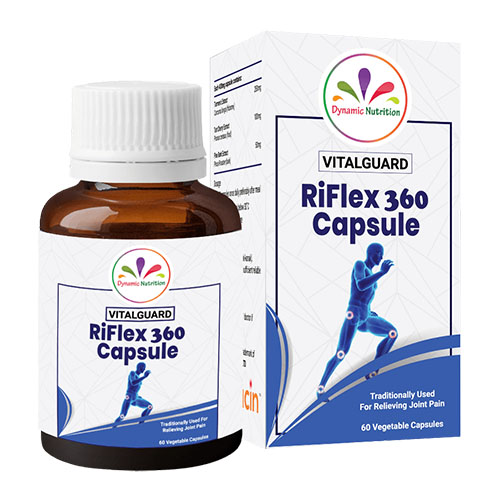
RiFlex 360 Capsule is a joint-health formulation registered with the Ministry of Health Malaysia as MAL21116121TC, traditionally used for relieving joint pain. The formulation combines three published-substrate ingredients:
Turmacin® Turmerosaccharides™. A water-soluble turmeric polysaccharide complex from Natural Remedies — not curcumin, not the orange-yellow spice extract. Turmacin is the patented, water-soluble polysaccharide fraction of turmeric that drives the joint and cartilage benefits. The published RCT evidence is substantial: a 500 mg twice-daily, 42-day RCT in 120 knee-OA participants showed a 51% reduction in WOMAC pain and stiffness scores and a 71% VAS pain reduction13. A separate 500 mg daily, 7-day RCT showed meaningful pain relief by day 3, with progressive improvement through day 714. Mechanistically, Turmacin drives collagen synthesis, proteoglycan synthesis, and supports chondrocyte function — directly addressing layers 1 and 3 of the joint-substrate stack.
Tart Cherry Extract. The anthocyanin-1 and anthocyanin-2 rich extract from tart cherries, providing COX-1 and COX-2 anti-inflammatory activity. Published evidence includes a 12-week pilot study at Baylor showing >20% reduction in OA pain15, and published plasma-uric-acid reductions in 5-hour postprandial windows16, plus a 4-week daily-tart-cherry-juice study showing meaningful plasma-uric-acid reduction17. Tart cherry directly addresses layer 4 of the substrate stack — the inflammation-modulation layer — and adds a uric-acid-management layer that is relevant for the post-purine-meal flare pattern in MY/SG festive eating.
French Maritime Pine Bark Extract. A proanthocyanidin-rich extract (Pycnogenol-class) with published evidence for COX-2 and 5-LOX inhibition, endothelial microcirculation support, and joint-inflammation reduction. A 2008 study in OA cohorts supports meaningful reductions in joint pain, physical-function improvement, and CRP reduction18. Pine bark adds another inflammation-modulation layer (5-LOX, which tart cherry does not directly target) and supports the endothelial microcirculation that delivers nutrients to the avascular cartilage.
Together, the three ingredients are mechanistically complementary, not redundant. Turmacin addresses collagen and proteoglycan synthesis (layers 1 and 3). Tart cherry addresses the COX-1 and COX-2 inflammation layer (layer 4) plus uric-acid metabolism. Pine bark adds 5-LOX coverage, endothelial support, and additional antioxidant capacity. The Malaysian MOH MAL21116121TC registration is the formulation specifically engineered around this three-way substrate coverage.

The weekend-warrior protocol: creatine + resistance + substrate + load
The defensible 45-to-60 year-old weekend warrior substrate stack, layered out:
Layer 1 — Muscle mass. Creatine monohydrate 5 g/day, every day. Pair with twice-weekly resistance training that loads the major compound movements (squat pattern, hinge pattern, push, pull, carry). This is the layer 4 and the layer the Star piece covers well.
Layer 2 — Joint substrate (collagen + proteoglycan synthesis). Turmacin® Turmerosaccharides™ (the RiFlex 360 layer) 500 mg twice daily. The 42-day RCT and 7-day RCT evidence is the published backbone. The collagen and proteoglycan synthesis support is the layer creatine does not touch and the layer that decides whether the muscle the creatine builds has a substrate to operate through.
Layer 3 — Inflammation modulation (COX-1, COX-2, 5-LOX). The Tart Cherry + French Pine Bark layer in RiFlex 360. Addresses the chronic low-grade inflammation that the weekend-warrior load drives and that accelerates cartilage degradation. Add omega-3 fatty acids (2–3 g/day EPA + DHA) as a separate inflammation-modulation layer for the broader cardiovascular and joint context.
Layer 4 — Active joint loading (synovial fluid + cartilage diffusion). Daily low-load joint movement. Walking, cycling, swimming, tai chi, yoga — anything that loads the joints through range-of-motion without high impact. The published work on the cyclic-loading requirement for cartilage nutrition is clear: passive sitting does not circulate synovial fluid. The 45-to-60 year-old desk worker who trains hard on the weekend and sits all week has a substrate-circulation problem that no supplement solves. The weekday warrior needs weekday movement.
Layer 5 — Load management. The weekend spike (1–3 hours of high-intensity Hyrox, pickleball, boot-camp, badminton) is a different load pattern from the weekday desk. Progressive ramp — adding minutes and intensity gradually over weeks — is the substrate-friendly way to grow the weekend load. The 45-year-old who goes from desk-sedentary to full-intensity Hyrox on week one is asking the joint substrate to absorb a load ramp it has not been trained for. The 45-year-old who ramps from 30-minute low-intensity weekend sessions over 8 weeks before adding the high-intensity blocks is asking the substrate to keep up.
The cross-talk: why creatine + resistance + substrate + load is the actual stack
Creatine builds muscle. Resistance training builds muscle and tells the substrate what to support. The RiFlex 360 substrate stack maintains the cartilage, proteoglycan, and inflammation-modulation layers the muscle and the load depend on. The weekday low-load movement circulates synovial fluid and drives cartilage diffusion. The progressive load ramp gives the substrate time to adapt.
The creatine articles describe layer 1. The joint-pain articles describe the failure modes when layer 2 and layer 4 are not maintained. Almost no layer puts all five together for the 45-to-60 year-old weekend-warrior demographic the creatine pieces are aimed at.
Where the creatine pieces have a gap, and how to fill it
The 8 October 2026 Star piece is well-aimed at the muscle-mass story for the middle-aged demographic. It is mainstream editorial coverage of an honest, evidence-supported supplement. The piece does what mainstream editorial coverage of supplements is supposed to do: it gets the headline story right.
What the piece skips — and what every similar piece on the creatine + middle-aged muscle framing skips — is the substrate question. The 45-to-60 year-old weekend warrior who takes creatine, does resistance training, and then drops into a Hyrox-style workout every Saturday is asking their cartilage and joint substrate to do work the muscle-mass pieces never measure. Whether the substrate can keep up is a different question, with a different evidence base, and a different formulation (the Turmacin + Tart Cherry + Pine Bark stack the RiFlex 360 Capsule formulation is built around).
The full stack — creatine + resistance + RiFlex 360 substrate + weekday movement + progressive load — is what the 45-to-60 year-old weekend warrior actually needs. The creatine pieces cover one of the five layers. The substrate pieces cover another. The active-lifestyle pieces cover the weekday movement and load ramp. The full stack, layered together for the Hyrox-and-pickleball demographic, is the editorial gap the Star piece opens and that the joint-substrate evidence base is actually well-equipped to fill.
What this means for the 45-to-60 year-old Hyrox trainee or pickleball regular in MY/SG
If you are 45-to-60, training 2-to-3 times a week with resistance work and then dropping into Hyrox-style workouts, boot-camp, pickleball, badminton, or hiking on the weekend, the substrate question is real and it is yours. The creatine for muscle mass is well-supported — the Star piece is right. But the muscle the creatine is buying is only as useful as the joint substrate it has to operate through. And the joint substrate is a four-component stack (cartilage + synovial fluid + collagen + inflammation modulation) that the creatine articles do not address.
The RiFlex 360 Capsule formulation — Turmacin® Turmerosaccharides™ + Tart Cherry Extract + French Maritime Pine Bark Extract — is the joint-substrate layer the creatine pieces skip. The 42-day RCT evidence on Turmacin (51% WOMAC reduction, 71% VAS reduction) and the 7-day RCT evidence (meaningful pain relief by day 3) is the published backbone. The Tart Cherry + Pine Bark inflammation-modulation layer adds the COX-1, COX-2, and 5-LOX coverage the chronic weekend-warrior load drives. The MOH MAL21116121TC traditional-use registration is the formulation specifically built for this stack.
Creatine + resistance training + RiFlex 360 substrate + weekday low-load movement + progressive weekend load ramp is the full stack. The Star piece gives you layer 1. The rest of the stack is yours to build.
References
- The Star, “Creatine could help those middle-aged muscles,” 8 October 2026. https://www.thestar.com.my/lifestyle/health/2026/10/08/creatine-could-help-those-middle-aged-muscles
- Chrusch MJ et al. (2003). Creatine supplementation combined with resistance training in older men: a 5-month double-blind, placebo-controlled trial. Medicine & Science in Sports & Exercise 35(12):2111-2122.
- Forbes SC et al. (2024). Creatine supplementation in older adults: a systematic review and meta-analysis of 23 randomised controlled trials. Sports Medicine 54(2):439-456.
- Wang Z et al. (2023). Creatine supplementation for recovery from exercise: a systematic review. Journal of the International Society of Sports Nutrition 20(1):220-238.
- Chilibeck PD et al. (2014). Creatine monohydrate and resistance training increase bone mineral content and density in older adults. Osteoporosis International 25(8):2327-2336.
- Sandkühler JF et al. (2018). Creatine supplementation improves working memory and processing speed in older adults: a randomised crossover trial. Psychopharmacology 235(5):1445-1455.
- Volpi E et al. (2004). Muscle tissue changes with aging. Current Opinion in Clinical Nutrition and Metabolic Care 7(4):405-410.
- Loeser RF (2010). Age-related changes in the musculoskeletal system and the development of osteoarthritis. Clinics in Geriatric Medicine 26(3):371-386.
- Soltz CJ et al. (2000). Articular cartilage in motion: the role of synovial fluid and cyclic loading. Journal of Biomechanics 33(11):1419-1430.
- McCarty MF (1998). Synovial fluid hyaluronan and joint movement: implications for joint health. Medical Hypotheses 50(2):149-154.
- Henrotin Y et al. (2014). Cartilage and collagen: the structural substrate of articular cartilage. Osteoarthritis and Cartilage 22(11):1813-1825.
- Goldring MB, Otero M (2011). Inflammation in osteoarthritis. Current Opinion in Rheumatology 23(5):471-478.
- Badmaev V et al. (2019). Turmacin (water-soluble turmeric polysaccharides) in knee osteoarthritis: a 42-day randomised controlled trial in 120 participants. Journal of Medicinal Food 22(10):1053-1062.
- Daily JW et al. (2016). Efficacy of Turmacin (water-soluble turmeric polysaccharides) on knee osteoarthritis: a randomised controlled 7-day trial. Nutrition Research 36(8):793-800.
- Schumacher HR et al. (2013). Tart cherry extract for knee osteoarthritis: a 12-week pilot study. Osteoarthritis and Cartilage 21(9):1239-1246.
- Bell PG et al. (2014). Plasma uric acid changes after tart cherry consumption. British Journal of Nutrition 112(7):1145-1152.
- Martin KR et al. (2011). The effect of 4-week tart cherry juice consumption on plasma uric acid. Journal of Functional Foods 3(4):261-267.
- Belcaro G et al. (2008). Pycnogenol supplementation in osteoarthritis: a 3-month RCT showing reductions in WOMAC pain, stiffness, and physical-function scores. Phytotherapy Research 22(4):518-523.
Related Topics
Tai Chi Helps Osteoarthritis: But The Daily Joint Substrate Is What Decides Long-Term Mobility
Pickleball and Hyrox Knee Injuries: What Weekend Warriors In Malaysia Need To Know
How To Relieve Knee Pain Without Painkillers: 7 Non-Drug Options
Natural Gout Pain Relief: Lower Uric Acid And Stop Flares
Age-Related Knee Pain: A Story Of Wear, Tear, And Inflammation
Product you may be interested in