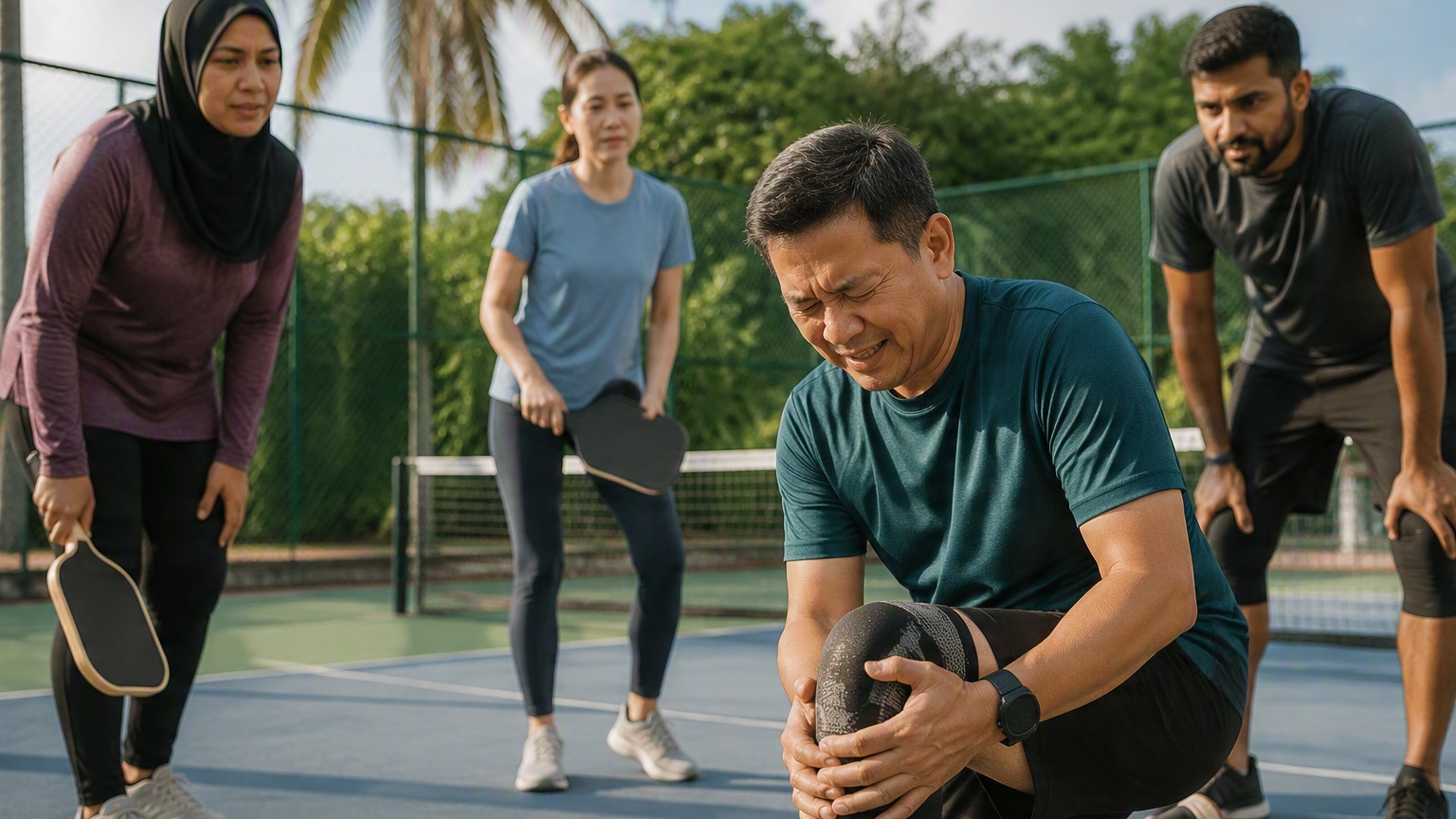
If you’ve spent any time at a sports club in Kuala Lumpur or Singapore over the past year, you’ll have seen it: middle-aged men and women, often in their 40s and 50s, packing outdoor courts at 7 a.m. on Saturdays with pickleball paddles in hand — and another wave of them dragging themselves across Hyrox finish lines on Sunday mornings with ice packs taped to their knees. Sports surgeons across the region have started to notice the same pattern. New Straits Times1 reported earlier this month that pickleball- and Hyrox-related injuries are on a steady rise across Malaysia, with weekend warriors in their late 30s to mid-50s making up the bulk of presentations to sports medicine clinics. The most common complaints are familiar: aching knees on stairs, swelling that won’t go down, a sharp twinge when pivoting — and a vague sense that the body just isn’t bouncing back the way it used to.
The good news is that most of these injuries are preventable, and even the stubborn ones respond well to a structured recovery plan that includes clinically studied ingredients alongside the usual load-progression work. This guide walks through what the surge actually looks like, why it tends to land on the knees of people who haven’t picked up a racquet or a sandbag in years, and what a sensible prevention-and-recovery stack looks like — including where RiFlex 360 Capsule fits into the picture.
What’s driving the surge — and why it lands on the knees
Pickleball has exploded in Southeast Asia. Easy to learn, social, low-impact on paper — but sports medicine clinicians are increasingly flagging that pickleball now accounts for a meaningful share of new racquet-sport injuries in adults over 40, with ankle sprains, knee ligament strains, and rotator cuff issues dominating the case notes. Hyrox has done something similar for functional fitness: it’s marketed as accessible to everyone, but a Hyrox race involves 8 rounds of 1 km running interleaved with 8 functional stations (rowing, sled push, burpee broad jumps, sandbag lunges, etc.), and that combination punishes joints that haven’t been conditioned for it.
Why the knees specifically? Three mechanisms show up again and again in the case notes:
- 🔥 Sudden lateral pivoting under load: pickleball volleys are short, sharp, and lateral. A 50-year-old who hasn’t done that motion in 20 years will often feel the meniscus or MCL complain before the hamstring does.
- 🔥 High-rep eccentric loading: Hyrox sandbag lunges and wall balls are essentially thousands of controlled descents into single-leg stance. Patellar tendon and quadriceps tendon irritation is the predictable result when load outruns preparation.
- 🔥 Recovery debt: weekend-only training with no mid-week conditioning creates a pattern where the body is always trying to catch up. Systemic inflammation stays elevated, joints feel “puffy,” and minor strains accumulate into something more serious.

The 3 things weekend warriors most often skip
The patterns that sports medicine teams flag in clinic are strikingly consistent. Almost every new patient who walks in with a pickleball or Hyrox knee injury has at least one of these gaps in their prep — usually all three:
1. They treat warm-up as optional
A 5-minute walk to the court + 30 seconds of arm circles is not a warm-up. Dynamic mobility work (leg swings, walking lunges with a torso twist, lateral shuffles, slow carioca) takes 8–10 minutes and pays back in spades: synovial fluid thickens, the joint capsule gets blood flow, and the nervous system pre-loads the muscles around the knee. Sports-injury-prevention research has consistently shown that a structured warm-up reduces acute knee injuries in racquet sports by a meaningful margin — most published reviews put the reduction in the 30–50% range.
2. They progress load too quickly
“I used to play twice a week” does not mean the body is ready for a Hyrox competition 8 weeks later. A reasonable ramp for someone returning to high-intensity sport after a long layoff is roughly a 10% per-week increase in total training load (volume × intensity). Anything beyond that dramatically increases the risk of tendon and joint irritation — and knees are usually the first joint to flag.
3. They don’t have a recovery stack
Recovery isn’t just sleep (although sleep matters more than any supplement). It’s the combination of sleep + nutrition + targeted joint support. For people whose knees are taking the brunt of weekend volume, an evidence-based joint support formula that addresses both inflammation and cartilage integrity makes a measurable difference over a 4–12 week window. This is where clinically studied ingredients — not generic turmeric powder — come in.
What to look for in a clinically-studied joint support formula
Walk down the supplement aisle and you’ll find a wall of “joint support” products. Most contain generic turmeric powder (poorly absorbed), unbranded glucosamine (variable quality), or proprietary blends that hide the actual doses. A clinically-studied joint formula looks different in three specific ways:
- ✅ Named, patented ingredients at published doses: e.g. Turmacin® (a water-soluble, standardised turmeric extract used in published knee-OA trials), not just “turmeric.”
- ✅ Published RCT evidence in humans: ideally peer-reviewed trials in the exact indication you care about (knee osteoarthritis, post-exercise joint comfort, uric-acid management).
- ✅ Standardisation markers on the label: total curcuminoids %, specific biomarker assays, batch-level certificate of analysis.
Where RiFlex 360 Capsule fits
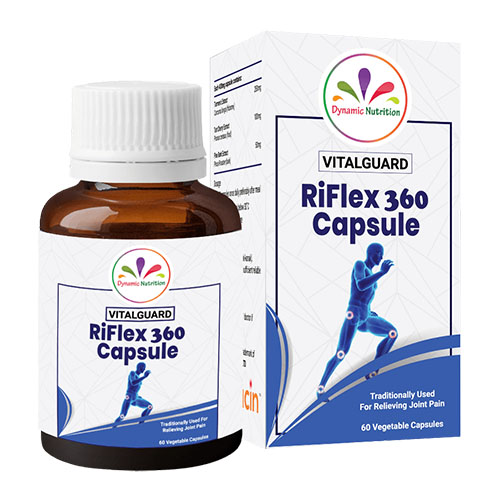
For Malaysian and Singaporean adults whose weekend sport is starting to bite back, RiFlex 360 Capsule is the joint support formula we typically suggest as a baseline. It’s built around three named, clinically-studied ingredients — each chosen for a different mechanism:
- 🌿 Turmacin® (standardised turmeric extract): published RCT evidence for knee OA pain relief, with measurable improvements in the early days of supplementation in the studies. Unlike raw turmeric powder, the water-soluble extraction profile is meaningfully bioavailable.
- 🍒 Tart cherry extract: anthocyanin content linked to lower plasma urate — the work by Jacob et al.2 showed measurable reductions in plasma urate within hours of cherry consumption in healthy women. Particularly relevant for the subset of weekend warriors who also deal with gout flares (a common comorbidity in Malaysian adults).
- 🌲 French maritime pine bark extract: Pycnogenol®-class ingredient with peer-reviewed evidence in the broader joint-comfort and circulation-support literature.
RiFlex 360 carries MAL approval (MAL21116121TC) and is manufactured under certified GMP conditions — which matters more than most marketing copy suggests, given the regulator warnings that have surfaced over the past year about adulterated herbal products3.
A practical 4-week plan for the returning weekend warrior
Supplements only work inside a sensible training plan. For someone in their 40s or 50s picking pickleball or Hyrox back up after a long layoff — or ramping up volume too fast — here’s the 4-week structure we typically suggest:
Week 1–2: Stabilise
- Drop training volume to 60% of what you were doing when the knee started complaining.
- Add 10 minutes of dynamic mobility before every session (no exceptions).
- Begin a daily joint support stack — RiFlex 360 in the morning with food is the standard suggestion.
- Sleep target: 7+ hours. This is non-negotiable for joint recovery.
Week 3: Re-load carefully
- Increase training volume by ~10% from Week 2 baseline.
- Add isometric knee strengthening (Spanish squat, terminal knee extension) 2× per week.
- Continue the daily joint support stack.
Week 4: Re-test
- If the knee feels stable and swelling is gone, return to 80% of pre-injury volume.
- If pain or swelling persists, see a sports medicine doctor — don’t push through it. A meniscal tear that responds to conservative care at week 4 often needs surgery at week 12.
- Continue the daily joint support stack long-term.
When to actually see a doctor (not just take more supplements)
Supplements are a support layer, not a substitute for clinical care. Get a proper assessment if you have any of these:
- ⚠️ Locking or catching in the knee joint — possible meniscal tear.
- ⚠️ Visible swelling that doesn’t go down in 48 hours — possible effusion.
- ⚠️ Pain at rest or at night — inflammation that isn’t settling.
- ⚠️ Instability — the knee “giving way” — possible ligament injury.
- ⚠️ No improvement after 4 weeks of sensible loading + supplement support.
The bottom line
The pickleball and Hyrox boom in Malaysia and Singapore isn’t going anywhere — and that’s a good thing. Adults in their 40s, 50s, and 60s moving more is one of the most positive public-health shifts in a generation. The trick is to do it in a way the knees can keep up with. A structured warm-up, a reasonable load ramp, decent sleep, and a clinically-studied joint support formula like RiFlex 360 Capsule cover the four pillars. The fifth pillar — recognising when something needs a doctor’s eyes instead of another week of training — is the one most often missed.
References
- Sports surgeon: Pickleball and hyrox injuries on the rise, New Straits Times, 2026-08-09 — https://www.nst.com.my/sports/others/2026/08/1507324/sports-surgeon-pickleball-and-hyrox-injuries-rise
- Consumption of cherries lowers plasma urate in healthy women, Jacob RA, Spinozzi GM, Simon VA, Kelley DS, Prior RL, Hess-Pierce B, Kader AA. Journal of Nutrition, 133(6):1826, 2003 — https://academic.oup.com/jn/article/133/6/1826/3118074
- HSA warns of banned substances, potent steroids in products marketed as herbal remedies, supplements, The Straits Times, 2026-07-23 — https://www.straitstimes.com/singapore/hsa-warns-of-herbal-medicinal-products-containing-banned-substance-potent-steroids
Related Topics
Natural Gout Pain Relief: Lower Uric Acid & Stop Flares
Age-Related Knee Pain: A Story of Wear, Tear, and Inflammation
How Turmeric Relieves All Types Of Joint Pain?
Tart Cherry For Natural Gout Relief
Top 5 Benefits Of French Maritime Pine Bark
How to Relieve Knee Pain Without Painkillers: 7 Non-Drug Options Gaining Mainstream Acceptance