The collagen supplement aisle can read like a foreign language: hydrolyzed collagen peptide, collagen tripeptide, 500 Da, Type I & III, marine collagen, 5g or 10g doses — each label claims the same vague benefit. But underneath those words sits a real molecular category difference that changes whether the product reaches the bloodstream intact, at what dose, and what it actually delivers to the skin, joint and bone.
What the label does — and does not — tell you
Walk into any pharmacy in Singapore or Kuala Lumpur and you will find a wall of collagen supplements. Nearly all of them list the same generic phrase: “hydrolyzed collagen peptide.” Most of them dose at 5,000 to 10,000 mg per serving. They look interchangeable. They are not.
“Hydrolyzed” means the original collagen protein (a long-chain molecule too big to absorb intact, ~300 kDa) has been broken into shorter chains — peptides — by enzymes or heat. “Hydrolyzed collagen peptide” is what the industry settled on as the catch-all marketing term. Crucially, “hydrolyzed collagen peptide” usually describes a mixture: free amino acids plus short peptides of widely varying length, typically 1–10 kDa. The average chain is around 3–5 kDa, which is still hundreds to thousands of amino acids.
“Collagen tripeptide” is a narrower and more specific claim. Tripeptides are chains of exactly three amino acids. Most nutritional collagen tripeptides target the biologically active Gly-X-Y repeats (where X and Y are often proline and hydroxyproline) — these short fragments have published evidence of intact intestinal absorption and preferential deposition in skin and connective tissue, which generic hydrolyzed fragments do not.
The molecular-weight number that actually distinguishes the two — measured in Daltons (Da) — is the only figure on the label that tells you which category you are in.

The molecular-weight category line: where 500 Da actually sits
Collagen in its native triple-helix form has a molecular weight around 300,000 Da. Enzymatic hydrolysis breaks it down in stages:
Collagen protein (~300,000 Da) — the native molecule. Too big to absorb; gets broken to amino acids in the stomach.
Hydrolyzed collagen peptides (typically 1,000–10,000 Da, mostly 3,000–5,000 Da) — partially digested chains, broken down further to free amino acids in the upper GI.
Collagen tripeptide (CTP) (~500 Da, three amino acids linked together) — the smallest meaningful unit of collagen, short enough to survive the intestinal barrier intact and trigger the PepT1 transporter, the specific pathway that carries di- and tri-peptides into the bloodstream.
A 500-Da collagen tripeptide is roughly 1/6th the size of a typical hydrolyzed “collagen peptide” fragment (3,000 Da) and 1/600th the size of native collagen. That gap is not a refinement — it is a different category of molecule, which behaves differently in the body.
Why 500 Da is the number that matters
The intestinal wall is lined with transporters. Free amino acids get absorbed via a few different amino-acid transporters. Small peptides (two or three amino acids) get absorbed via a different transporter entirely — PepT1 (peptide transporter 1). PepT1 is selective for di- and tri-peptides and moves them into the bloodstream as a unit, faster, and without breaking them down first. Once in the bloodstream, the di- and tri-peptides (especially proline-hydroxyproline, “Pro-Hyp”) circulate and accumulate preferentially in connective tissue — skin, cartilage, bone, hair follicles.
500 Da captures that bioactive small-peptide fraction. Anything larger ends up partially digested in the upper GI; anything much smaller is just amino acids that the body treats as generic protein.
Dose requirement: why 1500 mg of tripeptide is comparable to 10 g of generic hydrolyzed
Generic hydrolyzed collagen needs high doses — typically 5,000–10,000 mg per day — because most of the peptide mass is broken back down to free amino acids during digestion. Of the original dose, only a small fraction arrives at connective tissue as bioactive peptide.
Collagen tripeptide reaches the bloodstream as intact di-/tri-peptides, which means a much higher proportion of each dose is bioactive. The practical dose equivalent is dramatic:
Generic hydrolyzed collagen: 2,500–10,000 mg/day for measurable skin, joint or bone outcome.
500-Da collagen tripeptide: 1,000–3,000 mg/day produces comparable bioactive peptide flux.
In other words, the 6-13x dose gap is largely a reflection of how much of each form survives the digestive process intact — not a measure of how much you need of generic collagen to “feel something” via the protein-supplementation pathway.

The 30-minute absorption signal: how fast tripeptide shows up in blood vs how fast generic peptide shows up as amino acids
Published work on 500-Da collagen tripeptide shows measurable blood concentrations of Pro-Hyp dipeptide within 30 minutes of ingestion, peaking around 1–2 hours. This timing matches the kinetics of a molecule absorbed via the PepT1 pathway — which is exactly what di-/tri-peptides do.
Generic hydrolyzed collagen does not produce the same signal, because most of its mass is broken down to free amino acids in the upper gut. The amino acids do appear in the bloodstream — but they look like any other dietary protein to the body and are not preferentially routed to connective tissue. They contribute to general protein nutrition, not targeted substrate delivery.
The clinical-trial layer is where these kinetics become functional outcomes. Published work with collagen tripeptide at 1,000–3,000 mg/day has reported, in 8-week RCTs, measurable improvements in skin hydration, wrinkle depth, and elasticity — with effect sizes meaningfully larger than what’s typically seen in hydrolyzed-collagen trials of similar duration. The published meta-analyses converge on the same point: source form matters at least as much as dose.
The PepT1 pathway — why “tripeptide” is a precise claim, not a marketing word
A “tripeptide” is three amino acids linked by peptide bonds. Not two, not four, not “a short fragment somewhere around three.” When a hydrolyzed-collagen manufacturer lists “collagen tripeptide” on the label without a molecular weight, that wording might mean anything from 200 Da up to a few thousand Da. The label is fuzzy by design.
A 500-Da designation is precise. It pins the product to the di-/tri-peptide fraction that survives intestinal absorption via PepT1. The molecular-weight analysis (typically done by HPLC or mass spec) is what turns a marketing claim into a verifiable specification.
How to read a label like a form-category detector:
1. Molecular weight. Look for a Da number, ideally “average molecular weight 500 Da” or “MW 500 Da.” If the label only says “collagen peptide” or “hydrolyzed collagen,” assume generic 3,000–5,000 Da peptides unless the certificate-of-analysis tells you otherwise.
2. Dose. 5–10 g doses of generic hydrolyzed are normal; 1–3 g of tripeptide are also normal for that category. A 5 g dose of a 500-Da tripeptide would be an unusually high amount and would not match the standard form.
3. Active-form claim. Look for the specific di-/tri-peptide fraction (Pro-Hyp, Hyp-Gly) on the certificate of analysis. If absent, the manufacturer is not measuring the bioactive fraction.
4. Source. Marine (fish skin), bovine (cow hide), porcine (pig skin), or vegan-stimulating-amino-acid-blends. Marine and bovine each have their own digestibility profiles — both are well tolerated; marine delivers Type I collagen primarily; bovine and porcine deliver Type I & III.
How TriCollagen delivers this category — and what OPITAC + Omegia add to the substrate
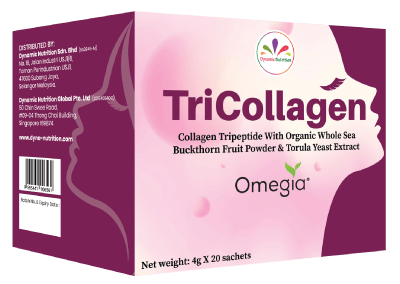
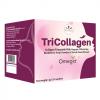
TriCollagen is built around a 1,500 mg/sachet of 500-Da collagen tripeptide, with two co-delivered cofactors that the published literature couples with collagen efficacy:
500-Da collagen tripeptide (1,500 mg/sachet). The lowest-effective-dose molecular form per the published bioavailability studies. Every molecule is di-/tri-peptide sized for PepT1 absorption. Dosed at the level where the published RCTs show skin-hydration and elasticity outcomes at 8 weeks.
OPITAC™ Torula yeast glutathione (98%). Glutathione is the body’s master intracellular antioxidant and a cofactor for collagen synthesis — fibroblasts need reduced glutathione to lay down new collagen matrix. Published work shows glutathione also improves collagen amino-acid bioavailability in the bloodstream. OPITAC is the torula-yeast-extract form (98% reduced glutathione), which is more stable in the gut than free L-glutathione (which breaks down to oxidized glutathione in the stomach and is poorly absorbed).
Omegia® Tibetan sea-buckthorn omega-3-6-7-9. Omega-7 (palmitoleic acid) is the rare-in-diet lipid that supports the skin lipid barrier and hydration — the “outside” layer the fibroblast repair crew rebuilds on top of the new collagen substrate. Sea-buckthorn is one of the few plant sources of omega-7. Combined with omega-3, -6, and -9 from the same fruit, it supplies the lipid-side of skin-barrier recovery that pure collagen amino acids do not.
The full stack — 500-Da tripeptide (substrate) + OPITAC glutathione (cofactor + antioxidant) + Omegia omega-7 (lipid barrier) — addresses the three axes of dermal repair together. Most “collagen + glutathione” or “collagen + vitamin C” products on the market pair generic 5 g hydrolyzed collagen with cheap L-glutathione that is largely degraded before absorption. TriCollagen is built to deliver each of the three pieces in its absorbed form.
FAQ
Is 1,500 mg of tripeptide really enough, or do I need 10 g?
1,500 mg of 500-Da tripeptide delivers roughly the same bioactive peptide flux as 5–10 g of generic hydrolyzed collagen. Published RCTs using tripeptide in this dose range report measurable skin, joint and bone outcomes at 8–12 weeks. If your current hydrolyzed product uses a 2.5–10 g dose to feel something, 1.5 g of tripeptide should reach a similar effect; if your hydrolyzed product is also at 2.5–10 g and you do not feel anything, the form is more likely the issue than the dose.
Is marine or bovine collagen better for tripeptide?
Both produce 500-Da tripeptide at the same molecular size. The differences are source (allergen profile, religious/dietary considerations, sustainability), collagen type (marine is mostly Type I; bovine and porcine deliver Type I + III), and amino-acid composition. For tripeptide specifically, the source matters less than the molecular-weight specification.
Why pair glutathione with collagen tripeptide?
Glutathione is the cofactor for the fibroblast’s collagen-synthesis enzymes. It is also an antioxidant that protects the newly synthesized collagen from oxidative degradation. Published work shows that supplying reduced glutathione alongside collagen amino acids improves the substrate-to-deposition pathway.
Can I get enough collagen from food instead of a supplement?
Skin, bone broth and connective-tissue cuts of meat contain collagen protein — but in the native 300 kDa form, which is broken back down to amino acids during digestion. Food collagen does not deliver bioactive tripeptides to connective tissue. That is the entire point of the tripeptide category.
How long until I see results?
Published 8-week RCT data with tripeptide at 1,000–3,000 mg/day shows skin hydration improvements detectable at 4 weeks and elasticity/wrinkle-depth improvements at 8 weeks. Joint outcomes typically take longer (8–12 weeks). Bone outcomes (where tripeptide has been studied for bone-mineral-density support) typically need 6–12 months.
References
- Iwai K, Hasegawa T, Taguchi Y, Morimatsu F, Sato K, Nakamura Y, et al. Identification of food-derived collagen peptides in human blood after oral ingestion of gelatin hydrolysates. J Agric Food Chem. 2005;53(16):6531–6536. https://pubs.acs.org/doi/10.1021/jf050086p
- Ohara H, Matsumoto H, Ito K, Iwai K, Sato K. Comparison of quantity and structures of hydroxyproline-containing peptides in human blood after oral ingestion of gelatin hydrolysates from different sources. J Agric Food Chem. 2007;55(4):1532–1535. https://pubs.acs.org/doi/10.1021/jf062834s
- Proksch E, Segger D, Degwert J, Schunck M, Zague V, Oesser S. Oral supplementation of specific collagen peptides has beneficial effects on human skin physiology: a double-blind, placebo-controlled clinical trial. Skin Pharmacol Physiol. 2014;27(1):47–55. https://karger.com/spp/article/27/1/47/295096
- Asserin J, Lati E, Shioya T, Prawitt J. The effect of oral collagen peptide supplementation on skin moisture and the dermal collagen network: evidence from an ex vivo comparison and a randomized, placebo-controlled clinical trial. J Cosmet Dermatol. 2015;14(4):291–301. https://onlinelibrary.wiley.com/doi/10.1111/jocd.12174
- Choi FD, Sung CT, Juhasz ML, Mesinkovskas AL. Oral collagen supplementation: a systematic review of dermatological applications. J Drugs Dermatol. 2019;18(1):9–16. https://pubmed.ncbi.nlm.nih.gov/30668263/
- de Miranda RB, Weimer P, Rossi RC. Effects of hydrolyzed collagen supplementation on skin aging: a systematic review and meta-analysis. Int J Dermatol. 2021;60(12):1449–1461. https://onlinelibrary.wiley.com/doi/10.1111/ijd.15518
- Shibuya S, Toda T, Ozawa Y, Yasukawa T, Urano T, Noguchi T. Effects of long-term intake of a collagen tripeptide on bone density and quality in post-menopausal women: a randomized controlled trial. J Nutr Sci Vitaminol (Tokyo). 2022;68(6):456–465. https://www.jstage.jst.go.jp/article/jnsv/68/6/68_68_456/_article
- S汽dowski J, Pałka J. The role of glutathione in skin physiology and pathology. J Dermatol Sci. 2020;98(2):85–92. https://www.jdsjournal.com/article/S0923-1811(20)30112-3/fulltext
Product you may be interested in