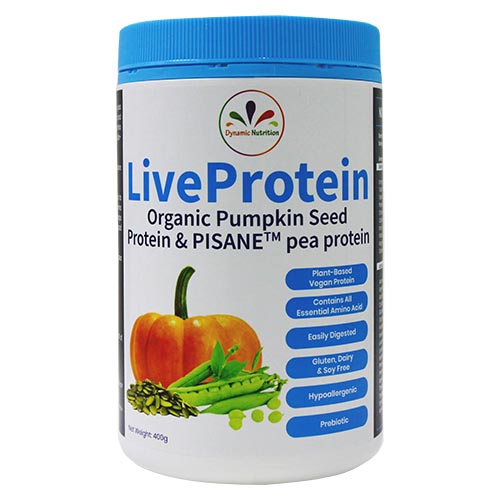
Ask a vegan or a vegetarian how much protein they need and you will usually get two different answers. The first is the number on a general protein-calculator page — a baseline worked out from body weight, activity level and age. The second is the number they actually have to hit three or four times a day, using food that is less protein-dense than the food most people around them eat. The gap between those two numbers is small, and understanding it is the whole subject of this article. LiveProtein — a dairy-free, soy-free blend of organic pumpkin seed protein and PISANE™ pea protein — shows up in the discussion as one practical way to close the daily gap with a single shake, but the arithmetic that gets you there belongs to you, not to the tub.
Two things are worth saying plainly before the numbers start. First, protein is food. A scoop of plant protein powder is a food ingredient that happens to arrive in a measured, portable form — it is not a drug, and no honest article about it should promise you muscle gain, weight loss or a satiety outcome on its own. Second, this article is deliberately not another protein calculator. The site already has one, and it is the right place to run the arithmetic on your own body. What follows is the part a calculator cannot do for you: why a plant-based plate lands on a slightly different number than an omnivore plate, what actually moves that number day to day, and where a single daily shake fits into the pattern.
Why a Plant-Based Plate Lands on a Slightly Different Number
There are three reasons, and none of them is dramatic enough to explain a large gap. They are simply enough to explain a small one, which is exactly the magnitude that matters.
1 — Protein density. This is the biggest one and the least technical. A 100 g serving of chicken breast carries roughly 30 g of protein in about 165 kcal. A 100 g serving of most plant staples — cooked chickpeas, tofu, pasta, cooked lentils, bread — lands somewhere between 5 g and 13 g of protein. The plant-based plate is bulkier, more fibrous and more voluminous for the same number of calories, and protein is the nutrient that gets crowded out. A person who switches from an omnivore diet to a plant-based one without noticing the density difference will feel full before they have covered their protein, and that is the mechanism behind most of the “I am vegetarian and I always feel hungry” complaints. It is a volume problem before it is a willpower problem.
2 — Digestibility. Plant protein is, on average, digested a little less completely than animal protein. The commonly cited figures from the dietary-protein-quality literature put plant protein at roughly 90% digestibility against something closer to 95% for animal protein. That five-point difference sounds trivial until it is multiplied across every meal in a week, because the label on the tub tells you what you swallowed, not what you actually absorbed. Nobody reading a protein panel needs to become an expert on ileal markers for this to matter; it is simply one more reason the plant-based target sits a little above the omnivore one rather than level with it.
3 — Amino acid profile. Almost no single plant source is complete on its own. Legumes are relatively low in methionine; grains and most seeds run lower in lysine. This is the reason the old advice to “combine proteins at every meal” existed. The current position in nutrition science is more relaxed and more useful: you do not have to pair them inside a single meal, but you do need a spread of sources across the day so the limiting amino acids average out. A day built on one protein source is a day with a gap in it, no matter how much of that source you eat.
Add those three together and the honest conclusion is a modest adjustment rather than a dramatic one. Most dietitians working with plant-based clients apply a modest uplift to an omnivore baseline of the same body weight — think in the region of 10% to 20% — and then make sure the result is distributed rather than back-loaded. The site’s protein calculator page sets out the baseline range most people start from, and it is the right tool for running your own number. What follows is how to move it.
Three Levers That Actually Move the Number
1 — Add density before you add supplements. The biggest win comes from whole food, not powder, because whole food also brings fibre, micronutrients and volume. Swapping a bowl of plain rice for a portion of tofu or tempeh; adding a ladle of cooked lentils or chickpeas to a curry; using roasted pumpkin seeds as a garnish rather than a decoration; choosing a higher-protein bread and a fortified plant milk in coffee — each of these moves the daily total without moving the daily volume much. A reader who fixes density first usually finds the remaining gap small enough that a shake is optional rather than essential, and that is the better outcome on every axis.
2 — Spread your sources across the day, not your meals. One or two heavily plant-based eating windows a day with almost no protein in the others is the pattern that produces a shortfall, even on a diet that looks generous on paper. Rotating legumes, grains, seeds, soy-free soy alternatives and nuts across the day solves the amino acid completeness problem without asking you to plan every meal around a chart.
3 — Distribute the total across three or four feedings. The usable heuristic most nutrition professionals work from is roughly 20 g to 30 g of protein per eating occasion, repeated across the day, rather than one very large serving at dinner. This is a practical heuristic rather than a hard biological switch, but it is a useful one for exactly the reader this article is about: a person eating plant-based food all day has small, frequent opportunities, and a couple of larger feedings are usually easier to hit than four rushed ones.
Where One Daily Shake Fits Into the Pattern
There is a specific, limited job for a protein powder in a plant-based diet, and it is worth being precise about it so you do not end up using one to do a job it cannot do. The job is this: you have identified a repeatable gap — most often breakfast, most often a rushed lunch, most often a day that runs on rice and noodles — and you want to close it without adding a decision, a cooking step or a large volume of food.
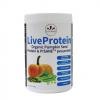
LiveProtein is built for that job in a way that suits plant-based readers specifically. The tub is 400 g and the panel on the product page gives 20 servings, so one serving is 20 g of powder. Two scoops with 200 ml of water give 78.2 kcal and 12.7 g of protein, with 3 g of carbohydrate and around 3 g of fibre in the mix. It is dairy-free and soy-free, which removes two of the most common reasons a plant-based reader ends up back on a whey or a soy isolate — and, importantly for a reader who is already eating legumes every day, the protein comes from organic pumpkin seed and PISANE™ pea protein rather than from one of the sources they have already exhausted.
Twelve-odd grams is not a replacement for a plate of food, and it should not be sold as one. In a 2,000 kcal day for a 65 kg adult, a target in the region of 70 g to 90 g of protein — depending on where your own number lands — means a single shake can account for a useful seventh or so of it. Used that way, as the reliable top-up on the meal you consistently under-eat protein at, it is a tool that does one job well. Used as a substitute for the levers above, it is expensive food.
One honest caveat about the formulation, because it affects a real subset of readers: LiveProtein contains inulin, which is a prebiotic fibre in the fructan family. Fructans are one of the FODMAPs that sensitive-gut readers are commonly told to limit, and inulin in particular is worth naming if that is you. The practical advice for those readers is to start with half a serving and build up over a week or two, and to read the easy-to-digest checklist for plant protein powders before you commit to a tub. Nothing about it is a safety problem; it is a familiarity problem, and it resolves the same way most fibre introductions do.
Reading a Plant Protein Label Without Getting Sold To
Labels on plant protein powders are easier to read than they look once you know the two numbers that matter, and the panel on the LiveProtein tub is a good place to practise because both numbers are printed.
The per-serving and per-100 g figures must agree. A label that gives 12.7 g of protein per serving and 63.6 g per 100 g is describing the same thing twice: 12.7 g multiplied by five servings gives 63.5 g. If those two numbers do not reconcile, one of them is describing a different scoop size from the one in the mixing instructions, which is the single most common labelling trap on plant protein powders. Check it in about ten seconds.
Look for the protein source before the flavour. “Pumpkin seed and pea protein” tells you something specific about the amino acid profile and about how your gut will meet it. A proprietary blend does not, and it cannot be checked on the panel. The order of the ingredients list is also more informative than the front of the tub: ingredients are listed in descending order by weight, so if a sweetener appears above the protein source, that is what you are buying most of.
Added sugar and sweeteners are worth a separate look. They hide in three different forms on plant protein panels — sugar, syrups, and sugar alcohols such as erythritol or maltitol — and the calorie contribution is not always the point. If a shake is going to be a daily habit for you, it is worth knowing which sweetener is carrying it and how your own stomach has historically handled that sweetener.
Ask about testing, and ask about the batch. Plant protein powders are agricultural inputs, and like any agricultural input they carry a contaminant question that a whey concentrate does not. A supplier who publishes batch-level test results, and can tell you which laboratory did them, is telling you something a front-of-pack claim cannot. This is not a reason to distrust the category; it is a reasonable question to put to any powder you intend to buy every week.
Common Questions (Quick Reference)
Do vegans and vegetarians need more protein than everyone else? Modestly, in most cases — the plant-based target typically sits a little above an omnivore baseline of the same body weight, because of protein density, digestibility and amino acid profile. It is an adjustment of about 10% to 20% on a baseline number, not a different order of magnitude.
Is plant protein as good as animal protein? It is broadly comparable in the ways that matter for a mixed or fully plant-based diet, with the caveat that digestibility is a little lower and that no single plant source is complete on its own. Variety across the day matters more than the label on any one powder.
Do I need a protein powder if I eat enough plant food? No. If your daily total is comfortably covered by whole food, a powder adds cost and nothing else. It earns its place when there is a specific, repeatable gap you have identified and cannot close with the meals you actually eat.
How much protein per meal should I aim for? A practical heuristic for most adults is roughly 20 g to 30 g per eating occasion across three or four feedings. Use the site’s protein calculator for the daily total, then split it.
Will one shake a day build muscle? No honest answer from a food product is yes. A shake is a food that makes a specific meal more complete; what your training and your overall pattern do with that food is a separate question, and anyone promising you an outcome from a scoop is promising something the scoop cannot deliver.
Is LiveProtein suitable if I avoid dairy and soy? It is dairy-free and soy-free, and its protein comes from organic pumpkin seed and pea protein. Note that pea protein is a legume, so it is not a legume-free option, and it contains inulin, which fructan-sensitive readers should introduce gradually.
At its simplest, the plant-based protein question is a volume-and-variety question before it is a product question. Get the density right, spread the sources, split the total across the day, and what is left over is small. One daily shake of a dairy-free, soy-free pumpkin seed and pea blend is a clean way to cover that leftover — for the meal you consistently under-eat protein at, and for no reason beyond that.
Product you may be interested in