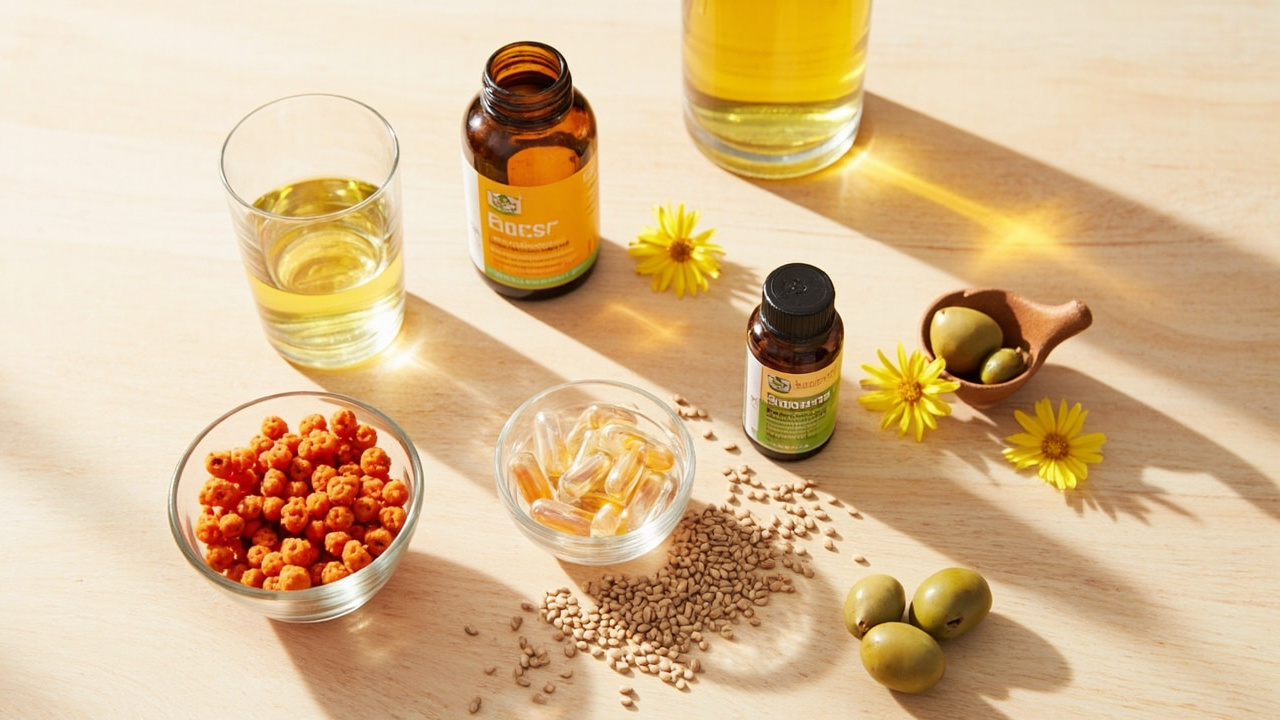
 If you have ever stood in front of the omega-3 shelf at a pharmacy and felt the decision fatigue creeping in, you are not alone. Fish oil. Flaxseed oil. Evening primrose oil. Olive oil. And — sitting somewhere between “superfood” and “mythical Himalayan berry” — sea buckthorn. The question that actually matters is not “which omega oil is healthiest?” — it is which one delivers a full omega profile, and at a meaningful dose? Because most omega supplements deliver one or two omegas well and skip the rest. Sea buckthorn is the only widely-available plant food that delivers all four — omega 3, 6, 7, and 9 — in a single source.
This side-by-side decode lays out the five most common whole-food omega sources, the mechanism each one actually works through, the dose at which the published evidence holds up, and the gap most supplement labels gloss over. By the end you will know exactly what each oil does, what it does not do, and how to layer them if you want to cover more than one omega in a daily routine.
The short answer: only one of these delivers a full omega profile
Before the long decode, here is the one-line consumer takeaway:
Sea buckthorn (whole-fruit powder, supercritical CO₂ extract) is the only widely-available plant food that provides all four omega fatty acids — omega-3 ALA, omega-6 LA, omega-7 palmitoleic acid, and omega-9 oleic acid — in a single source, plus 190+ co-occurring nutrients (polyphenols, proanthocyanidins, flavonoids, beta-carotene, vitamin E, plant sterols). Every other option on this list delivers one or two omegas well, but the others are absent or present only in trace amounts.
The other four split into clear roles: fish oil for marine omega-3 (EPA + DHA), flaxseed oil for plant-based omega-3 ALA on a budget, evening primrose oil for the rarer omega-6 GLA (used for hormonal-skin and PMS contexts), and olive oil as the cooking-and-dressing omega-9 base. They are not competitors — they are layers.

What “full omega profile” actually means (omega 3, 6, 7, 9 decoded)
Omega fatty acids are not interchangeable. Each number is a different molecule with a different structural role in cell membranes, a different metabolic pathway, and a different evidence base.
Omega-3 (alpha-linolenic acid — ALA — in plants; EPA + DHA in marine sources)
The most-published omega and the one your body cannot make on its own (essential fatty acid). Plant sources deliver ALA — a short-chain omega-3 that converts to EPA and DHA inefficiently (about 5–10% conversion). Marine sources (fish oil, krill oil, algae oil) deliver the long-chain EPA and DHA directly — the forms with the strongest cardiovascular and triglyceride evidence. Omega-3 supports cell-membrane fluidity, anti-inflammatory eicosanoid production, and triglyceride metabolism.
Omega-6 (linoleic acid — LA — plus gamma-linolenic acid — GLA — in evening primrose)
Also essential, but the Western diet already delivers a surplus of LA from sunflower, corn, and soybean oils. Most people do not need more omega-6 LA. The rarer GLA form (in evening primrose oil and borage oil) converts further down the anti-inflammatory pathway — useful for cyclical breast discomfort, skin barrier support, and hormonal-skin contexts where standard LA oversupply does not help.
Omega-7 (palmitoleic acid)
The least-known and the rarest in the diet. Palmitoleic acid (16:1 n-7) was first isolated and characterised by Harvard Medical School researchers in 2008, who found it diminished in chronic inflammation and Type 2 diabetes in their initial cohort studies. It is a structural lipid for the phospholipid bilayer of all wet mucosal surfaces — eyes, mouth, throat, lungs, gut, vagina — and for the lipid layer of skin. The highest plant-source concentration known comes from Tibetan plateau sea buckthorn (Hippophae rhamnoides) — several-fold higher than avocado, Peruvian anchovy, or macadamia. Published research supports mucous-membrane regeneration (ocular, oral, respiratory, intestinal, vaginal, skin tissues), vascular endothelial protection, and skin-barrier lipid support.
Omega-9 (oleic acid)
The body can make this one, so it is not “essential,” but it is the dominant monounsaturated fat in the Mediterranean-diet evidence base for cardiovascular and longevity outcomes. Olive oil is the canonical omega-9 source, with the most-published dietary-pattern research behind it. Sea buckthorn delivers omega-9 alongside its omega-3, 6, and 7 layers — a free bonus in the same source.
The five-way decode: sea buckthorn vs fish oil vs flaxseed vs evening primrose vs olive oil
Five oils. Five different jobs. The mistake most readers make is treating them as competitors when the layered reading is far more useful.
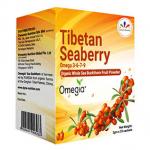
1. Sea buckthorn (Omegia® whole-fruit powder, supercritical CO₂)
The only widely-available plant food that delivers all four omegas in a single source. Omega-7 palmitoleic acid is the headline — the highest plant-source concentration known — and the structural lipid for mucous-membrane regeneration and vascular endothelial support. Plus 190+ co-occurring nutrients and a 70×-vitamin-C antioxidant layer (proanthocyanidins + flavonoids + polyphenols).
Mechanism: omega-7 palmitoleic acid integrates into cell-membrane phospholipids (especially in mucosal and vascular endothelium), supporting membrane integrity and regeneration; omega-3 ALA, omega-6 LA, and omega-9 oleic acid round out the essential-fatty-acid stack; polyphenols buffer the oxidative-stress load that chronic inflammation creates. Form matters: whole-fruit powder (juice + seed oil) captures all four omegas plus the polyphenol layer; supercritical CO₂ extraction preserves the fragile polyunsaturated fraction (heat extraction destroys omega-7). Generic “sea buckthorn juice” is mostly low-omega-7 juice with the seed-oil fraction removed. Dose: a meaningful daily dose is 5–10 g of standardised whole-fruit powder delivering a specified omega-7 content (look for the Omegia® or equivalent supercritical-CO₂ source on the label). Evidence: omega-7 mucosal-regeneration research is anchored in the 2008 Harvard discovery and subsequent published work on ocular, oral, respiratory, intestinal, vaginal, and skin tissues; broader sea-buckthorn-berry antioxidant claims have an in-vitro ORAC base but variable in-vivo bioavailability depending on form.
2. Fish oil (EPA + DHA, marine omega-3)
The most-published omega-3 source and the one with the strongest cardiovascular and triglyceride evidence base. Delivers EPA + DHA directly (no conversion needed). Zero omega-7, zero meaningful omega-6, zero omega-9. Only omega-3.
Mechanism: EPA and DHA integrate into cell-membrane phospholipids (especially in cardiac, neural, and retinal tissue), support anti-inflammatory eicosanoid production, lower triglycerides, and contribute to the structural integrity of neuronal and retinal membranes. Form matters: triglyceride form (re-esterified, not ethyl ester) has the best published bioavailability; enteric-coated softgels reduce fishy burp; molecular distillation removes heavy metals and PCBs. Dose: the AHA targets 1 g/day of combined EPA + DHA for general cardiovascular support and 2–4 g/day for triglyceride lowering (under clinical supervision). Evidence: the strongest omega-3 evidence base — REDUCE-IT, JELIS, VITAL, and many smaller trials support triglyceride lowering, cardiovascular event reduction in high-risk populations, and modest blood-pressure benefit. Vegan-unfriendly. Sustainability and heavy-metal concerns are addressed by reputable IFOS-certified brands.
3. Flaxseed oil (ALA, plant-based omega-3)
The most-published plant-based omega-3 source and the cheapest per gram. Delivers ALA only — the short-chain precursor to EPA and DHA — which converts inefficiently in humans (5–10% to EPA, 2–5% to DHA). For cellular-membrane and cardiovascular benefits comparable to fish oil, you would need a much higher ALA dose. Zero meaningful omega-7 or omega-9.
Mechanism: ALA converts to EPA and DHA at low efficiency; the conversion is further reduced by high background omega-6 intake (which competes for the same desaturase enzymes). Direct ALA benefits include modest lipid-profile support and a lignan layer (if whole-seed, not the oil). Form matters: cold-pressed, refrigerated, opaque bottle (ALA oxidises fast); whole-seed ground at home has better oxidative stability than pre-ground oil. Dose: 1–2 tablespoons/day (15–30 mL) for general omega-3 ALA support. Evidence: modest lipid-profile and anti-inflammatory effects; weaker than fish oil for triglyceride lowering and cardiovascular event reduction because of the conversion bottleneck.
4. Evening primrose oil (omega-6 GLA)
The rarest of the omega-6 sources and the one with a distinct hormonal-skin and cyclical-discomfort profile. Delivers gamma-linolenic acid (GLA) — a downstream omega-6 that bypasses the sluggish delta-6-desaturase step (which is impaired in some people with diabetes, eczema, or hormonal shifts).
Mechanism: GLA converts to dihomo-gamma-linolenic acid (DGLA), which produces anti-inflammatory Series-1 prostaglandins (PGE1). Useful for cyclical breast discomfort, PMS-related skin changes, mild atopic eczema, and hormonal-skin contexts. Form matters: cold-pressed, with vitamin E added for oxidative stability; borage oil is a higher-GLA alternative (20–26% GLA vs evening primrose’s 8–10%). Dose: 1–3 g/day for cyclical symptoms, taken with food for absorption. Evidence: mixed but positive in the cyclical-breast-discomfort and atopic-eczema niche; weaker for general “PMS cure” claims. Complementary to other omega sources, not standalone.
5. Olive oil (omega-9 oleic acid)
The cooking-and-dressing base of the Mediterranean diet and the omega-9 source with the strongest longevity and cardiovascular evidence base. Delivers oleic acid (omega-9 monounsaturated fat) plus the polyphenol layer (oleocanthal, hydroxytyrosol, oleuropein) that contributes to the anti-inflammatory and endothelial-function benefits. Zero omega-3, zero omega-7, modest omega-6.
Mechanism: oleic acid integrates into cell-membrane phospholipids, supports HDL cholesterol maintenance, and contributes to endothelial function; the polyphenol layer (especially oleocanthal, a natural COX-2 inhibitor similar in mechanism to ibuprofen) provides the anti-inflammatory backbone of the Mediterranean-diet evidence. Form matters: extra-virgin olive oil (EVOO) retains the polyphenol layer; refined olive oil loses most of it. Dose: 1–2 tablespoons/day as part of a Mediterranean-style dietary pattern. Evidence: the strongest dietary-pattern evidence base for cardiovascular and longevity outcomes (PREDIMED trial and predecessors); olive oil is the base layer, not the supplement layer.
How to layer them: the reader self-diagnostic
The right answer depends on what you are trying to cover. Here is the matched stack for the most common reader priorities.
Cardiovascular + triglyceride priority, marine-omega tolerance OK
Fish oil (2–4 g/day combined EPA + DHA under clinical supervision for triglyceride lowering, or 1 g/day for general cardiovascular support) + olive oil as the cooking base + sea buckthorn for the omega-7 vascular-endothelial layer. The fish-oil-and-olive-oil pair is the Mediterranean-plus-marine-omega stack with the strongest combined evidence.
Complete omega profile + mucosal regeneration + skin/hydration priority
Sea buckthorn (5–10 g/day of supercritical-CO₂ whole-fruit powder, standardised omega-7 content) + olive oil as the cooking base. Skip the fish oil if marine omegas are not the priority — the sea-buckthorn-and-olive-oil pair covers all four omegas plus the polyphenol layer in two daily products.
Plant-based + budget priority
Flaxseed oil (1–2 tablespoons/day for ALA) + sea buckthorn (for the omega-7 layer that flaxseed cannot deliver) + olive oil for cooking. The flaxseed-and-sea-buckthorn stack covers plant-based omega-3 + the rare omega-7 + omega-9 from olive oil — the closest plant-only path to a full omega profile, with the budget upside of flaxseed’s low per-gram cost.
Hormonal skin + cyclical-discomfort priority
Evening primrose oil (1–3 g/day for GLA) + sea buckthorn (for the omega-7 skin-barrier and mucosal layer) + olive oil as the base. The evening-primrose-and-sea-buckthorn stack covers the rare omega-6 GLA + omega-7 in two products — a focused hormonal-skin daily layer.
Cooking + Mediterranean-diet base priority
Olive oil (1–2 tablespoons/day extra-virgin) + sea buckthorn (whole-fruit powder, in a smoothie or with food) + fish oil or flaxseed depending on marine-omega tolerance. The olive-oil-and-sea-buckthorn pair delivers the Mediterranean polyphenol base plus the omega-7 layer that most Mediterranean-diet stacks miss.
What the labels do not tell you
Three label-reading rules that separate evidence-based omega supplementation from marketing.
1. Look for the form, not just the ingredient
“Sea buckthorn” on a label can mean whole-fruit powder, seed oil alone, berry juice, or generic extract — very different active-compound profiles. The omega-7 lives mostly in the seed oil and pulp skin; the polyphenols live mostly in the juice and skin; the lipid-soluble antioxidants (beta-carotene, vitamin E) live in the seed oil. Whole-fruit powder captures all four omegas + the polyphenol layer + the lipid-soluble antioxidants in one source. Look for “whole-fruit powder” or “Omegia®” or equivalent supercritical-CO₂ specification on the label — not “sea buckthorn extract” or “sea buckthorn juice.”
2. Look for the dose, not just the active
“Fish oil 1000 mg” on a label can mean 1000 mg of fish oil (containing 300 mg of EPA + DHA combined) or 1000 mg of EPA + DHA combined (a much higher dose). The published cardiovascular evidence is anchored on EPA + DHA content, not fish-oil mass. Same principle for evening primrose (look for GLA content per dose, not oil mass) and sea buckthorn (look for omega-7 content per dose, not powder mass).
3. Look for the extraction method
Heat extraction destroys omega-7 and most of the fragile polyunsaturated fraction in sea buckthorn. Generic “sea-buckthorn juice” has had the seed oil removed (low omega-7). Cold-pressed flaxseed oil in a clear bottle on a sunny shelf has likely oxidised — ALA is fragile. Fish oil softgels that are not enteric-coated produce fishy burp and faster oxidation. The extraction and storage method is part of the dose, even when it is not on the front of the label.
The daily-from-inside stack: which oils, in what order
If you wanted the simplest evidence-based omega stack — one that covers all four omegas plus the antioxidant and polyphenol layers — the highest-yield daily routine would be:
(1) Sea buckthorn (Omegia® or equivalent supercritical-CO₂ whole-fruit powder, 5–10 g/day) — the only source that delivers all four omegas plus 190+ nutrients in a single daily dose; covers the omega-7 layer that none of the others can. (2) Olive oil (extra-virgin, 1–2 tablespoons/day, used in cooking or as a dressing) — the omega-9 and polyphenol base of the Mediterranean-diet evidence. (3) Fish oil or flaxseed oil, depending on marine-omega tolerance and budget — fish oil for direct EPA + DHA, flaxseed for plant-based ALA. (4) Evening primrose oil, only if hormonal-skin or cyclical-discomfort is a priority — a focused add-on rather than a baseline.
The Mediterranean-diet pattern (olive oil as the base, fish 2–3 times per week, polyphenol-rich plants daily) is the most-published dietary pattern for cardiovascular and longevity outcomes. Sea buckthorn slots into that pattern as the omega-7 + polyphenol + 190-nutrient daily add-on that most Mediterranean-diet stacks miss.
The bottom line
Sea buckthorn is the only widely-available plant food that delivers a full omega 3-6-7-9 profile plus a 70×-vitamin-C antioxidant layer in a single daily source. Fish oil is the strongest omega-3 (EPA + DHA) with the strongest cardiovascular and triglyceride evidence. Flaxseed oil is the cheapest plant-based omega-3 (ALA) but converts inefficiently. Evening primrose oil delivers the rarer omega-6 GLA for hormonal-skin contexts. Olive oil is the Mediterranean-diet base for omega-9 and longevity.
The mistake is treating them as competitors. They are layers. The stack that covers all four omegas — sea buckthorn + olive oil + fish oil or flaxseed — is two to three daily products and one cooking habit. That is the whole decode.
Related Topics
Sea Buckthorn for Menopause: 5 Science-Backed Benefits for Women
Vegan Omega 3, 6, 7 & 9 – Ultimate Women’s Nutrition
Why You Need Omega 7 in Your Diet?
Omega 3, 6, 7, 9 – What are The Differences and Benefits?
Sea Buckthorn Oil Benefits to the Skin
How Does Sea Buckthorn Lower LDL Cholesterol & Triglycerides?
Product you may be interested in