If you have ever read the ingredient panel on a hair supplement and seen the word spermidine, it is tempting to treat it as shorthand for this will make hair grow. That reading is wrong, and it is wrong in a way that is worth a few minutes of your attention before you spend any money.
Spermidine is one of three polyamines — putrescine, spermidine and spermine — that every living cell makes and uses. The research connecting them to hair is genuine, and in places quite good. What is missing is the specific claim most products make: that a polyamine supplement has been shown to regrow hair in people who are losing it. No controlled trial has demonstrated that. So this article does three things: it sets out what the polyamine studies actually measured, it sets out what they did not, and it explains how to read a spermidine or polyamine label for yourself.

What spermidine and the other polyamines actually are
Polyamines are small, straight-chain molecules built from amino acids. They are everywhere in biology — they regulate gene expression and protein synthesis, and they sit inside cell growth, cell division and cell differentiation as a matter of routine1. Because they are so widely used, they are tightly regulated: your body makes them, breaks them down and transports them through a dedicated metabolic cycle whose steps are easy to describe and easy to disturb.
The hair follicle is one of the most rapidly dividing organs in the human body, which is why researchers have looked hard at polyamine metabolism in it. In mouse models, altering polyamine metabolism changes how fast follicular keratinocytes divide, and when the balance is disrupted the result is hair loss1. The same pathway runs in reverse in medicine: eflornithine, a drug that blocks the rate-limiting enzyme in polyamine synthesis (ornithine decarboxylase), is used to reduce unwanted hair growth in women1. That symmetry is the clearest single demonstration that polyamine chemistry is genuinely wired into the follicle, in both directions.
Where polyamines come from is a mundane but important part of the story. Your body makes its own, and it also absorbs them from food. Dietary polyamines are present across both plant and animal foods, and the levels are substantial in some staples: wheat germ is the richest common source at around 2,437 nmol per gram of spermidine, followed by soybeans at roughly 1,425 nmol per gram, with mushrooms, peas, hazelnuts, pistachios, spinach, broccoli, cauliflower and green beans all contributing meaningful amounts2. Your own synthesis rate, meanwhile, declines with age2.
Two other facts about polyamines are worth holding onto, because they are frequently used to oversell the category. First, polyamines are a double-edged molecule in health terms: in conditions involving high cellular proliferation — cancer above all — elevated polyamine levels are a problem, and drugs that suppress polyamine synthesis exist precisely because of that7. Second, the large-scale human evidence for dietary polyamines is about general health markers, not hair: in one cohort of 829 participants followed for 20 years, spermidine showed the strongest inverse relationship with mortality among 146 nutrients examined2. Neither fact makes polyamines a scam. Both mean that a hair claim needs hair evidence.
What the hair research actually measured
There are two studies worth reading properly, because they are frequently quoted and frequently over-quoted — and they measured quite different things.
The first is a 2011 study published in PLoS ONE, by Ramot and colleagues, that put human scalp hair follicles into serum-free organ culture and exposed them to spermidine at concentrations between 0.1 and 1 µM3. The authors reported that spermidine promoted hair shaft elongation, prolonged the anagen (growth) phase, and increased expression of the keratins K15 and K19 associated with follicular epithelial stem cells. Quantitatively, the best-performing dose of 0.5 µM produced more than a 20% increase in hair shaft production after six days in culture3. The paper is careful, and it contains a detail that is often left out: at the highest dose tested, 1 µM, colony-forming efficiency and the proliferation of isolated follicular progenitor cells were inhibited by day six, which the authors attribute to metabolites of excess spermidine generating oxidative damage3. More is not better; at the cellular level there is a ceiling, and it arrived inside a one-micromolar window.
This is an in vitro study. The follicles were dissected from human scalps and cultured in a laboratory for six days. No one swallowed anything, no one was photographed, and no scalp on a living head was measured. It is good mechanistic work and it is not a clinical trial.
The second study is the one that actually involves people. In 2017, Rinaldi and colleagues published a randomized, double-blind, placebo-controlled trial in Dermatology Practical & Conceptual involving 100 healthy men and women in Milan, aged roughly 22 to 501. Participants took either a tablet containing a spermidine-based nutritional supplement or a placebo once daily for 90 days. Hair bulbs were plucked and examined microscopically to count follicles in the late anagen phases, Ki-67 (a proliferation marker) and c-Kit (an apoptosis marker) were measured immunohistochemically, and a hair pull test was performed at three and six months.
The results were clear. The number of anagen V-VI hair bulbs in the treatment group rose by more than 50% over the 90 days, while the placebo group declined by about 20% — a difference with p<0.00011. Ki-67 rose and c-Kit fell in the treatment group and moved the opposite way in the placebo group1. At the six-month pull test, none of the 50 treated participants had a positive result, against 34 of 50 (68%) in the placebo group1. On the terms it was measured on, this is a real and reasonably strong result.
What the research has not shown in people with thinning hair
Here is the part that marketing leaves out, and it is the part that decides what a spermidine product can honestly promise you.
To understand the limit, you need to know what the trial measured: the proportion of hairs in the growth phase. The hair cycle runs from anagen (growth) through catagen (transition) to telogen (rest), and scalp hair can spend up to six years in anagen, roughly two to three weeks in catagen and one to four months in telogen, with up to 10% of the hairs on a normal scalp resting at any one time4. Keeping a follicle in anagen for longer is how hair density is maintained in the first place. That is why the trial’s result is meaningful.
But the trial deliberately avoided the exact population most people reading about spermidine are in. Hair bulbs were plucked from the occipital area of the scalp, chosen precisely because that region is not affected by the androgen receptor changes typical of androgenetic alopecia; the authors state this was to avoid enrolling anyone with as-yet clinically undetectable androgenetic alopecia1. The exclusion criteria went further: participants with initial signs of androgenetic alopecia (miniaturisation of the hair shaft in the occipital region), those with a family history of it, and anyone who had used any topical or systemic hair-loss therapy in the previous three months were all ruled out1. So the trial studied healthy people with normal hair cycling. It did not study people with thinning hair.
And the authors were careful about the boundary themselves, writing that the possible beneficial effects of this compound for telogen effluvium and other hair disorders, such as pattern hair loss, need to be further confirmed in larger controlled studies1. That sentence is the honest summary of the entire evidence base, and it is worth reading twice.
Three further limits belong on the same list. The trial was single-centre, in one clinic in one city1. The intervention was a tablet containing a spermidine-based nutritional supplement — that is, a blend, so the study cannot separate spermidine’s contribution from the other ingredients in the tablet1. And the wider human polyamine literature has been measuring something else entirely: in a small randomized trial, 15 older adults per group took 1,200 mg of spermidine daily for three months and the measured outcome was cognition, not hair6.
Why does that gap matter for pattern loss specifically? Because the mechanism of androgenetic alopecia is not mainly a shortage of growth-phase support. It is dihydrotestosterone shortening the anagen phase from a usual three to six years down to weeks or months, with the follicle miniaturising and producing progressively finer hair5. A product that supports anagen is addressing a different variable from the one that drives pattern loss. Separately, one large study of dietary polyamine intake and colorectal cancer in 87,602 postmenopausal women found no positive association, which is reassuring for healthy consumers6 — but it is a cancer-risk study, not a hair study.
How to read a spermidine or polyamine label
There is no official recommended daily intake for polyamines in any major guidance2. That single fact changes how you should read the front of a bottle, because there is no reference number to compare a dose against. Estimated total polyamine intake for European adults is around 354 µmoles per day, and estimates for Japan and the United States run lower2. The numbers vary with diet and methodology rather than with any standard2.
With no reference standard, these are the questions worth asking a label:
- Is the stated amount the extract or the polyamine? A figure in milligrams of a rice-germ or wheat-germ extract is not a figure in milligrams of spermidine. The polyamine content of the extract is the number that matters, and it is often the number that is not printed.
- Which polyamine, and how much of it? Spermidine is the main polyamine in plant-based foods, spermine tends to be higher in animal-derived foods, and putrescine is usually the largest single contributor to total intake because it arrives with fruit and vegetables2. A label that says only “polyamine blend” without naming the amounts tells you very little.
- Is it a proprietary blend? If the polyamine amount sits inside a blend, the amount is undisclosed, and undisclosed is the same as unverifiable.
- Does the dose correspond to anything studied? The 2017 trial used a specific commercial tablet at one specific dose1. A different product at a different dose is a different intervention, and the result does not transfer.
- How does the product compare to simply eating the food? Concentrated extracts and whole foods are not interchangeable. A grain of wheat germ delivers a measurable polyamine load alongside fibre, protein and micronutrients; an isolated extract delivers the polyamine without the rest of the matrix, and food itself carries other compounds that influence absorption2.
One more label detail is easy to miss: processing and storage affect polyamine content, and putrescine in particular can be produced by spoilage or fermentative bacteria rather than by the food itself2. Ingredient quality is not a neutral variable here.
Where Oryza Polyamine fits
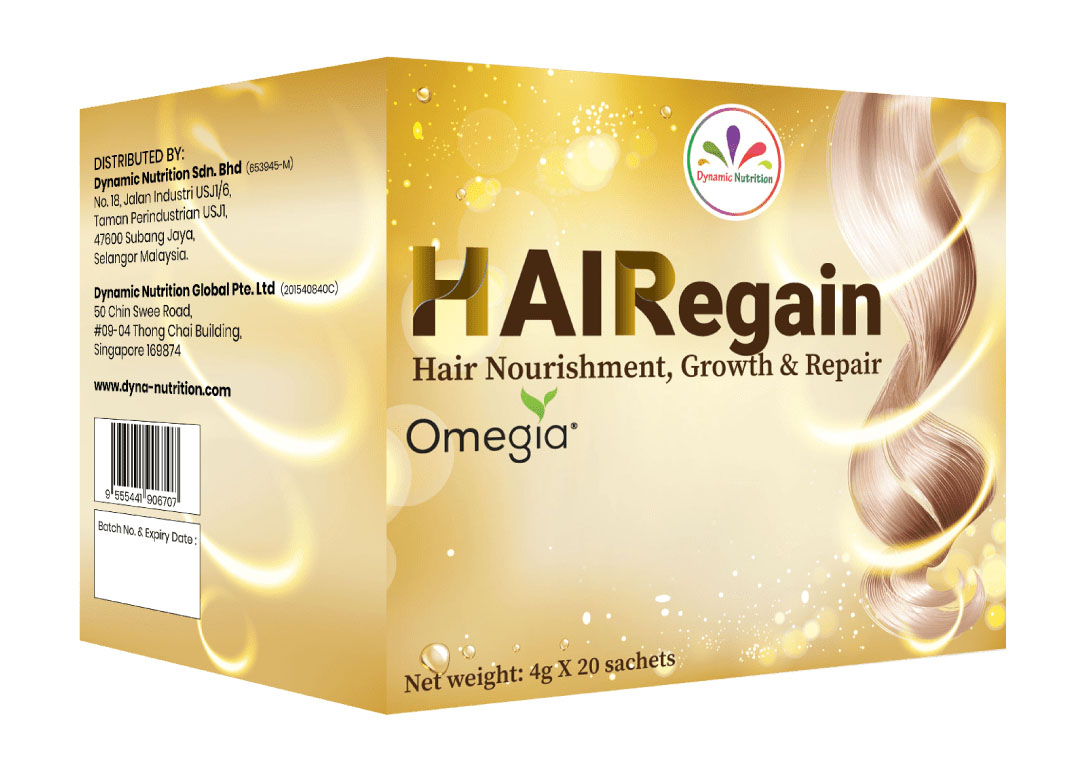
HAIRegain’s polyamine ingredient is Oryza Polyamine, a patented polyamine fraction derived from rice germ. Rice sits comfortably in the right category on the evidence above: cereals and legumes are the single largest source of polyamine intake in most diets, and cereal products carry among the highest measured spermidine content of any food group2. Our fuller guide to spermidine and polyamines for thicker hair covers the ingredient angle in more depth.
Two things follow from that, and they pull in opposite directions. In favour: the ingredient is a food-derived polyamine source rather than an exotic compound, and the general polyamine literature on dietary intake is not unfavourable. Against: rice-germ polyamine extract is not the same thing as the tablet used in the 2017 trial, and nothing in the trial tested a thinning scalp. Anyone whose hair is visibly thinning is dealing with a pattern-loss mechanism — DHT-driven miniaturisation, with follicle and scalp assessment the appropriate first step45 — and a nutrition label, however well made, does not diagnose that.
HAIRegain also carries L-cystine, zinc from a zinc-enriched nutritional yeast source, sea buckthorn omega-7 and horsetail extract, which is a reasonable way to build hair nutrition around a nutrient gap rather than a single headline compound. The honest framing is that a complete hair-nutrition formula addresses the inputs a follicle needs to run its cycle properly; it is not a substitute for understanding why a particular scalp is thinning in the first place.
The bottom line
Here is what you can and cannot conclude from the research.
You can conclude that polyamines are genuinely central to follicular biology; that spermidine at micromolar concentrations prolongs anagen in cultured human follicles3; that a randomized, double-blind, placebo-controlled trial in 100 healthy adults found more growth-phase follicles, higher proliferation markers and fewer positive pull tests than placebo over six months1; and that dietary polyamine intake is well characterised and not associated with harm in healthy populations26.
You cannot conclude that a spermidine or polyamine supplement regrows hair in a person with androgenetic alopecia or visible thinning. That question has not been answered by a controlled trial, the best available trial deliberately excluded people with pattern loss, and its own authors said the pattern-loss question remains open1. The broad general-health findings on polyamines — cognition, inflammation, mortality267 — are not hair findings, however healthy they are on their own terms.
So if your hair is thinning, the highest-yield next step is still a clinical one: iron and ferritin, thyroid function, vitamin D, and a dermatologist’s assessment of the scalp and follicle pattern, because DHT-driven miniaturisation needs a different answer from a nutrition gap45. If your hair is simply what it always was, and you are looking for the most complete nutrition base for a follicle that works hard, then reading a polyamine label for the three things above — the actual polyamine amount, which polyamine, and whether it was studied at that dose — is a far better use of your time than looking for a regrowth promise.
References
- Rinaldi F, Marzani B, Pinto D, Ramot Y. A spermidine-based nutritional supplement prolongs the anagen phase of hair follicles in humans: a randomized, placebo-controlled, double-blind study. Dermatology Practical & Conceptual, 2017, https://pmc.ncbi.nlm.nih.gov/articles/PMC5718121/
- Muñoz-Esparza NC, Latorre-Moratalla ML, Comas-Basté O, Toro-Funes N, Veciana-Nogués MT. Polyamines in Food. Frontiers in Nutrition, 2019, https://www.frontiersin.org/journals/nutrition/articles/10.3389/fnut.2019.00108/full
- Ramot Y, Tiede S, Biró T, Abu Bakar MH, Sugawara K, Philpott MP, et al. Spermidine Promotes Human Hair Growth and Is a Novel Modulator of Human Epithelial Stem Cell Functions. PLoS ONE, 2011, https://journals.plos.org/plosone/article?id=10.1371/journal.pone.0022564
- Hair loss, balding, hair shedding, alopecia. DermNet, https://dermnetnz.org/topics/hair-loss
- Male pattern hair loss (androgenetic alopecia, balding). DermNet, https://dermnetnz.org/topics/male-pattern-hair-loss
- Health-Promoting Effects of Dietary Polyamines. PubMed Central, https://pmc.ncbi.nlm.nih.gov/articles/PMC7930991/
- Polyamines: Bio-Molecules with Diverse Functions in Plant and Human Health and Disease. PubMed Central, https://pmc.ncbi.nlm.nih.gov/articles/PMC5807879/
Related Topics
DHT Blocker Malaysia: What the Evidence Actually Supports
Stop Hair Loss Naturally with HAIRegain: A DHT-Blocker Approach
The Science of Hair Regrowth: Unlocking Spermidine Polyamines for Thicker Hair
Beyond Shampoo: How Vitamin Deficiencies Affect Your Hair
9 Reasons You Are Losing Your Hair
8 Proven Benefits of Sea Buckthorn For Hair
Top 7 Benefits of Sea Buckthorn
DHT: A Hormone That Causes Hair Loss in Male, Both and Female
Silica: The Crucial Ingredient for Stronger Bones, Hair and Nails
Product you may be interested in