
Two products can both be sold on the promise of “stem cells”, and the gap between them is not a matter of degree — it is a matter of category. One is a bottle you swallow. The other is a procedure a clinician performs on you, usually after harvesting cells from your own body and processing them in a laboratory before they go back into you. They are governed by different regulators, supported by different kinds of evidence, and carry different risks. Yet marketing routinely runs them together, borrowing the language of one to sell the other.
This article sets the two side by side and stays deliberately narrow: what each one actually involves, what the published evidence actually supports for each, and the short list of questions that lets a reader tell them apart in about two minutes. It is written for the MY and SG reader in their 40s to 70s who is being sold an oral “stem cell support” product and has heard a clinic promising regeneration. Nothing here promises an outcome for any oral product, and nothing here makes a clinical claim for the procedure category.
First, what “stem cell” means in each case
The word is doing two completely different jobs on the two sides of this comparison, and almost every confusing sales pitch comes from that ambiguity.
What a clinic stem cell procedure involves
A clinic procedure typically starts with a consultation and a claim about what “stem cell therapy” can repair. The commonest versions harvest a small sample of a patient’s own fat tissue (usually via liposuction or a biopsy) or use donor-derived material, then process it in a clean-room laboratory: separating the cell population, expanding the cell number, screening the culture for contamination, and preparing it for delivery. The prepared cells are then administered — very often by intravenous infusion, sometimes by injection into a joint, a disc, an injection site, or an intravenous drip alongside conditioning medication. The whole episode involves a procedure, a facility, a laboratory, a clinician, a fee that is often five figures, and a recovery window.
Regulators treat this as a medical intervention, and the regulatory position is not subtle. In the United States, the only stem cell products approved for use are blood-forming stem cells derived from umbilical cord blood, approved for disorders of blood formation — and for nothing else. Everything else in the regenerative-medicine market, including adipose-derived stromal vascular fraction, umbilical cord products, amniotic products, Wharton’s jelly products, orthobiologics and exosomes, sits outside approved use unless it is being administered under an investigational new drug application in a clinical trial that FDA oversees.1 The regulator has been explicit that being “FDA-registered” or listed on a trial registry does not mean a product is legally marketed, and that clinics offering these products outside an FDA-oversight trial are likely being offered an illegally marketed product.2
What an oral “stem cell supplement” involves
An oral product contains no stem cells and no cells of any kind. Living cells cannot survive digestion, and nothing in a capsule delivers a mesenchymal stem cell into a joint or into tissue. What an oral “stem cell support” product actually contains is ordinary nutraceutical ingredients — botanical extracts, polyphenols, minerals, vitamins — sold under a label that borrows the vocabulary of cell biology. Sometimes that vocabulary is honest marketing shorthand for a plausible mechanism (“supporting your body’s natural stem cell release”). Sometimes it is an unsupported claim dressed as a mechanism. Telling those two apart requires reading the ingredient list and the trial evidence, not the front of the bottle.

What a clinic procedure can realistically deliver
Honest answers here start from the fact that the highest-quality evidence is condition-specific, modest in size, and rated low certainty — and that a large share of the improvement people report is contextual rather than cellular.
The best current synthesis: Cochrane on knee osteoarthritis
The most rigorous available read on injected stem cells for knee osteoarthritis is the Cochrane living systematic review, which pooled 25 randomised trials and 1,341 participants.3 Against placebo injection, stem cell injection may slightly improve pain (about 1.2 points better on a 0–10 scale at six months) and function (about 14.2 points better on a 0–100 scale). The reviewers rated both of those findings low certainty, because the source, preparation method and dose of the cells varied widely across studies, and because three larger trials that had been conducted were withdrawn by their investigators before reporting. Quality of life and the proportion of people rating treatment a success were rated very low certainty. Radiographic progression of the joint was not assessed in any included study. On safety, the review was unable to reach a conclusion: serious adverse events were infrequently reported, event numbers were very small, and no trial reported withdrawals because of harms.
Read that carefully and it is a far more modest claim than the marketing suggests: for one specific joint indication, a possible small-to-moderate short-term improvement in pain and function, on low-certainty evidence, with the effect on structural progression unknown.
How much of the improvement is actually the cells?
This is the question most regenerative-medicine marketing leaves out, and a 2025 systematic review and meta-analysis in Frontiers in Medicine put a number on it.4 Pooling eight randomised trials and 467 patients, the analysis found that contextual factors — the placebo and nocebo components of an injection, the attention, the expectation, the ritual — accounted for roughly 63% of the pain reduction and about 61% of the functional improvement at six months, and around half and two-thirds respectively at twelve months. The conclusion the authors draw is that in knee osteoarthritis, the majority of symptomatic improvement after mesenchymal stem cell injection is attributable to contextual effects, while the cells themselves confer only a modest incremental benefit. The evidence was rated low certainty at both time points.
That does not make the procedure worthless. It makes the honest baseline higher than the sales pitch: whatever the cells add, it is added on top of an effect that a good conversation and a convincing ritual would produce anyway.
What the regulatory position means for a buyer
Because approved stem cell products are limited to blood-forming stem cells for blood disorders, the products most often marketed for anti-ageing, arthritis, neurological disease, autism, chronic pain or general “regeneration” are unapproved products. FDA has received reports of blindness, tumour formation, bacterial infections including life-threatening bloodstream infections, unwanted immune responses, cells migrating to an unintended site and growing there, and cross-contamination with bacteria, viruses or mould during processing.1 The professional societies have responded in kind: the ISSCR guidelines set out what responsible clinical translation of stem cell-based interventions requires, including what a patient must be told before consent, and separately set standards for patient communication and for the informed consent process itself.5
The practical test is not whether a clinic says the word “FDA”. It is whether the procedure is being administered under an FDA-oversight trial with an investigational new drug application number, and whether an institutional review board approved the consent form. If a clinic cannot produce those, the price being quoted is for an unapproved procedure sold as though it were a regulated treatment.
What an oral supplement can realistically deliver
The honest ceiling for the oral category is much lower than for an injection — but the honest floor is also much higher than “it does nothing”, because at least some oral products have published human data behind a specific, measurable, non-regenerative endpoint.
The strongest published oral datapoint, stated accurately
The most-cited human trial behind the oral “stem cell support” category is a 2019 randomised, double-blind, placebo-controlled, cross-over study in Clinical Interventions in Aging, which tested a proanthocyanidin-rich sea buckthorn berry extract in 12 healthy adults.6 The design is worth stating precisely, because marketing rarely does. Subjects took a single 500 mg dose of either the extract or placebo; blood was drawn immediately before, and at one and two hours afterwards; each participant received both arms, and the cell counts were compared against each individual’s own matched placebo response. The reported changes were acute — a placebo-adjusted rise of about 24% in one CD34-positive progenitor population, about 19.5% in a second, about 33% in circulating endothelial stem cells, and about 21% in a lymphocytoid mesenchymal population, all measured at whichever of the one- or two-hour draws showed the larger response, with only minor effects on the pluripotential population.
That is a real, controlled, human finding: an oral extract moved specific circulating stem cell populations within two hours in a small crossover trial. It is also, precisely as published, an acute mobilisation result in 12 healthy people — not a tissue-regeneration result, not a disease-outcome result, and not a measurement of anything a patient would notice. The trial was co-sponsored by Biomx Stemceuticals, where the lead author was affiliated, and by NIS Labs, where two of the three authors were affiliated, so it is a small industry-partnered study and should be read as one.
What that trial does not establish
It does not establish that the extract regenerates cartilage, reverses biological ageing, lengthens lifespan, improves a disease outcome, or has any durable effect after the dose is stopped. It does not establish that any finished retail product delivers the same dose of the same extract, because a trial on a standardised extract does not transfer automatically to a capsule whose dose per serving is unknown or whose extract is unstandardised. And it does not establish an effect size for a consumer, because twelve healthy subjects measured over two hours is a biomarker study, not an outcomes study.
There is a second category of number that gets quoted alongside it — in vitro antioxidant capacity scores such as ORAC. Those measure how well an extract neutralises free radicals in a test tube. They are reproducible and standardised, which makes them useful for comparing extracts with each other, but they measure nothing about absorption, tissue levels or clinical effect, and regulators have removed them from approved nutrient-content claims for exactly that reason.
How to tell the two apart: six questions
This is the part worth keeping. Six questions, asked in this order, separate the categories faster than any amount of label reading.
1. Who administers it, and where? If it requires a clinic, a laboratory, a harvest procedure and an infusion, it is a medical procedure, and it should be assessed as one — regulatory status, trial oversight, clinician credentials, facility accreditation, and a consent process. If it is a bottle on a shelf, it is a supplement and it should be assessed as one: ingredient list, dose per serving, standardisation, and the published evidence for that specific ingredient at that specific dose.
2. Can you name the trial number? For a procedure, ask for the investigational new drug application number and the institutional review board that approved the consent form. If the answer is a marketing brochure, a “registered with FDA” claim, or a clinicaltrials.gov listing, that is not the same thing — a trial registration is not approval, and FDA states this explicitly.
3. Does the evidence measure something you would notice? A trial that measures circulating cell counts is a biomarker trial, and it says nothing about how you will feel. A trial that measures pain, function or a clinical outcome is a different kind of evidence. Ask which one you are being shown.
4. Is the effect bigger than the placebo it was compared against? This is where the placebo-context analysis earns its place: in the knee osteoarthritis meta-analysis, the majority of the measured benefit was contextual. A procedure result that has not been placebo-adjusted is not yet a result.
5. Is the claim about a procedure or about the product? Watch for borrowed authority: a supplement page that says “clinically proven”, or that describes what stem cell therapy does and then pivots to a capsule, is importing the credibility of the procedure without its evidence, its regulation or its risk. The clinical-procedure claim is being used to market the supplement.
6. Can you name the ingredient, the dose and the trial behind that exact product? A product that names a trademarked extract or complex is at least traceable to a specific study. A product that says only “stem cell support”, or lists a generic botanical without a standardisation figure or a dose per serving, cannot be checked against anything.
Where an oral product like NuSTEM actually sits
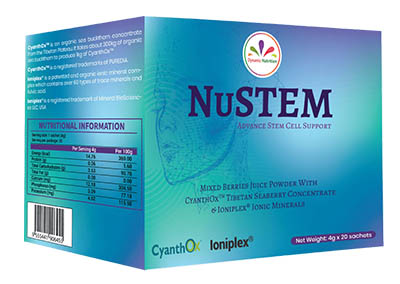
Being concrete about the product this article is published alongside is the fairest way to make the comparison useful. NuSTEM is an oral supplement — a powder in sachets — combining two trademarked ingredients: CyanthOx™, a highly concentrated Tibetan sea buckthorn extract standardised for polyphenols and proanthocyanidins, and Ioniplex®, an ionic fulvic-mineral complex. It is not a stem cell product and it does not contain stem cells, and it is not a substitute for any clinical procedure.
What can be said honestly is narrower and still worth saying. The published human evidence behind the sea buckthorn extract category is an acute circulating-stem-cell mobilisation result, as described above, and the published evidence behind the ionic fulvic-mineral category concerns mineral uptake and mitochondrial metabolism rather than regeneration. Both are substrate-level claims. Neither is a tissue-repair claim, and neither is a lifespan claim. For a reader who wants to know what an honest oral “stem cell support” product looks like, the two questions are the same ones the label should answer: which trademarked ingredient, at what dose, on what published human endpoint, and which outcome is being claimed? If the page does not answer all four, it is not describing evidence.
The other honest point is that the two categories are not substitutes in either direction. If a person has a specific joint, neurological or systemic condition, that is a conversation for a qualified clinician — and the regulatory position described above is exactly why the first thing to establish is whether a proposed procedure is approved, or being administered under legitimate trial oversight. If a person is looking for daily nutritional support alongside diet, sleep and exercise, then a supplement claim has to be judged as a supplement claim: modest, specific, and checkable.
Safety, contraindications and the questions to take to a clinician
Both categories carry real cautions, and they are different cautions.
For the procedure category, the documented risks are the ones already listed above: blindness, tumour formation, infection, unwanted immune response, cross-contamination during processing, and the failure of a therapy to work as intended where an approved treatment was available.1 Beyond that, procedural risks apply — including the small but real risk of septic arthritis with any joint injection — and there is the opportunity cost of delay while a largely unproven intervention is pursued. The professional guidance for anyone considering an unproven stem cell intervention is to ask for the trial documentation before agreeing to anything, and to keep their own clinician informed.5
For the oral category, the safety profile at standard doses is generally benign, but the interactions are worth a pharmacist’s eye rather than a label reader’s. Sea buckthorn extracts may have mild antiplatelet effects at higher doses, which matters if you take warfarin or another anticoagulant; bone-marrow mobilisation may interact with immunosuppressants; and stem cell mobilisation during active chemotherapy is contraindicated. The safety record does not cover pregnancy or breastfeeding, which is why those populations are usually excluded from use. Anyone on anticoagulants, immunosuppressants, thyroid medication, statins or active cancer treatment should ask a pharmacist or prescriber rather than reading a product page for the answer.
The evidence-tiered verdict
Well-supported: that injections of stem cells for knee osteoarthritis may slightly improve pain and function over about six months on low-certainty evidence, with the effect on joint structure unknown and safety uncertain; that contextual effects account for the majority of the measured symptomatic benefit; and that the regulatory position on unapproved regenerative products is unambiguous, with documented harms.
Moderately supported: that specific standardised oral extracts can acutely mobilise selected circulating stem cell populations in small human trials — a biomarker result, not an outcomes result, and the basis on which the category is defensible at all.
Weakly supported or marketing-only: that any oral product can regenerate tissue, reverse biological ageing, reset telomeres, extend lifespan, or deliver the effect of a clinical stem cell procedure; and any procedure claim for an indication where no approved product exists and no trial oversight is in place.
Safety boundary, both categories: for procedures, regulatory status and documented harms are the first filter; for oral products, the medication list — anticoagulants, immunosuppressants, chemotherapy, thyroid medication, statins — plus pregnancy and breastfeeding.
So the honest answer to “which one delivers more?” is: in terms of measurable effect on structure and function, a procedure under legitimate oversight may deliver more than an oral product can, and it also carries the risk of delivering less than you were promised — and a meaningful share of the difference is expectation rather than biology. In terms of the word “stem cell” on a label, neither category means what the marketing implies. One is a cells-in-a-lab intervention with a regulator watching. The other is a nutraceutical with a specific, modest, checkable evidence file. Read them as what they are, and the confusion largely dissolves.
References
- US Food and Drug Administration. Consumer Alert on Regenerative Medicine Products Including Stem Cells and Exosomes, 22 July 2020, https://www.fda.gov/vaccines-blood-biologics/consumers-biologics/consumer-alert-regenerative-medicine-products-including-stem-cells-and-exosomes
- US Food and Drug Administration. Important Patient and Consumer Information About Regenerative Medicine Therapies, 3 June 2021, https://www.fda.gov/vaccines-blood-biologics/consumers-biologics/important-patient-and-consumer-information-about-regenerative-medicine-therapies
- Cochrane Database of Systematic Reviews. Stem cell injections for osteoarthritis of the knee, living systematic review, 2025, https://pubmed.ncbi.nlm.nih.gov/40169165/
- Yin F, Wu H, Tong D. Contextual effects of mesenchymal stem cell injections for knee osteoarthritis: systematic review and meta-analysis of randomized controlled trials, Frontiers in Medicine, 2025, https://pmc.ncbi.nlm.nih.gov/articles/PMC12487426/
- International Society for Stem Cell Research. ISSCR Guidelines for Stem Cell Research and Clinical Translation — clinical translation, communications and informed consent standards, https://www.isscr.org/guidelines-online/clinical-translation-of-stem-cell-based-interventions
- Drapeau C, Benson KF, Jensen GS. Rapid and selective mobilization of specific stem cell types after consumption of a polyphenol-rich extract from sea buckthorn berries (Hippophae) in healthy human subjects, Clinical Interventions in Aging 2019;14:253–263, https://pmc.ncbi.nlm.nih.gov/articles/PMC6368418/
Also available in Bahasa Malaysia and 中文.
Product you may be interested in