If you have ever bought a hair supplement on the strength of a promise on the front of the box, you have probably been given a number. Thirty days. Sometimes sixty. Sometimes “visible results in a few weeks”. Almost every one of those numbers is wrong, and it is wrong in a way that is easy to explain once you understand the biology: hair does not respond on the schedule of a marketing department, because the follicle it has to affect is running on a cycle measured in years, not weeks.
This guide works through what the hair cycle actually predicts, how long a fair trial of any hair supplement needs to run, and how to tell the difference between a product that is working and a shedding phase that has simply passed its peak. It is written for someone who has already bought the sachet and is now wondering, three weeks later, whether they are wasting their money. The short answer is that three weeks is too early to tell, and the reason is not a marketing euphemism — it is the structure of the follicle.

Why the 30-day promise is wrong
A 30-day promise is not a conservative estimate of hair growth. It is a description of how long it takes a supplement bottle to be emptied once. The two have no relationship to each other, and the gap between them is the single biggest reason people give up on products that would have worked.
The reason is that the thing you are trying to change is not a single hair but a population of follicles moving through fixed phases, and the visible result of anything you do to those follicles is filtered through the slowest phase in the cycle. If a follicle happens to be resting when you start, it will not visibly respond until it has finished resting and grown for a while. If a follicle is shedding when you start, the hair you are counting may be on its way out regardless of what you are doing. Neither situation is a verdict on the product, but both look exactly like failure if you are judging the product in week four.
There is a second reason the 30-day promise misleads, and it is about measurement rather than biology. Hair density does not move in a straight line. It moves in a line that is interrupted by a normal, well-documented shedding phase, a seasonal fluctuation, the visual effect of a haircut, and the fact that a head of hair is seen from a different angle in every photograph. A product can genuinely be doing something, and a person looking at their own hair every few days can genuinely see nothing, and both of those can be true in the same person in the same week.
The honest way to judge a hair supplement is therefore not to count days. It is to fix the measurement method first, and then to judge the product against the biology it is supposed to be influencing.
What the hair cycle actually predicts
Scalp hair grows in cycles, and the phases are well documented. Each follicle passes through an anagen phase, when it is actively growing, a short catagen transitional phase, a telogen resting phase, and finally an exogen phase in which the hair is released. The timings matter more than the names.
Anagen lasts roughly two to six years on the scalp, with the great majority of follicles in this phase at any one time — usually quoted at around 90 percent.1 Catagen is brief, lasting about two to three weeks, and telogen, the resting phase, runs approximately three months.2 Hair is shed from the follicle at the end of telogen, and a new cycle begins.
Growth itself is slow. Scalp hair grows at roughly one centimetre a month on average, with considerable individual variation.1 A normal scalp sheds somewhere around 50 to 100 hairs a day as part of that cycle.2 These three numbers together are the whole argument against a 30-day promise. Any visible change in hair volume or shaft calibre has to be expressed in a structure that grows about a centimetre a month, sits in a resting phase for around three months, and replaces roughly one hair per day.
It also follows that the phase you happen to be in when you start is a large part of what you observe. If you start a supplement two weeks before a telogen wave releases, you will see a burst of shedding that has been scheduled for months, and it will be happening no matter what you put on your plate.

Why shedding can look like getting worse before it gets better
This is the part of the hair-supplement experience that unsettles people most, and it has a well-understood explanation. In telogen effluvium, a shock to the system — illness with fever, surgery, childbirth, marked weight loss, a new medication, major psychological stress — pushes a large number of growing follicles prematurely into the resting phase. The shedding that follows appears two to three months after the trigger, not at the time of it, because the follicles have to complete the shortened cycle first.3 In one in three cases no clear trigger can be identified at all.5
The same delay governs the recovery side of the ledger. Acute telogen effluvium generally resolves within three to six months of the trigger being resolved,3 but it may take considerably longer for the hair bulk to look normal again — the International Society of Hair Restoration Surgery notes that it can take a year and a half or more to regain previous fullness, because the replacement hairs are still growing.4 Where shedding persists beyond about six months it is generally classified as chronic telogen effluvium, a condition that tends to fluctuate over some years rather than resolve cleanly.3
The practical lesson for anyone testing a supplement is this: a rise in shedding in the first couple of months is not, by itself, evidence that the product is failing. It is evidence that you are inside the window in which a rise in shedding is possible. The question worth asking is not “did I shed this week” but “did I shed this week more than I would have without doing anything”. That is a much harder question, and it is why the tracking method below matters more than any label claim.
How to track your own progress: four things, and nothing else
Because visible change is slow and noisy, the useful part of any hair supplement trial is the measurement, not the product. Four things, done consistently, will tell you more in six months than daily mirror checks will tell you in six weeks.
1. Standardised part-width photographs. Pick one part line — typically the widest point of your parting — and photograph it in the same place, in the same light, at the same distance, with your hair dry and unstyled, once a month. Clinical practice treats good serial photography as part of the work-up, not an optional extra, because a subjective “does it look better” is too noisy to detect the size of change that is actually on offer.7 If you change the lighting or the angle, you have lost the comparison.
2. A monthly shed count, not a daily one. Count the hairs you collect over a single wash, once a month, on the same schedule. Assessing a shedding complaint in clinic commonly involves avoiding shampooing for several days and then counting what comes out, since a one-off wash total is far more informative than a running mental tally.4 One number a month is enough. Daily counting tells you about your stress, not about your hair.
3. A fixed wash schedule. Wash frequency, shampoo, conditioner, heat styling and chemical processing all change how much hair ends up in the drain. Change them and your measurement changes with them. Lock the routine for the duration of the trial.
4. A record of everything else that happened. Illness, a new medication, a significant weight change, a demanding month at work. Each of these can enter the cycle as a trigger and show up months later as a shed spike you would otherwise attribute to the product. A short dated note in a diary turns a confusing story into a readable one.
What you are looking for is not a dramatic before-and-after photograph at week four. It is a slow trend line across four or five monthly points, with a shedding count that has stopped climbing, and a part width that has stopped widening. That is the shape of a real result, and it is genuinely visible to a careful observer long before it is visible to a stranger.
What a realistic supplement timeline looks like
With the cycle above in mind, here is the timeline a fair trial of a hair nutrition product needs, expressed in the checkpoints that actually exist in clinical practice rather than in advertising.
Months 0 to 3: the baseline and the settling period. Nothing visible is expected here, and nothing visible should be judged. If there is a genuine deficiency or a physiological shock, this is the window in which a shed spike may appear, because that is how the cycle expresses disruption. Most of the useful information from this period comes from your photographs and shed counts, not from your reflection in a mirror. Your own baseline is established here, so that the later periods have something to be compared against.
Month 3 to 6: the first honest checkpoint. Primary care dermatology pathways commonly work on a three-to-six month horizon before a response to treatment is assessed at all, and a reasonable timeline for improvement is part of the management plan rather than an afterthought.7 At this point the question is not “is my hair falling” but “has the shed count stopped rising, and has the part width stopped widening”. In practice, this is also the point at which the underlying cause should be confirmed rather than assumed.
Months 6 to 12: the visible window. This is where any real change becomes measurable, and it is the earliest point at which photographs taken on the same standard are worth comparing side by side. Objective assessment of hair-loss therapies typically needs six to twelve months to establish a sustained response, precisely because the hair cycle sets that length.8 New growth appears as fine, short hairs along the part line, which is exactly the change that standardised photography is designed to pick up.
Month 12 and beyond: the honest verdict. If a full year of consistent use with disciplined tracking has produced no change at all — no plateau in shedding, no narrowing part, no new growth — then the honest conclusion is that this product is not doing anything for you, and continuing is a matter of preference rather than evidence. Two cycle boundaries with nothing to show is a reasonable point to stop.
That timeline is not a hedge. It is what the biology of the follicle permits, and it applies to every product in the category, including the one that claims to be different. Nobody has produced credible evidence that a nutritional supplement can shorten a phase that takes months.
What HAIRegain can and cannot do
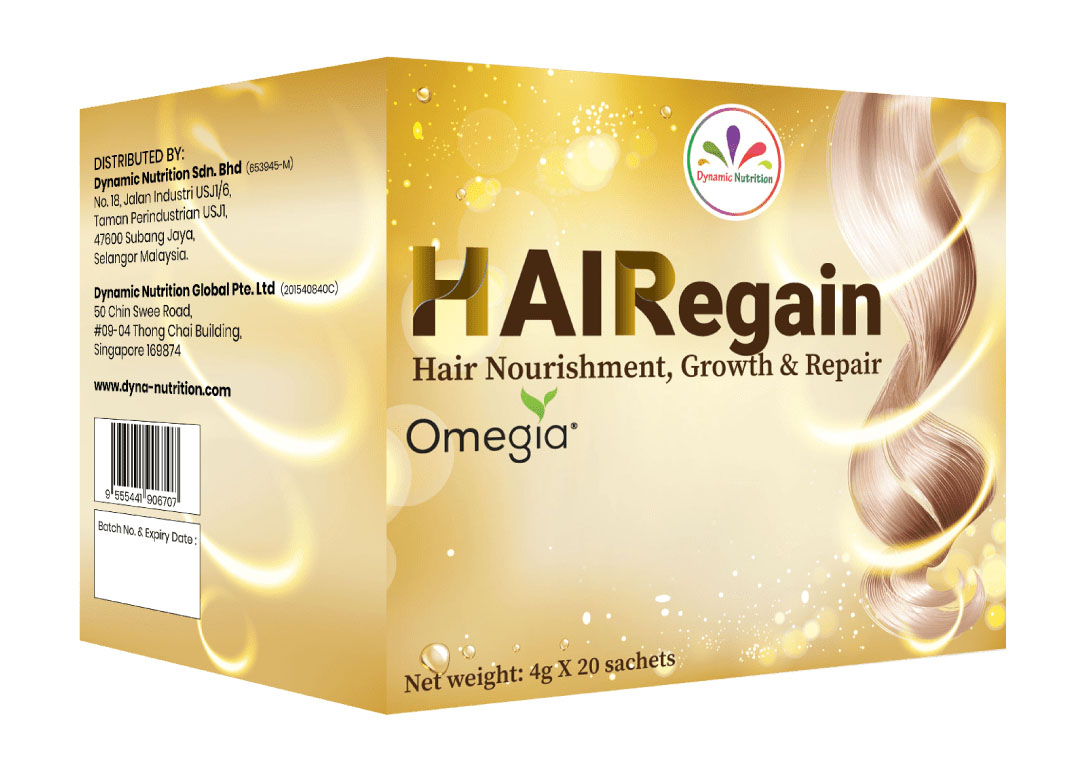
HAIRegain is our own daily hair nutrition sachet, so it is fair to be specific about where it sits in all of this. It supplies polyamine from Oryza, sea buckthorn omega-7, elemental zinc, L-cysteine and horsetail silica — inputs aimed at supporting the follicle’s nutritional environment and at hair that is breaking or shedding under nutritional stress. It is a nutrition-support product, not a pharmaceutical, and it is not capable of reversing a diagnosed androgenetic alopecia or of correcting a deficiency you have never tested for.
That distinction matters for the timeline question. A supplement that supplies nutrients is working in the same category as correcting an inadequate diet: its effect, where there is one, is bounded by the requirement it is helping you meet. The review literature on vitamins and minerals in hair loss makes the same point from the clinical side — iron deficiency is the most common nutritional deficiency in the world and a recognised contributor to shedding, and most authors recommend iron supplementation where iron or ferritin is deficient, while the data on zinc are explicitly described as not homogeneous and insufficient to recommend routine screening.9 The same review finds no literature support for biotin or vitamin E supplementation in androgenetic alopecia or telogen effluvium, and notes that biotin can distort laboratory results.9
So the sensible way to use a hair nutrition product is alongside adequate protein, alongside an iron and thyroid work-up, and with the timeline above in mind. If a ferritin result is low or a thyroid marker is out of range, no sachet is going to fix it, and the review literature is explicit that iron deficiency in hair loss is one of the few nutritional causes where targeted repletion is clearly indicated.9 Patient guidance on telogen effluvium makes the same point from the other side: a balanced diet rich in iron and protein, and supplementation where the diet is genuinely restricted, is where the evidence sits.5 Our companion guide to how vitamin deficiencies affect your hair covers the blood-work side in more depth, and the science of hair regrowth and spermidine polyamines covers the mechanism this product works on.
When to stop, and when to see a dermatologist
Two questions deserve a straight answer, because both are the ones a supplement retailer is least likely to raise.
When to stop. If you have followed the protocol above — consistent daily use, a fixed wash routine, monthly photographs, monthly shed counts — and two cycle boundaries have passed with no plateau in shedding and no measurable change, then stop. Continued spending on a product that has not moved anything is not persistence. If your shed count has risen steadily rather than levelled off, or if you are getting steadily worse rather than staying level, that is also information, and it points at a cause rather than at a missing ingredient.
When to see a dermatologist rather than a shelf. Patchy loss, a shiny or scaly scalp, sudden diffuse shedding two to six months after an illness, pregnancy, a major weight change or a new medication, hair loss alongside fatigue or unexplained weight change, or a visibly widening part are all presentations that need a clinical assessment and a blood test, not a different supplement.7 A dermatologist working up a hair complaint asks how long the loss has been running and whether it came on quickly, looks closely at the scalp and nails, and may order a blood test or a scalp biopsy where a disease, vitamin deficiency, hormone imbalance or infection is suspected.10 The bloods that matter for hair are a full blood count, iron status with ferritin, kidney and liver function, vitamin D and thyroid function, with zinc, folate and B12 added where diet is a concern.7 That work-up is the step most worth taking before any product, and it costs nothing at the point where it prevents months of the wrong spend.
There is also a timeline point in the other direction that deserves stating plainly: where a treatment for hair loss is being assessed, the assessment itself takes time. In alopecia areata, where regrowth is judged on a completely different mechanism, clinicians set a minimum of roughly twelve weeks before the efficacy of a treatment can be determined.6 Even for conditions with far more powerful treatments than any supplement available, the measurement windows are in months, not weeks.
The bottom line
The 30-day promise is not a conservative estimate. It is a category error — it treats a follicle with a multi-year cycle as though it were a marketing deadline. The honest timeline for a hair supplement trial is measured in cycles: nothing visible in the first quarter, a first real checkpoint between months three and six, the first measurable change somewhere in months six to twelve, and a verdict at the end of the year.
Set the measurement up before you start, not after you have started judging. Standardised photographs, a monthly shed count, a fixed wash routine, and a dated note of everything else going on. That is a modest amount of discipline, and it converts a frustrating guessing game into something you can actually read.
And keep the expectations in the right place. A daily nutrition product that supplies polyamine, sea buckthorn, zinc and L-cysteine can support a diet that is short of something, and it can be part of a sensible approach to hair fall under nutritional stress. It cannot regrow follicles that have been destroyed, replace an iron deficiency you have not tested for, or reverse a diagnosed pattern loss, and no timeline in this article should be read as promising otherwise. If you have not had the basics checked, that is where the next step is — not a different sachet.
References
- ATSDR Hair Analysis Panel Discussion: Section 2.4, Agency for Toxic Substances and Disease Registry, https://www.atsdr.cdc.gov/hac/hair_analysis/2.4.html
- Hair shedding, DermNet, https://www.dermnetnz.org/topics/hair-shedding
- Diffuse alopecia, DermNet, https://dermnetnz.org/topics/diffuse-alopecia
- Telogen Effluvium: A Guide to Temporary Hair Loss, International Society of Hair Restoration Surgery, https://ishrs.org/telogen-effluvium
- Telogen Effluvium (A Type of Hair Loss), Patient Information Leaflet, British Association of Dermatologists, https://cdn.bad.org.uk/uploads/2021/12/14161411/Telogen-effluvium-PIL-Oct-2025.pdf
- Introducing New Standards in Assessing and Tracking Alopecia Areata, Cleveland Clinic, https://consultqd.clevelandclinic.org/introducing-new-standards-in-assessing-and-tracking-alopecia-areata
- Hair Loss — Primary Care Treatment Pathway, Primary Care Dermatology Society, https://www.pcds.org.uk/files/general/Hair-Loss-Pathway-web.pdf
- Trichoscopic Evaluation of the Effectiveness of Topical Stemoxydine for Hair Restoration in Androgenetic Alopecia, PubMed Central, https://pmc.ncbi.nlm.nih.gov/articles/PMC13034500/
- The Role of Vitamins and Minerals in Hair Loss: A Review, Dermatology and Therapy, https://pmc.ncbi.nlm.nih.gov/articles/PMC6380979/
- Hair loss: Diagnosis and treatment, American Academy of Dermatology, https://www.aad.org/public/diseases/hair-loss/treatment/diagnosis-treat/
Disclosure: HAIRegain, the daily hair nutrition sachet referenced above, is our own product. This article is an explanation of hair-cycle timing and of how to measure a supplement trial; it does not claim that any supplement regrows hair, reverses a diagnosed condition, or replaces medical assessment. Individual results vary with the underlying cause of shedding, the formulation, the dose and the duration of use. Anyone with a diagnosed condition, who is pregnant or breastfeeding, or who takes prescription medication should speak to a clinician or pharmacist before starting any new supplement.
Also available in Bahasa Malaysia and 中文.
Related Topics
DHT Blocker Malaysia: What the Evidence Actually Supports
Stop Hair Loss Naturally with HAIRegain: A DHT-Blocker Approach
The Science of Hair Regrowth: Unlocking Spermidine Polyamines for Thicker Hair
Beyond Shampoo: How Vitamin Deficiencies Affect Your Hair
9 Reasons You Are Losing Your Hair
8 Proven Benefits of Sea Buckthorn For Hair
Top 7 Benefits of Sea Buckthorn
DHT: A Hormone That Causes Hair Loss in Male, Both and Female
Silica: The Crucial Ingredient for Stronger Bones, Hair and Nails
Product you may be interested in