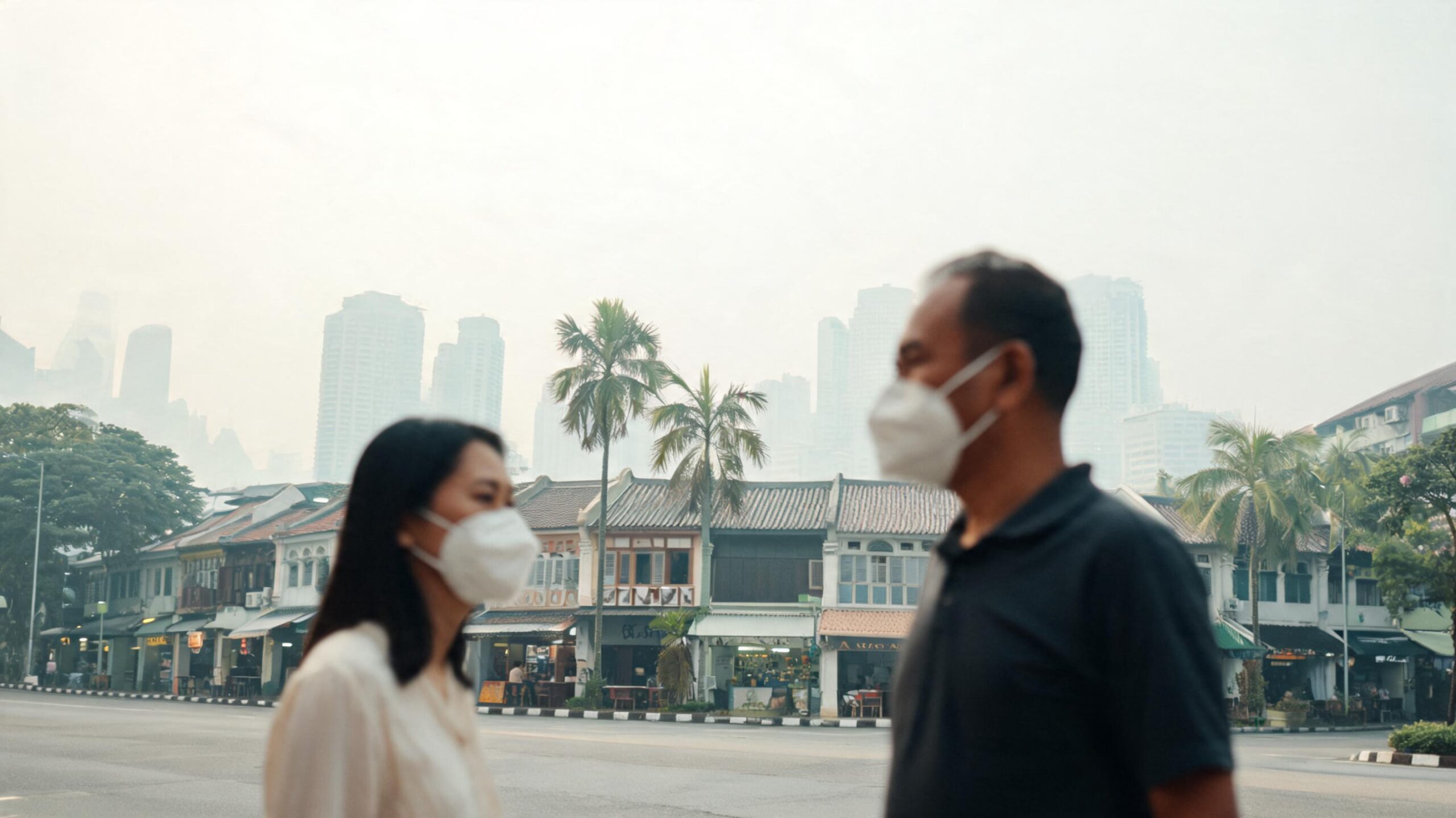
Every year, the same two things happen to the air in Malaysia and Singapore, and they are usually discussed as if they were one thing. The sky goes white, the air quality index climbs, and the haze season arrives. Within the same weeks, influenza and the seasonal respiratory viruses circulate through offices, classrooms and homes. The marketing that arrives with the haze season tends to treat these as a single problem with a single answer, and it is worth separating them before spending money on anything.
The starting point is what haze season actually changes. Singapore’s National Environment Agency notes that transboundary smoke haze affects the country particularly during the Southwest monsoon period from August to October, when regional burning overlaps with the dry spell and the air quality portal it publishes moves into its Unhealthy bands with an accompanying health advisory.1 What that does to a body is physical: fine particles, and the gases that travel with them, load the airways. But the secondary effect is behavioural, and it is the one that matters for this article. When the air outside turns milky, people close windows, switch on air conditioning, drive with the recirculation on, and spend more hours indoors in shared air with other people. The respiratory season and the haze season therefore overlap in the environment people actually live in, not only in the calendar.2
This article is deliberately narrow. It is about elderberry: what the published research on it does and does not cover, where its honest limits sit, and what it can plausibly be asked to do during a season when hazy air and respiratory viruses arrive together. It is not a list of antioxidants for lungs. That question is answered elsewhere on this site, in the article on whole-berry polyphenols and haze-season oxidative load. What follows is the virus-versus-particle distinction, and the precise boundary of the elderberry evidence.
What the elderberry research actually covers
Two studies carry most of the weight, and they are worth stating precisely because most of what circulates about elderberry is a blurry version of them.
The first is laboratory work, not a patient trial. A 2011 paper in BMC Complementary & Alternative Medicine tested a standardized elderberry liquid extract in liquid culture against four respiratory bacteria and in cell culture against two influenza strains, one of them an H5N1-type virus isolated from a patient. The extract showed antimicrobial activity against Streptococcus pyogenes, group C and G streptococci and Branhamella catarrhalis, and an inhibitory effect on the propagation of the influenza viruses.3 Read that carefully. It is a dish, not a person. It establishes that the extract interacts with these pathogens at certain concentrations. It does not establish what happens in a human lung, at the dose in a sachet, during a real influenza season.
The second is a clinical trial, in people, but in a very specific setting. In 2016, researchers at Griffith University in Australia ran a randomised, double-blind, placebo-controlled trial in 312 economy-class passengers flying from Australia to overseas destinations, testing a standardized membrane-filtered Sambucus nigra L. extract. Passengers on the extract had significantly shorter cold episodes (57 days against 117 in the placebo group, p = 0.02) and a markedly lower symptom score across those days (247 against 583, p = 0.05). The number of cold episodes, however, was not significantly different between groups (12 versus 17, p = 0.4).4 That last figure is the honest headline: the extract did not stop people catching a cold. It was associated with shorter, milder colds once they had them, in a population exposed to a shared, dry, recirculated aircraft cabin for many hours.
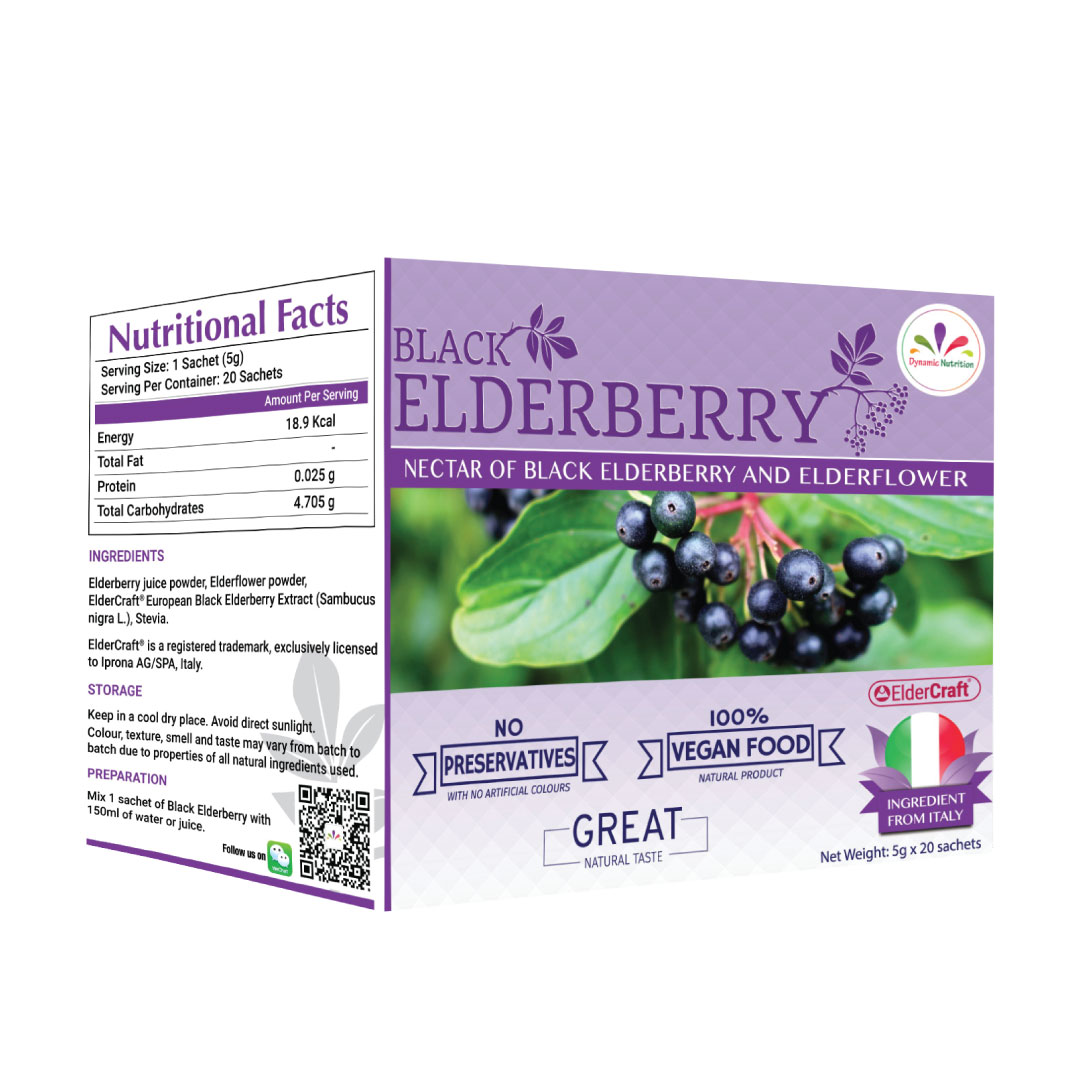
That is the evidence base. Short-duration viral upper-respiratory infection, in the context of a stress window, with an extract that is not the same as every bottle on a shelf. Notably, the extract used in that trial was produced by Iprona AG in Italy under the BerryPharma trademark, from the Haschberg cultivar, and our sachets use ElderCraft, a trademark licensed from the same Italian company. The manufacturer and cultivar family therefore match the trial. A trial is still not a guarantee that any given sachet in any given batch reproduces it, and no label on a supermarket shelf can tell you that without naming the extract.
The line elderberry does not cross
Here is the part that gets lost, and it is the part worth insisting on.
No published study has tested elderberry against PM2.5, against haze, or against particulate exposure of any kind. Not a trial, not an animal study, not a cell-culture study. The elderberry literature is about viral and bacterial respiratory infection. The particulate-matter literature is about oxidative stress, airway inflammation and, increasingly, about impaired antiviral defences. These are two separate bodies of work that arrive in the same season, and the marketing fuses them.
So the defensible statements are these. Elderberry does not protect the lungs from haze. It does not bind, clear or detoxify particulate matter. It does not lower the dose of PM2.5 that reaches the alveoli. No one has shown that it shortens a haze-related illness, because no such study exists. Any product page that implies otherwise is making a claim the evidence cannot carry.
What the particulate research does show is a genuinely interesting mechanism, and it explains why the virus-versus-particle distinction is not a technicality. A 2025 systematic review and meta-analysis of 16 studies found that a 10 µg/m³ increase in daily PM2.5 was associated with about a 1.5% relative increase in influenza risk on the weighted meta-analysis estimate, with larger pooled averages across models, and the shortest lag effects appearing within zero to seven days of exposure. The association was stronger in warmer seasons and in adults aged 18 to 64.5 The same review notes the mechanism running in a direction most readers would not expect: PM2.5 does not merely add irritation on top of an infection. It impairs the antiviral machinery itself, impeding the production of interferon-beta and interleukin-1β and dampening the inflammatory response that normally controls viral spread.
Read those two literatures side by side and the logic of this article becomes plain. Particulates weaken the defences that fight a viral infection. Elderberry has weak-to-moderate evidence for shortening a viral infection once it is under way. Neither of them does anything for the other. Elderberry does not neutralise haze; it is plausibly, modestly relevant to the viral infection that the same season is delivering into lungs that particulate exposure has already made less capable of dealing with it.
It also means the honest priority order is not negotiable. Exposure reduction comes first, because it acts on the cause. Elderberry, if it is used at all, is second, and only for the viral half of the problem.
What actually reduces your exposure
These are the interventions with evidence behind them, and none of them require a supplement. The World Health Organization’s 2021 global air quality guidelines put the PM2.5 annual guideline at 5 µg/m³ and the 24-hour guideline at 15 µg/m³.6 On a bad haze day in the region, measured concentrations sit above those numbers by a wide margin, which is why the practical measures are about dose rather than about clever timing.
Wear a well-fitted respirator on the bad days. The word that matters is fitted. A respirator that leaks around the edge filters very little of what it appears to filter, and a mask over a stubble line is close to decorative. Sealing the nose bridge and checking for an inward suck are unglamorous and effective, and they matter more than the brand.
Treat indoor air as the priority once you are indoors. Doors and windows closed against haze means the air you breathe for the next eight hours is whatever was already in the room, recirculated. Filtration and ventilation do more for a daily dose than almost anything done outdoors, and portable HEPA units and closed-room air-conditioning with a clean filter are the two levers most people in the region actually control.
Move outdoor exertion to better days and better hours. Particle concentrations follow a daily curve and a wind pattern, and the current readings on Singapore’s PSI portal and the regional air quality dashboards are public. Morning and late-afternoon readings are often lower than midday. If a run, a football match or a long commute falls on a high-reading day, moving it is a real reduction in dose.
Treat respiratory illness with the tools that exist for it. Influenza has vaccines and antivirals, and both work better when used early and correctly. Nothing in a supplement aisle substitutes for either, and nothing should be sold as if it does.
Where elderberry fits, and where it does not
Given all of that, a daily elderberry sachet during a hazy, viral month is defensible on narrow grounds: it is a standardized extract at a research-relevant dose, from the same cultivar and manufacturer as the trial, taken as one layer of a routine that also includes indoor air management, sensible mask use on bad days and appropriate medical care for symptoms. Each of those five is a good idea. The supplement is the least well-evidenced of them, and it should be understood that way.
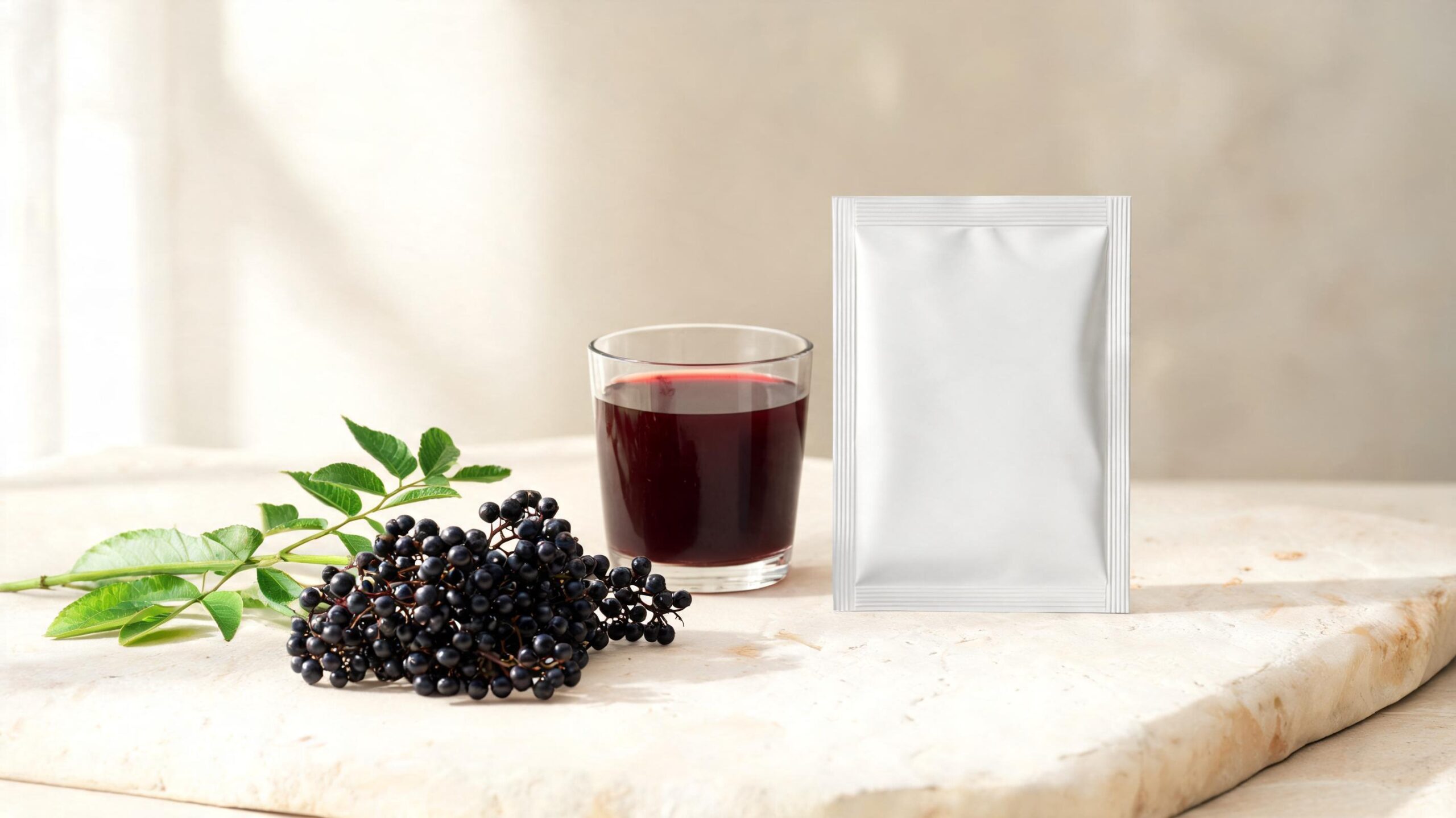
On the specifics, this product is a 5 g sachet providing 460 mg of ElderCraft European Black Elderberry extract, equivalent to roughly 19.26 g of fresh black elderberries, sweetened with stevia rather than sugar, and labelled for teenagers and adults. The liquid sachet format matters more than it sounds: it needs no water, no pill, and no break in whatever routine the day already has. Stevia rather than sugar matters for a drink someone might take daily for three months. And for anyone on medication, with a respiratory condition, or pregnant or breastfeeding, the sensible move is to ask a pharmacist or doctor first, which is true of elderberry for the usual reasons.
What a sachet does not do is worth stating as plainly as what it does. It does not shield anyone from haze. It does not make clean air unnecessary. It does not treat influenza, and it does not replace vaccination or an antiviral prescription. It does not substitute for the exposure reduction that actually changes the dose your lungs receive. And the in-vitro finding that has the most dramatic sound, the one about inhibiting influenza viruses in a cell dish, is a laboratory finding about an interaction at a concentration in a dish, not an outcome measured in a person.
If you take it, take it for the virus. Do not take it for the haze.
Who should ask a doctor first
Anyone with a known allergy to elderberry should not take it. Anyone on immunosuppressive medication, and anyone who is pregnant or breastfeeding, should speak to a clinician before adding it to a routine. And anyone with an existing respiratory condition, or with symptoms that are worsening rather than settling, should be talking to a doctor rather than reading about supplements. That is true in a hazy, viral season more than most, because the interaction between the two is exactly what makes it harder to self-diagnose.
The uncomfortable but useful conclusion is this. During haze season in a tropical city, the same season delivers particulates that weaken antiviral defences and the viruses that exploit that weakness. Elderberry’s honest position is on the second side of that pairing, and only for infections already under way. The exposure reduction on the first side is where the evidence is strongest, and it is also the part that costs nothing to do.
References
- National Environment Agency, “Air Quality.” https://www.nea.gov.sg/our-services/pollution-control/air-pollution/air-quality
- National Environment Agency, “Haze (health advisory and Pollutant Standards Index).” https://www.haze.gov.sg/
- Krawitz C, Abu Mraheil M, Stein M, Imirzalioglu C, Domann E, Pleschka S, et al. (2011) — Inhibitory activity of a standardized elderberry liquid extract against clinically-relevant human respiratory bacterial pathogens and influenza A and B viruses. BMC Complementary & Alternative Medicine. https://pmc.ncbi.nlm.nih.gov/articles/PMC3056848/
- Tiralongo E, Wee SS, Lea RA. (2016) — Elderberry Supplementation Reduces Cold Duration and Symptoms in Air-Travellers: A Randomized, Double-Blind Placebo-Controlled Clinical Trial. Nutrients. https://pmc.ncbi.nlm.nih.gov/articles/PMC4848651/
- Orr S, Kendall R, Jaffar D, et al. (2025) — A systematic review and meta-analysis on the association between PM2.5 exposure and increased influenza risk. Frontiers in Epidemiology. https://pmc.ncbi.nlm.nih.gov/articles/PMC12021895/
- World Health Organization (2021) — WHO global air quality guidelines: particulate matter (PM2.5 and PM10), ozone, nitrogen dioxide, sulfur dioxide and carbon monoxide. https://www.who.int/publications/i/item/9789240034228
Also available in Bahasa Malaysia and 中文.
Related Topics
Black Elderberry extract inhibits the replication of SARS-CoV2 in vitro
The Difference between a Cold and Flu
5 Natural Treatments of Cold and Flu
People who are Susceptible to Influenza and How to Strengthen Their Immunity
Novel Coronavirus (2019-nCoV) Advice for the Public
Elderberry – Makanan Super yang mengandungi Kepekatan Quercetin Tertinggi
Product you may be interested in