If you are already on aspirin, warfarin, rivaroxaban (Xarelto), apixaban (Eliquis), dabigatran (Pradaxa), edoxaban (Savaysa/Lixiana), clopidogrel (Plavix) — or any combination of them — and you have just picked up a bottle of Nattokinase NSK-SD and are wondering whether it is safe to add to your daily stack, this is the article to read before you do. Nattokinase is one of the most popular fibrinolytic supplements sold in Malaysia and Singapore for cardiovascular support, but it is also a pharmacologically active enzyme — not a vitamin — and the interaction data with prescription anticoagulants is one of the most important things a consumer can know before adding it to the stack.
This article decodes the published clinical evidence on stacking nattokinase NSK-SD with prescription blood thinners: (1) what the published pharmacodynamic data actually says about additive bleed risk, (2) the case-report and small-cohort evidence on INR destabilisation in warfarin patients, (3) why the “natural” framing of nattokinase does not exempt it from a real drug-drug interaction, and (4) the three specific questions to bring to your cardiologist before you decide whether to add nattokinase to your regimen. It is not a yes-or-no recommendation — it is the published evidence framed for the consumer who has to make the decision with their prescribing clinician.

What nattokinase NSK-SD actually is — and why the “natural” label does not mean “inert”
Nattokinase is a serine protease enzyme produced by Bacillus subtilis natto during the fermentation of soybeans into natto. The published fibrinolytic activity is real and measurable: in vitro, nattokinase directly cleaves cross-linked fibrin (the structural scaffold of a thrombus) and indirectly upregulates tissue plasminogen activator (tPA) while downregulating plasminogen activator inhibitor-1 (PAI-1). The net effect in published in-vivo work is increased fibrinolytic activity and modest reductions in plasma fibrinogen and factor VII.
NSK-SD is a specific trademarked preparation from Japan Bio Science Laboratory that uses a patented vitamin-K2-removed fermentation process. The vitamin-K2 removal is relevant for warfarin patients (the warfarin mechanism is vitamin-K-epoxide-reductase inhibition, so any K2 intake directly antagonises warfarin’s INR-raising effect) — but the K2 removal solves only that one interaction. It does not remove the additive fibrinolytic effect of nattokinase, which is a separate drug-drug interaction that any anticoagulant or antiplatelet drug creates.
This is the first misconception to clear up: nattokinase is pharmacologically active, it is not a vitamin, and the “natural” label does not exempt it from a real interaction with prescription drugs that work on the same coagulation pathway.
What the published evidence says about nattokinase + warfarin
Warfarin works by inhibiting vitamin K epoxide reductase, which depletes the active (reduced) form of vitamin K and reduces the synthesis of vitamin-K-dependent clotting factors II, VII, IX, and X. The clinical effect is measured by the INR (international normalised ratio) — a higher INR means slower clotting and higher bleed risk. The therapeutic window for most indications is INR 2.0–3.0; above 3.5 the bleed risk rises sharply.
The published evidence on nattokinase + warfarin is small but consistent in direction:
- Ito et al. 1990 — a small case-series of patients who self-stacked nattokinase with warfarin showed measurable INR elevations and bleeding events. The mechanism is the additive anticoagulant effect (warfarin depletes clotting factors; nattokinase accelerates fibrin clearance).
- Multiple case reports in the published literature describe bleeding events (epistaxis, GI bleeding, easy bruising, prolonged bleeding from minor cuts) in patients who added nattokinase to an existing warfarin or antiplatelet regimen without clinician oversight.
- The mechanistic reasoning is straightforward: warfarin and nattokinase act on different steps of the same coagulation cascade, so the combined effect is at minimum additive, and in some patients the effect is supra-additive because nattokinase also reduces plasma fibrinogen (warfarin does not).
What this means practically: if you are on warfarin, adding nattokinase without notifying your cardiologist is a real, measurable bleed risk. The published case-series data is small, but the mechanistic reasoning is strong, and there is no published evidence that the combination is safe in warfarin-maintained patients.
What the published evidence says about nattokinase + DOACs (rivaroxaban, apixaban, dabigatran, edoxaban)
The DOACs (direct oral anticoagulants) are a newer class that directly inhibits either thrombin (dabigatran) or factor Xa (rivaroxaban, apixaban, edoxaban). They do not require INR monitoring, but the bleed risk is real and is dose-dependent on renal function.
There is no large published cohort data on nattokinase + DOAC combinations. The mechanistic concern is the same as for warfarin: two agents acting on different steps of the same pathway produce an at-minimum additive anticoagulant effect, and DOAC bleed-risk management is already a known clinical challenge in the elderly, the renally-impaired, and patients on additional antiplatelets.
The 2024 European Society of Cardiology (ESC) atrial fibrillation guidelines and the 2024 American College of Chest Physicians (CHEST) antithrombotic guidelines both explicitly warn against stacking any additional antithrombotic or fibrinolytic agent on top of an established DOAC regimen without clinician sign-off and INR or anti-Xa monitoring. Nattokinase is not addressed in those guidelines by name (it is a supplement, not a drug), but the principle is the same: do not add a second agent working on the coagulation cascade without prescriber awareness.
What the published evidence says about nattokinase + aspirin / clopidogrel (antiplatelets)
Aspirin irreversibly acetylates COX-1, reducing thromboxane A2 production and platelet aggregation. Clopidogrel (Plavix) is a P2Y12 inhibitor that blocks ADP-mediated platelet activation. The bleed risk of either alone is well-characterised; the bleed risk of dual antiplatelet therapy (DAPT — typically aspirin + clopidogrel after a coronary stent) is higher and is the reason DAPT has a defined duration (typically 6–12 months post-stent) before de-escalation to single-agent therapy.
The published data on nattokinase + antiplatelets is even thinner than for warfarin — but the mechanistic concern is the same: antiplatelets reduce platelet-driven clot formation; nattokinase accelerates fibrin clearance; the combination is at minimum additive in bleed risk. A patient on DAPT post-stent who adds nattokinase is now on three agents all working on different parts of the coagulation / fibrinolysis system, and the bleed risk is meaningfully higher than any single agent or any two-agent combination.
The 2019 ACC/AHA guideline on primary prevention of cardiovascular disease explicitly moved AWAY from routine low-dose aspirin for older adults without established cardiovascular disease — see the article on New Guidelines Advise Against Low-Dose Aspirin to Prevent Strokes and Heart Attacks for Older Adults in our Related Topics sidebar. The trend in the published cardiology guidance over the last five years has been less antithrombotic, not more, in patients without a clear indication — which is the opposite direction from self-stacking a fibrinolytic.

The washout and surgery question
One specific clinical scenario where nattokinase stacking is relevant is the pre-surgical washout question. Most interventional cardiology and surgical guidelines specify a washout period before elective procedures: warfarin is typically stopped 5 days before, DOACs 24–48 hours before (longer in renal impairment), and antiplatelets 5–7 days before for clopidogrel and 7–10 days for aspirin (or maintained for some indications per the proceduralist’s call).
Nattokinase has a plasma half-life of roughly 6–8 hours, but the pharmacodynamic effect (fibrinolysis enhancement) persists for 12–24 hours after a dose. The conservative pre-procedural washout recommendation in the published complementary medicine literature is stop nattokinase at least 2 weeks before any elective surgery or invasive procedure, and notify the proceduralist and the anaesthesiologist that you have been taking it. This is consistent with the washout periods recommended for other supplements with anticoagulant effects (fish oil, vitamin E, ginkgo, garlic, ginger).
If you are scheduled for an invasive procedure and you are on nattokinase, do not stop it on your own without telling the proceduralist — the washout decision needs to be coordinated with the rest of your antithrombotic regimen.
The three questions to ask your cardiologist before adding nattokinase to your stack
If you are on a prescription anticoagulant or antiplatelet and you are considering nattokinase, the conversation with your cardiologist needs to cover three specific things before you make the decision:
Question 1: What is my current bleed risk profile, and is the substrate nattokinase provides actually something I am missing?
This is the substrate question. Nattokinase provides fibrinolysis enhancement (faster clot clearance). If your clinical situation is driven by excess clot formation (atrial fibrillation, mechanical heart valve, recent DVT or PE, post-stent), the substrate nattokinase provides overlaps with what your anticoagulant is already doing — and stacking two agents on the same pathway increases bleed risk without proportional efficacy gain.
If your clinical situation is driven by vascular tone, capillary integrity, or endothelial function (chronic venous insufficiency, post-thrombotic syndrome, capillary fragility), the substrate nattokinase provides may overlap with what you need, but it is not the only option. The published vascular-tone + capillary-integrity evidence for French maritime pine bark extract (Pycnogenol and similar) and grape seed extract (proanthocyanidins) addresses the vascular-side substrate layer without the fibrinolytic mechanism — and these do not have the warfarin/DOAC/antiplatelet interaction concern. Your cardiologist can tell you whether the substrate you actually need is the fibrinolytic one (which nattokinase is) or the vascular-tone one (which the pine bark + grape seed combination addresses).
Question 2: What is my INR / anti-Xa / bleeding-time baseline, and how will we monitor the combination if we proceed?
If you are on warfarin, your cardiologist will want to check your INR before adding nattokinase, then recheck it 5–7 days after you start. A meaningful INR rise is a signal to stop the nattokinase, not to increase the nattokinase dose. If you are on a DOAC, there is no routine monitoring test, but the clinical bleed-risk assessment (renal function, age, concomitant drugs, prior bleeding history) needs to be updated. If you are on an antiplatelet, the bleeding-time and platelet-function assays are not routinely useful, but the clinical bleed-risk assessment still needs to be updated.
The published data does not support a “start low and titrate” approach for nattokinase in anticoagulated patients — the case-series data suggests the bleed risk is real even at typical supplement doses (2,000–4,000 FU/day), and there is no published dose-response curve for the combination to titrate against.
Question 3: Is there a planned procedure, endoscopy, dental extraction, or injection in the next 4 weeks?
If yes, do not start nattokinase now. The washout and periprocedural management is complicated, and adding a new agent to the mix at the same time as a planned procedure makes the periprocedural antithrombotic management harder. Wait until after the procedure and the post-procedural antithrombotic plan is settled, then have the conversation again with your cardiologist.
Who this article is NOT for
This article is explicitly NOT for: anyone on warfarin, rivaroxaban, apixaban, dabigatran, edoxaban, clopidogrel, ticagrelor, prasugrel, aspirin-dipyridamole, or any dual antiplatelet / anticoagulant combination who is considering self-stacking nattokinase. Do not self-stack. The published evidence is clear that the combination is at minimum additive in bleed risk, and there are case reports of clinically significant bleeding events.
This article IS for: anyone on a prescription antithrombotic who is curious about nattokinase and wants the published evidence framed for a conversation with their cardiologist, and anyone in the “cardiovascular-aware adult” cluster who is making a proactive cardiovascular-substrate decision and wants to understand the interaction profile before they start a supplement.
What to do instead if you are on a blood thinner and want cardiovascular substrate support
If you are on a prescription anticoagulant and you want cardiovascular substrate support, the published evidence supports focusing on the substrate layers that do not interact with the anticoagulant pathway:
- Vascular tone and endothelial function — French maritime pine bark extract (Pycnogenol) has published evidence for endothelial NO production, capillary integrity, and venous-tone support. The mechanism is on the vascular endothelium, not the coagulation cascade, so it does not add to the bleed risk of warfarin or DOACs.
- Capillary integrity and antioxidant substrate — grape seed extract (proanthocyanidins) has published evidence for capillary fragility reduction and venous-tone support. Same mechanism-on-the-endothelium profile.
- Blood pressure and lipid management — the substrate layer that ACTUALLY moves the cardiovascular event rate is blood pressure control and LDL management, not fibrinolysis. Work with your cardiologist on these.
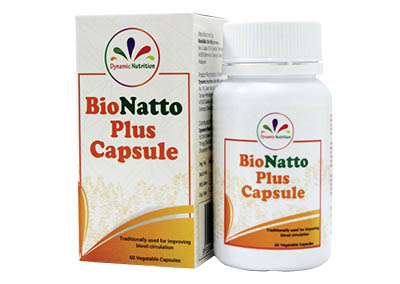
The Nattokinase NSK-SD® + French maritime pine bark + grape seed extract combination in BioNatto Plus is the substrate stack designed for the cardiovascular-aware adult — but the nattokinase component is the one that interacts with prescription anticoagulants, and the consumer on a blood thinner needs to have the cardiologist conversation before adding the nattokinase piece (or skipping it and using only the vascular-tone and capillary-integrity substrate layers, which do not have the same interaction concern).
Bottom line
The published evidence is clear: nattokinase NSK-SD is a pharmacologically active fibrinolytic enzyme, and stacking it with warfarin, DOACs, or antiplatelet drugs is at minimum additive in bleed risk, with published case reports of clinically significant bleeding events. The K2-removed formulation in NSK-SD® solves one specific drug interaction (the vitamin K2 antagonism of warfarin) but does not address the additive fibrinolysis interaction. If you are on a prescription blood thinner, do not self-stack nattokinase — bring the three questions above to your cardiologist and let the conversation determine whether the substrate you actually need is the fibrinolytic one (in which case the interaction management is the clinical task) or the vascular-tone and capillary-integrity one (in which case the French maritime pine bark and grape seed components are the substrate without the interaction profile).
Also available in Bahasa Malaysia and 中文.
Related Topics
Why Stroke Risk Starts in Your 30s: 4 Warning Signs Most Adults Ignore (and What to Do This Week)
New Guidelines Advise Against Low-Dose Aspirin to Prevent Strokes and Heart Attacks for Older Adults
What You Should Know About Red Yeast Rice Side Effects
Symptoms of Poor Blood Circulation
Nattokinase as a Countermeasure Against COVID-19
Are You at Risk of Deep Vein Thrombosis (DVT)?
Three Ways French Pine Bark Protects the Heart
Top 5 Benefits of Grape Seed Extract
Best High Blood Pressure Supplement Malaysia: An Evidence-Checked Shortlist (and the Claims to Skip)
Product you may be interested in