If you’re under 40, healthy by every measure you can name, and you’ve started seeing headlines about stroke in adults who “look fine” — you’re not imagining the trend. A recent New Straits Times feature1 laid out the Malaysian picture plainly: too many patients are arriving at the hospital past the treatment window because the early warning signs were missed. The same pattern is showing up in Singapore2, and the underlying biology is the same everywhere — strokes are overwhelmingly ischemic, caused by a clot blocking blood flow to part of the brain.
This article is the conversation most general-health articles skip: what are the four most-missed warning signs, why is the risk rising in your 30s, and what can you actually do this week — including the daily-circulation conversation most adults don’t even know to have until their doctor brings it up.

The 4 Warning Signs Most Adults Miss
Most strokes don’t arrive as a Hollywood moment — a slumping body and slurred words out of nowhere. The vast majority begin with one or more of these subtle, transient, easy-to-ignore signs. The clinical term for the transient version is TIA (transient ischemic attack) — a “mini-stroke” that resolves on its own, often within minutes, but is the single strongest predictor that a full stroke is coming.
1. Sudden one-sided numbness, tingling, or weakness
The single most consistent stroke warning sign: numbness or weakness on one side of the body — usually the face, an arm, or a leg. The tell is sudden. Not the tingling you get from sitting cross-legged, not the numb thumb you slept on. A face that droops on one side when you try to smile, or a hand that suddenly can’t grip a coffee cup the way it did thirty seconds ago — that pattern, even if it goes away, is a five-alarm signal.
2. Sudden slurred speech or word-finding difficulty
The second-most-consistent sign: speech that suddenly doesn’t work. Slurred words you can’t seem to slow down. Sentences where you know what you want to say but the wrong word keeps coming out. A family member who suddenly can’t follow what you’re saying. Again, the key is sudden — not the occasional tip-of-the-tongue moment everyone has.
3. Sudden one-sided vision loss or double vision
A third pattern that gets misread as “eye strain”: losing vision in one eye, or seeing double, suddenly. Often described as a curtain coming down, or as the world looking like it’s smudged on one side. The mechanism is the same — a small clot briefly cutting off blood flow to the part of the brain that processes vision from one eye.
4. Sudden severe headache with no obvious cause
The fourth warning sign is the one that gets dismissed most often: a sudden, severe headache — “the worst headache of your life” — with no clear trigger. Especially concerning when combined with any of the above. This pattern can indicate a hemorrhagic stroke (bleeding into the brain) rather than the more common ischemic kind.
The single most important number to internalise: thrombolytic therapy (clot-busting drugs) works best within 4.5 hours of symptom onset3. After that window, the risk of treatment starts to outweigh the benefit. If you or someone near you has any of these signs, treat it as an emergency — call an ambulance, not a clinic.

Why Stroke Risk Is Creeping Into Your 30s
Stroke is not “an older person’s disease” anymore. Two trends are driving the shift into younger adults:
The first is lifestyle. Sedentary desk work raises fibrinogen (the clotting protein that scaffolds clots) within weeks4. Chronic low-grade inflammation — partly driven by poor sleep, processed food, and weight gain — makes platelets “stickier.” Dehydration concentrates clotting factors. None of these on their own causes a stroke, but together they shift the balance of your haemostasis system toward clotting. The pattern is the same one long-haul flyers and economy-class travellers see (the so-called “economy-class syndrome”), except now it’s the daily office worker.
The second is the rise of modifiable mid-life risk factors that are showing up earlier. Untreated high blood pressure in your 30s. Early-stage type 2 diabetes or pre-diabetes (often undiagnosed). High LDL cholesterol or Lp(a). Atrial fibrillation in younger adults — sometimes linked to heavy endurance exercise or simply to undiagnosed sleep apnoea5. None of these will produce a stroke by themselves; what they do is move the dial on your baseline clot risk, so a small trigger (dehydration, a long flight, a viral illness) becomes enough to push you over.
The Fibrinolysis Story Your Doctor Doesn’t Always Mention
Most adults think of blood as either “thin” or “thick” — as if it were one dial. It’s actually three systems in dynamic balance:
1. Coagulation — the formation of clots (the body’s response to a cut, but also the mechanism behind a stroke-causing clot).
2. Fibrinolysis — the body’s own clot-clearing system. Once a clot has done its job, the body breaks it down using an enzyme called tissue plasminogen activator (tPA) and a network of supporting enzymes.
3. Platelet aggregation — the stickiness of the platelets that start the clot in the first place. Aspirin works here; that’s why cardiologists prescribe it post-heart-attack or post-stroke under specific conditions6.
Most of the public-health conversation focuses on coagulation (“blood thinners”) and platelet stickiness (“aspirin therapy”). What gets less airtime is fibrinolysis — your body’s daily clot-clearance capacity. As fibrinogen climbs with sedentary lifestyle and as low-grade inflammation suppresses the fibrinolytic side of the balance, the system tips toward clotting without any obvious acute trigger.
Supporting fibrinolysis is where the daily-circulation conversation fits. It’s also where the most-studied fermented soybean enzyme comes in.
Where Nattokinase NSK-SD® Fits (and What “Fibrinolytic Support” Actually Means)
Nattokinase is a serine protease enzyme discovered in 1980 by Dr Hiroyuki Sumi at the University of Chicago, produced by Bacillus subtilis natto during the fermentation of soybeans. It’s the molecule that gives natto — the Japanese fermented soybean dish — its characteristic slimy texture, and it’s been the subject of more than thirty years of Japanese clinical research.
The mechanism is exactly what the fibrinolysis conversation above describes: nattokinase enhances the breakdown of fibrin (the scaffolding of clots that have already formed) by cleaving fibrin directly and by upregulating the body’s own tPA pathway. Critically, it does this without suppressing normal coagulation — meaning it doesn’t carry the bleeding-risk profile of pharmaceutical anticoagulants in healthy adults7.
The brand-specific distinction matters here. NSK-SD® (Natural Super Kinase-Sprayed Dried) is a trademarked, vitamin-K2-removed form owned by Japan Bio Science Laboratory. Vitamin K2 removal matters because it means the supplement can be considered alongside anticoagulant medications like warfarin under medical supervision — most other natto products cannot8. If you’re considering nattokinase and you’re on a prescribed anticoagulant, the NSK-SD® form is the one clinicians are most likely to be familiar with.
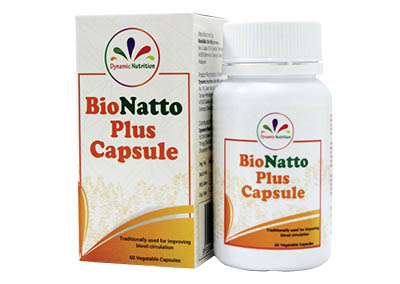
The clinically studied dose in the literature is typically in the range of 2,000–4,000 FU (fibrin units) per day9. Bionatto Plus delivers 50 mg of fermented soybean extract standardised to NSK-SD® per capsule — combined with French Pine Bark Extract (which supports endothelial nitric oxide and vasodilation) and Grape Seed Extract (which contributes antioxidant protection of LDL). The triple-mechanism daily stack — fibrinolysis + vasodilation + antioxidant — is the daily-circulation conversation most adults over 40 should at least be aware of, even if they ultimately choose not to supplement.
What to Do This Week — A 4-Step Starter Checklist
You don’t have to overhaul your life to act on this. Four steps, in order of effort:
1. Know your numbers. Book a single bloodwork panel that includes fasting glucose + HbA1c, full lipid panel (LDL, HDL, triglycerides, and Lp(a) if your doctor will order it), hs-CRP (inflammation marker tied to arterial plaque), and a basic coagulation screen if you have any family history of clotting. Adults over 30 with a family history of stroke or cardiovascular events should also ask about a carotid intima-media thickness ultrasound and an ankle-brachial index (ABI).
2. Audit your sitting. If your work is desk-based, stand up for two minutes every 45 — the pattern matters more than the absolute minutes. The fibrinogen-raising effect of sustained sitting starts within weeks; the fibrinolytic benefit of frequent short movement starts within days.
3. Hydrate deliberately. Aim for roughly 30 ml/kg of body weight per day of water (a 70 kg adult = ~2.1 L), more if you’re active or in a hot climate like Singapore or Malaysia. Dehydration concentrates clotting factors and is one of the easiest levers to pull.
4. Have the fibrinolytic-support conversation. Read up on nattokinase NSK-SD® — the mechanism, the dose range, the K2-removed distinction. If you’re over 35, have a family history of cardiovascular events, sit for long hours, travel long-haul frequently, or are in mid-life recovery under medical supervision, this is one of the few supplement categories where the literature has been consistent for decades. Bionatto Plus is the verified NSK-SD® source available in Malaysia and Singapore — formulated with the two complementary antioxidant and vasodilation mechanisms most standalone natto products skip.
None of this replaces the medical evaluation of stroke symptoms. None of it is a substitute for an annual cardiovascular check-up, blood pressure management, or a personalised conversation with your doctor. But the daily-circulation layer is one most adults over 30 simply haven’t thought about — and it’s the layer where the gap between “I look fine” and “I had a stroke at 38” gets closed.
References
- New Straits Times — “#HEALTH: Malaysia’s stroke care gap puts patients in a race against time” (2026-09-04) — https://www.nst.com.my/lifestyle/heal/2026/09/1525346/health-malaysias-stroke-care-gap-puts-patients-race-against-time
- HealthHub Singapore (HPB) — “Be Stroke Smart” — https://www.healthhub.sg/health-conditions/strokeawareness
- American Heart Association / American Stroke Association — “B.E. F.A.S.T. Infographic” — https://www.stroke.org/en/help-and-support/resource-library/be-fast-materials/be-fast-infographic
- Cleveland Clinic — “Health Risks of a Sedentary Lifestyle” — https://health.clevelandclinic.org/sedentary-lifestyle
- Mayo Clinic — “Sleep apnea — Symptoms and causes” — https://www.mayoclinic.org/diseases-conditions/sleep-apnea/symptoms-causes/syc-20377631
- Harvard Health Publishing — “Aspirin and your heart: Many questions, some answers” — https://www.health.harvard.edu/press_releases/aspirin-and-your-heart-many-questions-some-answers
- Memorial Sloan Kettering Cancer Center — “Nattokinase” (Integrative Medicine monographs) — https://www.mskcc.org/cancer-care/integrative-medicine/herbs/nattokinase
- Japan Bio Science Laboratory — “Fermented Soybean Extract NSK” (manufacturer product specification) — https://www.jbsl-net.com/english/nsk/
- PubMed / National Library of Medicine — “Nattokinase” (research-indexed publications) — https://pubmed.ncbi.nlm.nih.gov/?term=nattokinase
Related Topics
Are you at Risk of Deep Vein Thrombosis (DVT)?
#HEALTH: Malaysia’s stroke care gap puts patients in a race against time (NST, 2026-09-04)
New Guidelines Advise against Low-dose Aspirin to Prevent Strokes and Heart Attacks for Older Adults
How To Identify Signs Of Heart Attack
Top 5 Benefits Of Grape Seed Extract
The Risk Factors of High Blood Pressure and Simple Steps to Control it
Symptoms of Poor Blood Circulation
Nattokinase With Warfarin or Aspirin: 3 Questions to Ask Your Cardiologist Before You Combine
Product you may be interested in