Nattokinase dosage is the question almost every buyer of a nattokinase capsule asks first, and it is the one most labels make hard to answer. The reason is simple: nattokinase is not dosed in milligrams the way most supplements are. It is dosed in fibrinolytic units (FU), a measure of enzymatic activity, and two capsules from two different brands can carry very different FU numbers while looking identical on the shelf. This guide walks through what an FU actually is, what daily FU doses the published nattokinase trials used, how per-capsule and per-day dosing differ, and what to look for on a label before you buy.
One thing to say up front, because it colours everything below: nothing in this article is medical advice, and none of it promises that any dose of nattokinase will prevent or dissolve a blood clot, lower your blood pressure, or treat any condition. Nattokinase is a fibrinolytic enzyme, which means it interacts with the biology of clotting, and anything that interacts with clotting belongs in a conversation with a clinician who knows your history — particularly if you take an anticoagulant or antiplatelet drug, or if you have a bleeding disorder, or if you have surgery or dental work coming up.
What a fibrinolytic unit (FU) actually is
An FU is not a weight and it is not a percentage. It is a measure of how much fibrin breakdown activity a given amount of nattokinase powder can produce in a laboratory assay — essentially, how hard the enzyme works on the protein that forms a clot. Nattokinase is sold as a purified soybean fermentation extract (the common standardised form is NSK-SD, manufactured by Japan Bio Science Laboratory), and because the enzyme’s activity varies with the fermentation batch, the manufacturer states it as activity units rather than as plain milligrams.1
There is also an older unit still visible on some labels: the CU, or casein unit. CU was replaced by FU at a conversion ratio of about 1.33, so the same activity expressed the old way reads roughly a third higher. A standard serving of fermented soybeans — about 50 g of natto — measures around 2,000 CU, which is approximately 1,500 FU. If you are comparing two products and one uses CU while the other uses FU, that is the first thing to reconcile before you compare anything else.1
For reference, the same manufacturer’s technical documentation describes its NSK-SD powder as having an activity above 20,000 FU per gram, with each 100 mg capsule delivering a minimum of 2,000 FU, and gives a recommended intake level of 2,000 FU per day.1 The reason this matters: 2,000 FU is a number borrowed from a specific powder at a specific activity. It is not a universal dose, and it does not travel automatically to a different product with a different milligram amount of extract.
What daily FU doses the published trials actually used
This is where a buyer’s intuition usually breaks down, because the answer is not one number. A 2024 systematic review and meta-analysis of randomised controlled trials on nattokinase and cardiovascular risk factors found that daily doses across the included trials ranged from 1,200 FU to as much as 8,000 FU — a spread of nearly sevenfold within the randomised evidence base itself.2 Knowing that range is more useful than knowing a single “recommended” figure, because it tells you that no single daily dose has been established as the one.
The specific trials behind the range are worth knowing, because they show how much the answer depends on the question being asked:
Blood pressure, 2,000 FU per capsule for 8 weeks. A randomised, double-blind, placebo-controlled trial enrolled 86 adults aged 20 to 80 with untreated systolic blood pressure between 130 and 159 mmHg; 73 completed the protocol. Against placebo, the net change was −5.55 mmHg systolic and −2.84 mmHg diastolic after 8 weeks, with plasma renin activity also falling significantly.3 Note what was dosed: 2,000 FU per capsule, at a specified weight of capsule contents.
The same question, asked differently. A separate randomised, double-blind, placebo-controlled multicentre trial in a North American population used 100 mg of nattokinase per day, standardised to at least 2,000 FU, over the same 8-week window. 79 subjects were enrolled and 74 completed. Here the diastolic reduction reached statistical significance (87 mmHg down to 84 mmHg against a placebo group that stayed at 87 mmHg), while the systolic decrease from 144 to 140 mmHg did not reach significance against placebo — it reached a statistical trend only.4 Two trials at the same dose, different answers on the systolic endpoint.
Coagulation markers, two 2,000 FU capsules daily for 2 months. In an open-label self-controlled study across healthy volunteers, patients with cardiovascular risk factors, and patients undergoing dialysis, subjects took two capsules of nattokinase at 2,000 FU per capsule daily for 2 months. Fibrinogen and clotting factors VII and VIII declined over the period, with no notable adverse events recorded.5 This is 4,000 FU a day — double the dose most trials use — which is exactly the per-capsule versus per-day distinction that catches people out.
A single dose. A double-blind, placebo-controlled crossover study in 12 healthy young men gave a single 2,000 FU capsule and tracked coagulation and fibrinolysis markers over 8 hours. Several markers moved in the expected direction, but all of the changes stayed within the normal range.6 It is a useful reminder that a biomarker shift inside the normal range is not the same as a clinical outcome.
The dose-response question nobody has fully answered
Here is the uncomfortable part. The largest nattokinase study in the literature — 1,062 participants followed for 12 months — reported that 10,800 FU per day was associated with meaningful improvements in atherosclerosis progression and lipid profile, while 3,600 FU per day was ineffective.7 That result is often quoted as though it settles the dosing question, and it does not, for two reasons that the paper itself is explicit about.
First, it was a retrospective study, not a randomised controlled trial — the authors flag this in their own limitations section, noting that self-reported lifestyle information cannot be validated and that there were no follow-up interviews. Retrospective dose comparisons cannot rule out that the people who took more nattokinase were different in ways that mattered.
Second, and more practically: a finding at 10,800 FU does not license a recommendation at 10,800 FU. That dose came from a single 3,600 FU tablet taken three times a day in a specific Chinese population with existing cardiovascular concerns, over 12 months. It is not a dose any of the randomised trials used, and the randomised trials — which are the ones designed to test cause and effect — cluster in a much lower band.
The honest summary is that nattokinase has a real, published evidence base at roughly 2,000 FU per day, some evidence at higher doses, and no established dose-response curve that would let anyone say “more is better.” If a seller tells you that a higher FU number means a better result, ask which randomised trial demonstrated that.
How to read a nattokinase label: five things to check
Now the practical half. When you pick up a nattokinase capsule and turn it over, look for these five things in this order:
1. Is the FU figure per capsule or per daily dose? This is the single most common source of confusion. A label reading “2,000 FU” next to a capsule that says “take 2 capsules daily” is a 4,000 FU daily dose. Some labels state the per-capsule figure and leave the daily arithmetic to you; others state the daily total directly. Find out which, then do the multiplication yourself.
2. Is it FU or CU? If the label uses casein units, convert at roughly 1.33 CU to 1 FU before comparing to anything labelled in FU.
3. How much extract is in the capsule, and what is that extract standardised to? These are two different numbers and they both matter. The milligram amount tells you how much powder you are swallowing. The FU amount tells you how much activity that powder carries. A product can have a respectable milligram figure and a low activity figure, or the reverse.
4. What else is in the capsule? A nattokinase product is rarely a single ingredient. If the capsule also carries botanical extracts, the FU figure only accounts for the nattokinase portion — and you have no way of separating the effects of the other ingredients from the nattokinase when you read a trial that tested nattokinase alone.
5. Is the FU number a minimum, a typical value, or a maximum? “Standardised to” and “minimum activity level” are not the same promise as a flat figure, and batch-to-batch variation is real. A label that states a minimum is making a different and weaker claim than one that states a tested typical value.
Reading the BioNatto Plus label specifically
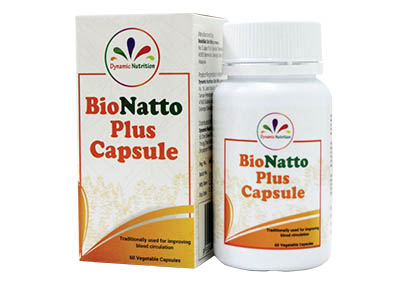
BioNatto Plus is the product this guide is associated with, so it is worth being concrete about what its own label does and does not tell you. Each capsule contains 50 mg of fermented soybean extract (NSK-SD), 50 mg of French maritime pine bark extract standardised to a minimum of 95% oligomeric proanthocyanidins, and 50 mg of grape seed extract standardised to a minimum of 95% proanthocyanidins, in a bottle of 60 vegetable capsules. The stated dosage is two capsules twice daily, preferably after breakfast and dinner, as a therapeutic dose, or one to two capsules once daily after a meal as maintenance.
Two observations follow, and a buyer should have both of them in mind before reading that dosage as a prescription.
First, the label states the nattokinase content in milligrams (50 mg of NSK-SD), not in FU. That is not an oversight to be angry about — it is simply how this particular front-of-pack panel is written, and it means the FU figure for a given bottle has to be obtained from the manufacturer’s specification for the batch rather than read off the box. Until you have that number, any conversion from “2 capsules twice daily” to “4,000 FU a day” is an assumption, not a fact. Ask the supplier for the FU activity of the NSK-SD in the lot you are buying.
Second, and more importantly, this capsule is not nattokinase alone. A 2,000 FU nattokinase trial tested nattokinase. BioNatto Plus pairs nattokinase with two botanical extracts that have their own evidence base, and the trials behind those extracts generally did not involve nattokinase at all. No published trial has tested this specific combination at this specific dose, so the honest position is that you are buying three separately-studied ingredients rather than one studied formula.
None of that is a reason not to consider the product. It is a reason to hold it at the same standard as any other product: ask what was tested, in whom, at what dose, and against what comparator — and take the answer to a clinician who can weigh it against your own situation.
What to ask before you start, and what to ask a doctor
Before buying anything on this ingredient, four questions are worth more than any FU number on the box:
What is my actual risk, and is nattokinase the right lever? Nattokinase acts on the fibrinolytic side of clotting. If your concern is blood pressure, there is a published blood-pressure literature with its own effect sizes, and it is worth reading separately from the clot literature. If your concern is a specific clot diagnosis, that is a clinical question with a clinical answer, not a supplement question.
What am I already taking? Combining nattokinase with warfarin, aspirin, clopidogrel, or any other drug that affects bleeding is a conversation to have with the prescriber before the first capsule, not after. The same applies if you have a bleeding disorder, a recent operation, or upcoming surgery or dental work — and to anyone who reacts to soy, since nattokinase is a soybean fermentation product.
How long would I take it, and how would I know? Most of the randomised trials ran 8 weeks, and the marker-based studies ran 2 months. A supplement with no stopping rule and no measurable endpoint is one you will keep taking indefinitely, which is not a neutral thing to commit to.
What is the actual cost per day of the FU I am paying for? Divide the price by the number of days and the FU per day. It is the only comparison that stays honest between products, because it puts a 2,000 FU capsule and a 4,000 FU capsule on the same footing.
And if a dose decision has to wait for a doctor’s appointment, waiting is the correct decision. Every FU figure in this article comes from studies in specific populations at specific doses over specific windows. None of them is a dosing instruction for you.
References
- Japan Bio Science Laboratory Co, Ltd. A Comprehensive Scientific Review of Nattokinase (NSK-SD). Osaka: JBSL. — https://www.lv-pharm.rs/wp-content/uploads/2018/01/A-Comprehensive-Scientific-Review-of-Nattokinase.pdf
- Li X, Long J, Gao Q, Pan M, Wang J. Nattokinase Supplementation and Cardiovascular Risk Factors: A Systematic Review and Meta-Analysis of Randomized Controlled Trials. Reviews in Cardiovascular Medicine. 2024;24(8):234. doi:10.31083/j.rcm2408234 — https://www.imrpress.com/journal/RCM/24/8/10.31083/j.rcm2408234
- Kim J, Gum SN, Paik JK, Lim HH, Kim KC, Ogasawara K, et al. Effects of nattokinase on blood pressure: a randomized, controlled trial. Hypertension Research. 2008;31(8):1583-1588. PMID 18971533 — https://www.nature.com/articles/hr2008203
- Jensen GS, Lenninger M, Ero MP, Benson KF. Consumption of nattokinase is associated with reduced blood pressure and von Willebrand factor, a cardiovascular risk marker: results from a randomized, double-blind, placebo-controlled, multicenter North American clinical trial. Integrated Blood Pressure Control. 2016;9:95-104. PMID 27785095 — https://pmc.ncbi.nlm.nih.gov/articles/PMC5066864/
- Sumi H, Sato Y, Kimoto S, et al. Nattokinase decreases plasma levels of fibrinogen, factor VII, and factor VIII in human subjects. Journal of Cardiovascular Pharmacology. 2009;54(5):609-618 — reviewed in Weng Y, Yao J, Sparks S, et al. Nattokinase: An Oral Antithrombotic Agent for the Prevention of Cardiovascular Disease. International Journal of Molecular Sciences. 2017;18(3):523 — https://pmc.ncbi.nlm.nih.gov/articles/PMC5372539/
- Kurosawa Y, Nirengi S, Homma T, Esaki K, et al. A single-dose of oral nattokinase potentiates thrombolysis and anti-coagulation profiles. Scientific Reports. 2015;5:11601 — https://pmc.ncbi.nlm.nih.gov/articles/PMC4479826/
- Chen H, Chen J, Zhang F, Li Y, et al. Effective management of atherosclerosis progress and hyperlipidemia with nattokinase: A clinical study with 1,062 participants. Frontiers in Cardiovascular Medicine. 2022;9:964977 — https://pmc.ncbi.nlm.nih.gov/articles/PMC9441630/
Product you may be interested in