If you have ever been handed an iron supplement and then told to take it with orange juice, you have already been given the single most useful piece of iron advice there is — and almost no explanation for it. The orange juice is vitamin C. Vitamin C is the only everyday dietary factor that reliably makes non-haem iron (the iron in plants, grains, legumes and supplements) easier for your gut to absorb, and it is also the factor most likely to be quietly cancelled out by the tea, coffee or calcium sitting on the same breakfast table.
That combination is why “take your iron with vitamin C” is repeated constantly while the more useful question almost never gets asked: what should be moved away from the meal, and what should be moved onto it? This article decodes the mechanism vitamin C actually has on iron absorption, the polyphenol problem that tea and coffee create in the same meal, the form question that decides whether vitamin C is even the limiting factor, and the safety boundary that separates a dietary-status decision from a medical one.
Why Vitamin C and Iron Are a Pairing, Not a Coincidence
Iron arrives at your gut in two very different forms. Haem iron comes from animal tissue and is already structured for absorption — roughly a third of it crosses the intestinal wall under normal conditions, and it is largely indifferent to what else is on the plate. Non-haem iron comes from plants, fortified foods and every iron supplement, and it is a different story entirely: it arrives as ferric iron (Fe3+), which is poorly soluble in the slightly acidic environment of the upper gut and therefore hard to keep in solution long enough to be taken up.
Ascorbic acid — vitamin C — does three useful things to that problem at once. It reduces ferric iron to ferrous iron (Fe2+), which is the form that is absorbed. It chelates the iron, holding it in a soluble complex that does not precipitate out. And it counteracts the inhibitors that would otherwise be present in the same meal. It is not a minor effect: in single-meal absorption studies, adding ascorbic acid to a meal has been reported to raise non-haem iron absorption several-fold, with one frequently cited estimate putting a 100 mg addition of ascorbic acid at roughly a fourfold increase in absorption from the meal it was added to.
This is why the pairing matters most for the readers most likely to be iron-deficient to begin with. If your iron comes mostly from red meat, haem iron already does the work and vitamin C is a rounding error. If your iron comes from spinach, lentils, tofu, fortified cereal or a supplement tablet, non-haem iron is your iron, and its absorption is entirely down to the chemistry of the meal. For a plant-based or low-meat cohort in Singapore, Malaysia and across the region, that is the majority of dietary iron.
The Breakfast Problem: Tea, Coffee and Calcium in the Same Meal
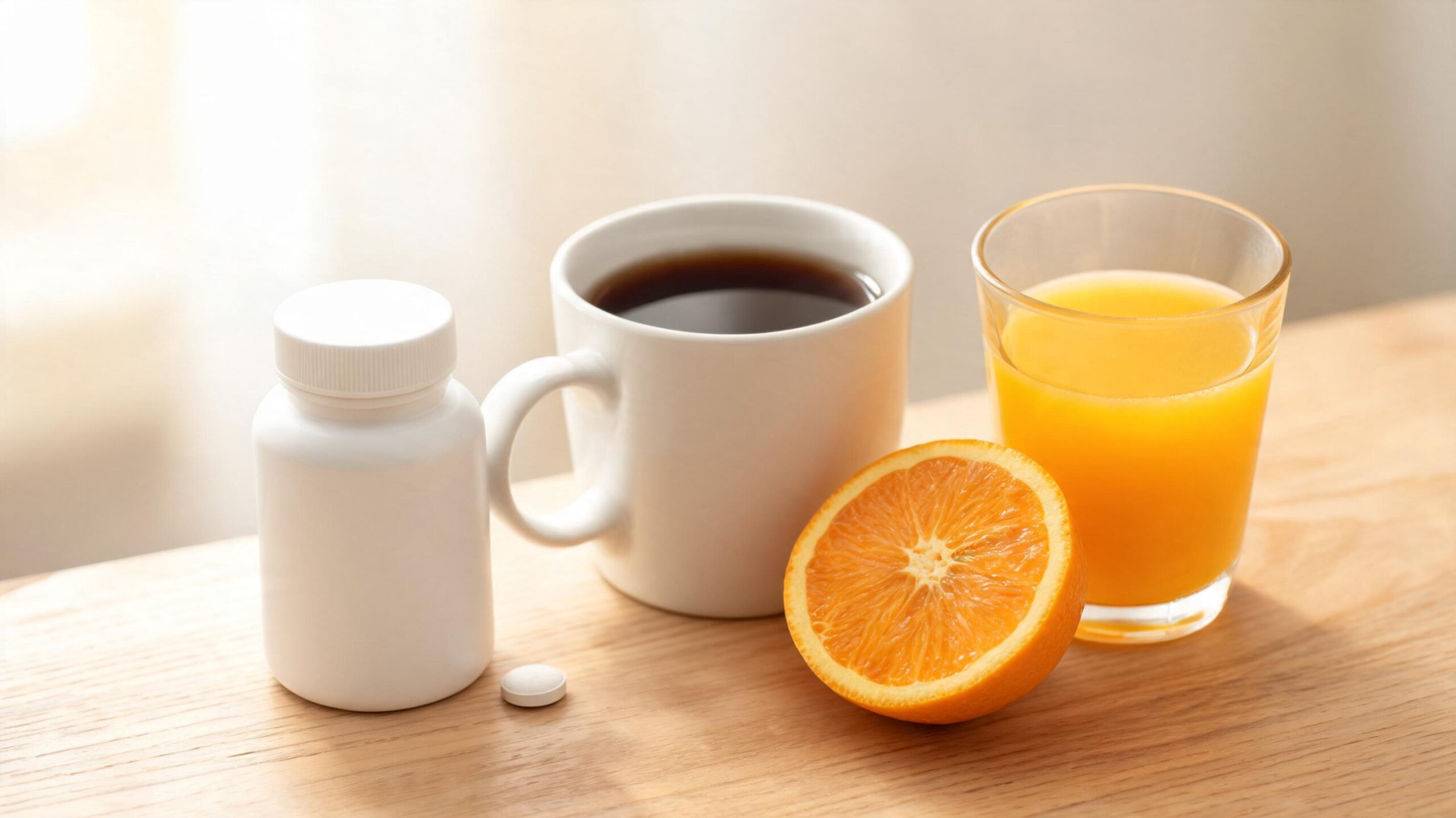
Here is the part that quietly undoes the advice. The most common iron-tablet moment in Asia is breakfast, and the most common breakfast companions are tea, coffee and milk. All three interfere with non-haem iron absorption, and the interference is not marginal.
Tea, coffee and cocoa are rich in polyphenols, and polyphenols bind iron in the gut. In a widely cited human absorption study, beverages containing 20–50 mg of total polyphenols per serving reduced iron absorption by roughly 60–90 percent, with black tea and coffee among the most potent. The mechanism is chemical: the polyphenol binds the iron and forms a compound the intestine cannot take up. It is not a matter of a few percentage points.
Calcium works differently but reaches a similar destination. Where polyphenols form an unabsorbable complex, calcium competes with iron for the same transport pathway, and a calcium dose taken at the same time can blunt non-haem iron uptake. Dairy is the obvious source, but so are fortified plant milks and calcium supplements — the pattern is the same regardless of whether the calcium came from a cow or a carton.
The practical consequence is not that tea and coffee are forbidden. It is that the popular instruction is half right in a way that produces the wrong behaviour. “Take your iron with orange juice” is sound advice that fails repeatedly for readers who also drink two cups of teh tarik or kopi o kosong with breakfast, because the juice is being asked to undo the tea rather than simply add to the iron.
The Timing Rule That Actually Works
If you take one practical rule from this article, take this one: pair the iron with the vitamin C, and move the tea, coffee and calcium away from the meal — not the other way round. You are not trying to win a tug-of-war between the orange juice and the tea in the same bowl.
Concretely, for a reader taking an iron supplement or eating an iron-rich meal:
• Take the iron with a vitamin C source — a glass of orange or guava juice, a kiwi, some acerola or amla, or a vitamin C supplement. The traditional advice of taking it with orange juice is not folklore; it is the cheapest and most reliable absorption enhancer available.
• Leave an hour or two either side of the iron for tea, coffee and dairy. If you need your kopi at breakfast, take the iron at a different time of day rather than at the same table.
• Separate calcium supplements from iron by the same margin. This matters most for women who take calcium for bone health and iron for low ferritin — a genuinely common combination, and one where the two supplements are frequently taken together and quietly working against each other.
• Do not take the iron with calcium-rich foods or with a coffee — the two are the same mistake, and the coffee version is the one almost nobody notices because the coffee is a habit rather than a supplement.
Notice what this rule does not say. It does not say you must give up tea, or that iron is a battle you win by winning every meal. It says the pairing and the antagonism are separate variables, and only one of them needs to be moved.
Ferrous vs Ferric: Why Your Iron Supplement’s Form Matters
Vitamin C is an enhancer. It cannot rescue a situation where the enhancer was never the limiting factor. Which brings us to the form of the iron itself.
Ferrous iron (Fe2+, usually ferrous sulfate, fumarate or gluconate) is the form that is directly absorbed. Ferric iron (Fe3+) is a more stable but much less bioavailable form, and iron supplements formulated as ferric compounds usually rely on the stomach’s own reducing chemistry to convert some of it before absorption.
This is where vitamin C earns its place for a specific reason: ascorbic acid is one of the few things that performs that reduction reliably. So on a ferrous supplement, vitamin C adds an enhancer on top of an already-absorbable form. On a ferric supplement, vitamin C may be doing the reduction work that the product itself did not do. The practical point for a reader comparing two iron products on a shelf is that the form of the iron changes how much the vitamin C matters — and a label that lists only “iron” as the active tells you nothing about which one you are buying.
Two further form issues are worth checking on any iron label: whether it is a slow-release or standard-release form (slow-release forms that are not designed for iron can reduce absorption by keeping the iron away from the stomach acid that dissolves it), and how much elemental iron a dose actually delivers, since a “500 mg iron” compound may contain a very different amount of elemental iron than the number on the front suggests.
What Vitamin C Does Not Fix
This article is about a dietary pairing, and it needs an honest boundary. Vitamin C is not a treatment for iron deficiency, and pairing an iron supplement with orange juice is not an alternative to either a diagnosis or a treatment plan.
Iron status has to be measured. Ferritin (the storage protein), transferrin saturation (how much of your transport capacity is loaded) and haemoglobin (whether you are anaemic now) are the numbers a clinician reads, and they answer different questions. A normal haemoglobin with a low ferritin is a common and real finding — depleted stores without anaemia — and it is exactly the state that most often gets missed. A supplement started without a measurement is a guess, and iron is one of the few nutrients where guessing upward has real consequences.
More iron is not always better. Iron overload and haemochromatosis are real conditions, and unnecessary iron supplementation is harmful in people who carry the genetic predisposition. Repeated high-dose iron without a diagnosis is not a cautious strategy; it is an unmeasured one. If you have haemochromatosis in your family history, or you have been prescribed and then re-prescribed iron without a follow-up blood test, that is a conversation to have with a doctor rather than with a vitamin C.
Certain groups should not self-dose vitamin C for iron — including anyone with iron overload, a history of transfusion-dependent anaemia, a post-transplant status, or recurrent kidney stones (ascorbic acid is metabolised to oxalate, and high-dose vitamin C increases urinary oxalate). None of that is an argument against vitamin C in food; it is an argument against a high-dose supplement taken for a condition nobody has measured.
And the honest evidence note, which belongs in every article on this subject: the large effect of vitamin C on iron absorption is clearest in single-meal absorption studies in fasting subjects. When the same effect is measured across a complete diet over several days, the influence of dietary ascorbic acid is substantially smaller — a well-known finding that is easy to skip and important to know, because it is the difference between “vitamin C meaningfully shifts absorption of this meal” and “vitamin C solves iron deficiency”.
How to Read Your Own Iron Results
Three numbers, and what each one is for:
• Ferritin — your iron stores. Low ferritin with normal haemoglobin means you are running down; it is the earliest and most sensitive of the three, and it is the number that responds to correction first.
• Transferrin saturation — how loaded your iron transport is. Low saturation with a low ferritin points at a supply problem; low saturation with a normal or high ferritin points somewhere else entirely, and vitamin C will not help.
• Haemoglobin — whether you are anaemic right now. It is the most clinically consequential and the least sensitive: by the time haemoglobin falls, stores have usually been low for a long time.
If you have a low ferritin result and a plan from a clinician, the pairing rules above are the part you control. If you do not have a result, getting one is worth more than any adjustment to the breakfast table.
The Vitamin C Half of the Pairing: A Natural Complex vs Isolated Ascorbic Acid
One last layer, because it affects what you are actually taking. Vitamin C on a label comes in two broad forms: isolated ascorbic acid — a measured dose of the single molecule — and whole-fruit concentrates, where the vitamin C arrives in the matrix it grew in, alongside the bioflavonoids and cofactors that were present in the fruit.
The argument for the complex form is not that it delivers a different molecule. Ascorbic acid is ascorbic acid. The argument is about what comes with it: the bioflavonoid layer in a whole-fruit concentrate is itself iron-relevant, and the matrix delivery changes how the dose behaves compared with a compressed isolated tablet. The argument for the isolated form is simpler and equally real: the number on the label is measurable, and a whole-fruit concentrate varies with the season and the batch, so you need the nutrition panel rather than the front of the pack to know what you are getting.
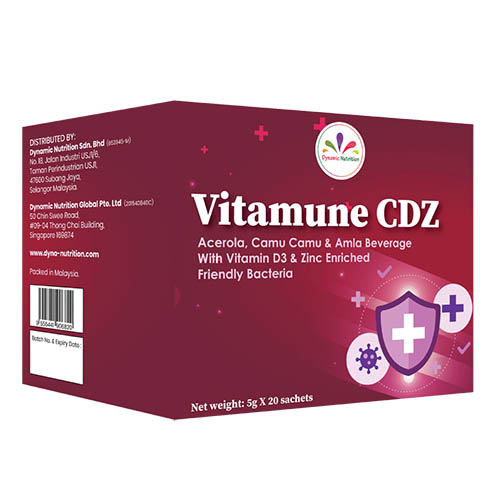
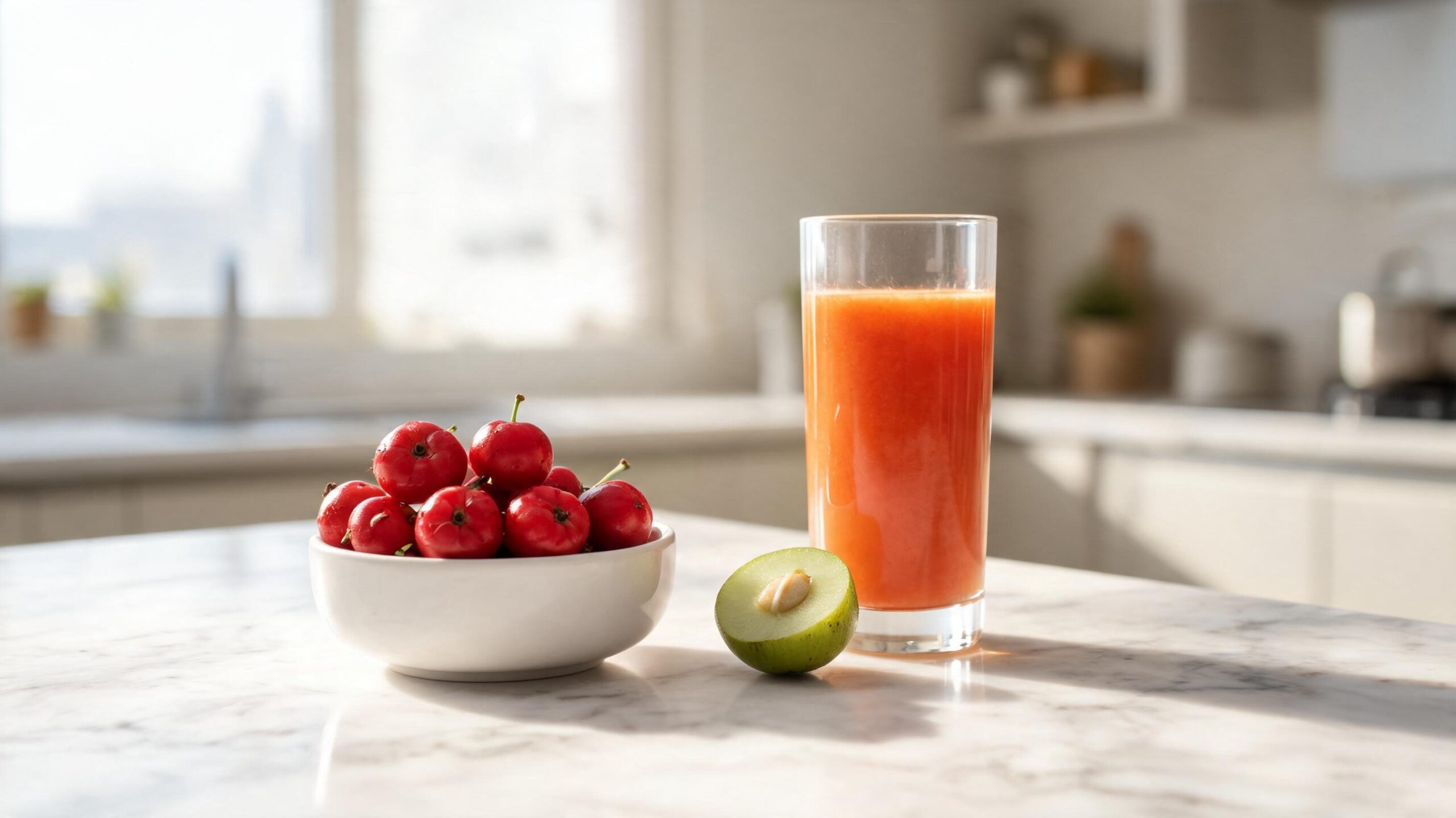
This is where the Vitamune CDZ sachet sits in the story. Each 5 g sachet delivers 903 mg of natural vitamin C drawn from acerola, camu camu and amla concentrates — three of the highest-vitamin-C fruits in common use, and a bioflavonoid cofactor layer that a straight ascorbic acid tablet does not carry. The same sachet also carries 1,550 IU of vitamin D3 and 12 mg of zinc, with a 101 mg five-strain probiotic blend including the zinc-bound Bifidobacterium longum CCFM1195, so the vitamin C sits inside a daily baseline rather than standing alone.
For the reader in this article specifically, the vitamin C is the half of the pairing that is doing the iron work. The iron itself still comes from diet or from a prescribed supplement, still needs a measurement behind it, and still needs the tea and the coffee moved out of the way. What the natural complex buys you is a vitamin C dose that arrives with the cofactor layer intact and does not need a separate orange juice to be worth taking.
The Bottom Line
Vitamin C improves the absorption of non-haem iron — the iron that most of the region actually gets — by keeping it soluble, reducing it to the absorbable form and counteracting the inhibitors in the same meal. But the same chemistry that makes vitamin C useful makes tea, coffee and calcium a counterweight, and the popular instruction to “take your iron with orange juice” quietly assumes you are not also drinking two cups of tea at that table.
So the practical version is short. Put the vitamin C with the iron. Move the tea, the coffee and the calcium an hour or two away. Check which form of iron you were given, because vitamin C matters more for ferric iron than for ferrous. And get a ferritin result before you treat anything. Vitamin C is the half of the pairing you can act on today; the iron, the dose and the diagnosis are the parts that belong with a clinician.
Related Topics
Vitamin C, D and Zinc: Why the Combination Matters (and Why Taking Them Separately Falls Short)
Vitamin C, D & Zinc: Science-Backed Synergy for Complete Immune Support
Is Vitamin C made of corn syrup natural?
An Incredible Source of Vitamin C – Acerola
Singapore’s Biological-Age Test: Why Vitamin D, C, and Zinc Keep Showing Up
Black Elderberry Juice: Clinically Proven for Colds & Flu
People who are Susceptible to Influenza and How to Strengthen Their Immunity
The Difference between a Cold and Flu
Product you may be interested in