Last week The Straits Times1 reported on Singapore’s new biological-age test — the first to be calibrated on Asian cohort data, rather than the European and North American reference populations that have dominated the field for the past two decades. The story made for a striking headline; the real news is what keeps showing up in the background: three micronutrients that biogerontologists, functional-medicine clinics, and the labs running these tests all keep pointing back to when they explain why some Singaporeans are testing younger than their passport says. Vitamin D, vitamin C, and zinc2. Not because any single one of them is a “fountain of youth” — but because each covers a gap that the other two don’t, and most of us are quietly under-shooting at least one of them on any given day.

Why biological age and chronological age are diverging — and why the Asian cohort matters
Biological-age tests measure a panel of biomarkers — DNA methylation patterns, inflammation markers, metabolic readouts, sometimes oxidative-stress indicators — and translate them into a single number. The marketing promise is seductive: “you’re biologically 38 in a 45-year-old body.” The science underneath is messier, but the directional signal is real: people whose diets, sleep, activity, and micronutrient status are solid tend to test younger than their passport age, and those running on coffee, takeout, and sub-15-minute sleep tend to test older.
The Singaporean angle matters because earlier methylation clocks were trained on Western cohorts whose diet, sun exposure, body composition, and lifestyle risks differ from those of urban MY/SG adults. A clock calibrated on a UK population may underestimate biological age in someone who sits 10+ hours a day, rarely sees direct sunlight, and eats a high-refined-carb diet — the very profile the new ST story describes as the local baseline. Recalibrating on Asian data doesn’t just tweak the number; it changes which interventions show up as the highest-leverage fixes.
Three micronutrients, three different jobs — none of them interchangeable
The reason vitamin D, vitamin C, and zinc keep surfacing in the biological-age conversation isn’t a coincidence and it isn’t a marketing coincidence either. Each one addresses a distinct mechanism that drives measurable biological aging, and the clinical literature on each is large enough to be taken seriously without cherry-picking.
Vitamin D — the hormone your skin stopped making this morning
Vitamin D is, functionally, a hormone. It binds to receptors in nearly every cell in the body and modulates calcium routing, immune-cell activation, and muscle protein synthesis. In Singapore and Malaysia, where indoor work and heavy sun avoidance are the norm, serum 25(OH)D below the sufficiency threshold of 30 ng/mL is common even in people who swear they “get plenty of sun.” A biological-age test that includes inflammatory markers or muscle-function proxies will often correlate a low vitamin D reading with an older-than-expected score — and supplementation trials typically show improvements in both immune response and muscle strength within a few months of restoring sufficient levels.
Vitamin C — the antioxidant the body can’t store
Unlike most micronutrients, the body cannot store vitamin C. Every cell relies on a steady dietary supply to regenerate other antioxidants (like glutathione and vitamin E), support collagen synthesis, and maintain the epithelial barriers in the gut, lungs, and vasculature that keep chronic low-grade inflammation down. Biological-age clocks that include oxidative-stress biomarkers — a growing category as the technology matures — consistently flag vitamin C status as a modifiable variable. The practical takeaway: the single orange at breakfast doesn’t cover it, but a steady 200-500 mg/day diet-plus-supplement intake does.
Zinc — the enzyme that sits in the doorway of every repair reaction
Zinc sits in or near the active site of more than 300 enzymes, including several directly involved in DNA repair, cell division, and T-cell maturation. Zinc deficiency is often silent — it doesn’t announce itself with a symptom — but it shows up in biological-age readouts as impaired cellular-repair capacity and weaker adaptive immunity. For MY/SG adults whose coffee and tea intake is high (both contain polyphenols that bind zinc and reduce absorption), the absorption-efficiency gap can be the difference between “adequate” and “functionally deficient” even with a normal diet.

Why the three work synergistically — and why “just take a multivitamin” usually misses
The biological-age framing matters because it reframes the standard multivitamin conversation. A generic once-daily multivitamin typically delivers sub-therapeutic doses of vitamin D, no meaningful zinc, and ascorbic-acid vitamin C in a form that passes through the body too quickly to sustain tissue levels across a 24-hour window. That’s fine as a nutritional insurance policy; it isn’t enough to move a biological-age number.
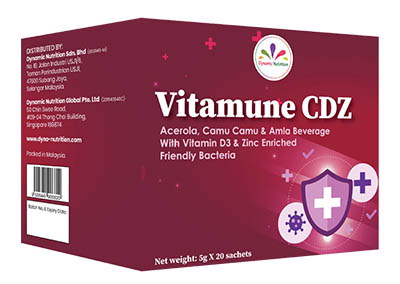
What the new ST story implies — without saying directly — is that a targeted three-nutrient stack, dosed to actually raise serum levels into the therapeutic range, is closer to what a functional-medicine practitioner would recommend than a single multivitamin pill. Vitamune CDZ3 is one example of a formulation that bundles exactly these three nutrients in a single daily protocol — D3 (often paired with K2 for proper calcium routing), a sustained-release vitamin C, and zinc at a dose that works with the day’s coffee-and-tea load rather than against it. It isn’t a “biological-age supplement” — no supplement does that — but it does address three of the variables the new clock is flagging for a large share of Singaporean and Malaysian users.
The honest caveat — what biological-age tests don’t tell you yet
The responsible thing to say about biological-age testing is that it’s still evolving. The clock algorithms differ between labs, the confidence intervals are wide, and a single test in a single clinic is a snapshot, not a diagnosis. What the technology is good at — and what the ST story captures well — is giving people a concrete, personal number that motivates behaviour change. If your test says you’re biologically four years older than you are chronologically, and the clinician explains that three modifiable variables account for most of that gap, that’s a much stronger intervention than a generic wellness pamphlet.
So the three-nutrient story isn’t “vitamin D, C, and zinc will reverse your age.” It’s: these are three variables that the new data says matter, that most urban MY/SG adults under-supply, and that a consistent daily protocol can actually address. For someone who wants a single capsule that covers all three instead of three separate pills at three different times of day, a formulation like Vitamune CDZ is a legitimate simplification — and one that maps cleanly onto what the new test is telling people to check first.
References
- The Straits Times, New biological age test uses Asian cohort data to measure how quickly you are ageing, 11 August 2026. Read the article.
- Wang T, et al. BioAge — a biological age calculator trained on longitudinal ageing data. PLoS Biology, 2022. Read the paper.
- Dynamic Nutrition Global. Vitamune CDZ — Vitamin D3 + C + Zinc daily nutritional support. Product page.
Related Topics
Vitamin C, D & Zinc: Science-Backed Synergy for Complete Immune Support
“Is Vitamin C made of corn syrup natural?”
5 Natural Treatments of Cold and Flu
An Incredible Source of Vitamin C – Acerola
People who are Susceptible to Influenza and How to Strengthen Their Immunity
The Importance of Natural Vitamin C in Our Body
Vitamin C, D and Zinc: Why the Combination Matters (and Why Taking Them Separately Falls Short)
Product you may be interested in