If you’ve ever stood in the supplement aisle staring at the wall of Vitamin C 1000mg tablets and wondered whether the orange tablet in your hand actually does what the label claims — you’re not alone. Walk down any pharmacy aisle in Singapore, Kuala Lumpur, or Penang and you’ll find the same scene: shelf after shelf of synthetic ascorbic acid tablets, zinc-only lozenges, single-strain probiotic capsules, and “immune booster” combinations that deliver one or two of the four mechanisms your immune-defence system actually runs on. The marketing is loud. The mechanism is thin.
This article walks through what your daily Vitamin C tablet is and isn’t doing, the four-mechanism substrate stack your immune-defence biology actually runs on, and why the natural-vitamin-C story (acerola, camu camu, amla) plus the organic-bound-zinc-probiotic story change the bioavailability picture more than the label dose suggests. We’ll also decode the “immune booster” label so you can read one like a clinician the next time you shop.

What “Vitamin C 1000mg” Actually Means on the Label
The dose number on the front of the bottle — 1000mg, 500mg, 1500mg — refers to ascorbic acid, the single isolated molecule. Most Vitamin C tablets are synthetic ascorbic acid: industrially produced from corn sugar (typically glucose derived from corn starch) through a multi-step chemical process. The molecule is bioidentical to the ascorbic acid your body makes, but the source and the company it keeps are not what your immune cells see when you swallow a whole acerola cherry.
Three things the label doesn’t tell you:
One — the bioflavonoid cofactor layer is missing. Natural vitamin C — from acerola, camu camu, amla, or other whole-food sources — exists as a vitamin-C complex, not as an isolated molecule. The complex includes ascorbic acid + bioflavonoids (rutin, hesperidin, quercetin) + Factor K + Factor P + Factor J + tyrosinase + ascorbinogen. These cofactors do two jobs: they improve the absorption of ascorbic acid across the gut wall, and they recycle oxidised ascorbic acid back to its active form once it’s spent neutralising a free radical. Synthetic ascorbic acid alone misses both jobs. The ascorbate gets in, does one round of antioxidant work, gets oxidised, and gets excreted — while the bioflavonoid-mediated recycling never happens.
Two — the bioavailability ceiling is built in. Even at 1000mg, oral ascorbic acid has a published plasma ceiling of around ~80-100 µmol/L. Above that, the gut down-regulates sodium-dependent vitamin C transporters (SVCT1) and absorption flattens. So a 1000mg tablet doesn’t deliver 10× the tissue exposure of a 100mg tablet — it delivers maybe 1.3-1.5× the plasma level, with the rest excreted in urine. More milligrams ≠ more immunity; better absorption and better retention at the cellular level does.
Three — there’s no immune-substrate beyond Vitamin C. A Vitamin-C-only tablet delivers exactly one of the four mechanism layers your immune-defence system runs on. It misses Vitamin D3 (the cellular-immune-activation vitamin; cholecalciferol; modulates T-cell and neutrophil function; >60% of MY/SG adults are deficient per published MOH data), zinc (the immune-substrate micronutrient most-published for viral-defence; required for thymulin and natural-killer-cell function), and the gut-immune axis (Bifidobacterium longum supports gut-barrier integrity + secretory-IgA + competitive exclusion of pathogens). One mechanism out of four is not an immune stack; it’s one quarter of one.
Why “More Vitamin C” Doesn’t Equal “Stronger Immunity”
The intuition is: more C = more antioxidant = more immunity. The biology is more nuanced. Vitamin C’s immune role is structural, not pharmacological — it’s a cofactor the body uses to maintain immune-cell function, not a drug that boosts immunity above baseline. The published effect sizes reflect this:
Cochrane review (Hemilä & Chalker, 2013, periodically updated). Across 29 trial comparisons and >11,000 participants, regular vitamin C supplementation produced a modest 8% reduction in cold duration in the general population, and a ~50% reduction in incidence in people under heavy physical stress (marathon runners, cold-exposed workers, subarctic exercise troops). The takeaway: vitamin C helps the immune system work at its baseline capacity; it doesn’t crank immunity above baseline. A 1000mg tablet vs a 200mg tablet, in a vitamin-C-replete adult, makes little measurable difference.
The depleted-vs-replete distinction matters more. In people with low baseline vitamin C status (smokers, the elderly, people with malabsorption, post-infection recovery), vitamin C repletion produces bigger immune-functional improvements than in people whose baseline is already adequate. Most MY/SG adults in their 30s-60s with a vegetable-rich diet have adequate baseline; the marginal benefit of an extra 800mg of synthetic ascorbic acid is small. The marginal benefit of switching to natural-vitamin-C-with-bioflavonoids is larger, because the bioflavonoid cofactor layer is missing from the standard tablet.
The intracellular layer is where the work happens. Neutrophils (the first-responder white blood cells) accumulate vitamin C at concentrations 10-30× higher than plasma; lymphocytes (T-cells and B-cells) at concentrations ~5-10× higher. The cellular-uptake mechanism uses the same SVCT transporters, which saturate at modest plasma levels. Once intracellular vitamin C is replete, more plasma vitamin C doesn’t deliver more intracellular vitamin C. Bioflavonoid-supported retention at the cellular level (the natural-vitamin-C advantage) is what keeps intracellular stores topped up — not higher plasma doses.
The Four-Mechanism Stack Your Immune-Defence Actually Runs On
Immune-defence isn’t a single pathway. It’s at least four interacting mechanisms. A daily “immune booster” needs to support all four to be called a real substrate stack:
1. Vitamin C — epithelial-barrier integrity + neutrophil + lymphocyte function. As above. The substrate layer the neutrophil oxidative burst and the adaptive-immune proliferation both depend on. Natural vitamin C (acerola + camu camu + amla) delivers the complete bioflavonoid complex; synthetic ascorbic acid delivers the isolated molecule.
2. Vitamin D3 — T-cell + dendritic-cell + neutrophil modulation. Cholecalciferol is the cellular-immune-activation vitamin. Vitamin D receptors (VDR) are expressed on T-cells, dendritic cells, macrophages, and neutrophils; D3 binding modulates the cells’ pathogen-recognition and cytokine-signalling behaviour. The 2017 BMJ meta-analysis (~25,000 participants across 25 RCTs) showed a ~12% reduction in acute respiratory infection incidence with daily D3 supplementation, with greater benefit in the deficient subgroup. >60% of MY/SG adults are deficient per published MOH data, so this layer is the one most worth correcting.
3. Zinc — thymulin + natural-killer-cell + neutrophil function. Zinc is required for the structural and functional integrity of >300 enzymes, including thymulin (the thymus-derived T-cell maturation hormone) and the natural-killer (NK) cell cytotoxic-granule release pathway. Zinc deficiency impairs T-cell maturation, NK-cell activity, and neutrophil respiratory burst. The 2013 Cochrane review on zinc for colds suggested ~1 day reduction in cold duration with zinc supplementation started within 24 hours of symptom onset. Most zinc tablets deliver inorganic zinc gluconate or zinc sulphate at 15-30mg; the bioavailability ceiling matters more than the dose.
4. Gut-immune axis — secretory-IgA + gut-barrier integrity + competitive exclusion. ~70% of the immune system sits in the gut-associated lymphoid tissue (GALT). Bifidobacterium longum supports gut-barrier integrity (the single-cell-layer wall that decides what crosses from gut into bloodstream), secretory-IgA production (the mucosal antibody that tags pathogens for clearance), and competitive exclusion (the probiotic occupying binding sites so pathogens can’t colonise). The modern MY/SG diet — high in refined carbohydrate, low in fibre, high in processed food, frequent antibiotic exposure — drives a Bifidobacterium decline + Proteobacteria rise pattern that suppresses this axis. A daily probiotic substrate is one of the four mechanisms, not an optional extra.
The four mechanisms interact. Vitamin C supports the epithelial-barrier cells that the gut-immune axis maintains. Vitamin D modulates the T-cells that secretory-IgA production depends on. Zinc supports the thymulin-driven T-cell maturation that adaptive immunity requires. A real daily substrate stack delivers all four, not one or two of them at high dose.
Why the Delivery Form Matters More Than the Dose
The same molecule delivered in different forms produces different biological outcomes. The form-vs-dose honesty test for an “immune booster” label looks like this:
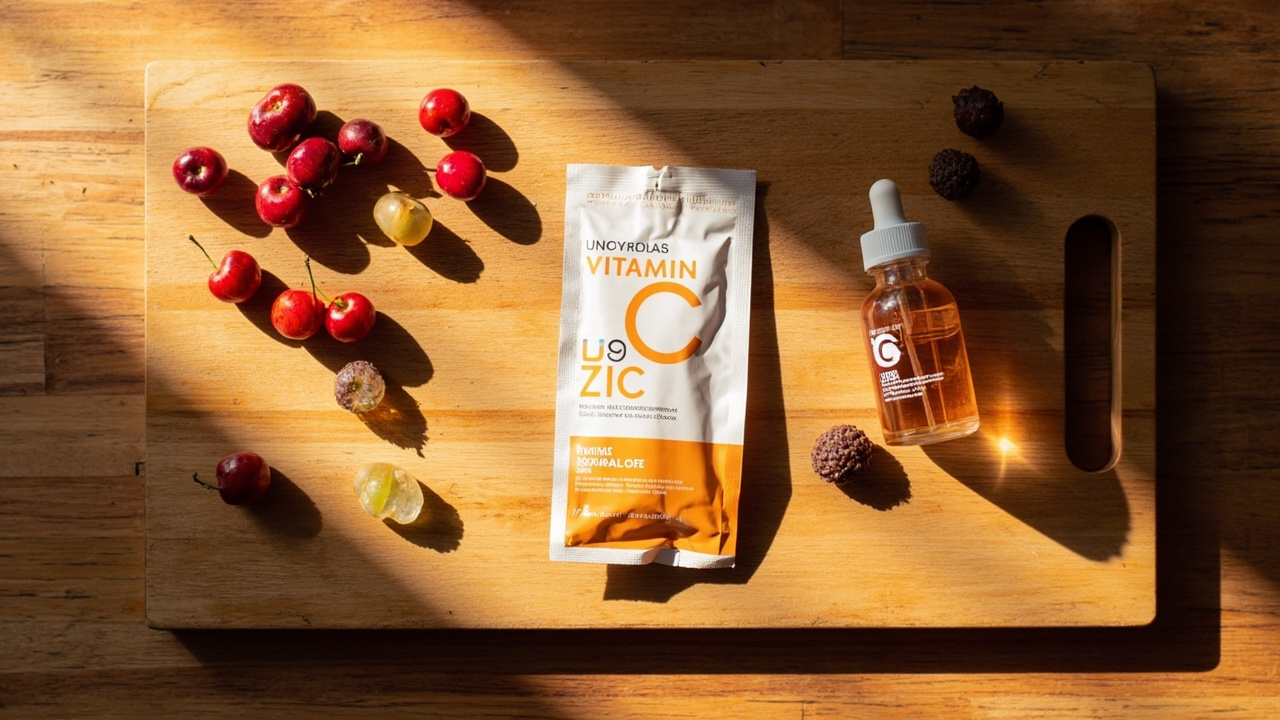
Vitamin C form — natural bioflavonoid complex vs isolated synthetic ascorbic acid. Natural: acerola (Malpighia emarginata, the highest known natural vitamin-C source at ~1,700mg per 100g fresh fruit — roughly 50× the concentration of an orange), camu camu (Myrciaria dubia, ~500-2,000mg vitamin C per 100g with unique pyrone + stilbene cofactor bioflavonoids), amla (Phyllanthus emblica, the Indian gooseberry with ~600-900mg vitamin C per 100g + unique tannin + flavonoid cofactors the body uses for full vitamin-C biological activity). Synthetic: corn-sugar-derived ascorbic acid, isolated molecule, no bioflavonoid cofactors, lower bioavailability in the natural-vitamin-C-replete consumer.
Vitamin D form — D3 (cholecalciferol) vs D2 (ergocalciferol). D3 raises serum 25(OH)D ~2-3× more effectively than D2 per published head-to-head studies. D3 is animal-sourced (lanolin from sheep’s wool, or lichen-sourced for vegans); D2 is plant-sourced (UV-irradiated mushroom ergosterol). The label should disclose the form. A product that says “Vitamin D” without specifying D3 vs D2 is probably using the cheaper D2.
Zinc form — organically zinc-bound probiotic vs inorganic zinc salt. Organically bound: the zinc is covalently bonded to the probiotic cell wall (e.g., Bifidobacterium longum CCFM1195, with >96% of the zinc organically bound to the probiotic). The binding protects zinc from dietary inhibitors (phytates in grains, oxalates in greens), delivers it across the gut wall with the probiotic, and adds the gut-microbiome substrate layer as a bonus. Inorganic: zinc gluconate, zinc sulphate, zinc oxide — cheaper, lower bioavailability (~30-50%), no probiotic benefit, GI side-effects at higher doses.
Probiotic strain specificity — named strain with published clinical work vs generic blend. Named strain: Bifidobacterium longum CCFM1195 (with >96% zinc binding + published clinical work on respiratory-tract-infection incidence + gut-barrier integrity + immune-modulation). Generic blend: “Lactobacillus + Bifidobacterium blend 10 billion CFU” with no strain disclosed, no clinical evidence, no viability-at-point-of-consumption data, no zinc-binding specification.
What a Real Daily Substrate Stack Actually Delivers
Putting the four mechanisms together with the delivery-form rules, a real daily substrate stack delivers:
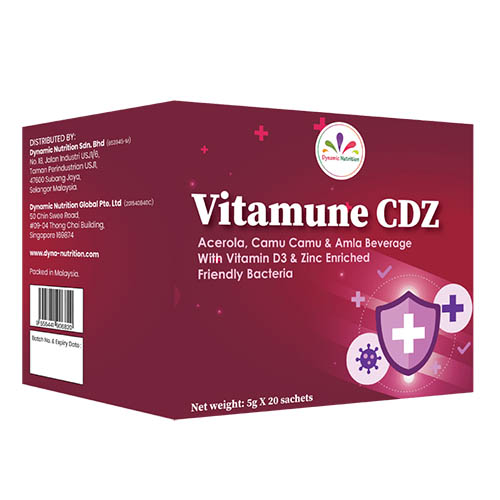
Natural Vitamin C from Acerola + Camu Camu + Amla — the complete bioflavonoid complex (ascorbic acid + bioflavonoids + rutin + Factor J/K/P + Tyrosinase + Ascorbinogen), qualitatively different from isolated synthetic ascorbic acid because the bioflavonoid cofactors are required for full vitamin-C biological activity. The substrate layer for epithelial-barrier integrity + neutrophil function + lymphocyte proliferation. >1,500-3,000mg equivalent ascorbic acid delivered across the three fruit sources, with the bioflavonoid cofactor retention the synthetic tablet misses.
Vitamin D3 (cholecalciferol) — the cellular-immune-activation vitamin, modulating T-cell + dendritic-cell + neutrophil function through VDR binding. Therapeutic-dose daily D3 (typically 1000-2000 IU/day for adults; higher for the deficient) raises serum 25(OH)D into the 75-100 nmol/L range where immune-modulating effects are documented. >60% of MY/SG adults are deficient; this layer is the one most worth correcting.
Zinc-enriched Bifidobacterium longum CCFM1195 — >96% of the zinc organically bound to the probiotic, high bioavailability vs inorganic zinc salts. The synergistic zinc + probiotic stack: supports immune-defence activation (the thymulin + NK-cell mechanism) + normal gut microflora (the Bifidobacterium substrate layer) + healthy gastrointestinal function (the gut-barrier-integrity mechanism). The single ingredient that delivers the zinc layer AND the gut-immune-axis layer in one.
Layered protection against viral infection + reduction in severity of symptoms + complications during infection — the four-mechanism substrate stack supports the immune-defence biology across the infection timeline: pre-exposure (epithelial-barrier integrity + gut-microbiome balance reduces pathogen entry), acute exposure (neutrophil + NK-cell function + adaptive-immune proliferation), recovery phase (lymphocyte proliferation + secretory-IgA + gut-barrier repair). A single-mechanism product supports one of these phases; the four-mechanism stack supports all three.
Who Benefits Most from a Combined C + D + Zinc Daily
The four-mechanism substrate stack is most useful for readers who fit one or more of these patterns:
The chronic-stress + sleep-deprived cohort. Chronic stress suppresses T-cell and NK-cell function through cortisol-mediated mechanisms; sleep deprivation (<6 hours/night) reduces secretory-IgA and neutrophil respiratory burst. The D3 + zinc + probiotic substrate layer directly addresses the immune-functional suppression; the natural-vitamin-C layer supports the epithelial-barrier recovery.
The recurrent-cold pattern. Adults experiencing 4+ colds/year or chronic sinus/respiratory symptoms often have low baseline vitamin D + zinc status and a gut-microbiome shift away from Bifidobacterium. The four-mechanism stack is the substrate layer that addresses all three at once; a Vitamin-C-only tablet addresses none of them.
The post-infection recovery cohort. After a viral or bacterial infection, intracellular vitamin C stores are depleted (the oxidative burst consumed them), gut-microbiome balance is disrupted (antibiotic + inflammation-driven), and zinc stores are drained. The four-mechanism stack is the recovery substrate; the natural-vitamin-C + zinc-probiotic pair in particular supports the gut-barrier repair that the post-infection state most needs.
The 50+ cohort with declining immune function (immunosenescence). Thymic involution (the gradual shrinking of the thymus after age 40-50) reduces T-cell output; NK-cell function declines; neutrophil respiratory burst slows. The four-mechanism substrate layer supports the immune function that’s declining, rather than trying to “boost” it above baseline. Vitamin D3 alone, at sufficient dose, has the strongest published evidence in this cohort.
The MY/SG urban professional. Sedentary + high-refined-carbohydrate diet + chronic sleep deficit + chronic stress + antibiotic exposure from frequent infections or dental work = exactly the cohort that needs the Bifidobacterium + zinc + D3 + natural-vitamin-C substrate stack. A synthetic-Vitamin-C-1000mg tablet misses three of the four mechanism layers this cohort needs.
How to Read an Immune Booster Label (5-question framework)
The next time you shop for an “immune booster” — whether in a pharmacy, an MLM catalogue, or a longevity-clinic menu — run the label through this 5-question framework:
Question 1 — is the Vitamin C from a named whole-food source (Acerola + Camu Camu + Amla)? Or is it corn-sugar-derived ascorbic acid? Whole-food sources deliver the bioflavonoid cofactor layer; corn-sugar-derived delivers the isolated molecule only. The label should name the fruit sources.
Question 2 — is Vitamin D3 (cholecalciferol) included at therapeutic dose? Or is it Vitamin D2 (ergocalciferol)? D3 raises serum 25(OH)D 2-3× more effectively than D2. The label should specify “D3” or “cholecalciferol”, not just “Vitamin D”.
Question 3 — is the zinc organically bound to a probiotic (Bifidobacterium longum CCFM1195 with >96% binding)? Or is it an inorganic zinc salt (gluconate, sulphate, oxide)? Organically bound delivers the synergistic gut-immune axis + higher bioavailability; inorganic salt delivers zinc only, lower bioavailability, possible GI side-effects at higher doses.
Question 4 — is the probiotic strain named (Bifidobacterium longum CCFM1195 with published clinical work)? Or is it a generic blend? Named strain = documented mechanism + clinical evidence + viability data. Generic blend = no documented mechanism, no clinical evidence, no viability guarantee.
Question 5 — is it approved by a recognised regulatory body (Ministry of Health Malaysia, TGA, FDA, HSA)? MOH Malaysia approval, TGA listing, or FDA GRAS status is the quality + safety + contamination-tested layer that unregulated “immune booster” products don’t have.
If the label answers “no” or “vague” to 3+ of these questions, the product is missing 3+ of the 4 immune-defence mechanism layers — regardless of the dose on the front of the bottle.
What a Daily Substrate Stack Looks Like in Practice
For the chronic-stress + recurrent-cold + MY/SG urban-professional cohort, the daily protocol that addresses all four mechanisms at once looks like this:
Daily substrate stack. Natural Vitamin C from Acerola + Camu Camu + Amla (the complete bioflavonoid complex) + Vitamin D3 (cholecalciferol, 1000-2000 IU/day, dose-adjusted to serum 25(OH)D status) + Zinc-enriched Bifidobacterium longum CCFM1195 (>96% zinc organically bound to the probiotic; the synergistic gut-immune axis layer). One daily dose. No synthetic ascorbic acid, no inorganic zinc salt, no generic probiotic blend.
What to skip. Synthetic-Vitamin-C-1000mg tablets (deliver the isolated molecule + miss the bioflavonoid cofactors + miss the other three mechanisms). Zinc-only lozenges (deliver zinc only + miss the bioflavonoid + D3 + gut-immune axis). Generic probiotic capsules (deliver the probiotic only + miss the bioflavonoid + D3 + zinc substrate). Vitamin-D-only supplements (deliver D3 only + miss the bioflavonoid + zinc + gut-immune axis).
What the daily protocol does NOT do. It doesn’t “boost immunity above baseline” (no substrate does — immunity is regulated, not boosted). It doesn’t “prevent all infections” (exposure + pathogen virulence + baseline status all matter). It doesn’t replace a vegetable-rich diet, regular sleep, stress management, or vaccination. What it does do: support the four immune-defence mechanisms at their baseline functional capacity, so the immune system can do what it does — handle the daily viral + bacterial load the modern urban environment delivers.
The Bottom Line
A Vitamin-C-1000mg tablet delivers one isolated molecule out of one of the four immune-defence mechanisms your immune system runs on. The other three mechanisms — Vitamin D3, zinc, and the gut-immune axis — are untouched by the tablet. The bioflavonoid cofactor layer that makes natural vitamin C qualitatively different from synthetic ascorbic acid is missing from the tablet.
The daily-from-inside substrate stack that addresses all four mechanisms at once looks like: natural Vitamin C from Acerola + Camu Camu + Amla (the complete bioflavonoid complex) + Vitamin D3 (cholecalciferol) at therapeutic dose + Zinc-enriched Bifidobacterium longum CCFM1195 (the synergistic zinc + probiotic layer). One product, four mechanisms, MOH Malaysia approved. The form-vs-dose test, the label-reading framework, and the who-benefits-most criteria all point to the same conclusion: the substrate stack beats the single-nutrient tablet, because the biology is multi-mechanism and the form matters more than the dose.
Related Topics
Vitamin C, D and Zinc: Why the Combination Matters (and Why Taking Them Separately Falls Short)
Vitamin C, D & Zinc: Science-Backed Synergy for Complete Immune Support
Is Vitamin C made of corn syrup natural?
An Incredible Source of Vitamin C – Acerola
Singapore’s Biological-Age Test: Why Vitamin D, C, and Zinc Keep Showing Up
Black Elderberry Juice: Clinically Proven for Colds & Flu
People who are Susceptible to Influenza and How to Strengthen Their Immunity
Product you may be interested in