Type “blood pressure” into a search bar and beetroot turns up on the first screen. It is the most-recommended natural remedy for hypertension in supplement aisles, juice bars and wellness feeds — and, unusually for that category, the claim is not folklore. It rests on a real, well-characterised physiological mechanism and on more than two dozen randomised trials. The problem is that those trials tested one specific thing: a specific dose of inorganic dietary nitrate, delivered as beetroot juice. Much of what is sold as “beetroot for blood pressure” contains a fraction of that dose — or none of the compound that does the work.
This article separates the three questions that usually get blended into one: what the trial evidence actually shows, how much nitrate produced it, and which beetroot products deliver that dose. The short version: the mechanism is real, the average effect is modest but clinically meaningful, and the form you buy matters more than the brand on the front of the jar.
What the blood-pressure evidence actually supports
The strongest summary of the early evidence is a 2013 systematic review and meta-analysis of 16 randomised crossover trials (254 participants) by Siervo and colleagues, which found that inorganic nitrate and beetroot juice supplementation lowered systolic blood pressure by 4.4 mmHg (95% CI −5.9 to −2.8) and diastolic blood pressure by 1.1 mmHg (95% CI −2.2 to 0.1, not statistically significant).3 A meta-regression found a dose-response relationship: more daily nitrate, larger systolic effect. A later meta-analysis of 22 trials (Bahadoran and colleagues, 2017) found a smaller pooled systolic reduction of 3.55 mmHg (95% CI −4.55 to −2.54) and a diastolic reduction of 1.32 mmHg (95% CI −1.97 to −0.68), with larger effects at higher daily juice doses (500 mL/day) and longer durations (≥14 days).4 The most recent meta-analysis restricted to people who already have hypertension (7 trials, 218 participants, Benjamim and colleagues, 2022) found a systolic reduction of 4.95 mmHg (95% CI −8.88 to −1.01) and no significant diastolic effect.6
The single most useful trial for a reader with high blood pressure is Kapil and colleagues’ 2015 double-blind, placebo-controlled study in 68 patients with hypertension. Half received 250 mL of nitrate-rich beetroot juice daily for four weeks, half a nitrate-depleted placebo juice. Clinic blood pressure fell by 7.7/2.4 mmHg, 24-hour ambulatory blood pressure by 7.7/5.2 mmHg, and home blood pressure by 8.1/3.8 mmHg, with no loss of effect across the four weeks. Endothelial function improved by roughly 20% and arterial stiffness fell measurably.5 The same group had already shown, in healthy volunteers, that a 500 mL beetroot juice load lowered blood pressure by up to 10.4/8 mmHg about three hours after ingestion, and that the effect tracked the rise in plasma nitrite.1
Read honestly, the evidence says three things. First, the effect is real and reproducible — it is not a marketing invention. Second, it is modest: a 4–8 mmHg systolic reduction, not a cure. A reduction of that size is still clinically meaningful at population scale, and it is the same order of magnitude as some first-line lifestyle interventions — but it is not a replacement for medication. Third, the diastolic effect is small and often not statistically significant, so anyone promising a large “both numbers” drop is overselling what the trials found.
The dose is the whole story: 250–500 mL of juice, not a capsule
Every positive trial delivered nitrate in a narrow band. The 2013 meta-analysis covered intakes equivalent to roughly 250–500 mL of beetroot juice a day; the Kapil trial used a fixed 250 mL daily; the 2017 meta-analysis found the largest systolic effects at 500 mL/day; and the 2022 hypertension review covered studies using 70–250 mL/day, with the pooled systolic effect surviving at −4.95 mmHg.3456 That is the dose range to reason from. It corresponds to roughly 250–400 mg of inorganic nitrate per day from a nitrate-rich beetroot preparation.
Two practical consequences follow. The first is timing: plasma nitrite peaks one to three hours after ingestion, and the acute blood-pressure effect is measurable within that window, which is why the studies dose daily rather than occasionally.1 The second is the volume problem. A 250 mL glass of juice needs roughly 500–600 g of fresh beet, so the trial dose is not a garnish — it is a daily commitment. It also explains why so many people go looking for a concentrated or shelf-stable form, and why so many of them end up with a product that does not contain the dose at all.
Why the form decides whether you get the dose
Beetroot is sold in four broad forms, and they are not interchangeable per gram.
Fresh-pressed juice is the form used in most of the trials, which makes it the reference standard. Its nitrate content is meaningful but variable, and it degrades as the juice sits, because bacteria and oxygen continue to work on it. It is also perishable and bulky — the 250–500 mL daily dose is a real kitchen commitment.
Whole-root beetroot powder is made by drying and milling the root. It retains fibre and some nitrate, but at a lower concentration per gram than a juice powder, because the non-nitrate plant mass comes along for the ride.
“Beetroot powder” that is mostly maltodextrin is the trap. Many cheap powders are blended with maltodextrin — a starch-derived filler with no nitrate, no betalains and no beet-specific compounds — often as a large share of the finished weight. The front of the pack says beetroot; the ingredient list says otherwise. These products are not fraudulent, but a spoonful is not the trial dose.
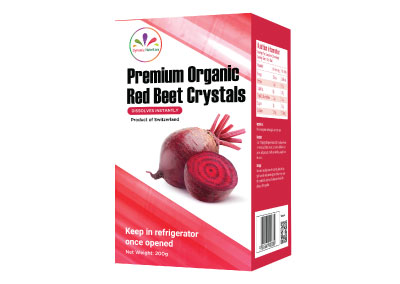
Freeze-dried beetroot juice crystals are what you get when pressed juice is frozen and the water is sublimated off under vacuum, leaving the nitrate, betalains, betaine and anthocyanins behind in roughly their original proportions, with no maltodextrin and no anti-caking agents. The concentration is the point: a 200 g jar can represent the dry weight of several kilograms of fresh beet, so a tablespoon-sized serving can sit inside the trial dose range rather than a fraction of it.
Five label checks separate a product that can plausibly deliver the trial dose from one that cannot be compared to it at all. One: the ingredient list should read beetroot — juice or root — and nothing else; if maltodextrin, dextrose, “natural flavour” or silicon dioxide is in the first few ingredients, the beet is not the main event. Two: the form should be declared (“freeze-dried juice crystals”, “spray-dried juice powder”, “whole-root powder”), because the three have different nitrate densities. Three: a serious product states a nitrate figure (mg per gram or per serving) or a betalain percentage; if neither is stated, no one has measured it. Four: watch for added sugars, fillers and flow agents. Five: the serving size should look like a dose, not like something that fits in a capsule machine.
The biology in one paragraph: nitrate → nitrite → nitric oxide
Inorganic nitrate from beetroot is absorbed in the upper gut, then concentrated in saliva and partly reduced to nitrite by bacteria that live on the surface of the tongue. Swallowed nitrite is converted to nitric oxide in the acidic, low-oxygen conditions of working tissue. Nitric oxide relaxes vascular smooth muscle, and that is the vasodilation behind the blood-pressure effect; it also improves the efficiency of oxygen use in muscle and reduces platelet aggregation.12
Two details from that pathway are worth knowing because they explain otherwise confusing results. First, it is dependent on oral bacteria: in the 2008 study, volunteers who used an antibacterial mouthwash around the dose did not convert nitrate to nitrite, and their blood pressure did not fall.1 Second, the mechanism explains why the effect is dose-dependent and zero at zero: a nitrate-depleted placebo juice produced no blood-pressure change in the Kapil trial, and trials that used nitrate-depleted beetroot juice as the placebo show smaller effects than trials using other comparators.45 No nitrate, no effect — which is precisely why the dose question, not the brand question, is the one that matters.
What is marketing and what is evidence
“A beetroot capsule gives you the same as juice.” Not supported. The trial doses are hundreds of millilitres of juice or the equivalent nitrate load; a small capsule of dried powder rarely reaches that, and rarely states its nitrate content.
“Beetroot lowers everyone’s blood pressure.” Overstated. The clearest effects are in people with hypertension; in normotensive volunteers the acute effect is real but the pooled evidence is dominated by short crossover studies.35
“You can stop your medication.” No. This is the most important line in the article. The Kapil trial treated nitrate as an adjunct, in both drug-naive and already-treated patients, and still framed the finding as a low-cost supportive measure — not a substitute for prescribed antihypertensives.5
“Nitrate is nitrate — vegetables are as risky as processed meat.” Not equivalent. The cancer concern attaches mainly to nitrite added to processed meats and to nitrosamine formation, not to the nitrate naturally present in vegetables, which is the substrate for the nitric-oxide pathway described above.1
“Any beetroot product works.” Only if it delivers nitrate. Filler-heavy powders and unstandardised extracts cannot be compared with the trials, because nobody — including the manufacturer — knows the dose.
The safety boundary
Beetroot is a food, and the trial doses were well tolerated.5 Four caveats belong next to any recommendation, though.
It adds to blood-pressure medication. If you take antihypertensives, a meaningful nitrate dose can lower your blood pressure further on top of them. That is usually the point — but it needs monitoring, not guesswork. Tell your doctor what you are taking and keep a home log.
Red urine and red stools are expected, not alarming. Beeturia is the harmless excretion of betalain pigments, and it is more common in people with iron-deficiency anaemia — which is one reason beetroot products are so often marketed alongside iron.
Beetroot is relatively high in oxalate. If you have a history of calcium-oxalate kidney stones or reduced kidney function, discuss a large daily beetroot habit with your clinician before starting it.
This is not a treatment for a diagnosis. High blood pressure is usually silent, and the complications — stroke, heart attack, kidney damage — accrue over years. A beetroot habit sits alongside monitoring and medical care; it does not replace either.
What to do with this
If the evidence has convinced you to try beetroot, copy the trial design rather than the marketing. Aim for a daily nitrate dose in the range the studies used, take it daily rather than occasionally for at least three to four weeks before judging it, choose a form whose nitrate content is at least plausible, and track your own numbers at home so you can see whether it is doing anything for you.
That is also the case for Premium Organic Red Beet, a freeze-dried Swiss-organic beetroot juice crystal with a single-ingredient list — beetroot — and no maltodextrin or fillers. A 200 g jar represents the dry weight of roughly 2.5 kg of fresh-pressed organic beet, so a heaping tablespoon (about 10 g) stirred into water, juice or a smoothie before meals lands in the sort of range the trials used, in a form you will actually take daily. It is vegan, has no artificial flavouring, colouring or sweetener, and keeps in the fridge after opening.
None of that changes the arithmetic in this article: the effect is real, it is modest, it is dose-dependent, and it is an addition to — not a replacement for — the blood-pressure plan your doctor has given you.
References
- Webb AJ, Patel N, Loukogeorgakis S, et al. Acute blood pressure lowering, vasoprotective, and antiplatelet properties of dietary nitrate via bioconversion to nitrite. Hypertension. 2008;51(3):784–790. PMID 18250365 — https://pubmed.ncbi.nlm.nih.gov/18250365/
- Bailey SJ, Winyard P, Vanhatalo A, et al. Dietary nitrate supplementation reduces the O2 cost of low-intensity exercise and enhances tolerance to high-intensity exercise in humans. Journal of Applied Physiology. 2009;107(4):1144–1155. PMID 19661447 — https://pubmed.ncbi.nlm.nih.gov/19661447/
- Siervo M, Lara J, Ogbonmwan I, Mathers JC. Inorganic nitrate and beetroot juice supplementation reduces blood pressure in adults: a systematic review and meta-analysis. The Journal of Nutrition. 2013;143(6):818–826. PMID 23596162 — https://pubmed.ncbi.nlm.nih.gov/23596162/
- Bahadoran Z, Mirmiran P, Kabir A, Azizi F, Ghasemi A. The nitrate-independent blood pressure-lowering effect of beetroot juice: a systematic review and meta-analysis. Advances in Nutrition. 2017;8(6):830–838. PMID 29141968 — https://pubmed.ncbi.nlm.nih.gov/29141968/
- Kapil V, Khambata RS, Robertson A, Caulfield MJ, Ahluwalia A. Dietary nitrate provides sustained blood pressure lowering in hypertensive patients: a randomized, phase 2, double-blind, placebo-controlled study. Hypertension. 2015;65(2):320–327. PMID 25421976 — https://pubmed.ncbi.nlm.nih.gov/25421976/
- Benjamim CJR, Porto AA, Valenti VE, et al. Nitrate derived from beetroot juice lowers blood pressure in patients with arterial hypertension: a systematic review and meta-analysis. Frontiers in Nutrition. 2022;9:823039. PMID 35369064 — https://pubmed.ncbi.nlm.nih.gov/35369064/
Product you may be interested in