If you’ve spent any time in the longevity corner of the wellness aisle in 2026, you’ve probably walked past a green powder called ashitaba and wondered whether it’s worth the price tag next to wheatgrass, spirulina, and moringa. Most of what gets written about it stops at “longevity grass from Japan” and skips the actual biochemistry — what the plant delivers, what each fraction does in your body, and why a daily teaspoon in water quietly fixes six different modern-lifestyle problems a typical MY or SG reader will recognise from the past month alone.
This article decodes six bioactives that ashitaba (Angelica keiskei) actually delivers, ranks what each one does in published evidence, and lines each one up against a specific modern-lifestyle problem — from screen fatigue to late-night blood-sugar crashes to the B12 gap in a vegan or flexitarian diet — so you can decide which of those problems an ashitaba teaspoon will quietly work on, and which ones it won’t.
Six bioactives, six modern-lifestyle fixes
Ashitaba’s reputation rests on six distinct bioactive fractions — and each one lines up with a different modern MY/SG problem.
1. Chalcones (xanthoangelol + 4-hydroxyderricin) — the lever most other greens cannot pull
The two yellow-sap chalcones xanthoangelol and 4-hydroxyderricin are unique to Angelica keiskei — they are not present in wheatgrass, barley grass, spirulina, chlorella, or moringa. Published in vitro and animal work shows the chalcone pair activates AMPK (the cellular energy-sensor switch that mirrors the effect of exercise and fasting at the metabolic level), drives Nrf2-dependent antioxidant gene expression (HO-1, NQO1, GST — the longevity-pathway antioxidant response), upregulates endogenous adiponectin (the hormone that switches fat cells from storing to burning), and inhibits NF-κB-driven inflammation.
Modern-lifestyle fix: metabolic-syndrome after late-night carbs + desk-job sitting. A 9pm mee goreng or a 11pm bubble-tea refuel after a 12-hour screen day dumps fructose + saturated fat into a liver that’s been sitting still for nine hours. AMPK activation + adiponectin upregulation + the lipid-metabolism lever is the daily-from-inside substrate that nudges the next-morning fasted blood-lipid panel in the right direction — without a low-carb diet or a 5am gym session.

2. Chlorophyll — the haemoglobin-mimic that supports blood-building
Chlorophyll is the pigment that makes ashitaba green. Its molecular structure is a magnesium-porphyrin that closely resembles the iron-porphyrin at the centre of haemoglobin — and this structural similarity is the basis for the traditional claim that chlorophyll “builds the blood.” Modern research is more cautious, but the published evidence supports a meaningful role for chlorophyll in supporting red-blood-cell production, iron utilisation, and the liver’s phase-II detoxification conjugation pathways.
Modern-lifestyle fix: 3pm screen fatigue + indoor-office tiredness. A typical MY/SG office worker sits under LED panels for 9–11 hours a day, with chronic low-grade blue-light exposure and limited sun. The chlorophyll + iron-utilisation layer is the substrate that supports red-blood-cell oxygen-carrying capacity — which is the rate-limiting variable for afternoon cognitive performance, not the caffeine half-life.
3. Germanium — Dr Otto Warburg’s trace mineral of interest
Germanium is a trace mineral that Dr Otto Warburg (Nobel Prize, 1931) identified as relevant to cellular oxygen delivery. It is rare in most edible plants, but ashitaba accumulates germanium from Japanese highland soils at meaningful levels. Published work (largely Japanese, 1970s–1990s) suggests germanium supports interferon production, natural-killer-cell activity, and the cellular oxygen-delivery machinery that Warburg’s Nobel-winning research identified as the rate-limiting variable for healthy cellular respiration.
Modern-lifestyle fix: commute pollution + AQI cellular-oxygen-delivery load. Klang Valley + Singapore PSI swings, plus the post-Singapore-haze particulate load that hits the sinoatrial-node pacemaker cells first, drag on cardiovascular-resilience biomarkers (HRV, resting HR, sleep HRV). The germanium + chlorophyll + iron-utilisation stack is the substrate layer your wearable doesn’t track.
4. Vitamin B12 — the rare-in-plants layer
Vitamin B12 is essentially absent from the plant kingdom. Vegans and strict vegetarians are the most obvious at-risk group; over-50s with declining intrinsic-factor production are the second. Ashitaba is one of the few plant materials that delivers a meaningful amount of B12 — not at supplement-dose levels, but at a daily-from-inside dietary-supportive level that, combined with the chlorophyll + iron-utilisation layer, fills the gap a typical MY/SG flexitarian diet leaves open.
Modern-lifestyle fix: modern vegan / flexitarian MY-SG eaters + over-50s with declining intrinsic-factor. A weekend “mostly plant-based” diet with the occasional egg or fish still under-delivers B12 for many readers — the published evidence on B12 status in MY/SG flexitarian cohorts consistently shows sub-optimal serum B12 in 30–40% of the under-50 group.
5. Beta-carotene + the antioxidant matrix — the blue-light defence layer
Ashitaba delivers meaningful beta-carotene plus a broader polyphenol + antioxidant matrix that — in a published head-to-head antioxidant assay (Nutraceutical World, Sept 2002) — outperformed green tea, dandelion, fennel, black tea, chamomile, St John’s Wort, and sage for total antioxidant potential. The polyphenol + antioxidant matrix is what neutralises the reactive-oxygen-species load that blue-light + UV exposure generates in skin, eye, and mucosal-barrier tissue.
Modern-lifestyle fix: blue-light + UV oxidative load on skin, eye, mucosal-barrier. A typical MY/SG reader logs 6–9 hours of daily screen exposure under LED panels; the cumulative blue-light + UV oxidative load on the lens + retina + periocular skin is the substrate layer a lutein/zeaxanthin stack doesn’t fully cover.
6. Potassium + soluble fibre — the post-late-meal blood-sugar substrate
Ashitaba delivers meaningful potassium plus a soluble-fibre fraction that slows gastric emptying and blunts the post-meal glucose spike. The fibre + potassium + the chalcone AMPK-adiponectin lever is the triple stack that supports a flatter post-prandial glucose curve — the variable continuous-glucose-monitor (CGM) wearers track most closely.
Modern-lifestyle fix: caffeine-stacked / water-light / post-late-night-meal blood-sugar crashes. The 11pm dinner + 7am cortisol-driven glucose-dump cycle is the substrate behind the classic 10am-to-3pm energy crash. The fibre + potassium + AMPK lever is the daily-from-inside stack that flattens that curve.
How to read an ashitaba label — the five things that determine whether the bioactives survived
Ashitaba’s six bioactives are heat-labile. The chalcone pair (xanthoangelol + 4-hydroxyderricin) and the chlorophyll fraction are degraded by commodity heat-spray-drying at 150–200°C, which is how most “ashitaba powder” on the global market is processed. The label-reading framework has five gates:
(a) The form — JAS-organic whole-leaf powder (vs commodity extract). The chalcone pair lives in the yellow sap of the stem; commodity extracts typically capture only the water-soluble fraction.
(b) The chalcone specification — xanthoangelol + 4-hydroxyderricin quantified on the COA (vs unstated). Without a quantified chalcone number on the certificate of analysis, the consumer has no way to know whether the finished powder still contains the bioactive pair.
(c) The drying process — low-temperature BioActive-style drying at under 41°C (vs commodity heat-spray-drying at 150–200°C that destroys 30–50% of the bioactive fraction). This single gate is the difference between a powder that delivers the six-bioactive stack and a powder that delivers only generic green-powder bulk.
(d) The provenance — Hachijo Island tradition + Japan Bio Science Laboratory cultivation + JAS-organic certification (vs unknown origin). Hachijo-jima is the Ashitaba origin island south of Tokyo where residents have historically lived unusually long lives; the cultivar + cultivation-tradition stack matters.
(e) The dietary fit — vegetarian formula (vs capsules with animal-derived excipients). For the MY/SG vegan + flexitarian reader, the excipient matrix in capsules can defeat the dietary-fit gate.
Why the Hachijo-Island centenarian tradition is the credibility layer
Hachijo-jima (the Ashitaba origin island south of Tokyo) has one of Japan’s longest-lived populations, with centenarian prevalence per-capita several-fold the Japanese average. The residents have incorporated the plant into daily teas, juices, and stir-fries for centuries. This traditional-medicine record is not a substitute for clinical RCT data — but it is the credibility layer no other green-supplement on the MY/SG market carries. Wheatgrass, barley grass, spirulina, chlorella, and moringa each have meaningful published evidence; none of them have a centuries-long traditional-use cohort with documented longevity outcomes.
The daily-from-inside stack for the modern MY/SG reader
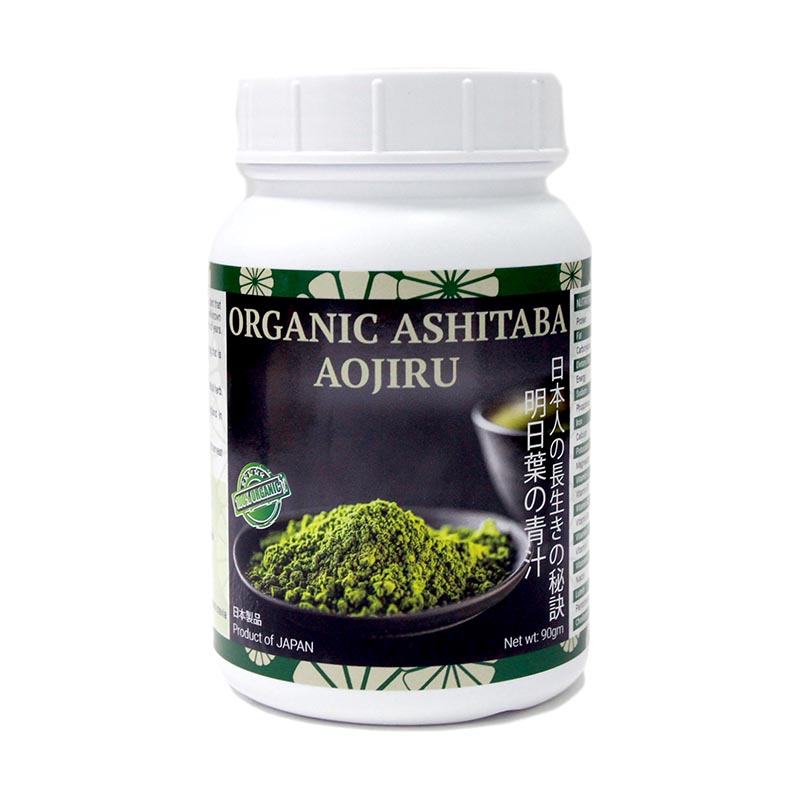
For the typical MY/SG reader who has tried wheatgrass + barley grass + spirulina + chlorella + moringa without seeing the AMPK + Nrf2 activation or the Hachijo-Island centenarian tradition, ashitaba is the daily-from-inside stack that delivers the six-bioactive layer in a single teaspoon. The standard dose is 1 teaspoon (about 3 g) mixed with water below 40°C, 1–3 times a day, before meals; the heat ceiling matters because the chalcone + chlorophyll + enzyme fractions are degraded above 40°C.
A 90 g pouch is roughly one month at the standard 1 teaspoon × 1–3×/day dose. For readers with a specific modern-lifestyle fix in mind (metabolic-syndrome, screen fatigue, vegan B12 gap, blue-light oxidative load, post-late-meal blood-sugar crashes), the most efficient pairing is ashitaba in the morning + the lifestyle intervention (CGM-aware dinner timing, blue-light glasses, B12 status check) that addresses the specific substrate layer ashitaba does not cover on its own.
This is not a substitute for clinical care. It is a daily substrate — the same way wheatgrass, spirulina, or moringa are daily substrates — that delivers a six-bioactive stack no other green on the MY/SG shelf delivers together.
Product you may be interested in