There’s a quiet parallel story running alongside the prenatal-exercise coverage in The Star1: the urinary tract problem that 10-20% of pregnant women in Malaysia and Singapore develop before they ever hold their baby. The exercise-and-neurodevelopment headline is real (a fresh observational cohort has linked moderate prenatal activity to measurable neurodevelopmental gains at 12-24 months2), but it sits on top of a much less-discussed layer: UTIs are the most common bacterial infection in pregnancy3, recurrence after a standard antibiotic course runs 20-30%, and the antibiotic-exposure-in-pregnancy question is now under genuine scrutiny because cohort data is starting to link second- and third-trimester antibiotic use to higher offspring wheeze, gut-microbiome disruption, and rising antimicrobial-resistance concerns4. This piece decodes the three layers a MY/SG mom-to-be reader needs to know: (1) what makes UTIs 10-20% more common in pregnancy, (2) the non-antibiotic prevention stack with the strongest published base, and (3) the integrated protocol that pairs a prenatal-exercise programme with the daily cranberry PAC + Lactobacillus layer for urinary tract comfort.

Why pregnancy makes UTIs more common (and why “drink more water” isn’t enough)
Three pregnancy-driven physiological shifts stack the deck against the urinary tract:
1. Progesterone-driven urinary-tract dilation. Rising progesterone relaxes smooth muscle throughout the urinary collecting system, dilating the ureters and renal pelvis. Urine flow slows, pooling in the upper tract gives uropathogenic E. coli more time to ascend, and a meaningful share of pregnant women develop asymptomatic bacteriuria that progresses to pyelonephritis if untreated. This is why urine culture at the first prenatal visit is standard — and why a recurrence-prevention stack matters once you’ve had even one UTI in pregnancy.
2. Bladder compression by the gravid uterus. From the second trimester onward the enlarging uterus physically compresses the bladder, reducing functional capacity and increasing post-void residual urine. Residual urine is the substrate uropathogens grow on — every millilitre left behind is a small incubator.
3. Glycosuria of pregnancy. Pregnancy increases glomerular filtration of glucose, and the resulting glycosuria gives E. coli a direct carbon source in the urine. This is one of the under-appreciated reasons the standard “drink water and wipe front-to-back” advice, while not wrong, leaves a lot of recurrence risk on the table in pregnant women.
Add to this the standard adult-woman baseline — roughly 50-60% of adult women will have at least one UTI in their lifetime, and 20-30% recur within six months — and the pregnancy window becomes a high-leverage prevention moment, not a “wait and see” one.
The exercise + UTI-prevention connection: what the new evidence actually says
The Star’s 14 Sept 2026 piece on prenatal exercise and offspring neurodevelopment pulled together a quietly consistent body of cohort and intervention work: 30-45 minutes of moderate activity (brisk walking, swimming, prenatal yoga, stationary cycling), three times per week, is associated with better neurodevelopmental scores at 12-24 months2. Plausible mechanisms include placental growth-factor upregulation, reduced maternal cortisol exposure, and improved foetal cerebral blood flow.
The less-discussed half of the story: regular moderate exercise also reduces UTI recurrence risk in non-pregnant cohorts (mechanism: improved pelvic-floor circulation, reduced constipation, better glycaemic control), and the immune-modulation and glycaemic-control layers transfer cleanly into the pregnancy window. Exercise is not a substitute for the urinary-tract-specific prevention stack below, but it lowers the baseline recurrence risk enough that the stack lands harder.
Where the standard advice falls short: most pregnancy-UTI content focuses on antibiotic treatment of an active infection, not on the non-antibiotic prevention layer that matters for the 20-30% who will recur after their first course. Antibiotic stewardship is now an active concern in MY/SG maternity care (see the cohort data on offspring wheeze and gut-microbiome disruption4) — which is why the cranberry PAC + Lactobacillus prevention layer has moved from “alternative” to “first-line non-antibiotic option” in most modern clinical guidelines for adult women with recurrent UTI.
The non-antibiotic prevention layer: what the clinical evidence actually supports
Three evidence-graded mechanisms stack up to give the most-published non-antibiotic UTI-prevention strategy for the pregnancy window:
1. Cranberry PACs at the 36-72 mg/day dose range — the anti-adhesion mechanism
Cranberry’s A-type proanthocyanidins (PACs) block E. coli P-fimbriae and type-1 fimbriae from gripping the uroepithelial wall — the bacteria literally cannot attach, are flushed out during normal voiding, and never get to colonise. The clinical evidence base: a Cochrane-review-anchored 20-40% reduction in UTI recurrence in adult women across the published RCTs5, with the strongest effect at the 36-72 mg A-type PAC/day dose range. Below 36 mg/day the effect drops off; above 72 mg there’s no additional benefit (only cost).
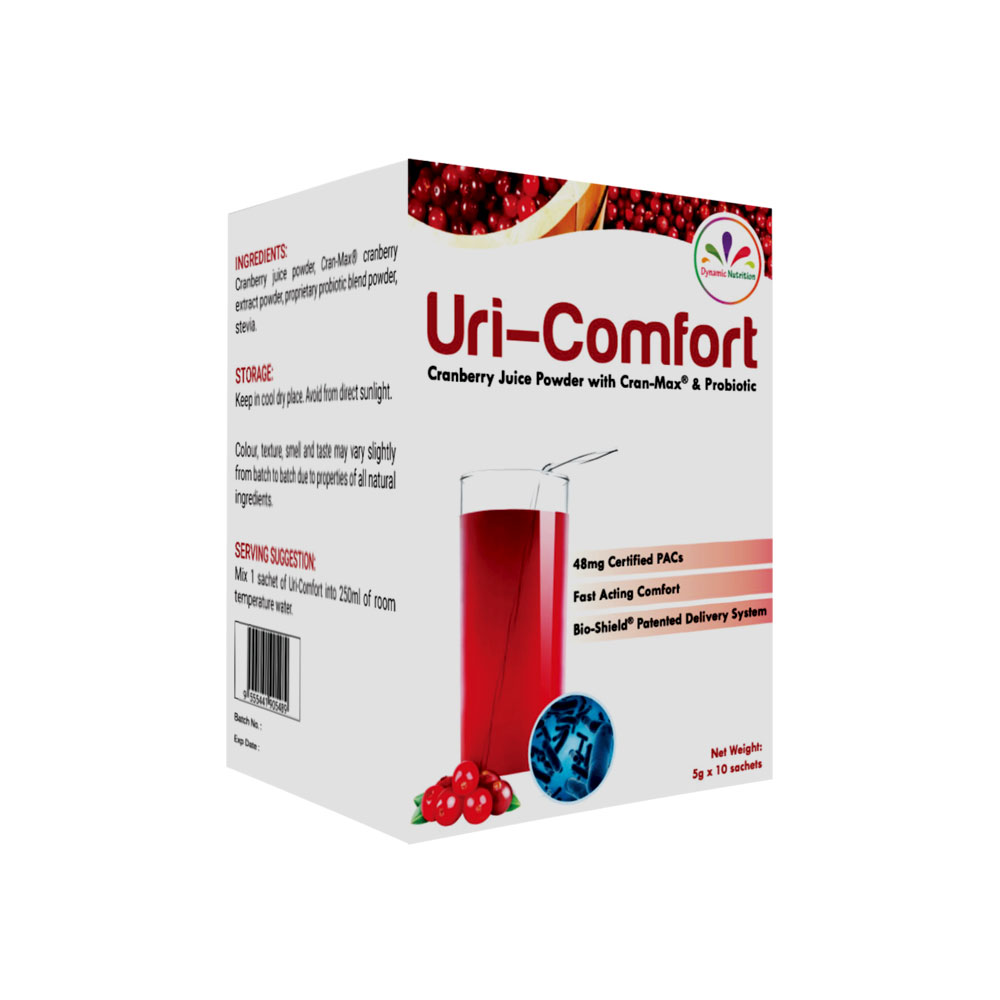
What matters for the MY/SG reader: the dose, the PAC measurement, and the formulation matter more than the “cranberry” label. Cranberry juice cocktail (the supermarket kind, mostly grape/apple juice + sugar) delivers 1-5 mg PAC per 250 mL glass plus a sugar load that may actually feed uropathogenic bacteria. Standardised whole-berry concentrates like Cran-Max® (with the Bio-Shield® delivery system that protects PACs through gastric acid and delivers them to the lower GI tract) hit the dose range used in the published RCTs.
2. 6-strain Lactobacillus probiotics — the vaginal-repopulation mechanism
The same E. coli strains that cause UTIs originate in the gut, transit the perineum, and colonise the vaginal and urethral epithelium when the Lactobacillus-dominant flora is depleted — by antibiotics, hormonal shifts, or pregnancy itself. Repopulating with the right Lactobacillus strains (L. rhamnosus GR-1 + L. reuteri RC-14 are the most-studied, with published RCT data showing vaginal-Lactobacillus colonisation recovery from 53% to 96% after antibiotic courses6) gives the gut-to-vaginal competitive exclusion of uropathogenic E. coli.
Multi-strain products (L. rhamnosus, L. reuteri, L. acidophilus, L. plantarum + 2 more) cover more of the vaginal microbiome than a single strain — and the multi-strain evidence base in the genitourinary-syndrome context is broader than any single-strain product.
3. Hydration, voiding hygiene, and the lifestyle layer
2-2.5 L of water daily, post-coital voiding, front-to-back wiping, and avoiding spermicides / long-interval voiding all contribute meaningfully but are individually small levers. Stacked together with the PAC + Lactobacillus layer above, they complete the protocol.
The integrated protocol — exercise + cranberry PACs + probiotics
For the MY/SG mom-to-be or the actively-recurrent UTI reader, the daily routine that maps to the evidence above is straightforward:
Morning: 30-45 minutes of moderate activity — brisk walking in a tropical park at dawn, prenatal yoga, swimming, or stationary cycling. Three times per week is the dose range used in the prenatal-neurodevelopment cohorts; daily is fine if tolerated.
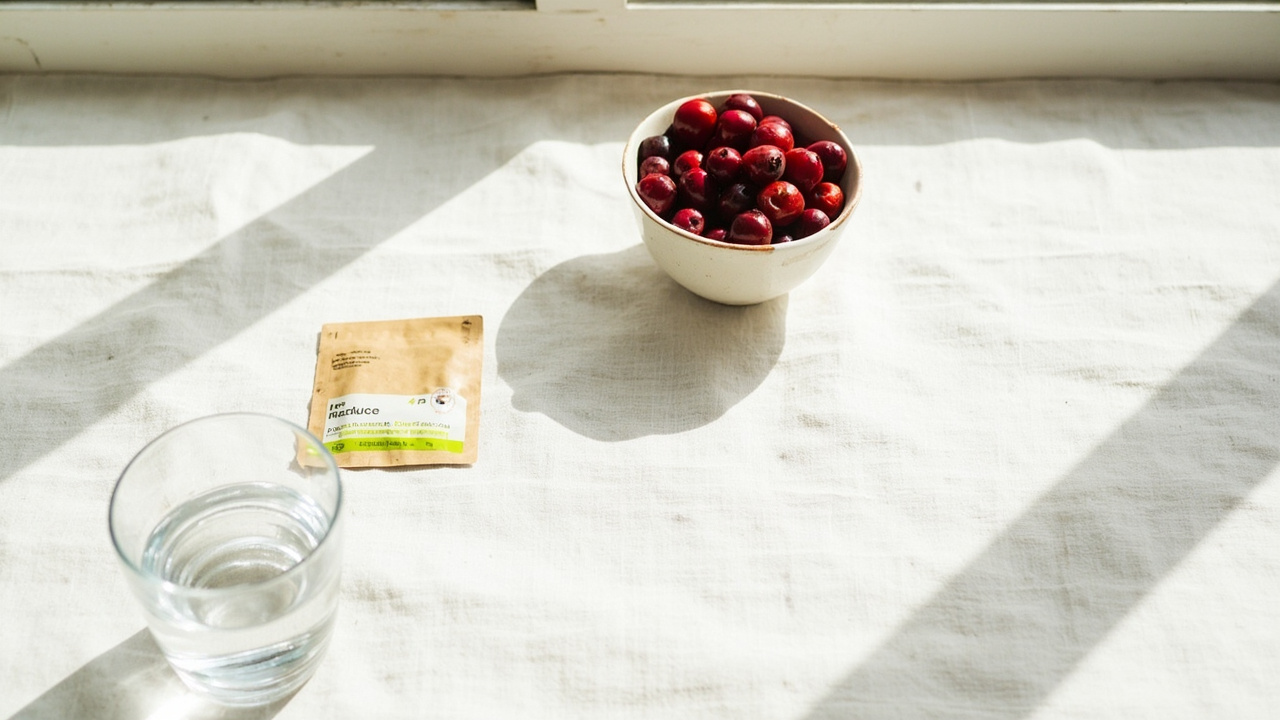
Daily, with food: 48 mg A-type PACs from a Cran-Max®-standardised whole-berry concentrate (the dose range used in the published UTI-recurrence RCTs), paired with a 6-strain Lactobacillus probiotic (L. rhamnosus GR-1, L. reuteri RC-14, L. acidophilus, L. plantarum + 2 more). The combination delivers the anti-adhesion mechanism (PACs) and the vaginal-repopulation mechanism (Lactobacillus) in one daily sachet — the only oral intervention with RCT data on vaginal-Lactobacillus recovery post-antibiotics.
Hydration: 2-2.5 L of water daily across the waking hours, with one glass within an hour of any exercise session.
Trigger monitoring: the 8-12 week horizon matters — most cranberry PAC + Lactobacillus clinical work measures UTI-recurrence reduction over an 8-12 week daily intake window, not a 7-day burst. The meaningful test of the protocol is a 3-month commitment.
When to escalate to a clinician (not a supplement)
This protocol is for prevention in the non-acute window, not for treating an active UTI. Symptoms that warrant a same-day clinician call: burning with urination, urinary frequency or urgency, suprapubic discomfort, visible blood in the urine, fever, flank pain, or any UTI symptom in pregnancy (where untreated ascending infection can progress to pyelonephritis within 24-48 hours). The cranberry + Lactobacillus stack is a daily prevention layer, not a substitute for a clinical workup when symptoms appear.
References
- The Star — “Exercising during pregnancy can help improve the child’s neurodevelopment” — https://www.thestar.com.my/lifestyle/family/2026/09/14/exercising-during-pregnancy-can-help-improve-the-child039s-neurodevelopment
- Clapp JF et al. — “Neonatal behavioral profile of the offspring of women who continued to exercise regularly throughout pregnancy” — https://pubmed.ncbi.nlm.nih.gov/10076116/
- Schnarr J, Smaill F — “Asymptomatic bacteriuria and symptomatic urinary tract infections in pregnancy” — European Journal of Clinical Investigation — https://onlinelibrary.wiley.com/doi/10.1111/j.1365-2362.2008.02036.x
- Örtqvist Å et al. — “Antibiotics in fetal and early life and subsequent childhood asthma” — BMJ — https://www.bmj.com/content/349/bmj.g6979
- Jepson RG, Williams G, Craig JC — “Cranberries for preventing urinary tract infections” — Cochrane Database of Systematic Reviews — https://www.cochranelibrary.com/cdsr/doi/10.1002/14651858.CD001321.pub5/full
- Anukam KC et al. — “Clinical study comparing probiotic Lactobacillus GR-1 and RC-14 with metronidazole vaginal gel to treat symptomatic bacterial vaginosis” — Microbes and Infection — https://pubmed.ncbi.nlm.nih.gov/16962761/
Related Topics
Cranberry juice vs cranberry sachets: what the ‘PAC’ number on the label actually changes
Why Women Get UTIs 4x More Often — Prevention Tips
Cran-Max – Effective Prevention of UTI
Top 7 Natural Remedies For UTI
Urinary Tract Infections – Symptoms & Natural Treatment
Antibiotics vs Natural UTI Prevention: What’s the Difference
Why Drinking Cranberry Juice Alone Is Not Enough for UTI Prevention
Which probiotics can help with vaginal yeast infection?
Bacterial Vaginosis – Tips for Prevention and Treatment
Why UTIs Are More Common During Ramadan and How to Find Relief
Product you may be interested in