If you read one Singapore headline in early January, it was probably this one: The Straits Times asked ‘Do you need that multivitamin supplement? Know the ABCs of vitamins’ and reported what local doctors told the paper — that vitamin A deficiency is rare in Singapore, that high-dose supplements taken without medical supervision can build up to toxic levels over time, and that a varied diet is the first-line answer to most vitamin questions rather than a pill1. That question lands squarely on the other bottle in the cupboard. A green powder — a wheatgrass, barley grass and ashitaba blend — and a multivitamin are sold as different products and routinely bought to do the same job. They are not the same job. Here is how to read the two labels side by side, what each one can and cannot tell you, and where the line between a food and a supplement actually sits.
Why the two labels look so different
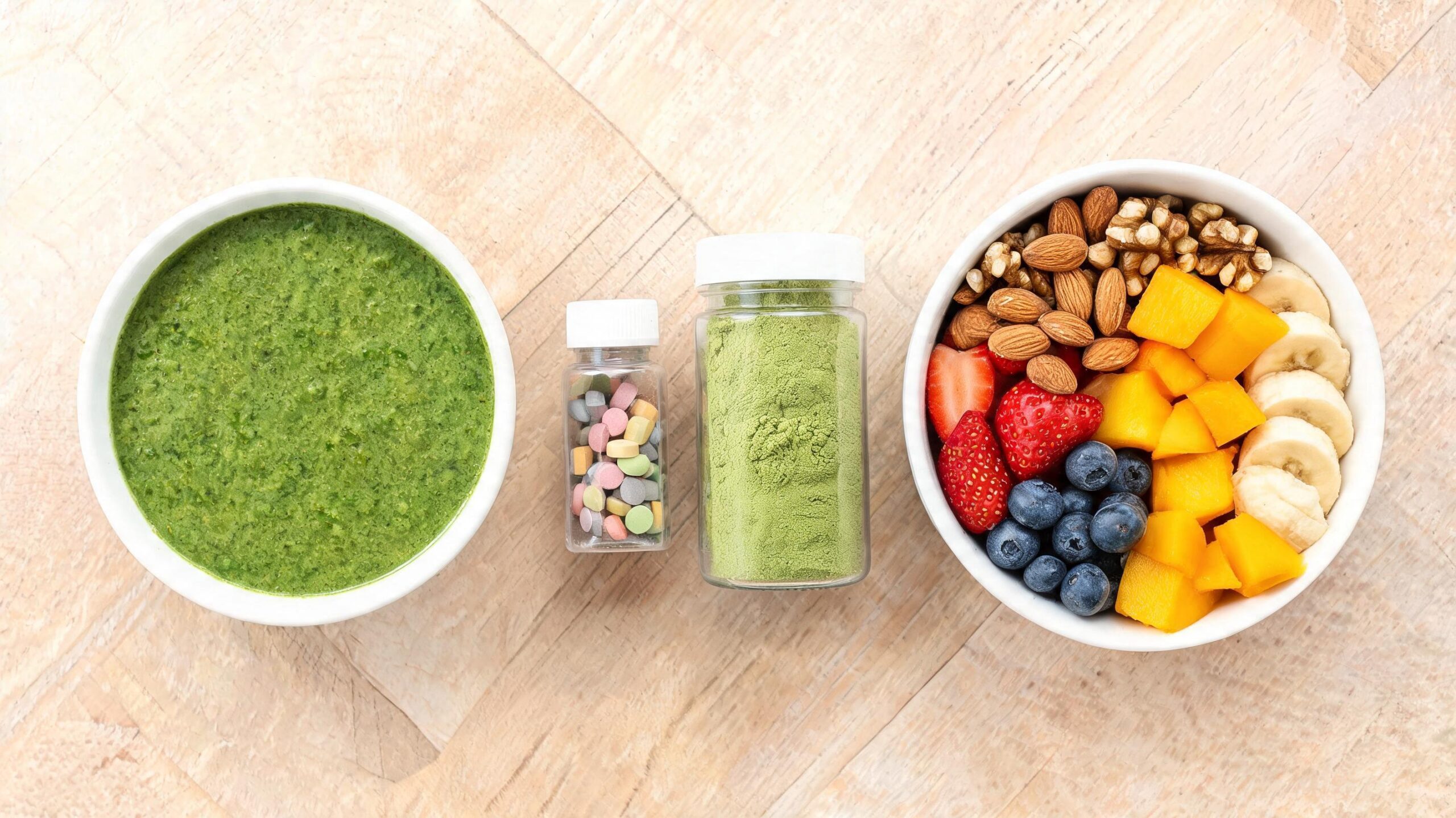
Start with the form. A multivitamin is a manufactured dose of isolated nutrients — ascorbic acid, thiamin, folic acid and the rest — each one purified, standardised and printed on the label with a percentage of the recommended dietary allowance. A green powder is a food concentrate: the label names the plants, the grams of each one per scoop, and the way the plants were grown and dried. One label is a specification; the other is an ingredient list. That single difference explains most of what follows.
The NHS summary of the evidence is why most dietary guidance still starts with food: most people should get all the nutrients they need from a varied and balanced diet, although some people do need extra supplements2. A green powder sits on the food side of that line. A multivitamin sits on the supplement side. Neither is the wrong answer — they answer different questions.
What a multivitamin label actually tells you
This is where a multivitamin earns its keep: it is quantified. Singapore’s own recommended dietary allowances give the daily reference numbers that every multivitamin label is measured against. For adults, vitamin A is set at 750 micrograms, vitamin D at 2.5 micrograms rising to 10 micrograms from age 60, thiamin at 1.18 milligrams, riboflavin at 1.77 milligrams, niacin equivalent at 19.5 milligrams, vitamin B12 at 2.4 micrograms, vitamin B6 at 1.3 milligrams, ascorbic acid at 105 milligrams for men and 85 for women, folic acid at 400 micrograms, calcium at 800 milligrams up to age 50 and 1,000 milligrams after, and iron at 8 milligrams for men and 18 for women3. A label that prints those percentages lets you add them up and know roughly where you stand against the numbers before you swallow anything.
Quantification is also what makes double-upping possible. If a multivitamin already carries a high percentage of the daily value for a fat-soluble vitamin such as vitamin A, adding a second product is not a rounding error — it is the accumulation scenario the Straits Times piece was written about1. The same label that lets you check for a gap is the label that lets you create an excess, which is why reading it matters more than the brand on the box.
What a green powder label tells you — and what it cannot
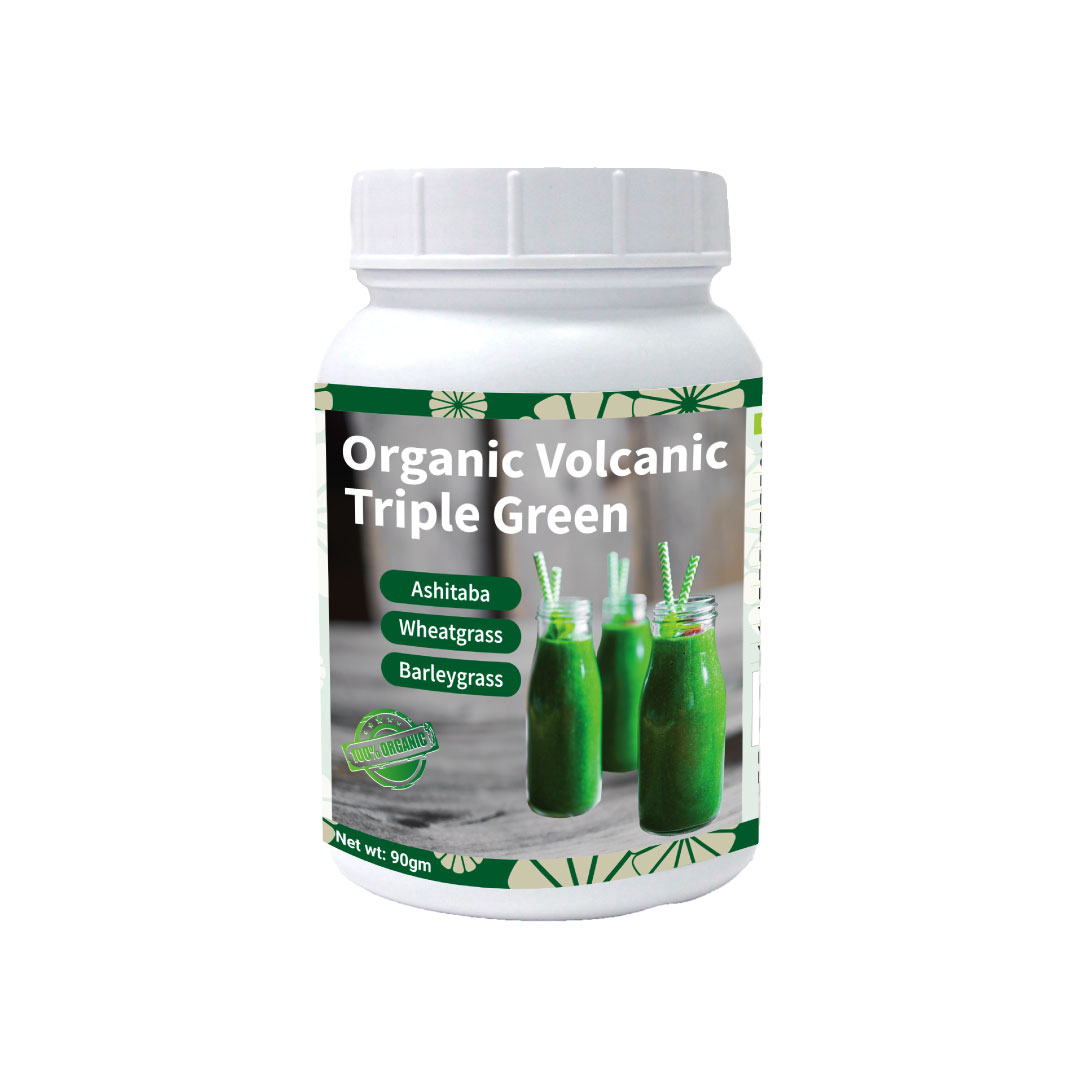
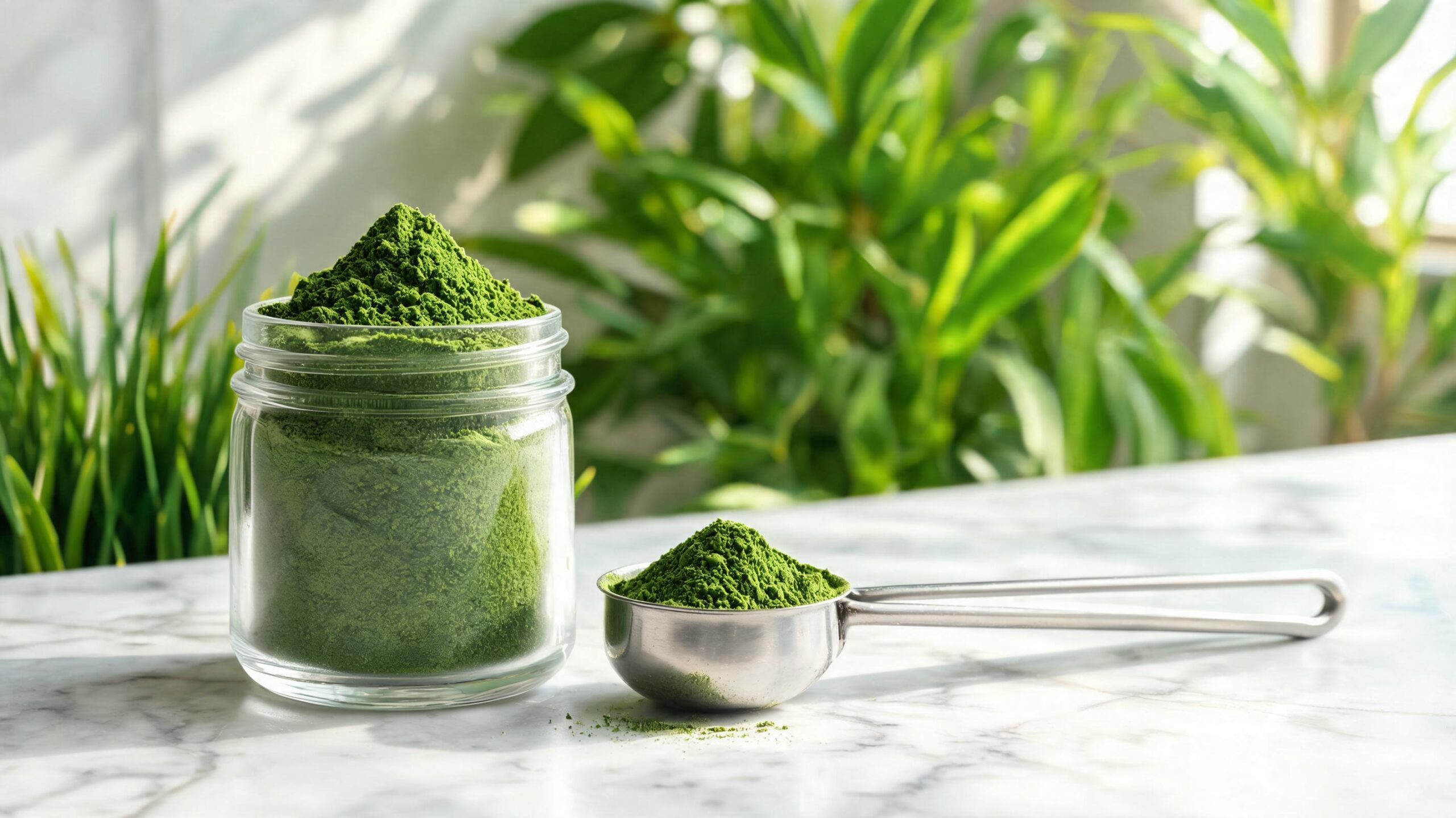
A green powder label is honest about what it is. Triple Green’s, for instance, names the blend and the method: organic ashitaba (Angelica keiskei) cultivated on a JAS-certified organic farm in the Indonesian highlands by Japan Bio Science Laboratory, alongside organic wheatgrass and barley grass, all dried by a BioActive Dehydration ambient spray-drying process at under 41°C that the maker states preserves colour, flavour, aroma and nutrients with virtually no thermal degradation. That is a real and checkable description of provenance and processing.
What the label does not give you is the thing a multivitamin gives you: a percentage of the daily allowance for each vitamin. That is not an accident of labelling. A green powder’s nutrient content moves with the crop, the soil, the season and the drying — which is exactly why a standardised percentage claim is not available for it. The honest summary is that the green powder label tells you what you are eating, and does not tell you how much of a particular vitamin you are getting, because nobody has standardised it to say so.
Where the green powder genuinely wins
Three places, and they are real. First, whole-food form: a powder of grasses and roots arrives with the plant matrix — fibre, polyphenols and carotenoids alongside whatever vitamins are present — rather than as an isolated compound. Second, no isolated-dose risk: because the amounts are not standardised to pharmacological doses, there is no 5,000% daily-value line to double up on. Third, it fits the food-first default that most dietary guidance already starts from2, and it does so without the fat-soluble vitamin accumulation question that high-dose pills raise.
What it does not win is coverage. Unless the label states them, a green powder is not a reliable source of vitamin D, vitamin B12, folate, iodine or the omega-3 fats — the nutrients with the most well-documented dietary shortfalls. If a blood test or a doctor has told you that one of those is low, a scoop of greens is not the intervention, and the ST doctors’ caution about unsupervised high-dose supplements applies just as much to the pill as it does to the powder1.
The Singapore rulebook on what these products may claim
Singapore’s health regulator is unusually explicit about the line between a supplement and a medicine, and it is worth reading before buying either product. Health supplements are not subject to approval, licensing or evaluation for effectiveness before they reach the market — the responsibility for safety, quality and truthful labelling sits with the dealers, and advertisements are not pre-screened by the authority. The guidance is blunt about specific phrases: there is no scientific evidence behind ‘detoxify your body’, ‘HSA approved’ is not something the authority grants because it does not assess or approve supplements for efficacy, and ‘clinically proven’ or ‘100% safe’ claims carry no regulatory backing. The same guidance reminds buyers that supplements are not meant to replace prescribed treatment4.
Two implications for anyone comparing the two bottles. A green powder’s own marketing is the least reliable part of its label, so judge it on ingredients, quantities and processing rather than superlatives. A multivitamin’s daily-value percentages are the most useful part of its label, so judge it on the numbers against the recommended allowances rather than on the word ‘multivitamin’. Neither product’s front-of-pack claim survives that reading — and the regulator’s guidance is the reason to assume none of them should4.
How to compare the two labels in five minutes
- Check whether the label gives you a number you can compare to a recommended allowance. A percentage of the daily value means the product is quantified; grams of plant means it is food.
- Check the vitamin D, B12, folate and iodine lines. That is where a green powder is likely to be silent and a multivitamin is not.
- Add up the percentages across every product you take — the multivitamin, any fortified drink, any single-nutrient tablet — before you add a second high-dose product.
- Read the claims on the green powder for what they are: provenance and processing claims are checkable; ‘detox’, ‘cleanse’ and ‘clinically proven’ are not.
- Take the labels to a pharmacist or doctor if you are on medication, pregnant or over 60 — the groups where dose and interaction questions are real rather than theoretical.
The bottom line
Read the two labels for what they are. The multivitamin is a quantified top-up: it states its dose in percentages against Singapore’s recommended dietary allowances, which makes it genuinely useful for closing a measured gap and genuinely easy to overdose by stacking products. The green powder is a food: it states the plants, the amounts and the drying method, and it fits the food-first default that most dietary guidance starts from — but it cannot promise a vitamin dose, because nobody has standardised one.
So can a wheatgrass, barley grass and ashitaba powder replace a multivitamin? As a substitute for a measured gap, no. As the food half of a routine that already covers the numbers, yes — and on the evidence, more comfortably than an unexamined high-dose pill. If a specific vitamin is the question, get the number first, then decide which bottle answers it.
References
- The Straits Times — ‘Do you need that multivitamin supplement? Know the ABCs of vitamins’ (6 Jan 2026) — https://www.straitstimes.com/life/do-you-need-that-multivitamin-supplement-know-the-abcs-of-vitamins
- NHS — ‘Overview – Vitamins and minerals’ — https://www.nhs.uk/conditions/vitamins-and-minerals/
- HealthHub, Ministry of Health (Singapore) — ‘Recommended Dietary Allowances’ — https://www.healthhub.sg/well-being-and-lifestyle/food-diet-and-nutrition/recommended_dietary_allowances
- HealthHub, Ministry of Health (Singapore) — ‘Understanding Health Supplements’ — https://www.healthhub.sg/well-being-and-lifestyle/personal-care/understandinghealthsupplements_hsa
Also available in Bahasa Malaysia and 中文.
Related Topics
The “Tomorrow’s Leaf”: Organic Ashitaba for Aging Well
The Ultimate Guide to Body Detox: How Superfood Greens Support Natural Cleansing
Wheatgrass vs Barley Grass – Are They Heaty Or Cooling?
Wheatgrass vs Barleygrass – Which One Should You Take?
Dark Green Leafy Vegetables Detox Heavy Metal
Top 10 Benefits of Eating Dark Green Leafy Greens
Liquadry’s Organic Volcanic Wheatgrass & Barley Grass
Is All the Green Foods Same? Why We Should Consume a Different Variety of Green Foods?
Product you may be interested in