Picking a vitamin C supplement for a child starts with a number on the back of a sachet and usually ends with a question your pediatrician would like to be asked first. This article works through the public reference intakes for children by age, why the physical form of a supplement matters as much as the number printed on the pack, and how to read a Vitamune CDZ label without over-reading it.
Two boundaries are worth setting before the detail. The intake figures below are reference values for healthy people, not prescriptions: they describe what meets a normal requirement, and a child’s real need depends on diet, size and medical history. And this is a food supplement, not a treatment for anything. No amount of reading below should be taken as dosing advice for a child.

What the Reference Intakes Say About Children by Age
Vitamin C requirements for children are lower than most parents expect, and they rise in steps rather than continuously. The Dietary Reference Intakes published by the National Academies set the following daily figures for vitamin C:1
0–6 months: 40 mg a day. This is an adequate intake rather than a full requirement, because the evidence needed to set one does not exist for this age band. 7–12 months: 50 mg a day, also an adequate intake.
1–3 years: 15 mg a day. 4–8 years: 25 mg a day. 9–13 years: 45 mg a day. For adolescents, 14–18 years: 75 mg a day for boys and 65 mg a day for girls.
Above those figures sit the tolerable upper intake levels, which are the highest daily intakes unlikely to cause harm: 400 mg for 1–3 year olds, 650 mg for 4–8 year olds, 1,200 mg for 9–13 year olds and 1,800 mg for 14–18 year olds. For infants under 12 months no upper level has been established, and formula and food should be the only sources of vitamin C.1
So the requirement for a small child is a fraction of what a typical adult supplement delivers, and the upper level is lower than many of those products contain. The NHS is blunt about the upper end: taking vitamin C supplements above 1,000 mg a day can cause stomach pain, diarrhoea and flatulence, while taking less than 1,000 mg a day of supplements is unlikely to cause any harm.2 That is a safety boundary, not a target. Intake above the requirement buys nothing, because the body does not store vitamin C and has no use for the excess.
Why a Tablet Is a Different Problem for a Small Child
Swallowing a tablet is a motor skill, and it develops later than most parents expect. A practical guide on administering medicines to children notes that while some children manage tablets from a young age, most children are usually at least 8–10 years old before they can routinely take them.3 Below that age the dependable options are a liquid, a chewable form, or a dose that disperses in liquid, because a tablet that has to be swallowed is both a choking risk and a daily negotiation.
The arithmetic runs in the same direction. An adult 1,000 mg vitamin C tablet carries roughly 20 times the recommended daily intake of a 4–8 year old and two and a half times that age band’s upper level of 650 mg.1 It also arrives as a fixed unit that cannot be served in a smaller amount without splitting or crushing it, which is precisely the adjustment a parent would need for a small child.
What a Sachet Actually Is: Reading the Label
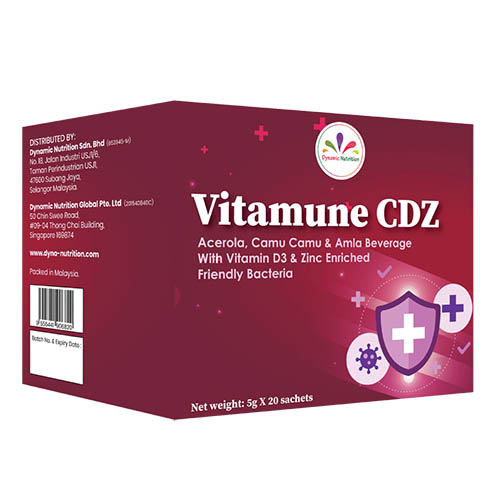
Vitamune CDZ is a 5 g powder sachet sold in boxes of 20, and its directions are to mix one sachet into 125 ml, half a cup, of water or juice kept below 50°C.4 The panel carries a set of numbers worth reading in a particular order, because they do not all describe the same thing:5
903 mg of vitamin C per 5 g sachet, drawn from acerola, camu camu and amla concentrates rather than isolated ascorbic acid. 1,550 IU of vitamin D3 per sachet. 12 mg of zinc per sachet. And a 101 mg five-strain probiotic blend, including the zinc-bound Bifidobacterium longum CCFM1195.
Read in that order, the sachet is a multi-nutrient product that carries a large vitamin C number, not a vitamin C product. The 903 mg on the front is a per-sachet total, and it sits about 60 times the recommended daily intake of a 1–3 year old, and above the upper levels set for the 1–3 (400 mg) and 4–8 (650 mg) age bands.1 Read the ingredient list alongside the front-of-pack figure: this is a food supplement, and nothing on the label is a claim about treating a condition.
Counting the Total When You Stack Supplements
Most supplement stacking happens by accident rather than by plan. If a child is already on a children’s multivitamin, a vitamin D supplement or a separate zinc product, then the sachet’s 903 mg of vitamin C, 1,550 IU of vitamin D3 and 12 mg of zinc all have to be added to what is already being consumed. The upper levels quoted above cover intake from food and supplements together, not from one product on its own.1
This is why more of a good thing reads as a problem rather than a benefit. A product that looks modest next to a multivitamin can push a small child past the age-appropriate ceiling once two or three of them sit in the same daily routine, and vitamin C is not the only nutrient that stacks. Vitamin C also does not behave like a nutrient you can bank in advance: because it is not stored, there is no reason to aim above the requirement, and the NHS treats anything under 1,000 mg a day of supplements as unlikely to cause harm, which is a safety line rather than an indication that more is useful.2
What a Sachet Cannot Do
Two limits deserve stating plainly. The first is that this is a food supplement and not a treatment, and nothing in this article is dosing advice for a child. The amount that makes sense for any individual child depends on age, diet, medical history and anything else being taken, and that is a conversation for a clinician who can see the child rather than a number on a sachet.
The second limit is what a supplement can be said to do at all. The intake figures above describe what meets a normal requirement; they do not establish a threshold beyond which extra vitamin C prevents illness, speeds recovery or makes a child grow stronger. Our own product page for Vitamune CDZ describes it as an immunity-support beverage, and it is fair to say plainly that the reference intakes do not turn a food supplement into a treatment for infection.1 For a child with a diagnosed condition, a child on medication, or any child under five, the sensible step before adding a high-dose product to a daily routine is a conversation with a pediatrician.
The Bottom Line
Most children who eat a varied diet, with fruit, vegetables and some animal protein most days, reach the vitamin C intake figures for their age without a supplement at all.1 Where a supplement is used, the form and the number both matter. A powder sachet mixes into water or juice and sidesteps the swallowing problem a tablet creates for small children, and it makes the dose per serving legible on the label rather than implied. But a 5 g sachet carrying 903 mg of vitamin C is an adult-scale amount set against a child’s requirement of 15 to 45 mg a day and against that age group’s upper level, so it is not something to scale down or schedule from the front of the pack alone.
The decision about whether a child needs a supplement at all, and in what amount, belongs with a pediatrician who can see the child’s diet and history. The label answers what is in the sachet. It cannot answer what a particular child needs.
References
- National Academies of Sciences, Engineering, and Medicine, Dietary Reference Intakes for Vitamin C, Vitamin E, Selenium, and Carotenoids, https://nap.nationalacademies.org/catalog/9810/dietary-reference-intakes-for-vitamin-c-vitamin-e-selenium-and-carotenoids
- NHS, Vitamins and minerals: Vitamin C, https://www.nhs.uk/conditions/vitamins-and-minerals/vitamin-c/
- Smith LC, et al., Administration of medicines to children: a practical guide, Aust Prescr 2022;45(6):188–192, https://pmc.ncbi.nlm.nih.gov/articles/PMC9722353/
- Dyna Nutrition, Vitamune CDZ product page, https://www.dyna-nutrition.com/products/vitamune-cdz/
- Dyna Nutrition, Vitamune CDZ nutrition facts panel, https://www.dyna-nutrition.com/wp-content/uploads/2025/01/Vitamune-Nutrition-Fact.jpg
Also available in Bahasa Malaysia and 中文.
Related Topics
Vitamin C, D and Zinc: Why the Combination Matters (and Why Taking Them Separately Falls Short)
Vitamin C, D & Zinc: Science-Backed Synergy for Complete Immune Support
Is Vitamin C made of corn syrup natural?
An Incredible Source of Vitamin C – Acerola
Singapore’s Biological-Age Test: Why Vitamin D, C, and Zinc Keep Showing Up
Black Elderberry Juice: Clinically Proven for Colds & Flu
People who are Susceptible to Influenza and How to Strengthen Their Immunity
The Difference between a Cold and Flu
Product you may be interested in